One-on-One
Idana Goldberg; Dionne Ledford; Alejandro Giménez Santana
Season 2025 Episode 2841 | 27m 57sVideo has Closed Captions
Idana Goldberg; Dionne Ledford; Alejandro Giménez Santana
Idana Goldberg, PhD, CEO of The Russell Berrie Foundation, discusses leaders making a difference in NJ. Dionne Ledford, EdD, Executive Director and Superintendent of Roseville Community Charter Schools, talks about the keys to our children's success. Alejandro Giménez Santana, PhD, Executive Director of Newark Public Safety Collaborative, discusses the city’s coordinated efforts to reduce crime.
Problems playing video? | Closed Captioning Feedback
Problems playing video? | Closed Captioning Feedback
One-on-One is a local public television program presented by NJ PBS
One-on-One
Idana Goldberg; Dionne Ledford; Alejandro Giménez Santana
Season 2025 Episode 2841 | 27m 57sVideo has Closed Captions
Idana Goldberg, PhD, CEO of The Russell Berrie Foundation, discusses leaders making a difference in NJ. Dionne Ledford, EdD, Executive Director and Superintendent of Roseville Community Charter Schools, talks about the keys to our children's success. Alejandro Giménez Santana, PhD, Executive Director of Newark Public Safety Collaborative, discusses the city’s coordinated efforts to reduce crime.
Problems playing video? | Closed Captioning Feedback
How to Watch One-on-One
One-on-One is available to stream on pbs.org and the free PBS App, available on iPhone, Apple TV, Android TV, Android smartphones, Amazon Fire TV, Amazon Fire Tablet, Roku, Samsung Smart TV, and Vizio.
Providing Support for PBS.org
Learn Moreabout PBS online sponsorship- [Narrator] Funding for this edition of One-On-One with Steve Adubato has been provided by PSE&G.
Powering progress.
RWJBarnabas Health.
Let’s be healthy together.
The Fidelco Group.
The Port Authority of New York and New Jersey.
Moving the region through air, land, rail, and sea.
The North Ward Center.
Community FoodBank of New Jersey.
United Airlines.
Congress Hall.
A Cape Resorts property.
And by NJ Best, New Jersey’s five-two-nine college savings plan.
Promotional support provided by BestofNJ.com.
All New Jersey in one place.
And by ROI-NJ.
Informing and connecting businesses in New Jersey.
- This is One-On-One.
- I'm an equal American just like you are.
- The way we change Presidents in this country is by voting.
- A quartet is already a jawn, it’s just The New Jawn.
- January 6th was not some sort of violent, crazy outlier.
- I don't care how good you are or how good you think you are, there is always something to learn.
- I mean what other country sends comedians over to embedded military to make them feel better.
- People call me 'cause they feel nobody's paying attention.
_ It’s not all about memorizing and getting information, it’s what you do with that information.
- (slowly) Start talking right now.
- That's a good question, high five.
(upbeat music) - Hi everyone.
Steve Adubato.
We kick off the program with a long time friend that's been with of us many times, Dr. Idana Goldberg, Chief Executive Officer of the Russell Berrie Foundation, a long time underwriter of our Making a Difference series.
Idana, good to see you, my friend.
- Good to see you too, Steve.
- We're gonna put up the website for the Russell Berrie Foundation.
I've been honored to also disclose for 29 years I have been emceeing these Making A Difference Awards.
The 30th year, next year will be the sunset year, the last year this has done.
Tell folks what these awards are, why they are, and why they're so darn important.
Please Idana.
- Sure.
So the making a Difference Awards are a way to recognize everyday heroes across the state of New Jersey.
The founder of our foundation, Russell Berrie, understood that people taking initiative, people seeing a problem and doing something to address it, is the foundation of kind of a good society.
And he, together with his wife, Angelica, initiated these awards, as you said, almost 30 years ago.
And every year they continue to impress upon us all how individuals across the entire state can see something, do something, and then make a difference.
And I think, especially now, when we see so much around us that looks like it's unraveling, so much polarization and toxicity, being able to recognize each year this group of heroes is a place of inspiration.
- Just to some of the top awardees, if you don't mind.
- Sure.
- I don't know if I can just share.
Adelaide's Place, Sister Patricia Pendergast of Atlantic City.
Adelaide's Place provides daytime relief healthcare and social services for homeless women.
You Are More Than Inc. Ashante Taylorcox organization supports the LGBT, survivors of exploitation and commercial sex trafficking with trauma informed mental healthcare, education, support and financial tools.
- And I would, I'll jump in just to say that- - Please.
- I think what's so special about Ashante is that she founded this organization specifically for survivors of color and that she saw that there was no organization that addressed those particular needs.
And now she's in, you know, dozens of states across the country, not just here in New Jersey meeting those particular needs.
Such an impressive young woman.
- By the way, our website will come up right now.
Go back and look at a series of interviews we've done with so many Making a Difference awardees and over the years.
I'm put you on the spot.
How many, we have, when I was hosting the event, I had the numbers.
- Is it?
- Yeah.
Oh my gosh.
It's close to 400.
- 400.
It's been 29 years worth of awardees and over $4 million that we've been able to award to these winners.
Really incredible.
- I'm sorry for interrupting.
Many of the people who started not-for-profit organizations helping people in the community, many of these people started organizations in part based on their own struggles, their own challenges, experiences in their lives.
And they choose, quote, chose not to be.
They choose and chose not to be victims, but rather to make a difference for others.
Is that a fair assessment Idana?
- Absolutely, I think if so many people, Pino Rodrigo, who in his own life- - Down in Camden.
- Right down in Camden, started the neighborhood association when his own children were not allowed to visit him because of the state of his neighborhood.
And he started to clean it up and to beautify it and brought others into that.
This year's one of this year's winners Nyene, who himself had been incarcerated, who when he came out, started a intervention program for teens at risk and through assertive technology lens to try to keep them from having, had to go through what he went through.
And there were so many of them who took their own struggles and rose above them.
- We're gonna put up the website again for the Russell Berrie Foundation.
Please go on the site.
Look at some of the video there.
The video team at the foundation has done a great job telling just a snippet, a small part of a powerful story for each one of the winners.
Let's shift gears, if you will.
Antisemitism on the rise.
Your involvement, your engagement and causes connected to the Jewish community to Israel.
Talk about that and why that is so important for you, for the foundation, especially now, Dr. Goldberg.
- Sure.
So Russell Berrie himself was a committed Jew for whom Israel was really important.
And building a thriving Jewish community was important.
And it was important for him to feel that Jews were protected.
You know, as someone who grew up in the shadow of the Holocaust, there was something that was present for him and for many of our trustees.
We've been investing in a strong, resilient, inclusive, and democratic Israel for more than 20 years.
How to bring marginalized populations into society, how to strengthen the democratic framework.
And we've been investing in a strong and inclusive and vibrant community, especially here in northern New Jersey.
But after October 7th, really for so many of us was such a wake up call.
And it was a wake up call in two different ways.
One obviously was just sort of this resurgence of antisemitism that we saw around us on our college campuses.
Unfortunately, in our community, I just saw a statistic that hate crimes in Bergen County are up at a sort of an inordinate amount.
But it was also a wake up call for many Jews who sort of woke up and said, wait, it's really important to us to be part of a Jewish community.
And so the foundation's work has been on both of those prongs on thinking about how do we invest in education programs so that our schools aren't inadvertently, I'll say, promoting sort of biased or anti-Semitic ideas about the Jewish people or Israel.
And also making sure that there are opportunities for the Jewish community to feel proud to be part of the Jewish community, to understand what it means to be Jewish in this day and age.
I'll give you one example.
- Please.
- In Northern New Jersey, we invested in something called the Jewish Student Union.
That's which are clubs that exist in public schools.
They're run for public school students.
They're not religious clubs, they're kind of ethnic clubs to identify, for students who identify as Jewish.
And students in public schools in Northern New Jersey all of a sudden said, wait, we feel alone.
And so we have been supporting now, they doubled since October 7th, I think almost 16, 17 clubs in these schools where kids can with a faculty advisor, talk about what, what does being Jewish mean?
What does Israel mean for them?
And in fact, we're now doubling down on that because we understand the importance of leadership, even for teens.
And we're gonna be helping the Jewish Student Union build a cohort of Berrie ambassadors of 25 or so exceptional students who are gonna go deeper onto a journey.
So that's the opportunity to say, right, how do you, you know, it's not enough to sort of know you're Jewish, but how do you understand what that means, what that means to you?
- So the foundation, the Russell Berrie Foundation doing important work, not only recognizing those who are making a difference every day, people who are really unsung heroes, but supporting the Jewish community continuing, and by the way, when I, we were at the event this year, the 29th of 29 years we were doing this.
Our great friend MaDame was there who was a Holocaust survivor.
And every year when I go there and I see her there, it reminds me that we have important work to do to continue to help people understand what the Holocaust was and why it matters and why it still matters.
So in that spirit, Idana Goldberg, Dr. Idana Goldberg, who's chief executive officer of the Russell Berrie Foundation, thank you to your team for bringing us together every year and celebrating people doing good things.
Could you imagine that?
Thank you Idana, appreciate it.
- Sure.
Thank you, Steve, for having me and for continuing to be such an important part of our Making A Difference Awards for so many years, - My honor.
Stay with us.
We'll be right back.
- [Narrator] To watch more One on One with Steve Adubato find us online and follow us on Social media.
- Recently, my colleague, Mary Gamba and I, on our series "Lessons in Leadership," sat down with Dr. Dionne Ledford, who's the executive director and the superintendent of Roseville Community Charter Schools.
We talked to Dr. Ledford about the keys to successful urban education institution like the Roseville Community Charter Schools.
We talked about her passion for education, the fact that her two parents were educators, public school teachers in New York City, the impact it had on her, a teacher in her life who influenced her trajectory.
She was not planning to go into education herself.
Dr. Ledford talks about that teacher, the impact that teacher had on her life, and the fact that right now Dr. Ledford is one of the leaders in education in this state, in this nation.
Here's that conversation, right now.
Dr. Ledford, great to have you with us.
- Thank you, it's great to be here.
- You got it.
The website's up right now.
Tell us what Roseville Community Charter Schools are all about.
- So Roseville Community Charter School is a public charter school, K to four originally, but we were just approved for grade five.
So we are a K through five public charter school in the great state of New Jersey, of course, in the city of Newark.
But we serve children within the city of Newark and the surrounding areas.
So not all of our children are residents of Newark, but the majority are.
- Y our passion for education, urban education, and frankly educational leadership comes from where?
- Well, that's a good question.
I have a legacy of educators in my family.
Both my parents were New York City public educators.
My father, by way of being a professional athlete and being injured early in his career, that's why education is so important, had a Plan B, that he was able to fall back on, which was education.
So both of my parents are retirees of the New York City public school system.
So I could say that's kind of where I get it from.
But I would also say that when I was at Hampton University, psychology major, I minored in special education.
So I took some education courses, but I said I was not gonna follow my parents' footsteps.
And so- - (laughs) What happened?
And then they put me in the laboratory school to do my rotation, and I got to meet a teacher by the name of Miss Littlejohn.
- Say it again 'cause we're big fans of recognizing, Miss Littlejohn?
- Miss Littlejohn, who was the teacher of the integrated preschool program at the laboratory school at Hampton University.
And she changed my whole mindset with regard to teaching and particularly teaching children with special needs.
- You know what I'm thinking?
Ms. Hoffman, my first grade teacher at Ridge Street School in Newark, in the North Ward, the great city of Newark, who's been long gone, Ms. Hoffman.
Thank you Ms. Hoffman.
Go ahead, Mary.
- Oh, I'm thinking about Ms. Sager.
She was my kindergartner first grade teacher back in the day in Fords, New Jersey.
So I think everyone has that teacher in their lives that just has impacted them.
And speaking of impact, one initiative that, one of many initiatives that we were looking into, and I'm fascinated by and I wanna look down, the SELF & Wellness Initiative, and self stands for social, emotional, learning, fun, and Wellness Initiative.
Talk about that and what type of skills the SELF & Wellness program is providing for the students.
- I'm so glad you asked about that because that is my, this like my baby.
So when I first started in this role, I knew the importance of social emotional learning well before it was really something that became a new initiative with regard to education.
I had always been a special educator.
So I understood the impact of social emotional wellness on academic achievement and school performance and success in school and success in life.
So when I came here, the first thing I did was I shifted the title that used to, it was a title that was called like Dean of Discipline or something like that in the school.
And I spoke to the board about, can I hire a behaviorist instead, because I know the importance of understanding the function of behavior.
It's not so much extinguishing the behaviors that we don't wanna see.
It's understanding the function of the behavior and then replacing it with a more socially acceptable, productive behavior, because we all have those.
We all have behaviors that we do it because we get what we want from these behaviors, right?
So the more we get what we want from these behaviors, the more we repeat it.
And that can be negative reinforcement or positive reinforcement.
So the SELF & Wellness program grew from that.
We were very lucky to be able to write a grant.
I wrote a grant back in 2020, and the dates I give you are going to, it's gonna start to make you think like, hmm, it's almost like I knew something.
But in January of 2020, I wrote this grant, and the Victoria Foundation in Newark Trust for Education granted us $50,000 to start this program.
And I titled it Social Emotional Learning, Fun and Wellness.
And then I was like, oh, it's SELF & Wellness, which talks about self-care, wellness, mental health, social emotional development, all of those things.
And then two months later we had a global pandemic.
Right?
So we had to shift gears, but we continued that program even virtually.
And that was our lifeline for our families.
Our SELF & Wellness program became, I didn't know it at the time, became the lifeline and the connection that we maintained through the tech, my technology plan, which who knew, was to have every child have a laptop.
Who knew?
I did that back in the fall of 2019.
I knew that I wanted every child to have a laptop because I felt like in this community, not every child has access to technology, like in some other communities.
And thank goodness I did, because that was our lifeline to that.
So the SELF & Wellness program provides weekly yoga, mindfulness art that's integrated into our art lessons.
It's parent university, I started here, where it educates our parents on how to support their children and their education.
So there's a lot of components to our SELF & Wellness program.
- We've been doing a lot of programming on urban education and what seems to be working and also what doesn't work.
Along those lines.
A few of the keys to the success of your children and teachers include?
- Well, I'm gonna start with our CHEER values.
Our CHEER values are collaboration, honesty, excellence, effort, and respect.
So they're the cornerstone of our program here.
We believe here at Roseville Community Charter School that every child can be college bound or if not college bound can be successful in life, as long as they are nurtured.
So the environment must be nurturing.
So that's why the SELF & Wellness program is so important to me to have in place here.
It's about community though also.
So a corner stone of our school, we have the word community in our name.
So community is also very important.
And so our scholars do a lot of community service, but also civic leadership is important, because in order for communities to thrive, you have to have, you have to have leadership.
And it should be homegrown leadership.
And so I would say that those are the key attributes of our school.
But also I think there are key attributes really, that children need to have in order for them to be successful in life.
- Well said.
You've just been listening to and watching Dr. Dionne Ledford, executive director and superintendent Roseville Community Charter Schools.
Dr. Ledford, thank you so much for joining us.
We appreciate it.
- Thank you so much, Steve, I appreciate it.
I appreciate this opportunity.
- We got it.
Thank you so much.
We'll have you back again.
For Mary and myself, stay with us.
We'll be right back after this.
- [Narrator] To watch more One on One with Steve Adubato find us online and follow us on Social media.
- We're now joined by Dr. Alejandro Gimenez Santana, Executive Director of the Newark Public Safety Collaborative and Assistant Professor of Professional Practice at Rutgers University of Newark School of Criminal Justice.
Doctor, good to see you again.
- Good to see you, Steve.
- Okay, talk to us.
2025, where are we in the City of Newark as it relates to crime rates?
- So a lot has happened over the last five years, particularly after the 2020 protests that led to massive changes in policing in the United States and more community engagement.
Today, Newark is a safer city.
We are at a 61 year low in homicides.
Just over 10 years ago, we were over 100.
Now we are just at 28.
Fewer homicides, fewer violent crimes, overall, a safer city, more coordinated in its public safety response.
So I think we have come a long way in over the last few years, and Newark is definitely now a safer city than it was before.
- Alejandro, tell everyone what the Newark Public Safety Collaborative is, because there whole bunch of folks involved looking to deal with crime in the City of Newark.
- Yes, so the Newark Public Safety Collaborative was created in 2018 out of Rutgers-Newark and the School of Criminal Justice.
The work that we do really is to create pathways between academic research and evidence and what the community can do to empower themselves and become co-producers of public safety.
We work within a large ecosystem of organizations led by both the mayor's office as well as stakeholders across different nonprofits that provide essential services to reduce crime, deter crime in places that had had, you know, chronic problems for years.
And we've seen spectacular reductions in crime since we started.
Thanks to, again, to this ecosystem of organizations that are working alongside the police department to reduce crime.
- Dr., what's the role of lighting?
I mean, someone says, "What does lighting have to do with crime?"
How do you respond?
- That's a great question.
So back at the beginning of the creation of NPSC, through a collaboration with PSE&G at the local utility company, we found an opportunity to prove something that evidence shows that works and that Newark has proved that it works as well, is how to improve lighting conditions in areas where there's increased levels of nighttime violent crime.
What we did is a collaboration where we matched crime records, so past crime, with locations where there were opportunities to change lighting or brighter and more efficient LED lights.
And what we found after almost 2,500 lights were changed is that the effect of lighting on crime is statistically significant.
In other words, it does reduce opportunity, it does help to reduce crime.
And we saw that over six months after those lights were changed, there were strong reductions, over 40% reduction in nighttime violent crime in the areas of the city where those lights were changed.
- Let's deal with this because there are crime rates, crime statistics, and then there's perception of crime.
Because if you ask most folks, what's your perception of crime in the City of Newark?
I anecdotally, I mean, I'd be shocked if people said, "Wow, I'm thinking crime rates are down in Newark."
That is not the perception.
Not just in Newark, but in cities across the east coast, city across the country, and urban communities the perception is crime rates are, quote, "through the roof."
- Mm-mm.
But that's not supported by current evidence.
What we are seeing, again is that- - Why do you think it is?
Why do you think the perception does not match the, quote, "statistics"?
- Because sometimes what people perceive is their immediate environment.
Sometimes there's quality of life issues that haven't been addressed that can be created in the perception that current conditions are heightened, and that can still perpetuate those perceptions.
I will say a problem that we are seeing now is more the under-reported, so crime statistics and crime data that we receive from the police department are not always the full picture.
We know that we are missing some data, particularly the more you move toward property crimes.
Violent crimes are well reported, same for auto theft because of insurance reasons, but other crime types are just not well reported, and particularly I'll mention domestic violence.
Domestic violence is a crime that is very under-reported and we've seen a trend over the last five months, but particularly, actually since January, where we've seen reductions in reported domestic violence, which we think are associated with, for example, the current federal administration and its practices, or it's tougher enforcement on the immigrant community.
- Okay, since you mentioned the federal government, talk to us about federal funding cuts to urban communities like Newark as it relates to crime reduction.
Has there been any direct- Have there been any direct cuts to crime prevention in the City of Newark?
And if so, where are they?
- Yes, several nonprofits have seen their budgets reduced dramatically over, and this happened about two, three weeks ago when they received letters of termination of their grants from the Bureau Justice Assistance, which is part of the Department of Justice.
These grants were supporting community responses, very much the work that we've been doing over the last five years to help the community be co-producers of public safety.
There's dozens of organizations, not just in Newark, but across the country, that have seen those close to $800 million evaporated from one day to the next, and that is- - What would be the motive to do that?
If everyone wants to reduce crime, particularly in urban communities where it is an issue, it's an issue everywhere, but what would be the policy logic to that?
- I cannot speak to the policy logic because I do think that- - Do you think the administration understands the implications, the impact of those cuts?
- That's where I think there's maybe a gap in misunderstanding about bipartisan support on these policies because I do think that evidence has shown that these responses work and that they should be continued, they should be maintained.
So I think there's a lack of understanding of the importance of helping first, that these policies, these grants, these funding was supporting alternative responses to law enforcement.
The community, we're working with the police in finding ways that fill the gap that the police sometimes feel powerless to feel.
I'm thinking, I'm talking about problems with homelessness, problems with mental health, problems of domestic violence.
The police are just not equipped to deal with some of these situations, that this is where the community comes in, this is where the high risk intervention groups come in, the violence interrupters.
And that's why it's so important, these funding, because it has been supporting the police in those functions where they're just not well equipped to deal with these situations.
- Next time we have you back, I wanna talk about the perception on the part of many that those who are here illegally, undocumented citizens, are disproportionately impacting crime rates.
Let's have that discussion next time.
Doctor, thank you so much for joining us.
We appreciate it.
- Thank you so much, Steve.
Thank you.
- Let me also remind folks that Rutgers-Newark is a higher ed partner of ours.
Doctor, thank you so much.
I'm Steve Adubato, thank you for watching.
We will see you next time.
- [Narrator] One-On-One with Steve Adubato is a production of the Caucus Educational Corporation.
Funding has been provided by PSE&G.
RWJBarnabas Health.
Let’s be healthy together.
The Fidelco Group.
The Port Authority of New York and New Jersey.
The North Ward Center.
Community FoodBank of New Jersey.
United Airlines.
Congress Hall.
A Cape Resorts property.
And by NJ Best, New Jersey’s five-two-nine college savings plan.
Promotional support provided by BestofNJ.com.
And by ROI-NJ.
- I’m very grateful that I’m still here.
- That’s me and my daughter when we went to celebrate our first anniversary.
- With a new kidney I have strength.
- They gave me a new lease on life.
- I’m still going everywhere and exploring new places.
- Nobody thought I was going to be here, nobody.
- I look forward to getting older with my wife, that’s possible now.
- [Narrator] We’re transforming lives through innovative kidney treatments, living donor programs, and world renowned care at two of New Jersey’s premiere hospitals.
- They gave me my normal life back.
It’s a blessing.
- [Narrator] RWJBarnabas Health.
Let’s be healthy together.
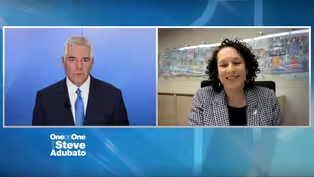
How The Russell Berrie Foundation recognizes leaders in NJ
Video has Closed Captions
Clip: S2025 Ep2841 | 9m 51s | How The Russell Berrie Foundation recognizes leaders in NJ (9m 51s)
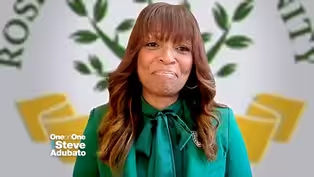
The importance of social emotional learning & wellness
Video has Closed Captions
Clip: S2025 Ep2841 | 10m 10s | The importance of social emotional learning & wellness (10m 10s)
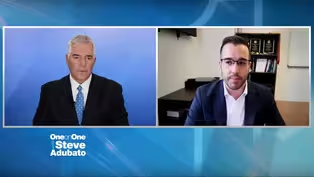
Reducing crime and improving public safety in Newark, NJ
Video has Closed Captions
Clip: S2025 Ep2841 | 8m 26s | Reducing crime and improving public safety in Newark, NJ (8m 26s)
Providing Support for PBS.org
Learn Moreabout PBS online sponsorship
- News and Public Affairs

Top journalists deliver compelling original analysis of the hour's headlines.

- News and Public Affairs

FRONTLINE is investigative journalism that questions, explains and changes our world.












Support for PBS provided by:
One-on-One is a local public television program presented by NJ PBS