
“If you can see it, you can be it”
Season 7 Episode 2 | 26m 46sVideo has Closed Captions
Leon Baptiste, CEO, LB Electric Company, talks about engineering, mentoring and success.
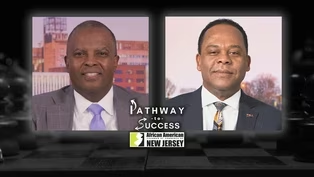
Host John E. Harmon, Sr., Founder & CEO of the AACCNJ, talks with Leon Baptiste, President/CEO of LB Electric Company. Baptiste talks about being one of 11 successful siblings, his company, his love of being an engineer and the pride in following in the footsteps of his Grandfather, also an engineer. Pathway to Success highlights the African American business community.
Problems playing video? | Closed Captioning Feedback
Problems playing video? | Closed Captioning Feedback
Pathway to Success is a local public television program presented by NJ PBS
“If you can see it, you can be it”
Season 7 Episode 2 | 26m 46sVideo has Closed Captions
Host John E. Harmon, Sr., Founder & CEO of the AACCNJ, talks with Leon Baptiste, President/CEO of LB Electric Company. Baptiste talks about being one of 11 successful siblings, his company, his love of being an engineer and the pride in following in the footsteps of his Grandfather, also an engineer. Pathway to Success highlights the African American business community.
Problems playing video? | Closed Captioning Feedback
How to Watch Pathway to Success
Pathway to Success is available to stream on pbs.org and the free PBS App, available on iPhone, Apple TV, Android TV, Android smartphones, Amazon Fire TV, Amazon Fire Tablet, Roku, Samsung Smart TV, and Vizio.
Providing Support for PBS.org
Learn Moreabout PBS online sponsorship- Support for this program was provided by Horizon Blue Cross Blue Shield of New Jersey.
- Hello, this is John Harmon, founder President, CEO of the African American Chamber of Commerce of New Jersey.
Thank you for tuning in to Pathway to Success.
Our guest today is Leon Baptist President, CEO of LB Electric.
Leon Baptist has been in the electric industry for years as a general contractor and has done a number of projects in both the public and private sector throughout the New York, New Jersey region.
So Leon, welcome to Pathway to Success.
- Thank you John.
It is a pleasure to be here.
- Well, we're delighted to have you.
Let's start with a little bit about you.
You come from a big family, small family.
Where are you from, - John?
We came from an an immigrant family over the years.
My mother's side is a Puerto Rican and Cherokee Indian.
On my father's side is African and Haitian.
So we came from a very mixed culture that allowed me to understand and working with everybody and it has helped me a lot in the industry to be able to relate to all and everyone.
- So where were you born - In New Jersey?
So I grew up in New Jersey and Newark and my involvement in the city of Newark from as a, as a young boy went to Bergen Street School, Avon Avenue School, went to high school at Weak Wake High School, in fact was inducted in the weak Wake Hall of Fame in 2018.
And subsequent to that, went to California to play football and decided to transfer to Cheney University.
And later, after two years of playing at Cheney, I decided to go to NJIT and obtain my electrical engineering degree.
- So you referenced Hall of Fame, where, what did they induct you based on?
- So I played football for weak wake.
And while I was at weak wake, I was also inducted in the National Football Hall of Fame.
- And what position did you play?
- Quarterback.
Oh, and special team.
- Oh, so that means you had an arm and you had pretty good legs.
Special team.
So you had to be pretty quick.
- Yes, sir.
- Do you have any siblings?
- Yes, there's 11 of us.
Oh, I'm number 10 out of 11.
- So how many boys, how many girls?
- So there's three boys and seven girls.
- Well, women ran the house and I'm sure they still running your house.
- You're right about that.
And it, it was a battle to try to get something to eat whatever you had to eat.
So.
- So let's talk about NJIT, one of the top engineering schools, not only in New Jersey but across this great country.
Why engineering?
- So my grandfather was a civil engineer and when I grew up, my mom used to always say that I resemble my grandfather in the same sort of, we were born in the same month.
So in her understanding, she knew that I would be an engineer.
And through my mentorship at Quake, I ran into a young lady that used to speak to us on Friday nights at NJIT and she asked me, what, what do you wanna study here?
I said, well, I was doing industrial engineering.
She says, well, I have a friend that's in the electrical business, would you like to meet him?
And that's how I got into the electrical engineering and graduated, worked for the firm for almost 15 years and I started LB Electric afterwards.
- So talk to us a little bit about, you know, why you are excited about being in this field.
- What's exciting is that there's always a challenge to something new.
As within my license, I have to renew it every three years.
So we have to keep up with the new technology code Yes.
And everything that's involved, but more importantly, it challenges a person to start looking at how you stay in business.
- You worked 15 years at this particular company once you left college.
Was that your last company you worked for before starting LB Electric or were there others?
- No, that was the only company I worked for.
- Okay.
And how did they prepare you for that next level?
Going from having your name on the back of the check to now being on the front of the check and then actually establishing and growing a a business enterprise?
Well, - John, you just hit the nail on the head.
It's not just technology, it's also having a business mind and working for this firm for 15 years I was the vice president, I was the business development for them and I ran a separate division for this company to be able to hire and at the end of the year for develop a budget, because you need to know the business side.
You can be greatest technical guy.
Well, without understanding how the business run, you will, he can't succeed.
- It was President Obama who said no one is successful on their own.
So what would you attribute to your level of success?
- I reach out to NJIT in terms of interns and then also I hired engineers out of NJIT to as to understand and train them to do the business that I'm running.
And also I'm part of the IBEW, which allows me to pull manpower wherever that I wanna work, whether it's out of New York, New Jersey, or whatever state.
So through the understanding to to, to run a business, you have to have quality people.
And also my wife who's a financial, an analyst, she, before I started the business, she was in the financial market and she is, she has a finance and economic degree.
She actually is the backbone of our account receivable, accounts payable, and also the way that we submit and present our, all of our paperwork throughout all the entities and the, the agencies that we work for.
So I need an amazing group to be as successful as we have been.
- Well, I'm sure your wife will be happy to hear that you gave her a shout out today.
But let's talk about your parents, you know, 11 kids.
Let's talk about how they inspire you to do what you do and what was it like growing up under their tutelage, their leadership, their guidance.
- You can't put a building up without having good structure foundation.
And my parents with 11 kids, we all went to school, graduated and got a degree in working in the world.
And sometime I think about it and I ask, how did they do it?
Yeah, well there were no nonsense in which that, what does that mean?
It's that we had no choice.
Failure was not an option.
It's either you make it or you will not be part of.
And every one of us, we knew what the right thing to do is to follow their leads.
But furthermore, mentorship also comes into play.
I've had great mentorship growing up through the weak Wake Father's Club when I was playing football at week wake.
And through that process I got to learn and being around executives, people that were able to guide us and give us direction and tell us the places we needed to go and the areas of not to get involved with.
So we always need that outside support outside of our parents in order to get further in life.
I worked around a lot of great people, companies and one individual I would say taking a business model and, and and tried to follow is Donald Donella from Terminal Construction.
- So you, you talked about your parents, you talked about some of your colleagues and people you work for as source of inspiration or contributors to your success.
Are there more?
- Yes, and, and John, again, it takes a village, you know, to to to get to where we have to go in life.
And you, and there were many others, Congressman Donald Payne Sr.
And throughout the years, again, it's from the high school days when he used to come on Friday night to speak to us at some point, take money out of his own pocket to feed us where before we play football.
Same with ex late Judge Irvin Booker, late Donald Bradley, coach Bernie Adams, many others.
- Gotcha.
So let's keep with that conversation.
How do you stay motivated in, in the technology sector and and similarly, how do you motivate, inspire others to pursue their dreams?
- Well the motivation always come from how there's a future.
There's a hope.
If you work hard and you put your time in and stay in the game, success will come later.
So that was the motivation speech that we used to get.
And now at my own time I spend a lot of time mentoring and coaching small businesses and also community involvement.
You know, it's important that we look back and help others and give them the same opportunity that I have receive as a young person when I first started out.
So I think it's important that we give back, we help people to understand how to get to point A at and B in a shorter amount of time.
- Can we just talk a little bit about the solar panel industry, your involvement?
- Yeah, so John, when I started out with Solar Energy in 2001 at that time how I got to learn about solar.
I was in California at a executive retreat and I met a, an Asian guy while we were playing golf.
Had asked me, have you started looking into solar energy and over in the East coast?
And I said, no.
He says, well, you know, you should really consider this, this is the future.
So I got back to New Jersey in 2003.
There was a solar installation proposal that was put out for bid for NJIT.
So I took on the, the opportunity to bid the job.
I called my friend in California with some advices on how to look at the project and it was a very unique type of installation.
It was a fixed mounted solar on the roof and then four actual stand standalone, they call them trackers where the sun was powering the motor that was actually moving the trackers following the sun.
So through the process after the project was all done, I was so excited about it and I say, you know, this is an opportunity to teach our community and others about solar energy.
I then open a division as an LB training service center that through that process I trained young individuals in the city of Newark.
There was a project in Newark that I had promised if I performed the work, I would train 30 individuals at no cost and allow them to participate on the job training.
Three of these individuals were gang members.
And through the process it was amazing to see how you can change someone's mind and life by giving them a different opportunity.
- No, that's fantastic.
I think this is a good place to take a break and come back because someone gave you an opportunity and you had also reinvested in others to contribute to their success.
So we're gonna take a break, we'll be back in a moment.
- For more information, please visit our website.
- Welcome back to Pathway to Success.
We're having a conversation with Leon Baptiste.
He is the president and CEO of LB electric.
Coming up on the break, we spoke about training and employing gang members.
- When I first got involved with training some of these youth in Newark, no one told me who was a gang banger or not.
And it's throughout the process I found out they revealed it to me and they used to call me Mr.
B and they go, Mr.
B, you know what I was doing out on the street?
And I said, no.
And they said, well this is what was my involvement.
Now I feel like I am part of something that I can develop my life with.
And he, and he goes, when I go to Dunking Donut, these yellow vests that you given us to put on when we're on the roof, I don't take it off because when I'm there they ask me, you work for this company.
And that just makes the whole day.
So, you know, I said to myself, if there's anything that would inspire me the most is someone to take someone out of an area that they were very uncomfortable and allow them to walk into a different door and change their life.
And it made me feel that we all to do so much more.
- And so as we look at the different corporations and the leadership they're in, they have the power to inability to make an impactful change on an individual's life.
Similarly with a community.
And you've, and you're doing that.
So talk a little bit about what you see you could ultimately become.
- You know, my mom almost, if you will drop the seed in my mind as to what my grandfather was all about.
I was so inspired because he was, my grandfather was an engineer and I went to school.
I said, that's what I want it to be.
I believe that not only giving back, but as parents or mentors, we need to inspire our young people.
Giving them positive development in their mind, what they can become.
- You know, Leon, you're right.
It's all about motivation.
The possibilities that, that they are attainable.
Even though they may not have witnessed it in their community or in their household.
If they have a dream, it is worth pursuing.
So what year did you start LLB Electric - In 1999?
Started out with this whole process and once I got into the business, preventative maintenance was where I felt I was going to be very strong.
I was one of two engineers at the time.
There was an older guy named John Wagner out of Siemens who was looking into power quality investigation.
And once I started doing this type of work, I found out that this is a niche I can go problems and then fix them.
And then two years later started doing business with NJIT and other municipal areas.
And because again, my experience as a working for a firm, I knew that I wanted to be in the union and I started working for P Port Authority doing work with the New Jersey Transit.
I had the largest project in 2010, which is now called the Hudson Tunnel.
Yes, this project was stopped by the governor at the time when I was a prime electrical contractor.
So I have experience working for $50,000 all the way up to $40 million contract.
And so, - I'm sorry, but as, as the president and CEO, how do you deal with adversity?
You mentioned that the rail project was stopped by the government and clearly you had monies invested, you had personnel involved.
How does one pivot and, and recover from something like that?
- It, it wasn't easy, John.
I had over $2 million out on the street for six months, could not collect because now the state had to look into a way for us for contractors to get paid.
I learned not to let things bother me as much, but stay focused in the bigger picture adversity in terms of being a small contractor, being a minority contractor, that's a different game.
It's a different play.
It can make you wanna close your books and say you had enough if you don't have the stomach and the tenacity to keep fighting.
And as you know, we don't give up.
We just keep fighting.
- I often say that if you don't get dirt on your uniform, you're not in the game.
- You got that right - And, and success is clearly in our DNA, but you had to really be committed to your own success.
So talk about some of the projects that you've done over the years.
Share with our viewers a little bit about those.
- So let's talk about the Newark Airport, the new terminal A we install over 40,000 electrical light fixtures in this, in this facility.
A million square foot.
The Tapse Bridge involved with the distribution of the high voltage system and all the out outdoor lighting that you see when you travel on the Tapse Bridge were installed by us.
- Leon, I have to ask you this question because I'm not one that that could deal with heights.
How does one deal with, on a bridge like that?
I, I get a little treble in my leg, even driving in the car.
So actually if you walk walking on a structure like that, - That was an amazing project, John.
It's - Not amazing.
Terrifying for me, - Right?
It it was an experience that, you know, you really have to go through it to really understand different facet of construction once the bridge was built, now walking from one end to the other and looking down at the water, yeah, it does feel a little funny in the stomach.
I have to agree.
- How's AI impacted your business?
- Well, AI certainly is not impacted.
It has increased my volume in many ways.
Why?
Because the information technology that needs to be obtained and transferred requires tremendous amount of electrical load.
So through that process you heard of data centers and so on.
So P-S-E-N-G is increasing their capacity, which we all part of installation and upgrade substations.
And then also the electrical equipment and installation that's required through that whole process become part of our installation.
I mentioned battery storage.
Battery storage is another area where we need backup power.
- How does renewable energy fit into this conversation?
Also, given that the state of New Jersey canceled the wind project.
So talk about the renewables.
Are they still alive and well?
- Solar is still alive and well in New Jersey and we're working towards the right clean environment.
So I think it's the best thing for us.
- All right.
What is a typical day like for you?
- I get up somewhere around 4, 4 15 every morning, do my exercise, and from six o'clock on, either I'm at meetings or I'm on the phone.
It's almost like the stock exchange, you know, a phone's ringing all day, communication's going, I'm on a computer, I'm making decisions.
That's what I do pretty much every day.
If, if I'm on vacation, I get on the phone before I go about my personal life every day.
- Mr.
Baptist, you know, let's look down the road a bit.
The next five years, what can we expect from you in LB Electric?
- So we have tremendous amount of work that's coming out and we're also looking to get more involved with the battery storage and more of the infrastructure type of work for the use of the AI systems.
- So Mr.
Baptist, it has been my pleasure having this conversation with you today.
- Thank you John, and thank you for the opportunity.
- Well, we're delighted to have you.
So Mr.
Baptist, until the next time, this is John Harmon.
Thank you for tuning in.
The president's message today is connecting to New Jersey's economy.
We just ushered in the new administration and we're very grateful to outgoing Governor Phil Murphy and Lieutenant Governor Way and, and the former Lieutenant Governor Sheila Oliver.
But now we have new leadership in the state of New Jersey, this Sherill Caldwell administration, and we look forward to engaging them and working with them in a meaningful way.
There's 1.2 million blacks in the state of New Jersey and over 124,000 black businesses, men and women that live in this state that are looking to looking to be a part of the economy in an equitable way.
Blacks still unfortunately have the highest poverty, the highest unemployment, low median incomes.
So I would encourage the men and women of this state to look at opportunities in the trades with carpentry, plumbing, electrical.
You don't have to have a four year degree to get actively involved in the economy.
Those of you who want to go to college, there's plenty of options that are available starting your own business.
There are so many ways to be a part of the economy, but you have to be intentional about it.
You know, success does not come in a vacuum.
We as a people within the state have to be committed to excellence, but you can't do this alone.
People have to have access to opportunity, a level playing field with transparency where the rules are clearly stated and access to compete so they can be equitably a part of the economy.
That's what we hope for.
We're not asking for any handouts.
All we're asking is let's coexist in a way that makes the state the best it could possibly be.
- Support for this program was provided by Horizon Blue Cross Blue Shield of New Jersey.
“If you can see it, you can be it”
Video has Closed Captions
Preview: S7 Ep2 | 29s | Leon Baptiste, CEO, LB Electric Company, talks about engineering, mentoring and success. (29s)
Providing Support for PBS.org
Learn Moreabout PBS online sponsorship
- News and Public Affairs

Top journalists deliver compelling original analysis of the hour's headlines.

- News and Public Affairs

FRONTLINE is investigative journalism that questions, explains and changes our world.












Support for PBS provided by:
Pathway to Success is a local public television program presented by NJ PBS