
IL budget, campaign issues, COVID-19
1/28/2022 | 26m 46sVideo has Closed Captions
IL budget, Campaign Issues and an update on COVID-19.
Host Hannah Meisel (NPR Illinois) and guests Jeremy Gorner (Chicago Tribune) and Amanda Vinicky (WTTW) talk IL budget, campaign issues and an update on COVID-19.
Problems playing video? | Closed Captioning Feedback
Problems playing video? | Closed Captioning Feedback
CapitolView is a local public television program presented by WSIU
CapitolView is a production of WSIU Public Broadcasting.
IL budget, campaign issues, COVID-19
1/28/2022 | 26m 46sVideo has Closed Captions
Host Hannah Meisel (NPR Illinois) and guests Jeremy Gorner (Chicago Tribune) and Amanda Vinicky (WTTW) talk IL budget, campaign issues and an update on COVID-19.
Problems playing video? | Closed Captioning Feedback
How to Watch CapitolView
CapitolView is available to stream on pbs.org and the free PBS App, available on iPhone, Apple TV, Android TV, Android smartphones, Amazon Fire TV, Amazon Fire Tablet, Roku, Samsung Smart TV, and Vizio.
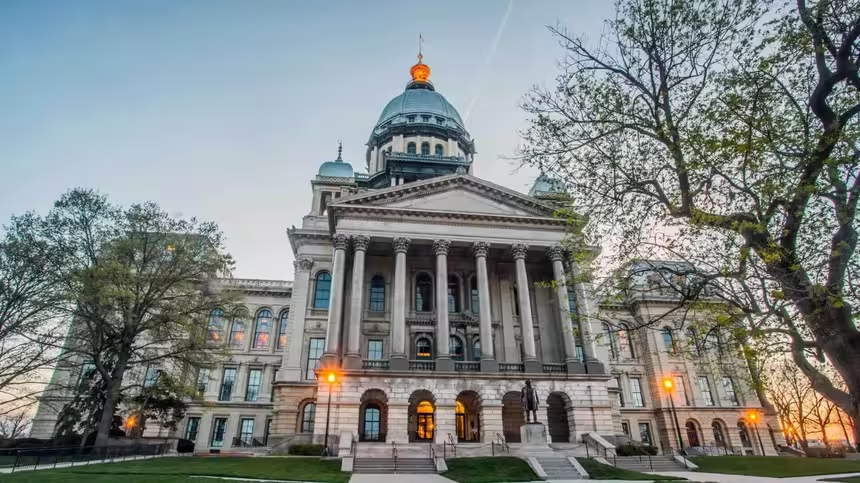
CapitolView
CapitolView is a weekly discussion of politics and government inside the Capitol, and around the state, with the Statehouse press corps. CapitolView is a production of WSIU Public Broadcasting.Providing Support for PBS.org
Learn Moreabout PBS online sponsorship(dramatic orchestral music) - Welcome to "Capitol View," where we discuss the latest in state government and politics.
I'm Hannah Meisel with NPR Illinois.
Joining us this week are Amanda Vinicky with Chicago Public Television station WTTW.
Welcome, Amanda.
- Thanks so much.
- And new to the show is Jeremy Gorner with the Chicago Tribune.
Glad to have you here, Jeremy.
- Thank you, Hannah.
Glad to be here.
- Well, it finally seems like campaign season is really ramping up in earnest, but first, we need to eat our vegetables, so they say, and we are about to see another budget address.
I can't believe it has been a year since Governor JB Pritzker gave his virtual budget address in the depths of the pandemic, and here we are again.
But so much has changed in the last year, but if we think back to when COVID first hit, the budget was just kind of in shambles, but thanks to a lot of federal money and some other money management kind of tricks from the governor's office and from the comptroller and those who handle our state finances, they say we are on a better fiscal footing, but is that really true, Amanda?
I mean, what do you expect to see next week when the governor gives his budget at the State of the State Address?
How firm is our fiscal footing?
- So, I guess, yeah, let's unpack that question and then maybe move on to the notion of predictions in what he might say.
I think we do already, by the way, have a little bit of a hint at that because Governor JB Pritzker, related to what you're talking about, the election is already up on air, sort of patting himself on the back for the state's finances and getting things in order after the destructive budget impasse, which he, of course, blamed solely on Governor Bruce Rauner.
And so that is going to be lingering over all of this.
What is the state of the budget?
How firm is Illinois' fiscal footing?
And as you noted, Hannah, I mean, it's pretty decent.
The governor can say for the first time, instead of Illinois getting its credit downgraded, it's been upgraded, the bill backlog has been chomped into, the pension payments have been made, that's ahead.
Are things really firm?
I mean, you still have a hundred billion dollars in unfunded pension liability.
That doesn't come due in one fell swoop, but that is something that other states are not dealing with.
I think there's going to have to, we're going to have to keep our eye on is the General Assembly, you've got all this money from the American Rescue Plan that is baked into this current budget and some of it will be baked into the next, as it should be, that's what it's meant for, for coming out of the pandemic.
But how many of these are beginning new problems, new promises, new programs, that once that federal money isn't here anymore, are going to force some bigger and harder decisions down the line because that isn't money that you can fully count on.
And so, better than before?
Yes.
Is that saying much for Illinois?
Alas, no.
- Right and in November, just a few months ago, the governor's office management budget came out with what they wanted to paint as a very rosy fiscal outlook.
"Oh, look, our budget surplus," I mean, when's the last time Illinois even had a budget surplus?
"Will be bigger than projected."
Of course, that is all how you look at it.
I don't know that we can truly say that we have any sort of budget surplus.
- Yeah, when you have these constant deficits from years past and again, the pension unfunded liability, fund sweeps, all of the things, is it really a surplus?
- Sure, right.
- Just because on paper, the original forecasting, I mean, again, better position than had been anticipated, but still not, I think, Illinois is not the envy of other states when it comes to its finances, that's for sure.
- That is a definite.
But Jeremy, we'll be tapping into this American Rescue Plan funding for the next four years.
It has to be committed, gosh, I wanna say, by 2024 or 3, and then spent by 2024 or 5, maybe I should have checked that before we started filming, but after that money goes away, it's not like, that's not permanent money, that's money that we're gonna have to spend judiciously.
And Amanda mentioned not having new programs, but I think there is room and lawmakers have been debating for the last several months in some small areas, for example, affordable housing, where this money could be spent for one-time things that could then put the state on a better fiscal footing by making its residents, them being in a better situation so that they can contribute to society, pay tax dollars.
So, where are you seeing debate about where to spend money?
I also think that we've talked about anti-violence and violence prevention and all that.
- Well, Hannah, the General Assembly is gonna be under significant pressure to figure out a way to resolve the Unemployment Trust Fund debt, which is a four and a half billion dollars and interests to at more than 2%.
And there's been some debate among Democrats and Republicans about whether to use, use the ARPA funds to pay back some of the UI funds and the Democrats have seemed to be, they've acknowledged it's a problem, they've kind of been non-committal about it, they've kind of said that it's something that we're gonna look at, whereas the Republicans are pretty adamant about, "Yeah, why aren't we talking about this?
This is something that we definitely should do," but obviously the Democrats are being very careful about not wanting to, trying to be judicious with the ARPA money that they do have.
A lot of the ARPA money, nationally, from the Biden administration, I think you were talking about violence prevention, I think it's like several billion dollars, nationally, is going to violence prevention alone.
And some of that is going to Illinois.
But the thing is, is that, I asked the governor this at a press conference about the funding for violence prevention, the 250 million from the Reimagine Public Safety Act, and he has said that that money is supposed to be separate from ARPA funds.
Whether that actually happens, as they negotiate the General Assembly, that remains to be seen, but obviously, just from everyone I've spoken to, the big question is whether paying back the Federal Unemployment Insurance will be spent, with ARPA paying that back, being spent with ARPA money, remains to be seen.
And there's gonna be a lot of pressure, right?
Because we're seeing the Biden administration easing off stimulus money as we're kind of progressing through the pandemic.
So, obviously, it seems like the state's not gonna get as much as they used to or any state in the union and also, there's rising inflation, so there's gonna be a lot of pressure to actually decide how to use this money and especially paying back that, 'cause nobody wants to pay a couple of hundred million dollars in interest, I know that that's something that Comptroller Mendoza has harped on repeatedly.
- But that's already happening, right?
I mean, due to- - Right, exactly, yeah.
- Right now, that is occurring with the Unemployment Trust Fund, and I think part of it- - Exactly.
- is being careful about spending the American Rescue Plan money, part of it is there are so many other more flashy, like sort of ribbon-cutting ways and other promises made.
When you brought up, again, public safety, that's a promise made.
I think that the governor needs to fulfill that, particularly in an election year and particularly just given what he has staked this past year or so on.
So, yes, I think it will happen, but this is the notion of it's still only a limited pot (laughs) and that therein lies the issue.
- And they have like 3.6 million left of that, it was like 8 billion or something that they started out with.
Is that right?
For... - Right.
- Yeah, sorry.
- (laughs) Well, you make a good point, Jeremy, about the Unemployment Trust Fund, because if there isn't a solution, worked out with ARPA dollars, or even if there is, you only have a few choices.
You would, you know, (laughs) You would have to raise unemployment taxes on businesses, which have obviously had the worst two years of their entire trajectory as business.
It's very difficult and it's, like you said, Amanda, unsexy, and that's why I think a lot of people have been avoiding talking about it because, of course, everyone would rather use this money in ways to improve people's lives.
And in fact, ARPA money, it was given certain federal parameters saying like, you can't just use this money to cut taxes and stuff like that for more conservative states who might be tempted to do something like that.
Obviously, that's not really an Illinois thing, but still, the money is supposed to be used in ways to kind of reimagine society in a post-COVID world.
And so, I think we're gonna see big fights.
We saw at the beginning of those fights last session, but there was so much else to do, but I think in this shortened session, this is, and especially, because it's an election year, this is when we're gonna see those fights come to bear.
But, Amanda, we've also seen a lot of trouble points in the Pritzker administration.
I would say tested by the beginnings of the campaign, campaign messaging, things like DCFS, we've seen a lot of headlines out of DCFS lately, an ever-present problem.
It is a large state agency that has, some might argue, never fully committed its purpose.
And it's just, it's a very difficult, difficult job that the folks at the top of that agency have to do, and obviously, the pandemic exacerbated those issues, but things like DCFS, other budget areas, I mean, education, we are still, several years ago, we changed the way Illinois funds schools, but we're still not seeing the full funding that we are supposed to, at least according to some estimates, so what do you think the Pritzker administration might want to do about this year's budget and investing in those key areas?
- So, I mean, he's, again, sort of tipped his hand that he's going to talk about making additional investments into DCFS.
This is another area in which Governor Pritzker blames his predecessor for his faults.
That's sort of a thing that Rauner did before him, the classic act, I would say, that this is something where every administration has had some sort of struggle there because, as you noted, it is particularly difficult.
That said, when you run for governor, you accept those responsibilities.
And particularly, given the finger pointing, need to be held accountable from a political point of view and also from a human point of view.
These are wards of the state that are hurting, that haven't found homes, that have been sleeping in hallways, that have been stuck in facilities versus going to a family.
I mean, it's really some tragic things to the point that, at this point, however, the governor is standing by the director of DCFS.
We have had no notions that he is going to ask for his dismissal and step down despite court intervention.
The governor, the other day, did say, "I'm planning to talk about that soon," so I think recognizing that this is going to be a political issue and then, again, clearly a human one, that needs remedy.
We're going to see additional dollars coming DCFS' way and probably some sort of programs, metrics, changes that he'll be promising.
And by the way, it's a combined State of the State and State of the Budget address, so that's where maybe we would normally have gotten the metrics and the planning in a different address, but this will be combined into two, and so I expect that we'll be hearing that next week.
- And Jeremy, before we move on, I guess, in transitioning to talking about campaign things, we were talking just a few minutes ago about investments in public safety, and of course, public safety in crime has turned into a huge messaging point on the part of Republicans who are trying to unseat JB Pritzker.
Let's talk a little bit about what we saw this week.
We saw ads from Richard Irvin, who we talked about on the show for the last several weeks and Jesse Sullivan, to remind viewers, the kind of tech entrepreneur who returned home to Petersburg to try to make a run for governor.
They both have new ads out that highlight what they say is Governor Pritzker and Democrats' failure on controlling crime.
Tell us a little bit about that and the messaging we're seeing.
- Yeah, so Jesse Sullivan's campaign ad was themed around Chicago and the violence in Chicago, of course, we're coming off 800 murders in 2021, 4,300 people shot, and obviously, he's reiterating a lot of the common talking points within the Republican Party about law and order.
And I know he's talked about partnerships, stronger partnerships with police and with prosecutors.
And it goes to one of his big talking points in his campaign legislatures, I was mentioning yesterday, is the creation of this job for an anti-violence director.
What he doesn't say is that the state of Illinois already has an anti-violence director, but it's not under, but that person does not fulfill the function that he envisions.
The anti-violence director under the Pritzker administration is overseeing the $250 million from the Reimagine Public Safety Act, money that's supposed to go to holistic community-based programs, to address mental-health issues, and other social services, root causes of violence.
But Sullivan's messaging for an anti-violence director is, again, partnerships between police and prosecutors and county sheriffs, something that local municipalities do already, so, so far, the messaging there has been kind of vague on why an anti-violence director is needed to facilitate partnerships like that when municipalities already do it.
So, we're seeing a lot of that.
And with Richard Irvin, we're seeing, his ad was, the civil unrest in 2020, that last weekend of May, where we saw similar arrests in Chicago, Aurora, and so that was really footage based on that.
And of course, he's taking some flack because of saying that he's calling in the National Guard when technically, the governor has to authorize that, not a mayor.
So, again, they're both taking very similar law and order stances.
There really isn't much difference in what they're doing.
And the rhetoric is pretty similar to a lot of the Republicans in the General Assembly who are really trying to pounce on Democrats for what they perceive as weak public safety policy.
It's something that the Republicans have been doing probably since the fall, since veto session, when they really started having these press conferences.
- And I'll add, Darren Bailey's jumped on that train too.
He's got legislation that would reinstate the death penalty, by the way, Illinois doesn't have it, so this does not really have much of a chance of going anywhere, but for those who murder or kill, parts of law enforcement and firefighters, along those lines, and his press conference really used some pretty heavy-handed language in describing the state of affairs, "Mayhem," "ambushes," kind of pull out your thesaurus and it was...
So, clearly, that is something that I'm guessing is pulling well.
And I think even, by the way, it's not just Republicans, we've heard, including speaker Chris Welch, who hasn't said what he is exactly going to do, but it is clear that the public has concerns along these lines when you see Democrats saying that they're going to intervene and do something that is sort of the opposite tact from what has been what they've passed in the past couple of years.
- Yeah, I mean, of course- - The other- - Oh, go ahead.
- No, no, no, the other thing I was just gonna add to what Amanda's saying is that what you're seeing is you're seeing some Democrats who are either introducing legislation or they're going on Twitter with trying to take a tough-on-crime stance, or at least in a very subtle way, trying to introduce bills really, to show like, "We gotta do something about carjackings and retail theft."
Regardless of what data shows on how bad the problem is, not to trivialize it, of course, but like, you know, but it's almost as if it's a way to conquer that messaging from the Republicans who are trying to perceive Democrats as being weak on that issue.
- Yeah.
I mean, like, I said on the show last week, I'll probably say it all this year, no matter what the data shows, because the data actually does show that, yes, while we've seen a spike during the pandemic, it's definitely not part of a larger trajectory, which has been seeing crime going down for years, but it doesn't matter at the end of the day because everyone deserves to live in a community where they not only are safe, but they feel safe.
And if their perception, if their personal perception is that they don't feel safe, that's what matters, that's what's gonna cause them to move out of Chicago, move out of Illinois, whatever, if that's their main reasoning and it's not, no amount of data is gonna convince them.
But yeah, I mean, this does seem to be a successful message, Amanda, you mentioned, it must be pulling well because this is kind of the messaging that Republicans have coalesced around and it's interesting, I mean, not interesting, it's standard operating procedure, really, in modern politics, but we saw a Richard Irvin fundraising email this week kind of disguised as a Lori Lightfoot watchdog trying to profit off of that, off of her perceived failure on crime.
But I do want to move on for the last five minutes of the show.
(laughs) We are still, unfortunately, in the middle of this pandemic, but we have seen some good news in the last week or so.
Our COVID numbers do seem to be stabilizing.
Number of new cases, number of new hospitalizations, have been falling consistently, although, I should say that is not even across the state.
In Southern Illinois, and the Metro East, particularly, it seems like those hospitals, those regions, are still at peak or definitely not as far along in falling as the rest of the state.
But Amanda, What... will this ease any pressure on the governor going forward or does he still have to...
I mean, he's got a lot of plates that he's had to spin all at the same time, and especially this year, in election year.
- Yeah, I mean, I think that there are those who are going to be forever anti-Pritzker and frustrated with his handling of the pandemic and then there are those who are forever going to embrace the stance that he took.
And so, it's those in the middle.
Perhaps, does this ease some pressure on him?
Will he be able to lift mask mandates and things?
Some people are gonna be mad if, and when, he does, regardless of where Omicron is and fearful of what is to come.
So, yes, to a degree, it certainly eases pressure on him, but I think what he has to be watching for is if there is another surge come campaign time.
People are just worn out.
Period.
And how much of that he carries a blame for, of course, this is a worldwide, global pandemic, (laughs) but nonetheless, it is the question of how he has handled this.
And so, I guess I would say that I think a lot of people's minds are pretty well made up by this point in time in terms of how the governor did it.
And the fact that there was no other shutdown, a true shutdown, during this surge is something that I think is probably going to be helpful for him politically.
I'm not sure how well that would have been tolerated.
And he would say, "It's not necessary because of vaccines at this point in time."
- And Jeremy, speaking of the possibility of lifting the mask mandate, I mean, really, our only COVID restrictions in Illinois are a public mask mandate and a mask mandate in schools and a court case being considered, it was heard in oral arguments last week, would attempt to kinda lift that mask mandate sooner than the governor would probably want.
If that we're successful, I would assume it would be appealed and appealed, but you know what, it's kind of a, you can't put the toothpaste back in the tube at that point, right?
- Well, I mean, certainly, there's a fear of that, right, Hannah?
I mean, I asked the governor that a week ago about the Tom DeVore case, is what you're referring to, and he says that if that were to be granted his way, then small businesses would close, schools would close.
His fear is that we would basically be back to where we started in March of 2020, basically during the, he didn't say it, but during the start of the shelter in place, basically.
And so, there's a lot of...
So, all he can really do is what he does at every press conference, and what he does every day, is urging people to get vaccinated.
That's kind of like his placeholder because he can only massage that message so many times before it becomes different and it doesn't become any different.
And what we're seeing with those COVID numbers is that week by week, they're changing too.
I mean, Chicago had the highest rate a couple weeks ago in the state, which we had never seen before.
Now Chicago has calmed down a little bit in the last few weeks.
The state now is kind of picking up a little after they had calmed down, even though they had picked up...
So, a lot of this stuff is just teetering and I think like, to the Pritzker administration, this DeVore case is just a distraction for them right now, but they definitely are fearing the worst, that, yes, like you said, there could be more school closures, more closures of small businesses, kids protesting, like you said, worst case scenarios, but that's really all they've kind of said on that, and so it's gonna be really hard to tell until a judge actually makes the decision.
- I guess we'll see.
But we're out of time for this week's edition of "Capitol View."
I'd like to thank my guests, Jeremy Gorner, Amanda Vinicky.
I'm Hannah Meisel and we'll catch you again next week on "Capitol View."
(dramatic orchestral music) (ethereal music)

- News and Public Affairs

Top journalists deliver compelling original analysis of the hour's headlines.

- News and Public Affairs

FRONTLINE is investigative journalism that questions, explains and changes our world.












Support for PBS provided by:
CapitolView is a local public television program presented by WSIU
CapitolView is a production of WSIU Public Broadcasting.