
Illinois Comptroller Susana Mendoza
2/9/2023 | 26m 46sVideo has Closed Captions
Illinois Comptroller Susana Mendoza
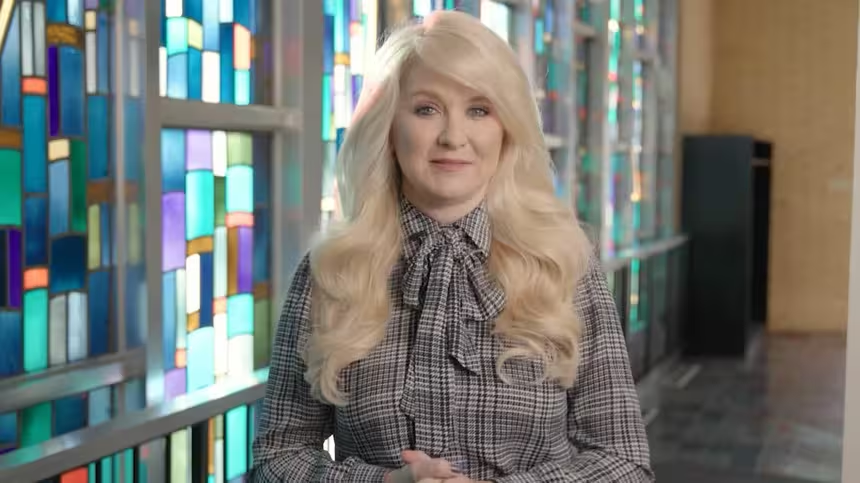
InFocus Host Jennifer Fuller sits down with Illinois Comptroller Susana Mendoza to look at the state’s fiscal picture for 2023. A preview of Mendoza’s expectations for Gov. JB Pritzker’s Budget and State of the State, along with updates to financial plans, and more.
Problems playing video? | Closed Captioning Feedback
Problems playing video? | Closed Captioning Feedback
InFocus is a local public television program presented by WSIU
Support provided by:

Illinois Comptroller Susana Mendoza
2/9/2023 | 26m 46sVideo has Closed Captions
InFocus Host Jennifer Fuller sits down with Illinois Comptroller Susana Mendoza to look at the state’s fiscal picture for 2023. A preview of Mendoza’s expectations for Gov. JB Pritzker’s Budget and State of the State, along with updates to financial plans, and more.
Problems playing video? | Closed Captioning Feedback
How to Watch InFocus
InFocus is available to stream on pbs.org and the free PBS App, available on iPhone, Apple TV, Android TV, Android smartphones, Amazon Fire TV, Amazon Fire Tablet, Roku, Samsung Smart TV, and Vizio.
InFocus
Join our award-winning team of reporters as we explore the major issues effecting the region and beyond, and meet the people and organizations hoping to make an impact. The series is produced in partnership with Julie Staley of the Staley Family Foundation and sponsored locally.Providing Support for PBS.org
Learn Moreabout PBS online sponsorship(gentle bright music) (upbeat bright music) - Welcome to another edition of "InFocus."
I'm Jennifer Fuller.
We're talking this week with Illinois Comptroller, Susana Mendoza.
Thanks for coming in.
- Always a pleasure, Jennifer.
How are you?
- We've got a lot to talk about, so let's dive right in.
People have been paying close attention to how COVID funding has been coming and going in the state.
Things that need to be paid off still, debts that are still happening, but I know where we wanted to start was with the unemployment insurance trust fund.
That was a big deal.
People who needed the help when COVID had everything shut down, they needed money and there were some loans made that have to be repaid.
Where does that stand now?
- Well, we've repaid every last penny.
So the good news for taxpayers is that we owe zero debt now on COVID borrowing during the pandemic.
So we're completely caught up.
And that means that by catching up, and now finalizing the last payment of 1.37 billion of a $4.5 billion dollar loan, we were able to stop the hemorrhaging, let's say, of interest.
And so, by paying the 1.37 billion, we have now saved an additional $20 million in interest that would've been due come September had we continued to, you know, not pay this back.
So this is a big deal, but it also means that we're completely caught up on all COVID-related borrowing during the pandemic.
- There was a lot of discussion about how to use federal funding that was coming in to help states support themselves during the downturn that came from the pandemic.
And there were some choices made at the state level that said, no, we're going to use it for this, and then we'll use other monies for this.
- Mm-hmm.
- Was there a moment of panic, at all, for you when you thought, oh no, we are going to have to incur this debt, we are going to have to pay off this interest, or did you see from forecasts that things would probably work out?
- There was never a moment of panic for me during the pandemic, and there might be people who don't believe that.
But the truth of the matter is that I became Comptroller during the worst fiscal crisis in our state's history in the middle of a 736-day budget impasse where we were going through the best economic bull market of our lifetime, yet took on eight consecutive credit downgrades, racked up over a billion dollars worth of late payment interest penalties, and had a bill backlog of almost $17 billion, and that was during the best of economic times.
And I had managed to be able to get our state moving in the right direction.
I had cut $9 billion off that bill backlog even before Governor Pritzker got elected.
And so, we were well on our way to economic recovery.
I passed things that we talked about before, like the Debt Transparency Act that let me see where all the state's liabilities were so I could better manage the state's finances.
And so, these things had already been put in place.
Illinois was moving in the right direction.
Our credit was sneaking towards a positive territory versus only being downgrades, 20 years of consecutive downgrades.
And then the pandemic hit.
And while most financial officers, I would agree, in every other state, probably did have moments of panic, if you think about it, the only thing I'd known as Comptroller was severe fiscal crisis.
So I was scared about the pandemic from a healthcare perspective, but I wasn't from a financial perspective because we self-inflicted that $16.7 billion backlog of unpaid bills, the $1 billion plus in late payment interest penalties.
The pandemic was something that was clearly out of our control.
And thank God we had already been moving in the right direction that I knew how to deal with crisis.
And no matter how bad the pandemic was, the worst fiscal crisis, the worst virus ever hit our finances was that 736-day budget impasse.
So I've had it under control and proof is in the pudding that not only do we not have a bill backlog anymore, and I paid that back before receiving a penny of federal ARPA stimulus dollars in the door.
We didn't even have that money.
So I had to just do it through good old-fashioned fiscal discipline and hard work over a five-year period.
But we paid down the bill backlog, we eliminated it.
I now have an accounts payable of only 1.4 billion, which is amazing.
And my oldest bill today is only 17-days old, well under a 30-day payment cycle, which is faster than the private sector pays.
And it's been like that for two years now.
We're going on two years of stable, predictable financial discipline here in Illinois.
And by the way, six credit upgrades, not just one that I promised when I ran, but six full credit upgrades on my watch.
So the pandemic, it was scary like I said, from a healthcare perspective, but from a financial perspective, there was no way that I would think that the federal government would not step up to help, not just Illinois, but every state in the nation because we were all going through unprecedented times.
- You mentioned the credit upgrades, and there have been several upgrades over the last six months to a year, maybe a little bit more, but there's still a little bit of uncertainty.
There are still those things hanging over the state that these credit rating agencies are saying, you know, you're doing okay, but you still need to pay attention to things like the unfunded pension liability.
- [Susana] Exactly.
- Not a lack of a rainy day fund, but maybe a rainy day fund that's not as robust as it should be.
- Exactly.
- So how are you working on those things to try and get the credit upgrades to continue?
- Well, one of the reasons that we did get a credit upgrade is because we've put more money into our state's rainy day fund, right?
We've obviously paid down our bill backlog, that was instrumental.
We've passed the Debt Transparency Act, which has been cited by the credit rating agencies as helping get us some of those credit upgrades.
The transparency, right, that my administration has brought into the state's finances has been heralded by the credit rating agencies as instrumental to getting these credit upgrades.
And so, we're not out of the woods yet.
And even though we have six credit upgrades, we're still not even close to where we need to be.
But this is still good news to celebrate, right?
We shouldn't poo poo on the fact that we have six credit upgrades.
They're very difficult to get.
In fact, Illinois had only seen credit downgrades over the previous 20 years.
So the fact that we got these credit upgrades, and that we earned them during very challenging financial times is wonderful for Illinois.
Now, having said that, we used to have less than $60,000 in the rainy day fund when I took office.
That's not enough to cover 30 seconds worth of government operations.
Today, we have $1,059,000,000 in that rainy day fund.
And the credit agencies love to see that, but it needs to get higher.
So when taxpayers hear that Illinois has over a billion dollars in the rainy day fund, they think that's a lot of money.
But let me educate you on that.
It's not, that's about close to a week's worth of reserves for the state of Illinois.
So if we get hit by another massive calamity through no fault of our own, that covers us for about a week.
The average state in the country has about 35 days worth of reserves.
That would be closer to, you know, over 4 billion.
If we can get to $3.75 billion, that's a really comfortable place for Illinois to be.
I pretty much guarantee you we'd get another credit rating upgrade with that.
But the fact that we're adding more money every time we have additional revenues for the state, instead of spending that money, we're adding it to the rainy day fund, that's a really good credit positive action.
And so, we're looking for that seventh credit upgrade.
Just recently, the governor and the legislature approved 850 million more into the state's rainy day fund, which my job will be to find that money and make sure we're saving it.
But that'll bring us close to $2 billion in reserves, which is getting us, you know, more than halfway there.
And I think over the next five years, if we play our cards right and we continue the fiscal discipline that we've done, we can get to our goal of 7.5% of savings for the state of Illinois, and then start putting even more money towards pension debt instead of only saving it, which saving it is critically important, but we wanna save and put money additionally beyond the minimums towards our pension obligations.
- You mentioned the rainy day fund, and people hear that sometimes and think, well, if the state has enough money to be saving, why aren't we investing that in lowering taxes or reducing the burden on the taxpayers?
And I know that you work with the legislature on that.
How important is it to have that rainy day fund?
And once you reach that 3.75 billion, is that when you think you could be talking about, okay, maybe we can give this back or reduce some tax burden?
- So remember we did 1.8 billion worth of refunds to taxpayers and tax savings just this last year.
That was the first time in the state's history that we were able to return some money to taxpayers.
And it sounds like, oh, that's a lot of money, but it only came out to about $50 per person.
So when you do the math on it, it's, you know, 1.8 billion is a lot for our revenue intake.
And to return it to taxpayers, it's not that much at the end of the day that you're getting back, but we'd rather taxpayers get some of it back.
But we can't afford to give it all back because we do need to save for a rainy day, and we do need to stabilize our pension debt, our obligations there.
And so, there are very important expenses that still need to be made, debts that have to be repaid, savings that have to be made to protect taxpayers in the long run, and those things are important to do.
And once we've done those and we have extra money, then you can talk about, do you invest it in education or do you invested in other types of programs, or how much of that can we return to taxpayers?
The fact that we were able to do that last year for the first time ever is good news.
It's not necessarily something we can do every year.
We just have to see how our revenues come in.
But the important thing is that we get in the habit of being fiscally disciplined, of saving for a rainy day, of paying down our debts.
And then when there's extra money, talk about what's the best use of that money, is it to give it back to people to help them get some tax relief?
And I would argue, yes, it is, along with other investments in critical areas that would give us a return on that taxpayer dollar, things like early childhood education or university for our students.
- There are a lot of people who are joining this program, and they hear pension debt, and that peaks a lot of interest.
A lot of state workers, a lot of university workers who are invested in state pension plans, and they hear unfunded pension liability to the tune of more than a hundred- - [Susana] $139 Billion.
- There we go, I was gonna say more than 130 so I'm glad that we are in the ballpark.
That's a scary number for someone to just look at and say, how on earth is the state going to be able to pay this when I retire, when someone else retires?
And in full disclosure, I'm a state employee, so this is something I'm interested in.
But how is that going to happen, and what is your level of urgency in getting that paid down?
- So this is why I think that we need to continue, not just talk about this, but actually put money towards paying down pension debt, right?
So previous years, everyone talks about what needs to be done and whether or not these pensions are going to be there, but they're not going to be there if we don't continue to pay down the pension debt, right?
And so, for the first time, again, ever, this administration has put more money towards beyond the minimum payments, right?
It's like paying a credit card.
If you only pay the minimums, that debt's gonna continue to grow and grow and grow and grow.
That's what's happening with the unfunded pension liability.
So we have to tackle the principal.
And so, whatever the minimum payments are, we can never skip those.
We have to make those, and then on top of those minimums, we have to add more real money to that issue so that we can cut down on what those increased interest payments are going to be.
Now, the credit rating agencies obviously love to see that type of fiscal discipline and are rewarding us for that.
And I would argue, that's why my legislation is so important, that would create automatic deposits into both the state's rainy day fund, and the pension stabilization fund so that when we hit our 7.5% savings in the rainy day fund, 1% of the entire budget of the state of Illinois would go towards stabilizing pensions.
Again, it's not gonna fix the problem, but it definitely creates some stability and predictability towards additional payments on unfunded pension obligations, and I think would help lead us to another credit upgrade.
Having said that, no need to be scared.
And I know that sounds like, well, why should we trust her?
But the reality of it, I would be scared too.
You used a keyword, you said, "When I retire."
So the entire state of Illinois is not retiring tomorrow.
I would be freaking out if you told me that tomorrow I have to come up with $139 billion worth of payments because every single state employee retired.
But that's just not how it works.
Think of this more like a mortgage.
If you have a mortgage and let's say it's $500,000, that would be a very nice house.
But let's just say $300,000, it's still a lot of money for the average Illinoian.
You would be freaking out if your bank called you tomorrow and said, guess what?
We need all of your $300,000 for your house or else we're kicking you out.
But that's not how it works.
Your mortgage is over the next 30 years and pensions are similar.
It's a long-term payment plan over 30, 40 years, right?
And so, we're looking at the fact that over the next 30 to 40 years, we have to worry about how we pay back $139 billion, not tomorrow.
And so, as long as we're paying more into the principal, just like if you make an extra payment on your mortgage, you're gonna save several years worth of payments over the life of the mortgage, and you're saving hundreds of thousands of dollars.
In Illinois, whenever we make an extra payment on our pensions, that saves us billions of dollars, not even hundreds of millions.
And so, this is why it's smart to put more money when we have extra cash towards paying down the principal on those unfunded pension liabilities.
- These are things that we continue to talk about, and I know that Governor Pritzker is aware of them as well and has ideas on how to work on that.
Governor Pritzker will give his budget and state of the state address on February 15th, and I should let people know, you can see that here on WSIU and find it online as well.
What are you hoping to hear from the governor, and what input do you have as he crafts that budget picture?
- Well, I'm really hoping to see, once again, a balanced budget.
And I have every faith and confidence that he will do that.
He's done a wonderful job over the last four years of introducing balanced budgets.
And you've seen that we've had budget surpluses, right?
We've had, just recently they were able to come back and do a supplemental because his budget was so balanced, frankly, the last time around that they were conservative on those revenue estimates.
And so, even with the budget surplus that they did, they didn't use it all.
They didn't spend it all.
COGFA predicted an extra billion dollars more than the legislature decided to appropriate with their supplemental budget, and that the governor signed.
And so, we are exhibiting fiscal discipline in a way that we haven't ever done in this state before.
And I'm very proud of what my office has done to lead the charge there, of what Governor Pritzker has done to maintain, you know, the budget balanced, and what the legislature has done, frankly, to all of us working together, be able to get to a point where we can have a discussion about what to do with the extra revenue that's come into the state.
So I'm looking to see what his plans are for free tuition for our college-bound kids, what his ideas are with how we're gonna provide or fund preschool for all.
I mean, these are wonderful ideas, but they cost a lot of money.
And so, depending on what those revenue estimates are going to be, can we afford to do those things?
I think we can't afford not to do them, but whether we can do them all fully right off the bat is probably not going to happen.
But some variant of getting us there, and what the plan is for getting us there quickly, I think would be very interesting to lots of taxpayers.
- You know, two issues, the college tuition and preschool for all have gotten a lot of attention since Governor Pritzker mentioned them in his inauguration address.
And I imagine that it's difficult to work that plan out when it needs to be sustainable for generations to come.
- That's exactly right.
- You're not talking about just a one year program.
How does your office work with the governor's office to talk about what's going to be needed?
- Yep.
- You have to, you know, plan for increases in cost of living and those sorts of things.
- That's right.
- How do you work those numbers out?
- Well, of course we have great working relationships, right?
And I'm always voicing what my thoughts are and from a fiscally conservative point of view, right, that I 100% think we do need to invest in our youth, certainly at the very early stages, which has a tremendous return on investment for taxpayers.
You don't see it right off the bat, but over the course of that kid's lifetime, the odds are that they're gonna be productive tax paying members of society versus entering into the prison pipeline, right?
And so, we wanna invest in them early so we don't have to invest way more money on them on the correctional side of the equation, which has a real cost, it's much larger to taxpayers.
and if this child is invested in early, goes through the process and becomes a good hardworking taxpayer for Illinois.
So it's a long-term investment.
The other thing is on colleges, I would like to say, I think that we should be fully funding our MAP Grants.
So when we talk about free college for everyone or free college, what does free college look like?
Is it free college for everyone?
I would argue that not everyone needs to get free college.
There's people whose parents can afford to send their kids to school, but there are kids who, without the financial aid, will not be able to go to school even though they're super smart and super talented and deserve that chance.
And so, that's where our MAP Grants come into play.
20 years ago, 21 years ago, we used to fund MAP Grants fully.
So if a kid had the smarts but just didn't have the money, the state would step up and say, "We'll pay for a hundred percent of your tuition."
And that was a game changer for so many kids, certainly here in Southern Illinois.
You look at the demographics of this campus right here in Southern Illinois, 42% of the kids who get MAP Grants are African-American, 41% are white, they're rural kids and 13% are Hispanic.
So the MAP Grant has this reputation of being for minorities, but that's not in fact the case at all.
And so, there are a lot of rural kids who would benefit from MAP Grants, but if you tell a kid, we'll only fund you at 44%, which is the case today, instead of a hundred percent, you might as well have to come up with a million dollars, right?
Kids can't afford that extra 56%.
And so, I think let's start by fully funding MAP Grants.
That's $850 million additional that we'd have to come up with as a state, which I think is frankly doable.
And we can start there because that's the most vulnerable group with the least access to money who has incredible potential that is going untapped.
So let's fully fund our MAP Grants again and see how that works out.
And then, talk about do we have additional revenues?
How do we go about, you know, expanding that pool year to year?
But we're gonna have to have these honest conversations because while we'd all love to see free college and free preschool, there is a cost associated to it, and we can only do it if we can afford to do it long-term and continuously, because there's nothing worse than telling a kid, we'll pay for your college this year, but next year, we're pulling the rug out from under you.
- Sure.
You mentioned earlier, COGFA, The Commission On Government Forecasting and Accountability.
There are a lot of people, including COGFA, the Office of Management and Budget watching the economy right now.
And they're talking about long-term projects like this and saying, you know, you need to be careful.
We see hints of the potential for recession.
- [Susana] That's right.
- High inflation that has started to somewhat stabilize.
But still, a lot of these hints that maybe there's a downturn on the horizon.
What are you doing to keep an eye on that?
And then how are you advising the governor's office, and the legislature as they begin to craft this budget for next year?
- That's a great question, and I am very closely keeping my eye on this.
Just over the last two months, right?
December and January, revenues have not come in when you add them both together as strong as they did last year or about 200 plus million less in revenues than we had over the same period a year ago.
Having said that, we're still about a billion dollars more in expected revenues than we had, but that may not be sustainable long term.
And so, that's why it's important to keep saying, we do need to invest more in these areas, but we need to be careful about overextending ourselves.
And so, I'm gonna continue to be that voice of reason on behalf of taxpayers that these are great areas to invest in, whether it's anything that will be good for economic growth for our state costs money, but the return on investment is significant.
Same with daycare services, right?
You're talking about if you could provide more assistance for daycare, it doesn't just cost money on the front end, it actually is more of a wash because, yes, we're investing in one area, but that means moms who right now don't go to work because they can't afford the daycare, with a little bit of financial assistance, would then be able to have jobs that might actually pay more into the tax base.
And so, it's not a like a hundred percent investment, it's a partial investment that has significant gains for our state long term.
The same can be said about educating our youth.
I mean, Jennifer, my biggest issue with the fact that we don't help kids with college tuition is really simple.
Number one, there's two factors to it.
Number one, the moral thing is to take care of our kids and invest in them.
But even if you don't wanna look at the morality of helping our youth, we've invested billions of dollars as a state in our children right now, from K through 12.
We've poured all this money, billions of dollars into getting them ready to go to college only to tell them that they're on their own when it's time to go to college.
And other states will say, hey, Illinois's got a great educational system.
Let's pluck those Illinois kids and we'll offer them scholarships to come to Iowa or go to Indiana or go to some other state, go to Boston, for example.
And then what happens?
We lose those kids.
So we've put all these billions of dollars towards getting these kids ready to only lose him to another state.
That's a terrible way of investing in our kids.
We need to continue that investment to get them ready to join the workforce, and to join the workforce right here in Illinois and have those taxpayer dollars going right here to Illinois.
So I think we need to look at this a little bit differently and talk about it differently that are we really helping our state financially by not investing in these kids all the way through?
I don't think we are.
We're losing them.
We're investing them and giving a gift to other states, and that's not good for our state overall.
- Lots of long-term picture things to talk about here, but with just a few minutes that we have remaining, I wonder if the picture remains bright, and the debt comes down, and you have money to spend, what would be your big idea, the one thing that you really wish you could get moving through the Comptroller's office if you didn't have to focus on some of these other issues that have to be resolved?
Oh my goodness, that's like the most awesome question.
Look, we're gonna be dealing with unfunded pension liability for quite some time.
So that is like a thing that we have to address.
It's not, I'm gonna still be very old by the time that is completely paid down, but we want it stabilized.
So that is something that is important to me.
It's why I've introduced legislation to save for the rainy day, get us to our 7.5% savings, and then put all of the extra savings that would've gone to rainy day into pension stabilization, right?
So that's important.
But I wanna see Illinois come back from a manufacturing perspective.
And I think that southern Illinois is pristinely positioned to be the area where manufacturing could really become a major player and driver of economic growth of job creation here.
We already talked about what I think about investing in our youth, and I think that's a game changer if we do it correctly.
But manufacturing, look at what happened during the pandemic, right?
During the pandemic, we came to realize that we have an over-reliance as a country on foreign countries like China where they produce everything cheap.
And it worked for a long time, right?
But during the pandemic, moms didn't have access to formula for their babies, right?
People who wanted to purchase a car who needed one couldn't because all the microchips were being made elsewhere.
We need to recognize that Illinois of all the states has rail.
We're the only state in the nation that has every single type of rail here in our state.
Airplanes, right?
I mean, we've got air, rail, water.
Hopefully this port was gonna revitalize this area as well in Cairo.
And, you know, intermodal transportation.
And so, we are perfectly positioned to say we shouldn't have this reliance on other countries because it may be cheaper to produce, but if you have another pandemic or something of the sort, you realize that the supply chain aspect, how it takes months to get a product that's stuck overseas to our country when we might really need that product is not a reliance that we wanna continue to have.
So we should be looking at regional growth.
Of course, global trade is always going to be the case, but we need a higher reliance on regional trade and regional development.
And when you look at regional, there is no better state than Illinois that has it all.
The skilled workforce, the great educational systems, every single type of interstate transport and the people, right?
So this is where I wanna see.
If you ask me where do I think that we can really see Illinois's future?
It's in making Illinois better positioned to be a manufacturing boom.
- I would be remiss if I didn't give you the opportunity to talk about your website where people can get more information on state finances before we say goodbye.
- Sure, thanks.
It's the longest website ever.
It's called illinoiscomptroller.gov, and it's spelled C-O-M-P-T-R-O-L-L-E-R.
But you can also track how we've spent every single dollar of COVID funds.
We have been recognized as the most transparent COVID-spending portal in the country.
I'm very proud of that, and I do believe that transparency really is the road to restoring trust in government.
So yeah, go take a look.
If you're super bored, it's always interesting.
And if you are a numbers nerd like me, it's definitely interesting.
- Susanna Mendoza is the Comptroller for the state of Illinois.
Thanks for coming in.
I appreciate it.
- Thanks for having me.
- And thank you for joining us on "InFocus" for this episode.
You can find us online at wsiu.org and subscribe at our YouTube channel.
I'm Jennifer Fuller, we'll catch you next time.
(upbeat bright music)

- News and Public Affairs

Top journalists deliver compelling original analysis of the hour's headlines.

- News and Public Affairs

FRONTLINE is investigative journalism that questions, explains and changes our world.












Support for PBS provided by:
InFocus is a local public television program presented by WSIU