At Issue with Mark Welp
Illinois Data Centers: Part 1
Season 3 Episode 33 | 26m 33sVideo has Closed Captions
Andrew Raine examines the environmental and community impacts of Illinois data centers.
In Part 1 of a two-part discussion, Prairie Rivers Network climate policy director Andrew Raine joins Mark Welp to examine the rapid growth of data centers in Illinois. They discuss energy and water demands, rising utility costs, local regulation, community concerns and what protections could help communities manage increasingly large AI data center projects.
Problems playing video? | Closed Captioning Feedback
Problems playing video? | Closed Captioning Feedback
At Issue with Mark Welp is a local public television program presented by WTVP
At Issue with Mark Welp
Illinois Data Centers: Part 1
Season 3 Episode 33 | 26m 33sVideo has Closed Captions
In Part 1 of a two-part discussion, Prairie Rivers Network climate policy director Andrew Raine joins Mark Welp to examine the rapid growth of data centers in Illinois. They discuss energy and water demands, rising utility costs, local regulation, community concerns and what protections could help communities manage increasingly large AI data center projects.
Problems playing video? | Closed Captioning Feedback
Where to Watch At Issue with Mark Welp
At Issue with Mark Welp is available to stream on pbs.org and the PBS app.
Providing Support for PBS.org
Learn Moreabout PBS online sponsorship(cheerful music) (cheerful music continues) - As we rely more and more on cloud computing, corporate IT operations, and artificial intelligence, we need data centers to house the storage and processing systems that support all those services that are supposed to make our lives easier.
However, with that convenience comes a lot of environmental, economic, and social concerns.
Andrew Raine is the climate policy director with the Champaign-Urbana-based Prairie Rivers Network.
Andrew, thanks for joining us today.
- Thanks for having me on, Mark.
- Tell us a little bit about what your organization does and how that relates to data centers.
- Sure.
So we work on water and energy issues broadly in Illinois.
Over the last decade, we've been involved, in partnership with the Illinois Clean Jobs Coalition, on working on climate legislation, focused on decarbonizing Illinois's electric sector.
And so throughout that time, we've become more and more involved with building out renewables and decarbonizing, so setting a glide path to closing our fossil fuel power plants.
So in that, so as we've been working on the energy sector, data centers have sort of emerged as the big new threat, both on energy and water, because of their genuinely unprecedented energy demand.
And with that comes a massive amount of water demand as well.
And so these could have pretty major impacts on our resources.
And to be clear, the big data centers, the ones we're talking about, aren't the ones hosting the internet.
They're not the ones providing the services that we use every day.
It's, really, the workhorses for training AI data sets, are what the biggest of the big AI data centers are, and the ones that are really driving this concern.
We've had data centers for a really long time, decades, right?
And there's data centers in the closet of your office, and then there's slightly bigger ones that are the size of a building, but now, we've got one in Joliet that's the size of Central Park.
And the energy and impacts that scale with that are unique to AI data centers.
So that's kind of the moment that we're in, and how Prairie Rivers Network comes to it as a threat to our water and a threat to our climate.
But it's such a big issue that we need to have comprehensive solutions to data centers overall.
- Well, like you said, data centers have been around for a long time.
You know, we have a few here in Central Illinois, but they're pretty minuscule compared to, like, that one you just mentioned in Joliet.
And it seems like basically every county in the state is now dealing with this issue.
It kind of seems to have snuck up on local governments.
They're not sure exactly what to do.
Tell us about Champaign County and the moratorium they just passed.
- Yeah, so Champaign County proposed the moratorium, I believe, in February.
And that's because there were rumors of a large data center coming west of Champaign.
And what the county board was facing was, look, we've got an ordinance for data centers, but that ordinance was written thinking about the data centers of the past, the data centers that are gonna run the internet and store our email, and do sort of just whatever things, not a data center that's 300-plus acres that uses as much energy as a coal plant by itself.
But that's the kind of proposals that are coming down the pike, that suddenly counties and cities across the state are considering.
And so Champaign chose to put a one-year moratorium and develop a new ordinance that is appropriate to the scale of those new data centers that are so much larger, that have so much more energy, water, and community impacts compared to the data centers of before.
And the trick is, if they had not put the moratorium in, they would have to use their old rules, consider even a big data center.
So they had to use those rules that would've been wildly inappropriate and would not be able to meet the concerns of a large data center.
So that's why the moratorium is a critical step to then revising and updating the ordinance.
- We know that data centers do use a lot of electricity.
They can use a lot of water, depending on what type of system they specifically use.
We know those things, but do we know a lot of other things?
I mean, there's a ton of rumors on the internet about, you know, what these data centers can do to the environment and do to people, and things like that.
Do we need more data on our data centers, or do we know enough to say, "Hey, we need to be careful about where we put these things"?
- I would say we know enough to say we should be careful and thoughtful.
But I also agree that we don't know a lot, but we know they're big and highly impactful, right?
So the fact that they haven't been transparent isn't reason not to take action.
It's reason to take action, right?
Like prove that you're not causing harm before you go and march us into some new, you know, era where we've got these massive data centers dotting our landscape.
Now, you know, they're not entirely new.
We've seen impacts in places where they've been in pretty broad development.
Aurora in Illinois is a great example, where a data center currently in operation was operating its backup generators nonstop because there had been a substation that went down.
And the community members, for days on end, were hearing what they described as like a helicopter landing on the roof of their house.
Like the sound was immense.
That's also a lot of diesel generators generating pollution.
You know, so those sorts of concerns really drove Aurora to develop a new ordinance.
And they've now approved their new data center ordinance, which is, you know, pretty, I would say, state of the art as far as a data center ordinance goes.
And actually, I just heard from the mayor presented to Champaign City, the data center task force that I'm on.
And the mayor of Aurora said, "You know, look, we've still got data centers working with us, even though we have this ordinance that sets the bar on energy efficiency, water efficiency, noise controls."
You know, they're really pushing data centers to show that they can be a good community partner, and we can still have data center development.
- Recently here around the Peoria area, we've had some data center controversy, specifically in Pekin.
And boy, I tell you, the community came out like I haven't seen in years, saying "We don't want this here."
So kind of the grassroots ground swelling of people who are, "Not in our backyard," kind of people is definitely happening.
I'm curious why these huge data centers, you know, they seem to be more in rural areas.
I guess a lot of it's because of the size, but how come the companies aren't just putting them literally in the middle of nowhere, where there are no people, and people may not care about what happens to the land as much as they do if it's near their town?
Do you know why that is?
- Yeah, I mean, it's a complicated issue, because people care about the land, no matter what, right?
If you put it in farmland, there'll be concerns about using that farmland as a data center.
And by the way, that data center, any farmland converted for a data center is never gonna be farmed again.
I mean, that's putting down paths of concrete that you're not gonna remove.
You know, if you put it close to a community, you've got lights, you've got sound, you've got resources.
Anywhere you put it is going to impact water and is gonna impact electricity.
And so, you know, there are real sighting concerns that we need to be addressing.
And I think one of the reasons why, I mean, there's a lot of reasons why folks are concerned.
I don't wanna speak to all of them.
Some folks are just concerned about AI and the direction that we're going, and genuinely dealing with a generational change.
I mean, if AI is what it promises to be, this is just something so different.
So I understand those concerns.
And then some people are worried about, "Well, look at my electricity rates that have been going up," and they have.
And in part, in large part, our electricity rates are going up because of data centers.
And so I understand that concern as well, right?
And so folks just need more, we need more assurances, we need something like the Power Act, which Prairie Rivers Network and partners are working on passing in Springfield, which would create standard protections and expectations of data centers, so that we could be more confident that they aren't going to cause our electricity bills to go up, overuse our water resources, engage in sort of behind-the-scenes deals with local governments, and ensure that communities receive benefit when a data center comes to town.
- Let's talk a little bit about those water resources.
If you can give us an idea of how much water some of these places use.
I know that some of the newer data centers, they're saying, "Well, we've got kind of a closed-loop system, where we're gonna pump the water in, but we're gonna use it continually.
It's not like we're pumping it in and pumping it right back out."
What are some of the concerns about all of this water usage?
- Yeah, so the water use is one of those areas where nationally, there has not been a ton of transparency.
And so we don't really know as much as we'd like to know.
We do know that a data center using evaporative cooling is gonna use a ton of water.
And some of these larger data centers, if they were using evaporative cooling, which means that the water comes through the plant, it absorbs the heat, and then a bunch of it evaporates away because it's absorbed that heat.
I mean, they can use... Half of the water it pulls through can go away.
And that means that the data center looks like a small town, or larger, depending on how big the data center is.
And I think for these hyperscalers, like the one in Joliet, which is a 1,800 megawatt data center, which is an insane amount of energy usage, that energy creates heat.
Heat needs to be cooled.
You use water as part of your cooling process, but if you were using evaporative cooling, that would consume an insane amount of water.
So they switched to technologies like closed-loop cooling, which do better on water use, but then they actually increase the energy use.
And we don't really know how often they're gonna be flushing that system and replacing it.
And when they flush the system, we don't know where that fluid that's in the closed-loop system is going.
And I say, "Fluid," because if it's a closed-loop system, it's probably gonna be things like glycerol, or like it's not just water in there, it's stuff that takes heat away from their chips more effectively.
And then on the other end, so you've got your chips generating heat, on the other end, you've gotta get rid of that heat, it's still gotta go somewhere.
And so if you've got a chiller tower on the other end of that loop, that closed loop that's using evaporative cooling, you're still using water in your chiller tower, unless it's an air-chilled tower.
And so there's just a lot of questions.
And this is why we're proposing, at the state level, and we'll be working on this in Champaign County, we're just proposing that they tell us what they're doing and set out a baseline of responsibility for water use, so that we know, "Okay, you are using technology that responsibly uses our water.
We have a sense of how much that's gonna be.
We have an understanding from the state water survey of how that might impact our water resources.
So if you're drawing for your closed-loop system from the Mahomet Aquifer, well, we wanna know how much water that is, so that we can kind of plan and have an idea of how much that will draw on our precious resources."
- It may be hard for a lot of people to kind of wrap their heads around the whole water usage thing, but when it comes to electricity, I think we can all understand that.
I mean, you know, if you've got your computer at home, and it's plugged in, not even doing anything, it's gonna be drawing electricity.
And, you know, some of these places, like in Joliet, where you say, you know, they're football fields, large, full of servers and things like that, I mean, that is just gonna suck the electricity out of the area.
Besides concerns about, you know, residential consumers, their bills going up, what are some of the other concerns about electricity usage?
- Yeah, so let me just help put it into scale, because not everybody thinks in megawatts every day.
A 1,800 megawatt data center, which is, by the way, just one that's in the Joliet area.
There's another nearby in that same area that's also 1,800 megawatts.
So what is 1,800 megawatts?
That's 1,800,000 homes.
A home uses about a kilowatt of energy.
Chicago, if you were to like plug in the City of Chicago, is using about 3,500.
So that Joliet data center is half of the energy demand of Chicago.
What we're seeing in terms of proposals is, in the next 10 years, more than doubling Illinois's energy usage.
These are threats, challenges that our grid has never faced, and certainly hasn't faced in the last couple decades, have been pretty flat energy growth.
And so the way our grid operates is socialized.
The costs of meeting new energy demand is actually socialized among all of the rate payers on that grid.
And that theory worked fine when individual additions to the grid were small.
And even a large factory can be small compared to one of these big data centers.
Now that we have a single customer class coming in with such immense demands, it's not fair for us to pay the cost of those data centers coming in and raising all of our rates.
So we don't literally pay for the energy that a data center uses.
What we pay for is the impacts to our shared resource that the data center is uniquely causing.
So that's a big challenge.
And then the other side of the energy problem is our climate.
Illinois has set climate targets to attempt to decarbonize our electric sector.
And data centers pose a real challenge to that, but they can also be an opportunity.
If data centers are bringing renewable energy with them, if they build enough renewable energy to meet their demand, not only do they not increase our electricity costs, because they're meeting their own demand, they also build out renewables on our grid.
And that has economic impacts, that builds up a sector, that means we can have more trained workers, more trained companies able to build, that reduces the cost of build for everyone.
So we have a path here where data centers can help us meet climate targets if we have them bring their own new clean energy, which is the key policy in the Power Act, acronym is Bring Your Own Clean Energy, is BYOCE.
And it really, if we get that, we can really reshape our energy in Illinois.
- Yeah, with the Power Act, I know they would love to have these data centers supply their own energy, preferably renewable energy.
But we will see what happens with that.
We talked a little bit about economics, but, you know, the people who were in favor of data centers will say, "Okay, these are gonna bring new, well-paying jobs, and permanent, well-paying jobs."
You know, you gotta pay the construction workers who are gonna build these things.
And then property taxes, I mean, some of these projects, for example, like one in Logan County, the developers are saying the property taxes that this will generate in a year is more than any every other business combined in Logan County for a year.
So how do you, you know, when you start seeing dollar signs coming into your county, what does that do to your argument?
And does that make it a little tougher?
- I mean, that's up for locals to decide, right?
Local leaders, but also the public.
And so this is why transparency is so critical.
If all the information is on the table, folks can make a decision based on all that information.
I'll also say that property tax is great, but no one's thinking about 10 years down the road.
Everybody's in the moment right now.
And if the bubble pops, what's gonna happen to these data centers?
Is anybody preparing for decommissioning costs?
Is anybody thinking about where they go next?
And then on jobs, I will say, it's a lot of construction jobs.
It's not as many non-construction jobs.
And those construction jobs are obviously valuable.
That's what construction people do.
All of their jobs are temporary.
They go to the next project.
They go to the next project.
So I understand that, but it's just something to keep in mind when you're thinking about local benefits.
Is it local labor being hired, or is it being brought in from somewhere else?
And then to run the data center is a lot less jobs than to build it.
So these are all factors that need to be considered.
And what the power act would do is mean that when these communities are competing for data centers, or considering a data center, they're not able to give up their water resources, and they, you know, like they're not able to exclude the public from decision-making.
We're creating a space where they can compete fairly with each other, because the community down the road isn't able to say, "We'll give you a deal on the water," 'cause nobody can say, "We can give you a deal on the water," 'cause the Power Act would prevent them from doing that.
So I don't think of it as necessarily stopping all data centers.
I think of it as ensuring that data center development is responsible, so that we can get these property tax benefits, but also that neighbors will be protected, and also that our water resources will be protected, and also that we'll be able to hit our climate targets and all of those things at once.
- Do you know if there's been any talk at Springfield about having a statewide moratorium, and if that's even possible?
- I have not heard talk of a statewide moratorium.
I am not as deep of a Springfield inside-outside kind of guy as, you know, as it might sound.
But, so I don't know.
There's no bill, there's no bill on the table that says, "We're gonna do a statewide moratorium."
And I would be surprised if... I mean, we're having trouble, we haven't passed the Power Act yet, right?
Like we're fighting to pass the Power Act.
We need to build support behind that.
And the fact that that's not easy and done already, to me, says that it would be even harder to do something like a moratorium.
But I think we need action, we need protection.
And we only have 20 days left in session, so we need to see something done on data centers, because if we wait until the next legislative session, this is moving so fast, we're gonna be building data centers without protections on our water, without ensuring that they don't impact our rates, and that without protections for communities that live near the data center.
- Let's talk a little bit about an event you've got coming up in Pekin at the public library on Thursday, May 21st.
It's called Let's Talk Data Centers: Our Water, Our Power, Our Communities.
What's going on there?
- Yeah, so we've been hosting events across Central Illinois and also in Chicago.
And we've got one coming up in Southern Illinois as well.
And the goal is to bring community members out to talk about data centers.
It's not just a presentation, it's also a chance for community members to discuss with each other.
And we're kind of taking notes and getting feedback, both on the Power Act and also just on thoughts on data centers overall, what are the impacts that people are seeing?
We do inform, but we also wanna know, are we missing anything?
You know, so you can come to learn about data centers, but if we, you know, say, "We'll tell you about our concerns.
And if you have a separate concern, we want to hear about that."
So it's really just a space to drive community conversation.
And then we take that back, and it informs our process.
As Prairie Rivers Network and our partners will be fighting in Springfield for protections, we want to know what the public thinks.
- And this event being co-hosted by the Heart of Illinois Sierra Club, Faith in Place, Citizens Utility Board, Central Illinois Healthy Community Alliance, and Prairie Rivers Network.
So it sounds like you've got a lot of different things covered there, the environment.
Of course, the Citizens Utility Board is gonna be talking about energy prices.
And the Sierra Club, I would assume, the environment.
How important is it, when you're getting the word out, to use things like social media?
It seems like here in Pekin, when people got together on social media, there were thousands joining different groups to try and get the Pekin City Council and the mayor to not- - Yeah.
- Get on board with this.
- Sorry.
Yeah, the social media is how organizing happens these days.
And I've been seeing that too.
When a data center comes to town, it's Facebook, it's Instagram, it's the other social media platforms that folks are able to connect and organize on.
And I think part of that is just how our society works now.
And I think, I would hope, our community events are a way for folks to connect with each other and build a core of folks who wanna work together to advocate for themselves and for their communities when encountering the data center.
But yeah, these Facebook groups are quite impressive.
And the folks who organize them are able to really get the word out and get people engaged in a process.
I'll say, the Champaign County board, when they were considering the moratorium, had over 200 people there at that meeting.
The public turning out filled up the discussion room, and then we spilled into the lobby.
And that's like 190 more people than ever come to county board meetings, right?
So like it's just impressive how much getting the word out can help bring people, make them aware of something that they really care about and wanna participate in.
- I guess the one maybe bad thing about social media is that anyone can post and anyone can put information out there.
And there is misinformation out there.
What is a good place that you would recommend for people to find out more information about this, whether it's coming to one of your meetings or an online website?
- Sure.
Well, we try to keep our website up to date.
Our partners all try to keep our website up to date.
So if you go to Citizens Utility Board or Faith in Place, or Sierra Club, or the Prairie Rivers Network website, you can find out information on data centers.
Although our website recently got attacked, so our website's kind of not great right now, but there are places online.
I would say, you know, your news outlets are important places to go to to read about what's happening with the data center.
But when it comes down to something hyperlocal, and when there's not a lot of transparency, you have to do what you can, right?
You have to like find out the information you can, you have to attend county board meetings in these public spaces that are there, and often ignored, but are there for the public to engage and participate.
And that's, you know, everybody needs to be stepping up right now, when we're seeing something.
I mean, this is truly a massive landscape shift happening in the course of a year, two years, three years.
And it means people are learning that they need to be more active and step up.
- I don't know who attacked your website, and I don't wanna speculate, but have you gotten pushback from certain groups or certain data center developers?
- Not like a direct pushback, but, you know, in Springfield, when I go and testify, the data center developer is there talking about water as well, or, you know, talking about energy as well.
So, you know, developers are in support, obviously, of data centers.
Labor has testified in support of data centers in many ways because those construction jobs are really valuable to them.
So, you know, it's a discussion, it's a debate.
And so far, you know, we've been engaging in that process in Springfield and in our communities.
- All right, well, for our viewers out there, if you wanna find out more about data centers, the event is at the Peoria, or, excuse me, the Pekin Public Library.
That's Thursday, May 21st, from 6:00 PM to 7:45.
The groups we mentioned earlier will be there to answer questions and discuss this topic more, which isn't going anywhere soon.
Andrew Raine is with the Prairie Rivers Network.
And Andrew, we appreciate your time and information.
- Thanks, Mark.
Thanks for having me on.
- Anytime.
And thank you for joining us.
If you wanna find out more about this, watch this again, go to wtvp.org.
Thanks for joining us.
Have a good night.
(cheerful music) (cheerful music continues) (cheerful music continues) (cheerful music continues) (cheerful music continues) (cheerful music continues)
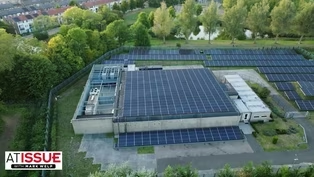
Could Data Centers Help Illinois Build More Clean Energy?
Video has Closed Captions
Clip: S3 Ep33 | 1m 52s | Andrew Raine explains how data centers could support clean energy without raising rates. (1m 52s)
What Communities Can Learn From Aurora's Data Center Rules
Video has Closed Captions
Clip: S3 Ep33 | 2m 16s | Andrew Raine says communities know enough to set protections before data centers arrive. (2m 16s)
Why AI Data Centers Raise New Energy and Water Concerns
Video has Closed Captions
Clip: S3 Ep33 | 1m 53s | Andrew Raine explains why massive AI data centers raise new energy and water concerns. (1m 53s)
Providing Support for PBS.org
Learn Moreabout PBS online sponsorship New Episode
- News and Public Affairs

Top journalists deliver compelling original analysis of the hour's headlines.

- News and Public Affairs

FRONTLINE is investigative journalism that questions, explains and changes our world.
 New Episode
 New Episode
 New Episode
 New Episode
 New Episode
 New Episode
 New Episode
 New Episode
 New Episode
Support for PBS provided by:
At Issue with Mark Welp is a local public television program presented by WTVP