
Illinois Governors Race, Kansas abortion votes
8/5/2022 | 26m 46sVideo has Closed Captions
Gov. JB Pritzker’s campaign attacked his GOP challenger, Sen. Darren Bailey, for comments
Gov. JB Pritzker’s campaign attacked his GOP challenger, Sen. Darren Bailey, for comments comparing the Holocaust to abortion. But how will that attack play out in the campaign. Kansas abortion votes.
Problems playing video? | Closed Captioning Feedback
Problems playing video? | Closed Captioning Feedback
CapitolView is a local public television program presented by WSIU
CapitolView is a production of WSIU Public Broadcasting.
Illinois Governors Race, Kansas abortion votes
8/5/2022 | 26m 46sVideo has Closed Captions
Gov. JB Pritzker’s campaign attacked his GOP challenger, Sen. Darren Bailey, for comments comparing the Holocaust to abortion. But how will that attack play out in the campaign. Kansas abortion votes.
Problems playing video? | Closed Captioning Feedback
How to Watch CapitolView
CapitolView is available to stream on pbs.org and the free PBS App, available on iPhone, Apple TV, Android TV, Android smartphones, Amazon Fire TV, Amazon Fire Tablet, Roku, Samsung Smart TV, and Vizio.
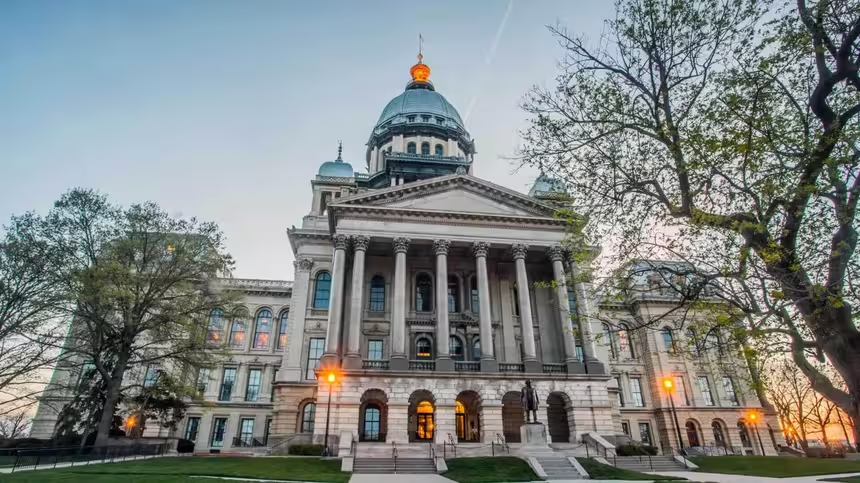
CapitolView
CapitolView is a weekly discussion of politics and government inside the Capitol, and around the state, with the Statehouse press corps. CapitolView is a production of WSIU Public Broadcasting.Providing Support for PBS.org
Learn Moreabout PBS online sponsorship(gentle music) (dramatic music) - Welcome to "Capitol View", our weekly look at happenings inside and outside the Illinois state capitol.
I'm Jennifer Fuller.
Our guests this week are Jeremy Gorner of the Chicago Tribune and Brenden Moore of the Lee Snterprises Springfield bureau.
Gentlemen, thanks for joining us.
- Happy to be here.
- Happy to be here.
- Ordinarily, we'd probably be talking about the lead up to the Illinois state fair, but we're talking about the campaign for Illinois governor instead as we start things off and new accusations from governor JB Pritzker that his GOP rival and challenger state Senator Darren Bailey had anti-Semitic comments in a statement that he made about five years ago.
Jeremy, I'll start with you.
How damaging are these comments to the Bailey campaign and does what governor Pritzker accuse him of hold water?
- I think it certainly does.
I mean whenever we've seen political candidates make comments like this before, it's definitely something that resonates with the public.
It certainly has on social media and of course it'll only add fuel to the fire for people who are already anti Darren Bailey to begin with.
I mean, we've seen this before, like for example, Mary Miller, who just won her race against Rodney Davis, of course, right before January 6th, the January 6th riot in DC, she obviously talked about Hitler, made her comments about Hitler and how he got one thing right about the youth of our country and so on and so forth that, but the thing about it is that that seemed to be a distant memory in this election for her, because she won handily against Rodney Davis, of course, that wasn't a statewide race.
This is a statewide race where there's gonna be a lot of Democrats.
Well, I shouldn't say a lot.
I mean, it's a majority democratic state, it's a blue state.
So of course I think that that's definitely something that could hurt Bailey.
The thing about it is that the election is three months away, so anything can happen in the next three months, especially when you look at a lot of undecided voters who really could be more issue oriented, but still, I mean, in past elections, we have seen when political candidates have made statements like this that have been deemed incendiary, they could go a long way with a lot of voters.
- And to clarify, the comments that Senator Bailey made were comparing the Holocaust to abortion.
And in the statement, he pointed to that abortion was as bad if not worse than the Holocaust.
And he's tried to walk back those comments this week.
- He was basically saying that the lives lost due to abortion pale in comparison to the lives lost during the Holocaust.
The other thing too is that in those 2017 remarks, he referred to the Holocaust as attempted extermination, which was another thing, he used the word attempted, which obviously that was no doubt part of his statement when he was trying to walk it back yesterday, which the word attempted is obviously very problematic, but yeah, in a sense that, yes, he was basically trying to say that the Holocaust paled in comparison to the lives lost due to abortion.
- Brenden, we always kind of wait and see after a primary election to see just what the tone and tenor a campaign to the general is going to be.
And it's clear this one's going to be messy and it's going to be mean in some cases.
What does governor Pritzker and his campaign gain from coming out the gate and saying, look, this is what we're dealing with in my opponent?
- Well they're clearly looking to make a contrast between the governor and Senator Bailey.
And obviously Senator Bailey has a track record of saying some controversial things, even right after the Highland Park massacre, he got in trouble for saying let's move on, celebrate 4th of July.
And then obviously these comments from 2017.
Senator Bailey is kind of known for doing these Facebook Lives where he talks directly to his followers.
And so it wouldn't be a surprise necessarily if more comments like this came out because he's speaking very off the cuff and yeah, the governor's campaign is certainly leaving no stone unturned to make the contrast of, they're trying to paint Senator Bailey as extreme, too extreme for Illinois.
Although in fairness, this was the candidate they wanted.
The governor's campaign and the Democratic governors Association poured millions of dollars into campaign advertisements in the primary that knocked Aurora mayor Richard Irvin, perceived as a more moderate candidate and elevated Senator Bailey saying that he was too conservative for Illinois, which obviously plays pretty well on a Republican primary, but obviously with comments like the ones that were unveiled a few days ago, I think the Pritzker campaign feels they have a pretty clear contrast with Senator Bailey and that they can paint him as out of the mainstream and as a candidate that is too conservative for Illinois and can't win a general election and shouldn't be elected.
- Well let's flip the perspective then here.
Were Senator Bailey's comments walking back his statement enough?
We saw admonishments from the house GOP leader and from us representative Adam Kininger this week after this campaign message came out.
- I think it's gonna be kind of hard to walk it back and I think when he did walk it back, he, I believe made a, he said, oh, well, that was not my intention was to downplay the Holocaust.
I was just trying to upplay the significance of abortion.
And then he made some comment about I have many supporters in the Jewish community and I'm gonna uplift them and give them economic opportunities.
It was a non apology apology basically.
And I think it's gonna be hard for Senator Bailey to walk back even more broadly some of his more conservative positions, because when you stand on a stage with Donald Trump a few days before the primary, it can be kind of difficult to then pivot to the middle.
And I don't think Senator Bailey has really made much of an effort to do that.
I mean, he is who he is, and I think he thinks that there's more conservatives in Illinois than maybe the conventional wisdom is.
Maybe he's right.
But as we've seen in several of the past cycles, Republicans have a hard time winning in this state statewide, especially if they can't appeal to independents and even some Democrats.
So he will have some work to do in that regard and there's still time, but I think it will be difficult to walk back this specific instance and also just more broadly on some of his more conservative policy positions.
- And I'll take both of your answers on this next part of this, which is when you look at this snapshot of what Governor Pritzker's campaign has come out with and how Senator Bailey has had to respond to it, does it help either of them do that walking back to the middle or trying to attract moderate or independent voters at this point?
Jeremy, I'll start with you.
- I think for an issue like this, I think one argument that can be made is why are there so many undecideds, why are there so many moderates?
Governor Pritzker's been in office for four years.
A lot of these undecideds had four years to decide whether they wanna retain them or vote for somebody else.
So I think it's really gonna be kind of hard to tell.
I mean, like what I was saying earlier, Bailey's comments are only going to inflame the anti Bailey crowd.
But I think the pro Bailey crowd, it's probably not gonna make the least bit of difference with them.
I was at an event a little over a week ago in the Northwest suburbs of Chicago where Bailey was there to speak at an event for a Republican congressional candidate.
And Bailey was talking about how he's been to Israel twice.
It's kind of a nod to a lot of the religious rhetoric that he incorporates in so many of his campaign messages.
I don't think it's gonna make much of a difference for his base.
And as far as undecideds go, it's gonna be really hard to tell too, because it's gonna come down to, again, the general election's three months away and are these undecideds, are they gonna be in tune enough to really... Have they paid attention enough to things that Senator Bailey has said, not just about the Holocaust, but also about Highland Park?
Or are they gonna really look at gas prices?
Are they gonna look at inflation?
Are they gonna look at abortion?
Are they gonna look at all these issues that seem to be something that might resonate more with them?
- Certainly interesting.
Yeah.
Interesting points.
Brenden, your thoughts?
- I agree, I mean, I think that at the end of the day, a lot of it's gonna come back to some of those kitchen table issues of inflation, the economy.
And then obviously we've been talking a lot about abortion the past few months because of the decision.
But I do think that that some of these comments that Senator Bailey made and some of his more, I guess, conservative positions will have an impact just because of the makeup of the state of Illinois.
As somebody told me a few weeks ago, we're not Kentucky, you can't get elected with such conservative positions statewide.
And I think that, and who knows, maybe Senator Bailey will make it a closer race because of some of those factors, because it's looking like a good year nationally for Republicans, but Illinois is still a fairly democratic state and he will need some crossover voters to win.
And I think that maybe if he did focus on the economy, on inflation, then maybe he would win over some more of those voters.
However, every time one of these controversies comes up, it's just another distraction.
That's another day you're not talking about inflation, you're talking about some of these other issues where you might be able to make inroads against the governor.
- And can I add to one thing Brenden was saying is that one of the things we really haven't heard out of Senator Bailey is on some of these key issues, we haven't heard a lot by way of solutions.
So just an example, he was in Springfield a little over a week ago to talk about the legislative commission audit hearing on DCFS and Bailey, like a lot of Republicans in the general assembly, took that opportunity to pounce on governor Pritzker once again, accusing him of fatal mismanagement of DCFS and accusing Mark Smith of poor performance and all those contempt orders, but didn't really come up with any ways about how he would solve the problem, basically the press conference, although it was a very short one, turned into some of his fellow members in the general assembly about why they're basically decrying Adam Kinzinger for his role in the January 6th committee hearings, and Bailey was basically dodging that even though he very clearly is not an Adam Kinzinger fan, that seemed to dominate.
That and other things like Brenden's talking about, just some of the things Bailey has said has really seemed to dominate the conversation at least publicly when it comes to Darren Bailey more than like how he stands on fixing some of these issues in state government really.
- Well, let's talk about another issue that's going to be a big part of the 2022 election across the country.
And that's the question of abortion.
A lot of states are going to be making decisions either at the ballot box or ahead of that, we saw that in Kansas this week with somewhat of a big surprise with voters voting down saying no to an amendment that would've allowed state lawmakers and state policy makers to either really restrict if not outright ban abortion services in the state of Kansas.
How does an election like that or a result like that shape what you're going to be watching over the next several months in Illinois, which already has laws on the books protecting reproductive rights within the state limits?
And Jeremy, I'll start with you.
- Kansas is a Ruby red state.
And if you look at how many people actually voted for or against this measure, it was a lot more than any of the Democratic and Republican ballots that were pulled in the primaries in Kansas.
And obviously this amendment was voted down overwhelmingly.
It just shows you that it's no wonder that the Pritzker campaign is celebrating this because if a state like Kansas, which is the heart of middle America and a pretty safe safe state for Republicans nationally is gonna vote this down, then this is clearly the kind of momentum that the Pritzker campaign is looking for in the general election.
But again, I mean, is the abortion issue gonna be something that is gonna be the focal point of the November election?
We don't know.
It's gonna play a significant part definitely.
It's been one of the issues of the day, but just the fact that the way that Kansas swings politically and how this was perceived as a victory for the Democrats, Pritzker especially, could be very telling going forward.
- Brenden, what about other races within the state, whether it's a hotly contested congressional race or others, does the result in Kansas inform anything that you might be watching?
- I think that what we see in Kansas is kind of some of the nuances on the abortion issue that it's not just a red blue issue, there are voters that have very complex, complicated views on this topic and that even if you vote Republican, maybe you don't want abortion to be banned.
As for what it means in Illinois, I think that one thing I saw, I saw a graph actually about voter registration in Kansas and right after the Dobbs decision overturning Roe, registration among women skyrocketed.
And I think that is really informative to the immediate impact of that decision and of the abortion issue that women voters in particular are mobilized.
And obviously in Illinois we always talk about, especially suburban women being swing voters and being able to influence the outcome of elections, whether it's in the state legislature or in some of these congressional races.
So I think that just the added mobilization surrounding this issue could tip the balance in some of these races if they're close especially and that should not be lost.
And again, these are likely, if you look at the results in Kansas, it was an overwhelming vote, but especially came out of the Kansas City suburbs.
So if you see a similar result in the Chicago suburbs, that might be a silver lining for Democrats who otherwise appear to be facing an uphill battle in a lot of those races in November.
- Let's talk about another issue or perhaps another person that has loomed over Illinois elections, well, to be clear for my entire lifetime and perhaps yours, I don't wanna make assumptions, but Michael Madigan was the chair of the Democratic party for decades, as well as the Illinois house speaker, he's since left office and given up the chair and he's been indicted.
And this week we see that a judge has heard some new testimony in terms of documents that have been turned over between both the prosecution and the defense and set a date well into next year before they'll hear status hearings or arguments in that way.
Brendan, Republicans have done fairly well over the last several years at saying this is the fault of Michael Madigan and our budget problems are the fault of Michael Madigan and the people that he controls.
Is Michael Madigan still someone that they can point to and say all of our problems are based in this one person?
- That'll be interesting because Madigan has been the boogeyman for Republicans for, I mean, at least since governor Rauner was in and spent millions of dollars in ads against him and really drove up his negatives and made it an issue in some races.
But at the same time, even when that was happening, Democrats never lost their majorities.
They in fact gained supermajorities.
And I think a lot of people will point to that perhaps yeah, maybe that motivates some voters, but at the end of the day, it's a lot of those kitchen table issues, those economic issues that really move people.
However, now that the former speaker is under indictment and is actually in some legal trouble, does that change things?
It remains to be seen, I think that obviously we've seen not only former speaker Madigan have legal trouble, we've had some other lawmakers get embroiled in some controversy.
And I guess if you can kind of weave that all together and make it a narrative of the Democrats are this big criminal enterprise, perhaps that might be able to make some headway, but I don't know.
I think that especially this year, elections are very nationalized now.
I think it's gonna be inflation.
It's gonna be abortion.
It's gonna be a lot of these national issues.
I don't necessarily see the former speaker moving the needle much, especially because he's not gonna be on trial when the elections happen.
I mean maybe next year, we'll see.
But this year, I don't think he's gonna have as much of an impact.
- Jeremy, what say you?
- Let's not forget the Republican primary.
Richard Irvin and his entire slate, they all had identical messages going into the June 28th primary.
We gotta address crime, we gotta address corruption.
And when you talk about corruption, they were all talking about this Mike Madigan enterprise.
And look how well they did in the primary.
They didn't really do very well despite and spending $50 million to try to hammer away that message that the Democrats are corrupt party.
Darren Bailey won handily and other statewide office challengers were able to beat the Griffin slate.
So again, like Brenden's saying, going into this election, especially since Madigan's not gonna go on trial until next year.
It's a message that wasn't very effective for the Republicans in the primary.
What's to say that it's gonna be the same thing for the general election?
- Can either party claim that they are the ethical party when you look at even just former governors, George Ryan, Rod Blagojevich, and others who have spent time in federal prison either for things that they have done while in office or outside of that?
- Corruption is certainly bipartisan in Illinois, no doubt.
Maybe the Democrats get a little bit more of it just because they are in the supermajority, there's more of them.
And obviously you have the whole Chicago angle of all the alderman that have also had some legal trouble in recent years, but yes, Republicans are certainly not immune from being corrupt.
- In the short amount of time that we have remaining, Governor Pritzker declared a state of emergency or an emergency declaration when it comes to monkeypox in the state of Illinois.
And that's just an effort really to leverage some federal support, whether it's vaccines, funding, those sorts of things, but Jeremy, are people paying attention or is monkeypox something that they are completely fatigued with any talk of an epidemic or a pandemic and they're just really not paying attention?
- I mean, COVID, it's definitely taken a backseat to COVID, even still, especially with this new COVID variant that's out there and without actually taking a poll and talking to people about this, that's just kind of what my gut tells me.
And of course, if you look at the number of COVID cases, it's overwhelmingly more than monkeypox, of course, monkeypox is rather new let's not forget we're talking about 500 cases in the entire state.
I mean, that's a lot compared to other parts of the country.
Obviously I'm not a scientist, but aside from Chicago, the other hotbeds for this disease are Los Angeles and New York, which shouldn't really be too much of a surprise.
These are the three largest cities in the United States.
So I still think it's definitely something, just if you read off how sick one could get with monkeypox, it's definitely not something to ignore or trivialize by any means, but when you compare it to everything that we've been through, we as society have been through in the last two years, I mean, it's still, especially since we haven't really heard of there being much of a fatal component with monkeypox like you have with COVID.
I still think that it's definitely something that's taking a backseat to COVID because we're still not out of the woods with coronavirus.
- Certainly.
Brendan, with students heading back into the classroom, students and teachers all over the state, any thought on how COVID might look going forward?
The Illinois department of public health has been reporting a nearly steady number of new cases, roughly 25,000 to 30,000 new cases over the last several weeks, a spike, a drop?
How is that going to impact things?
- I think any of us who have been in school or kids in school, the first couple of weeks of school, there's always a bunch of colds and a bunch of kids getting sick.
You're around each other for the first time in a while.
So I think it would normal to expect that at least in some of the schools, maybe a rise in cases, just because people are in close settings.
Obviously masking is pretty much gone away in schools and will probably not be coming back at least anytime soon.
And so that would not be surprising.
I haven't checked the vaccination data lately for school-aged children, but it'll be interesting to see how that might impact things in the level of spread.
- With that, we're out of time.
Brenden Moore, Jeremy Gorner, Thanks so much for your time this week.
- Thank you.
- Thank you.
- And I'm Jennifer Fuller.
We'll catch you again next time on "Capitol View".
(dramatic music)

- News and Public Affairs

Top journalists deliver compelling original analysis of the hour's headlines.

- News and Public Affairs

FRONTLINE is investigative journalism that questions, explains and changes our world.












Support for PBS provided by:
CapitolView is a local public television program presented by WSIU
CapitolView is a production of WSIU Public Broadcasting.