
Immigrant Labor
Season 2 Episode 7 | 26m 46sVideo has Closed Captions
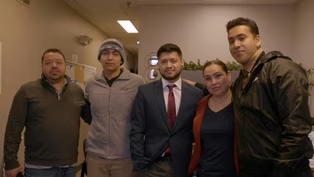
The Flatland team looks at industries that depend on immigrant labor despite barriers.
Many jobs in our area are performed by folks who have immigrated to the US, but the complexities of our immigration system can make this labor easy to exploit. This month, the Flatland team looks at industries that survive on immigrant labor and what systemic barriers affect these workers.
Problems playing video? | Closed Captioning Feedback
Problems playing video? | Closed Captioning Feedback
Flatland in Focus is a local public television program presented by Kansas City PBS
Local Support Provided by AARP Kansas City and the Health Forward Foundation
Immigrant Labor
Season 2 Episode 7 | 26m 46sVideo has Closed Captions
Many jobs in our area are performed by folks who have immigrated to the US, but the complexities of our immigration system can make this labor easy to exploit. This month, the Flatland team looks at industries that survive on immigrant labor and what systemic barriers affect these workers.
Problems playing video? | Closed Captioning Feedback
How to Watch Flatland in Focus
Flatland in Focus is available to stream on pbs.org and the free PBS App, available on iPhone, Apple TV, Android TV, Android smartphones, Amazon Fire TV, Amazon Fire Tablet, Roku, Samsung Smart TV, and Vizio.

More to Explore
Meet host D. Rashaan Gilmore and read stories related to the topics featured each month on Flatland in Focus.Providing Support for PBS.org
Learn Moreabout PBS online sponsorship- [Speaker] Flatland in Focus is brought to you in part through the generous support of AARP, the Health Forward Foundation and RSM.
- Hi, I'm D. Rashaan Gilmore and welcome to our renamed program Flatland in Focus.
And while this show may have a new title we're still digging into issues affecting folks in our region.
And for this episode, we'll be looking at the increasingly important role that immigrant workers play in our local economy.
(upbeat music) According to recent findings from the Kansas City Federal Reserve the key to economic stability locally and nationally is immigrant labor.
But even industries that need more workers struggle to find them due to the complications in their applicants legal status.
Let's take a look at how we got here and what obstacles stand between immigrant workers and fair employment.
(soft music) - People don't like to move.
It's never been that common.
What pushed them out were natural disasters, political uncertainty, war, famine.
People's livelihoods are just wiped away.
So once again, they're pushed and then they're pulled to the United States.
When you start to restrict immigration we've seen with Japan they're having problems now with labor shortages.
And there are a number of countries in Europe too that are having the same problems where you have an aging demographics.
Here in this United States you have the baby boomers that are all retiring.
And that was something that you have to, you know, look at when you're looking at immigration.
(gentle music) Economists will tell you that immigrants add more economic development to your economy that they take in resources.
And businesses who deal in, you know, certain high service area are saying, we need these workers.
- We're in a spot right now where we probably are several years away from being able to have enough healthcare, no personnel to do the things that we need to do.
My hospital and other hospitals are trying to recruit people from other countries to come in to decrease that gap.
(speaking in foreign language) - We do have a lot of people that come and apply but we can't hire them because of their legal status.
We can't really hire maybe 80% of the people that come here.
We know that if we are able to hire them, we would have in phenomenal employees.
- 90% of the people that come to apply here at the company are women.
I kind of see my mother in them cause my mother is also a cleaner.
It's hard to see the disappointment in their eyes when you have to turn them away.
- I was illegal for a long time until I was able to understand how I can work the process to become a resident.
And I did, you know, but it was a long process.
It's an expensive process and like I said there's a lot of barriers.
It's not as easy as people think.
Immigration fees, depending on what type of case you have could go from $500 to a $1000, $700, $2,000.
That's just on the immigration fee.
Lawyer fees could go anywhere from $5,000 to $10,000 that depends on the case.
There is jobs out there that will pay cash and I think a lot of immigrants go that route, you know, but it's not fair to them because they're not getting paid properly.
They don't offer benefits, insurance, things like that.
(speaking in foreign language) - We all know what would help is legalizing everyone that is here illegal to be able to work.
I mean that's what would help all of us.
(speaking in foreign language) - And welcome back into the studio for the discussion portion of today's program.
And I'd like to welcome to the table Chris Keel, economist and managing director of Armada Corporate Intelligence.
Aracely Salinas, sales manager at KCK Maintenance Solutions.
Danielle Atcheson, business immigration attorney with Mdivani Corporate Immigration Law Firm and Marvin Munge with the International Union of Brick Layers and Allied Craftsmen.
And I just kind of wanna jump into this conversation with you Chris, because it seems like when people hear the words immigrant or immigration our minds immediately flood with all the things we think we know about the issue.
We think about the visuals we've seen of the southern border, and of course the president just took his first trip down there during his administration.
But it's a much broader issue than that, right?
I mean, when we talk about labor shortages we need immigrants but can you set the table for us what it is that people should know about this issue that they don't know?
- Well, putting in the context of the worker shortage we have to realize that by 2030, every single baby boomer will have reached retirement age.
That 74 million people out of a population of 330 million people, do the math.
We're losing our workforce.
We've got to come from someplace else.
- And so, are there specific industries Aracely that we're seeing where the need is greater than others?
Food service, for example, hospitality is what immediately comes to mind.
But we're talking about people in tech, we're talking about people in healthcare.
What if, from your experience are you seeing?
- 80% of the people that come to our office looking for work we turn them down because they are not legal so we can't really give them jobs.
So it's a big percentage.
And then we're looking for people that want to, you know, do the janitorial part of it.
And we're having problems with that.
- And so are you seeing that right now with the union that you've got.
We still have these great opportunities that are open and unfilled.
How are you going about meeting that need?
- Actually, what we have done is that we have created that incentive, which is, you know, $2,000 for any individual that is joining the union as opposed to paying a fee, which used to be the case in the past, you know, where they had to pay certain amount of money to become a member.
- If I'm an employer and I'm running a, maybe a smaller medium sized business or even a very big business and I've got to find workers but maybe the people that I'm finding are not documented but I want to help them, what does that process look like?
What are the options?
- I think we start by recognizing that you're not helping anyone.
That it's a business need that you're filling.
I think that's number one.
And once the employers get on board with that understanding that it's not assistance but rather moving the business forward with the key position filled, then we can start talking about how the process goes along.
And the reason for that is it's all business driven.
When Congress built the laws, the Immigration Nationality Act was created a business immigration employment, you know, matters were created to support businesses and not displace American workers.
And I think it's important that they understand they're in the driver's seat making decisions, paying the fees, making sure they're in compliance with Department of Labor and Immigration Regulations.
And so once that's out of, you know, decided then we can identify what in the law applies and there's different visas available.
They're called non-immigrant visas.
There's the H-1B that's widely used and that is used for specialty occupations, positions requiring at least a bachelor's degree.
There's not enough of them available.
Every year there's only 85,000 new H-1Bs available.
We do a lottery, there's half a million registered.
So it's- - And that's every year?
- That's well the last few years have been half a million.
It's steadily climbed.
So I've been doing this for 10 years almost and it was around 250,000 when I started.
And it's ballooned and we don't have enough.
- I would imagine that cliff for Chris for a number of businesses like this is impossible.
They can't do this over and over and over again for so many employees.
So how are we going to meet the demand for labor if we can't get people legally through the process?
- One of the things that's developed in the last couple of years is aggressive reshoring.
We've been seeing the supply chain breakdowns.
We know that we're not gonna be getting the kind of supply we used to from Asia, which is a good thing.
It's brought a lot of businesses back to the United States, manufacturing, construction.
The rub is they don't have people.
So they come back from wherever they used to produce to the United States.
The reshoring is taking place, it's a great opportunity.
They don't have the workers.
And when you turn to the unions they're doing what they can to try to train and bring people into the system.
Trade schools, community colleges, we don't have enough of them.
And the pipeline just isn't there.
One of the things that has been evolving over time only 5% of high schools in the United States still have industrial arts.
We really have to take advantage of every opportunity we can to bring the necessary workforce to the United States.
Reshoring is a good thing.
It's great to see this come back but not if you can't run the business.
- I imagine on the other side of that Aracely that staring into the eyes of somebody who's made it through unmentionable horrors in many cases Steven get here that they are hopeful to get a slice of the American dream, right?
But you have to look them in the face sometimes and say what to them when you can't hire them.
- Most of the time we just tell them the process.
You know, we in order for us to hire you have to be documented and it's hard.
It's really hard for us on our end because we do turn people down.
I mean, we do turn people that I know that would do an amazing job that are willing to work and we can't help them.
- Workers do get exploited quite a lot because of their immigrant status.
Can you talk about what you've seen?
What you've experienced?
- In my 10 year as a business immigration attorney I have never seen that.
It is, I will pay triple.
I need people.
My entire third line is shut down.
- So not, so not exploitation, but doubling and tripling of incentives.
- I don't have the people.
Yeah and I'm sure it happens.
I can't stand here or sit here and say that that's not happening.
That is not what we experience.
The phone calls we have are, I just bought this car wash, I just found out that the main, the lead person is undocumented.
I, you know, doing due diligence, can't have them on.
What am I gonna do with this business?
It is not about underpaying and my experience with all the phone calls we get, it's about how can pay be the way I can get them on.
And our laws are limited.
So I mentioned the H-1B.
We have a medley of work visas, but none of them fit the carwash lead individual, janitor, brick layer, even though brick layer could be seasonal.
My boyfriend's actually a brick layer.
He works for himself and it can be seasonal.
He can work year round here in Missouri though so it doesn't fit in our H-2B work visa opportunity.
So they're very narrow what's out there available and they're capped.
Those are capped as well.
We just don't have the visas for them.
So they would pay the money.
They would go through all the processes, but there's no way.
- I'm just interested to know if anybody else in the panel feels like that exploitation.
Have you heard of those stories or is it something that's not really a thing that happens?
- I mean, it is.
I will say I've worked with companies in the past, you know, I won't say names, but I've worked with companies in the past where the people that were working with us were getting paid cash and they were doing very hard work and getting maybe $9, $10 an hour.
- Wow.
- No insurance, no benefits.
They're, you know, there is a lot of, there's people that need work and there is companies out there that will you know, let's pay you cash and whatnot, but they don't get paid what you're supposed to get paid with what people with documents do get paid or they don't get any benefits, any insurance, any days off PTO things like that.
- And I see it from an economic perspective the area that gets hit hardest is agricultural work.
- Yes.
- Because this is very seasonal by definition.
It's isolated people in rural areas and you will run into more of that kind of higher people off the streets or wherever you find them and not pay them very well.
It's very rare in more settled sectors like manufacturing.
Even construction is a lot less exploitative than it used to be.
The biggest threat now for sort of the future worker is that companies that can't find people are turning increasingly to automation, robotics, technology.
And they can't find human beings.
So they're simply replacing them.
It's even hitting the service sector now.
And you're running into more and more service.
I mean, I had my first encounter with a service robot at a restaurant.
- How was that for you?
I should ask.
- It was great.
The robot came rolling up she had little apron that said Marge.
And she wanted to know if I was happy with the temperature of my coffee and if I was, I was supposed to hit a green.
That was the best service I'd gotten in months.
So, but that's a job that would have been available to someone who is a starting employee can't find them.
And so a company invests an incredible amount of money in having a robot do that work.
- Well, I wanna talk about the broader economic implications of some of this.
And I really am interested to know how we see policy change to meet the economic needs.
And I do wanna come back to that.
But first I have to take what you were just sharing about the robot and say it wouldn't work for you in your industry and the work that you do, Marvin.
So what is at risk?
Cause you're not gonna have robots laying bricks or are we?
- Well, we are already.
As a matter of fact, we had the what's called a mule, basically a block layer.
And we have sand, which is basically a brick layer.
Okay but still not to the point where it becomes a big threat to our industry.
But on the other hand, we're trying to be proactive in trying to embrace it.
So if there's gonna be a robot doing this we definitely want a bricker to be the one operating it.
So that's how we handling that aspect.
- So it's still a higher level of skill and human involvement that's necessary.
- Yes.
- But it also accelerates the need because now you're not hiring somebody just to do this now they have to have familiarity with the machine.
It's welders.
- Software that supports it, yeah.
- I mean, a good welder could put down a good bead and they've got a good job.
Now you better be able to do a good bead and a program, a robot welding arm.
- So what is it that we need to see change from a policy and legal perspective to really make sure that we have the labor force that we need?
- Training and education and to start spending a lot more energy with the unions.
Not looking at them as adversarial, but to saying look we're partners.
In Britain, for example, the unions basically is where all the training takes place.
And companies don't have a resentment towards the unions because they can go to the union and say, I need five guys Monday.
And the union says they'll be there.
We've trained.
- That's very different from what I think we could all probably agree.
Most people very experiencing.
- Very different.
- So if that's the economic shift that has to occur.
What from a legal and legislative perspective I mean Danielle you're dealing with the country's seemingly arcane laws around immigration now.
What is it that Congress and the White House are missing?
- They are it's in front of them often.
Lots of proposed legislation that takes that goes nowhere.
It dies in committee.
Often what has to happen is a lift on the caps that we have maybe a creation of new visas capturing the industries that aren't even factored in in our current laws.
Additionally, I think that education in Congress may be where we start to get that.
- Well good luck with that.
- I understand.
I think though that sitting down and knowing that this is a United States effort and not a political move game making but that it's affecting our economy.
And one of the things, so robots are one of the answers to the shortage of worker.
The other answers that we're seeing are, I don't know our neighbors to the North who welcome immigrants open arms you can get a work visa in a couple of months.
It's very seamless and it works.
And why are we not looking to that to guide what we have going on here?
A lot of our clients are saying, well, if I didn't get in the cap, how do I retain this worker?
And Canada's saying, bring them up here.
You can employ them.
So you're saying, you know, reshoring, you know, business but we're offshoring workers.
So it's this weird tug that is not, I don't think it's front and center in Congress the way it should be.
I think it's scary.
- Yeah, we people call that nearshoring.
It's like it's not coming back to the US but it's close.
And, but that's one of the reasons that if you look at manufacturing data just that alone.
We've seen a bit of decline when it comes to the manufacturing activity.
Mexico's growing and Canada is growing and it's growing because they've taken that step to say, okay you're now close to your market in the United States but you can operate from here.
And it's a much more welcoming environment as far as the workers concerned.
- What is the message that we need to be delivering to our elected representatives because they're not getting it, apparently?
- We need to explain chronology and we need to explain that age is progressive and if somebody was 64 last year, they're not gonna be- - Right, they're not gonna be 63 next year, right.
- So we can't go in reverse.
You know, boomers have tried, but it's that's something we should have been preparing for 20, 30 years ago.
We knew when people were gonna reach retirement age the moment they were born.
- So we just have not prepared as a country.
- We have not understood the nature of the problem.
We don't understand the competitive environment that we now live in as far as the workforce is concerned.
If you look globally, we have one of the older populations in the world, not as old as Japan, not as old as Europe beginning there.
The youngest populations in the world right now it's Africa.
50% of the population of Africa is under the age of 30 and largely educated.
And now the issue for a lot of those countries is now that we've educated people, how do we get them jobs?
And so one of the things that's gonna be happening not that far down the road, is a lot of immigration pressure from Africa from people that have the skills, have the training, have been to school and are now prepared.
Can't find a job in Ethiopia or Botswana or Tanzania or Mozambique.
I'll come here.
- We're doing it now, by the way.
- Yeah we are doing it now.
- We're pulling.
We are way short on nurses after the pandemic.
It's been a nightmare for nurses in general.
And hospitals are coming to us saying, what do we do?
- Well, we just saw that in New York.
I mean, you have one of the largest hospitals in the entire city that, you know, the nurses went on a strike and their main complaint was, we need more nurses and so it seems like, we're on a bit of a collision course as a country.
If we don't make something happen very soon and the cost to the economy are going to be staggering.
What happens if we don't make something happen sooner rather than later?
- I don't see, you know, at this stage at the climate of our clients, the US employers are we will create a big budget.
We will work hard to fill the jobs here.
I see them continuing.
But if push comes to shove, especially in the tech sector we have 5,000 open jobs in Kansas City alone in technology.
And they're having to pull from all the other places.
There's a huge salary fight basically among those who are qualified cause we don't have enough people.
They will continue to push, but at some point they're not gonna be able to afford it.
It turns upside down.
So what we are encouraging employers to do is speak to their Congress persons.
I can stomp my feet all day.
- Sure.
- Because I'm experiencing it all day.
But we are asking them, can we go with you to the office?
Can we sit down with you?
Let's go to DC and meet with everybody who you know represents you in the state of Kansas.
So hopefully that does something.
- Yeah, Kansas City has a 2.3% unemployment rate.
It's among the lowest in the country.
There are very few states that have a lower rate and that means that you have a chronic shortage of workers.
The economic implication is that when that becomes the norm wages go up and they go up steadily.
Right now the wage increases are averaging around 5.5% to 6% per year.
A year ago that was not keeping up with inflation.
Today, the inflation rate that was released yesterday, - Yeah, that's 6.5.
- The wage increases are 6.5, inflation to 6.5.
What's driving inflation now is wages.
- Well, it's certainly a very complex issue and one that I hope that everybody can see.
We're all impacted by it.
It's not those people over there or somebody.
We're all, whether you're getting a cup of coffee or need the bricks laid for your new building.
We are all impacted by it.
And for better or for worse, we're in this together.
And I hope that as a country we can figure out how to get our act together so we can move forward.
And this is where we wrap today's conversation.
For this episode of Flatland and Focus, I wanna say thank you to our guests Chris Keel from Armada Corporate Intelligence, Aracely Salinas from KCK Maintenance Solutions, Danielle Atcheson with the Mdivani Corporate Immigration Law Firm, Marvin Munge with the International Union of Bricklayers and Allied Craftsman.
Confined additional reporting on immigration and labor issues in Kansas city at flatlandkc.org.
And please also join us on Instagram at Flatland KC for our flatland follow-up.
An open discussion where we invite anyone to come and talk more about this issue.
This has been Flatland in Focus.
I'm D. Rashaan Gilmore.
And as always, thank you for the pleasure of your time.
- [Speaker] Flatland in Focus is brought to you in part through the generous support of AARP, the Health Forward Foundation and RSM.
Preview: S2 Ep7 | 30s | The Flatland team looks at industries that depend on immigrant labor despite barriers. (30s)
Providing Support for PBS.org
Learn Moreabout PBS online sponsorship
- News and Public Affairs

Top journalists deliver compelling original analysis of the hour's headlines.

- News and Public Affairs

FRONTLINE is investigative journalism that questions, explains and changes our world.












Support for PBS provided by:
Flatland in Focus is a local public television program presented by Kansas City PBS
Local Support Provided by AARP Kansas City and the Health Forward Foundation