VPM News Focal Point
Immigration | March 30, 2023
Season 2 Episode 6 | 26m 46sVideo has Closed Captions
Revisiting Afghan refugees in Virginia; ICE detention centers; A refugee rebuilds her home
Revisiting Afghan refugees who arrived in Virginia a year and a half ago; A look at ICE detention centers in Virginia; A Cambodian refugee in Richmond builds schools and helps feed children in her childhood hometown.
Problems playing video? | Closed Captioning Feedback
Problems playing video? | Closed Captioning Feedback
VPM News Focal Point is a local public television program presented by VPM
The Estate of Mrs. Ann Lee Saunders Brown
VPM News Focal Point
Immigration | March 30, 2023
Season 2 Episode 6 | 26m 46sVideo has Closed Captions
Revisiting Afghan refugees who arrived in Virginia a year and a half ago; A look at ICE detention centers in Virginia; A Cambodian refugee in Richmond builds schools and helps feed children in her childhood hometown.
Problems playing video? | Closed Captioning Feedback
How to Watch VPM News Focal Point
VPM News Focal Point is available to stream on pbs.org and the free PBS App, available on iPhone, Apple TV, Android TV, Android smartphones, Amazon Fire TV, Amazon Fire Tablet, Roku, Samsung Smart TV, and Vizio.
Providing Support for PBS.org
Learn Moreabout PBS online sponsorshipANGIE MILES: America opened its arms to thousands of Afghan refugees when Kabul fell.
Last year, we introduced you to some of those adjusting to life in Virginia.
We'll hear from them again in this program.
Virginia has two immigrant detention centers.
Are they needed?
What are the benefits and what is the cost?
And after a horrific journey to our shores, a Cambodian immigrant makes a way for others.
You're watching VPM News Focal Point.
Production funding for VPM News Focal Point is provided by The estate of Mrs. Ann Lee Saunders Brown.
And by... ♪ ♪ ANGIE MILES: Thanks for joining us for VPM News Focal Point.
I'm Angie Miles.
We're focusing on immigration.
More than a million people migrate to America each year.
Some seek a better life.
Many are fleeing war, famine, or persecution.
This episode explores what America is doing, or isn't, to address the needs of immigrants and we hear the stories and concerns of those who've become our neighbors.
Nearly 4,000 children were separated from their families at the border with Mexico during the Trump administration.
This zero-tolerance policy has ended, but nearly 1,000 children remain apart from loved ones.
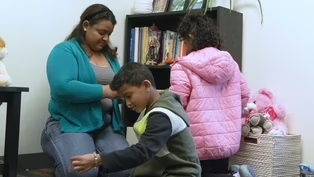
Immigrant and refugee families do separate for a variety of reasons, and there is a Virginia organization that helps them reunite.
VPM News Multimedia Journalist, Keyris Manzanares, tells us more.
KEYRIS MANZANARES: Tatiana Bardales came to the US from Honduras in 2016, leaving behind her two youngest children, Maria and Alex.
(Tatiana speaking Spanish) KERYIS MANZANARES: In 2021, Bardales sent for her children after Maria had an epileptic episode.
When the children arrived at the US border, Bardales says they were detained by US Immigration and Customs Enforcement and taken to a foster home in New York.
(Tatiana speaking Spanish) KEYRIS MANZANARES: The Catholic Charities of the Diocese of Arlington helps immigrants and refugee families with reunification.
JESSICA ESTRADA: We work primarily with unaccompanied minors who have crossed the border and have been detained in ORR shelters and then are released to family members.
KEYRIS MANZANRES: Jessica Estrada, director of Newcomer Services says family reunification can be challenging.
JESSICA ESTRADA: Some of these young people have been separated from their families for a very long time, and so there's a process of getting to know each other again, getting to know the environment in which they're coming to.
KEYRIS MANZANRES: Bardales says without the support of Catholic Charities, it's hard to say if she would be with her children today.
ANGIE MILES: Catholic Charities has more than 100 children in its current caseload.
On average, the charity assists more than 300 children each year through its reunification program.
ANGIE MILES: It's been more than 20 years with very little change in American immigration law, a source of frustration for citizens and immigrants alike.
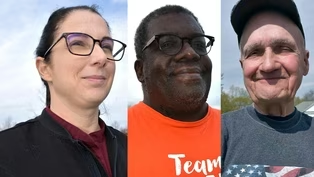
We asked people of Virginia what should happen when those who come to America overstay their visas or arrive illegally and whether our laws adequately address these situations.
LETICIA PEREZ: I still think they should be allowed, especially if their country's in turmoil, just 'cause of what they're experiencing.
It's not safe, especially if you have kids.
I think you should still be allowed to come.
There should be rules, steps, regulations, in order to ensure that they have proper access to resources they need.
Not only to live here, but to also become a citizen.
BOB ENGLISH: Its the United States.
We have a system, if you follow the system, Im fine with it.
Otherwise they shouldnt be here.
JULIAN WILSON: In order to become a citizen it's a lot of work, and it is not cheap.
So when people overstay their, so-called overstay their visit, I think there should be a process in which they can almost renew themselves, and give them the proper tools to become citizens.
TED SWEDALLA: As far as entering illegally, I don't think it should be.
But unfortunately, Congress, in their wisdom, hasn't done anything in the last 30 years to do anything to correct this immigration issue.
All they do is throw bricks at each other, Democrats and Republicans, and not try to come up with solutions.
They just look for the boogeyman.
I think its totally wrong.
ANGIE MILES: Support for immigration has increased in recent years with slightly more than 50% of Americans calling the ability to move wherever you wish a basic human right.
Pew Research shows more than 70% of Americans have favored extending safe haven for Afghan refugees.
Many who fled when the Taliban took control in 2021, left out of necessity, their safety compromised by their ties to the US government.
A year ago, we introduced you to some of those refugees.
We followed up with them and found that while they are safe, they are not completely out of danger.
(gunshots banging) 'KHAN': It was like a doomsday.
Everyone was telling one another that the government was collapsing, the Taliban entered the Kabul city.
And I was just thinking that I would be no longer a resilient, brave Afghan.
I would be a helpless refugee looking and searching for food, shelter, and identity.
This is what happened to Afghans for the past 40 years.
ANGIE MILES: When we met 'Khan' and 'Khabir' in 2022, the Afghan men were new to America.
Both were still incredibly devastated from the sudden departure from their country just months before.
'KHABIR': Leaving Afghanistan is very hard.
Whenever I hear the name of my country in the media, it make me to cry.
The day I remember I was leaving my country the hardest day in my life.
ANGIE MILES: Both men used assumed names and concealed their identity in our Focal Point story, concerned for the safety of loved ones left behind.
Now they're resettled with homes and work and school.
'KHAN': We were in a temporary house that was rented by our immigration agency, Commonwealth Catholic Charity.
And then in the spring we were moved to a new house, a better house in the Chesterfield County.
I have my own transport.
I didn't have my own car at that time.
We are used to the area.
I'm no longer using GPS (laughs) for some areas.
ANGIE MILES: He says he also enjoys American French fries and is pleased that he's working in his field of engineering which he was not able to do in his homeland.
(men praying in foreign language) ANGIE MILES: Both have some family and friends here with them and both are in touch with loved ones still in Afghanistan.
'Khabir' is now comfortable enough to speak openly using his real name.
AJMAL HAMZA: I got a job that was a nonprofit organization and I was helping refugees.
I was enjoying it and I worked with that office for a year and then, due to my studies, quit that job and resigned it.
So I'm self-employed now and I'm studying IT.
Many thing changed and I'm happy with that.
ANGIE MILES: But a source of constant worry is America's inaction on their legal status.
More than 70,000 Afghan evacuees were granted only temporary parole in the United States.
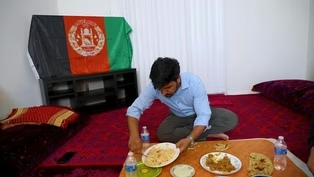
'KHAN': Our parole, which was only for two years, that expires in August for most of the people and the government, the Congress have not acted so far and if they don't act within these coming few months most of the people will lose that status and then facing court proceeding or deportation.
So that's a big problem right now.
ANGIE MILES: Ajmal points out that the whole reason refugees fled Afghanistan and left behind the country they love is because their friendships, alliances, or support of the United States put their safety in jeopardy when Kabul fell.
A number of US veterans have become ardent advocates, saying the mission is not complete until America does right by those who risked and sacrificed for the US.
CHRIS COONS: We are convinced the Afghan Adjustment Act furthers the national security of the United States and it is a moral imperative.
ANGIE MILES: But the Afghan Adjustment Act, a bipartisan proposal initiated in 2021, expired without approval in 2022.
Without an act of Congress, tens of thousands of Afghans may find themselves here illegally or may even be deported, which for some could be a death sentence.
AJMAL HAMZA: We appreciate people.
We appreciate the United States government that they gave us safe haven or maybe like a good life.
We really appreciate that, but we still need to be very legal in this country and we want to be legal.
ANGIE MILES: Last year we also interviewed Afghan refugees receiving support from the Adams Center in Northern Virginia.
When we followed up, they reported that all are doing well, that the adults each have jobs and vehicles of their own and that the young man is in school and doing well in his studies.
We're told that no additional family members have been able to join them here in the States and that they miss and worry about those still in Afghanistan.
ANGIE MILES: VPM News Focal Point is interested in the points of view of Virginians.
To hear more from your Virginia neighbors, and to share your own thoughts and story ideas, find us online at vpm.org/focalpoint.
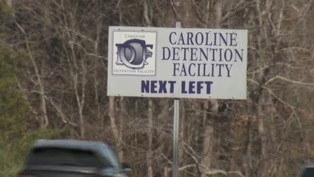
ANGIE MILES: Virginia is home to two US Immigration and Customs Enforcement Detention Centers.
These ICE facilities are located in Farmville in Caroline County.
Over the years, advocates and impacted families have openly called for the closure of these centers.
At one point during the pandemic, Farmville Center made national headlines as nearly 90% of detainees had COVID-19.
Allegations of medical neglect, racism, abuse, and more have been leveled at both centers.
VPM News Multimedia Journalist, Keyris Manzaneras, sent out to explore how these detention facilities impact families and Virginia communities.
KEYRIS MANZANARES: In 2008, the town of Farmville signed an intergovernmental service agreement known as an IGSA with US Immigration and Customs Enforcement amidst protests.
(crowd chanting indistinctly) KEYRIS MANZANARES: This resulted in the opening of what is now known as the Mid Atlantic's hub for ICE detention.
LUIS OYOLA: When I first learned about Farmville, it sort of seemed obvious to me why people should be pissed off about it.
It's jail for people who should have the right to move wherever they decide.
KEYRIS MANZANARES: Luis Oyola was only 17 when ICA Farmville opened.
Today, he's the director of organizing at Legal Aid Justice Center in Charlottesville where he is working to see the detention center close.
LUIS OYOLA: I think the best future for them is to close down and for the federal government to put money towards community programs that actually help people through their immigration cases.
KEYRIS MANZANARES: IGSAs allow the federal government to pay localities a per diem rate for holding immigrants in detention.
These localities can then contract detention services to a private company.
That's the case of ICA Farmville.
The facility is owned and operated by for-profit provider Immigration Centers of America.
According to ICE, as of March 1st there were 11 people detained at ICA Farmville.
The Center's capacity is 732.
Documents obtained by the National Immigrant Justice Center show on average, Farmville bills ICE over $2 million a month.
After paying its private contractor to run the facility the town pockets its percentage.
In 2021 that was $200,000 according to their budget.
Farmville has come to rely on that income to help pay for essential town services.
BRIAN VINCENT: They're treated like any other business, right?
They pay their way.
And so you, that money then gets poured into the core services that we give to our town residents.
KEYRIS MANZANARES: Farmville Mayor Brian Vincent was elected in 2022.
He says, while campaigning for mayor not one of his constituents brought up concerns regarding the town's agreement with ICE and ICA.
BRIAN VINCENT: As of this timeframe, there has not been an appetite or a movement to separate from that agreement.
But there's always that chance that that happens.
But the other side of that is this is rural Virginia and that facility supplies federal wage jobs in a locality that needs jobs.
KEYRIS MANZANARES: In 2018, this man who we are calling ‘Jose to protect his identity, was picked up by ICE and taken to ICA Farmville after serving a sentence for a misdemeanor traffic violation.
(Jose speaking foreign languag BRIAN VINCENT: People who are immigrants, when they are convicted they served their sentences and then ICE is able to get them and put them in a detention center.
So to people who say it is necessary, why is it necessary to people who just so happen to not be citizens but not necessary for people who just so happen to be citizens?
It's arbitrary double standard.
KEYRIS MANZANARES: ‘Jose says his time at ICA Farmville caused him so much stress and trauma there were times he wished to be deported although he had fled El Salvador because of threats to his safety.
(Jose speaks Spanish) KEYRIS MANZANARES: In the United States immigration detention is civil detention and is not intended to be punishment for criminal convictions.
Yet the people detained are in facilities that mirror the country's criminal incarceration system.
BRIAN VINCENT: The Immigrant Naturalization Act empowers the federal government to determine that someone in immigration proceedings either awaiting for their court case to be heard or they've lost their case and they are awaiting deportation that they can be held in detention.
KEYRIS MANZANARES: ICE Enforcement and Removal Operations field office director Russell Hott says, generally speaking the purpose of detention is to facilitate repatriation and or removal proceedings.
RUSSELL HOTT: I think often, right, especially when we started to see some of the abolish ICE movement, there was definitely a lot of misgivings on the agency's focus overall, you know ultimately, you know, we continue to prioritize our efforts on those individuals that pose the greatest threat to undermine the immigration laws of the US.
KEYRIS MANZANARES: But traffic violations like ‘Jose's can often trigger the possibility of deportation and result in what justice advocates call the “traffic stop to deportation pipeline.
” RUSSELL HOTT: Here within the Commonwealth, we have a program we refer to as the criminal apprehension program, and its focus is based on individuals who have already been arrested for other state and local charges.
Right?
We'll interview those individuals, determine whether or not they are subject to removability.
KEYRIS MANZANARES: Hott says two detention centers in Virginia are a requisite to the level of activity they are seeing overall.
Caroline Detention facility used to be a jail located in Bowling Green.
Caroline County and ICE entered into that five year agreement in 2018.
As detailed in the county's detention fund they are reimbursed $7 per detainee at a minimum rate of 224 people per day, per month.
That's more than half a million dollars a year going into the county's budget.
Opponents of the Caroline Detention Facility have leveled charges of detainee abuse.
In 2021, immigrant advocate groups filed a civil rights complaint with the Department of Homeland Security on behalf of people detained at Caroline Detention outlining medical neglect, solitary confinement and COVID 19 negligence.
The Office of Civil Rights and Civil Liberties within the Department of Homeland Security acknowledged the complaints and allegations made against the facility.
At last report, they intended to investigate.
LUIS OYOLA: The federal government, you know at the end of the day determines immigration law.
But as Virginians, we can decide that we don't want to be part of the detention arm of that anymore and say, you know, the federal government cannot host detention centers in Virginia anymore or hold contracts with local jails for holding immigrants.
KEYRIS MANZANARES: ‘Jose fought deportation for five years and has finally been granted asylum.
However, he says that because of the two months he spent in ICE detention worried he might never see his wife and children again he is being treated for post-traumatic stress disorder.
ANGIE MILES: After repeated attempts, we were unable to arrange for Carolines Board of Supervisors chairperson, or ICA Farmvilles CEO to appear in our story.
We've also requested the following information from ICE, up-to-date bed rates for each facility and the number of people detained, deported, and or removed since the Centers opened in Virginia.
They've not yet responded.
ICA Farmville and Caroline County's contracts with ICE are up for renewal this year.
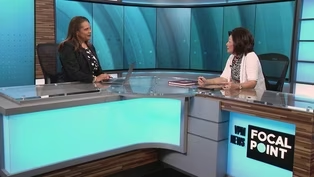
ANGIE MILES: More than 42% of immigrants come to Virginia from Asia, and Asian Americans represent the largest group of immigrants in the state.
Joining us is Julie Laghi, chair of the Asian American Society of Central Virginia.
So tell us a little bit about your organization.
What is the purpose?
JULIE LAGHI: Our purpose is to create awareness, unity, harmony amongst our community Asian members.
ANGIE MILES: How would you characterize the contributions of Asian immigrants to Virginia?
JULIE LAGHI: The Asian immigrants have businesses.
They are restaurants, laundromats, nail salons, usually all run by Asian immigrants.
I would say that they contribute in the sense culturally as well as economically.
ANGIE MILES: Your organization has taken a firm stance on the Afghan Adjustment Act, which of course did not succeed in Congress in 2022.
What is your position on the fate of Afghan parolees?
JULIE LAGHI: There are like, from what I know, 76, or 75 or 76,000 of them, Afghans, that are waiting in line to have their status change so to speak because what will happen to them is they will lose their Social Security benefits.
They will also lose their temporary working card.
So then that means that they would be unable to find a job because not having a permit to work.
ANGIE MILES: So what is your message then to Congress?
JULIE LAGHI: I would say that please pass this bill for the Resettlement Act for the Afghans so that they will be able to settle here legally.
They will be able to get jobs.
They will be able to support the community and basically to have a better life.
ANGIE MILES: You can watch the full interview on our website.
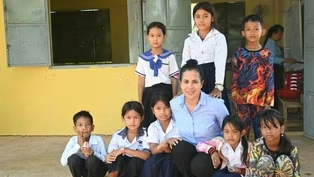
ANGIE MILES: Amanda Prak Sam was six years old when her family was forced to flee their home in Cambodia.
Two of her siblings died of starvation and 2 million people were killed.
Now the Virginian, who is a mother of two, provides hope to Cambodians by offering food, education, and inspiration.
VPM News Senior Producer, Roberta Oster, brings us the story.
MATTURA SAM: My mother was about to go to school for the first time, I believe, when the regime stepped in and the violence started.
AMANDA PRAK SAM: We start hearing a lot of loud sound like thunders.
We didn't know it was bombing.
So the civil war was going on.
The Khmer Rouge regime, they took over Cambodia.
My father was a school teacher, and they start killing the intellectual.
We were forced to leave our home all at once, giving us no time to even pack our belonging.
We change our identity completely.
We had to destroy all document, birth certificate, photos.
We travel on foot for days.
We ran out of food of course, and there's a lot of people die from either poisonous snake or eating poisonous mushrooms.
We eat all kind, anything that we can possibly find.
So we fled Cambodia through the Thai jungle.
We roamed the jungle for couple of months before refugee camp opened up in Thailand.
We moved from camp to camp for, I think, like three, four different camp before we come to America in 1981.
We came straight to Richmond and America is heaven, it's just heaven for us.
MATTURA SAM: I remember as a kid, my mother was always interested in going back to Cambodia and just determining that she wanted to start helping the place she grew up.
AMANDA PRAK SAM: People were so desperate.
So that's when I told myself, I got to do something.
MATTURA SAM: At first, it started out with feeding the people that needed it the most with literally bags of rice and it's been wonderful seeing that then sprout into a mission for education.
AMANDA PRAK SAM: My father sat down with me one time, say, "Darling, you're doing a wonderful job, but if you keep just giving fish to them, how they going to know how to learn to fish?
But if you give them education, it lasts a lifetime."
I'm pleased to build a school to where my father first taught before the war.
Leave a little legacy for him.
Good AMANDA PRAK SAM: We're just trying to find a solution, how we going to make this water look clear usable.
Even though it's dirty, it's better than not washing their hand after you're playing with the dirt.
(people chatter) (water splashes) We bought some shoes, uniform for those kids and it's 40% of them, they don't have the parent living with them.
Are you guys ready for soccer?
>>Yes, yes.
AMANDA PRAK SAM: Yes?
Raise your hand if you're ready.
Crowd Member: Woohoo!
AMANDA PRAK SAM: The biggest reward is to see some of these children break out that cycle of poverty.
I want to make a change as many life I can.
I was just there this past summer.
Now, we've just finished the second school building.
So right now, we have not just the nice school, but we have clean drinking water, indoor bathroom for the students.
The clean waters not just for the kid, the students, but the the villagers also.
MATTURA SAM: If anyone has an opportunity to help someone out, even if it seems like something small, even if it seems like it could be inconvenient to you, it doesn't even have to be anything as extreme as what my mother went through, but just to help them out and encourage them to go on their right path because a lot of the times, it is just a community supporting each other that will change the world.
AMANDA PRAK SAM: And what's your name?
(children say their names together) ANGIE MILES: Amanda's nonprofit called H.O.P.E., Helping Others Pursue Education, currently serves 430 Cambodian students and now they're building a second school.
We invite you to explore more on our website where you'll find additional information about our stories and can provide your feedback and ideas.
You can also watch our full interview with Julie Lahgi at vpm.org/focalpoint.
We look forward to seeing you again soon.
Production funding for VPM News Focal Point is provided by The estate of Mrs. Ann Lee Saunders Brown.
And by... ♪ ♪
Asians make up Virginia’s largest immigrant population
Video has Closed Captions
Clip: S2 Ep6 | 5m 59s | Asian immigrants helping Afghan refugees resettle in Virginia after escaping the Taliban. (5m 59s)
Catholic Charities helps reunify Virginia families
Video has Closed Captions
Clip: S2 Ep6 | 1m 38s | The Catholic Charities Diocese of Arlington is helping families reunite. (1m 38s)
Horror to hope: educating impoverished children in Cambodia
Video has Closed Captions
Clip: S2 Ep6 | 3m 34s | Amanda Sam escaped the Cambodian genocide and now builds schools in her former hometown (3m 34s)
The impact of Virginia’s two immigration detention centers
Video has Closed Captions
Clip: S2 Ep6 | 7m 47s | Virginia is home to detention centers located in Farmville and Caroline County. (7m 47s)
People of Virginia | Immigration
Video has Closed Captions
Clip: S2 Ep6 | 1m 19s | We asked people what should happen when those who overstay their visa or arrive illegally (1m 19s)
Will Congress extend protections for Afghans in America?
Video has Closed Captions
Clip: S2 Ep6 | 3m 59s | Only months remain on the temporary parole granted to refugees. (3m 59s)
Providing Support for PBS.org
Learn Moreabout PBS online sponsorship
- News and Public Affairs

Top journalists deliver compelling original analysis of the hour's headlines.

- News and Public Affairs

FRONTLINE is investigative journalism that questions, explains and changes our world.












Support for PBS provided by:
VPM News Focal Point is a local public television program presented by VPM
The Estate of Mrs. Ann Lee Saunders Brown