
Impact Of Bird Flu In Kentucky
Clip: Season 2 Episode 241 | 4m 18sVideo has Closed Captions
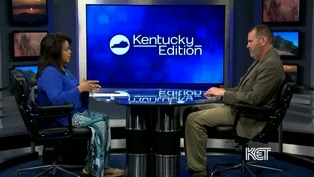
Commissioner Jonathan Shell talks about the impact a new outbreak of bird flu is having in KY.
Kentucky Commissioner of Agriculture Jonathan Shell talks about the impact a new outbreak of bird flu is having in Kentucky.
Problems playing video? | Closed Captioning Feedback
Problems playing video? | Closed Captioning Feedback
Kentucky Edition is a local public television program presented by KET
Impact Of Bird Flu In Kentucky
Clip: Season 2 Episode 241 | 4m 18sVideo has Closed Captions
Kentucky Commissioner of Agriculture Jonathan Shell talks about the impact a new outbreak of bird flu is having in Kentucky.
Problems playing video? | Closed Captioning Feedback
How to Watch Kentucky Edition
Kentucky Edition is available to stream on pbs.org and the free PBS App, available on iPhone, Apple TV, Android TV, Android smartphones, Amazon Fire TV, Amazon Fire Tablet, Roku, Samsung Smart TV, and Vizio.
Providing Support for PBS.org
Learn Moreabout PBS online sponsorshipA new outbreak of avian influenza, also called the bird flu, has infected commercial poultry facilities in the US since 2020.
On March 25th of this year, experts spotted the first case of it infecting dairy cattle in Texas.
We sat down with the Kentucky Department of Fish and Wildlife and the commissioner of AG, Jonathan Schell, to see how it's impacting Kentucky.
We had our first detection in February, and so we've been tracking this since then, and it has previously showed up in the United States, in North America.
Back in 2014 through 2016, there was a big outbreak and that predominantly affected domestic birds at that time.
It didn't really have this big impact in wildlife that we're seeing with the current outbreak where, you know, we're seeing mortality in wild mammals.
We've seen in wild birds as this strain came in and then it started to reassert with North American variants and actually made it a little less severe.
But there's also been some other spill over into I wouldn't say non-target but accidental host.
So like the wild mammal situation.
So we've had detections in raccoons and Kentucky and then we also just had our recent detection in a mink, which is the first in the United States back in March.
It was first detected in Texas dairy cattle.
And since then it's been in the news and we've been aware of the situation through our state vet's office.
So far it is only in dairy cattle, lactating dairy cattle.
And what the infection is, is a high path.
Aviation influenza, which I think it's H5N1, is the classification of it, the new stuff with cattle, I mean, that's a totally different system and they're not as confined.
And there's definitely a potential exposure to wild birds.
But once what they're seeing in the cows is the count of cow transmission and the movement of the cows has propagated this influenza outbreak.
It's basically it's making them have a little bit less milk production and dehydration a little bit.
But as of now, it's those are mild symptoms and it's affecting the production of the dairy cattle.
The FDA recommend communications that we've got now is that pasteurized milk is completely safe through this process.
It's not in any of the other types of cattle as of right now.
And so the restriction movements that the Federal Government has put down on having them being pre tested before movement across state lines and then here in Kentucky we've implemented a quarantine section to where that they can permit and say that, you know, just make notification that they're receiving cattle into the state of Kentucky from other affected areas in the nation.
Right now, we don't have any cases in Kentucky, in dairy cattle.
And we're we're trying our best to be monitoring that situation.
And with the permitting and the notification process for the state vets office, we should be able to keep a pretty close handle on it.
Now, USDA does some surveillance in Hunter harvested birds, so those are also dead birds.
So that's kind of like passive surveillance where they're harvesting these birds.
And then we would USDA would swab them.
And so we've gotten a few detections through.
That is a zoonotic disease.
And that's one of the reasons why High Path is on everyone's radar from a domestic poultry side or domestic animals to wildlife.
It also affects public health and human health.
The biggest thing we have to keep in mind is the virus can be in the environment, so it can be on your shoes.
That's honestly probably how a lot of the transmission happens on the domestic side is humans moving the virus around, practice effective and understood biosecurity measures on your farm.
It's just clean workstations in your barns that you're milking with.
It's washing in and out, making sure that you don't have any unnecessary composting laying around that animal removals, those kind of things.
Cleaning up in between washes.
The people that have contracted it have either worked in a poultry house that had an outbreak.
So you imagine that a lot of virus in a confined space.
And then the other one was actually a dairy operator.
We know that there was high viral loads in the milk and that's clearly not pasteurized at that point.
So they had a very high risk exposure there and they were able to get it.
And so, yes, it can infect humans, but the average person is at very low risk for this disease.
Currently, nine states have reported outbreaks in dairy cattle.
They are Colorado, Ohio, Idaho, New Mexico, Michigan, Texas, Kansas, South Dakota and North Carolina.

DEA Moves to Reclassify Marijuana
Video has Closed Captions
Clip: S2 Ep241 | 1m 56s | What impact might the DEA's proposal to reclassify marijuana have on those researching cannabis? (1m 56s)

Video has Closed Captions
Clip: S2 Ep241 | 3m 19s | Most women should get their first mammogram earlier, according to an expert panel. (3m 19s)

Video has Closed Captions
Clip: S2 Ep241 | 3m 35s | A pro-Palestine protest gets loud, but stays calm, at the University of Kentucky. (3m 35s)
UK Professor Discusses Current Conflict
Video has Closed Captions
Clip: S2 Ep241 | 6m 17s | Prof. Robert Farly talks about campus protests and helps us better understand the current conflict. (6m 17s)

Upgraded Paddock at Churchill Downs
Video has Closed Captions
Clip: S2 Ep241 | 3m 41s | Churchill Downs is showing off a two-year, $200 million dollar upgrade to its paddock. (3m 41s)
Providing Support for PBS.org
Learn Moreabout PBS online sponsorship
- News and Public Affairs

Top journalists deliver compelling original analysis of the hour's headlines.

- News and Public Affairs

FRONTLINE is investigative journalism that questions, explains and changes our world.












Support for PBS provided by:
Kentucky Edition is a local public television program presented by KET