
Impact of Major Corporations on Giving in Nevada
Clip: Season 6 Episode 9 | 16m 51sVideo has Closed Captions
The role major companies have on philanthropy efforts in Nevada& where the need is in 2023
The role major companies have on philanthropy efforts in Nevada, and where the need is in 2023.
Problems playing video? | Closed Captioning Feedback
Problems playing video? | Closed Captioning Feedback
Nevada Week is a local public television program presented by Vegas PBS
Impact of Major Corporations on Giving in Nevada
Clip: Season 6 Episode 9 | 16m 51sVideo has Closed Captions
The role major companies have on philanthropy efforts in Nevada, and where the need is in 2023.
Problems playing video? | Closed Captioning Feedback
How to Watch Nevada Week
Nevada Week is available to stream on pbs.org and the free PBS App, available on iPhone, Apple TV, Android TV, Android smartphones, Amazon Fire TV, Amazon Fire Tablet, Roku, Samsung Smart TV, and Vizio.
Providing Support for PBS.org
Learn Moreabout PBS online sponsorship-We move now to the soon-to-be-released Nevada Corporate Giving report.
Its authors say the latest data will show that in 2022, Nevada companies donated about $621 million, up 7.2% from the year before.
So what's behind that increase, and why should you care?
For that, we bring in Julie Murray, CEO and Principal of Moonridge Group; Brian Gordon, a Principal with Applied Analysis; and Sam Joffray, President and CEO of the Las Vegas Super Bowl Host Committee.
Everyone, welcome.
Thank you for joining Nevada Week.
I want to start with Julie.
Moonridge Group is a philanthropy consulting firm.
You worked with Applied Analysis to come up with this annual Nevada Corporate Giving report.
Why should people care about its findings?
(Julie Murray) Because in communities where corporate philanthropy is thriving and it's doing well, it's a better community to live, to work, to play.
Corporate philanthropy helps to fill the gaps in the community with needs, and it makes us a better group altogether.
If you look at Austin, Texas, or San Antonio, or many communities where philanthropy is thriving, you'll find those are great places to live.
-What do you think about this report, Brian?
Does it hold companies accountable here in Nevada?
(Brian Gordon) Yeah, I think it does to some extent.
We've been producing this report with Julie's help over the last 10 years, and we've seen pretty consistent growth in terms of overall giving.
It also has an opportunity to align what corporate philanthropists are looking for with what some nonprofits may be trying to attract in terms of funding and finding ways to align better.
So I think there's some, clearly some benefits to it, but also provide some accountability and benchmarks, if you will, for those donors to measure up against.
-And that increase in donations I talked about in the intro, what is behind that?
-There's a lot of increased interest, I think, in a number of organizations in this community.
I also think that the economy has been doing relatively well, when we think about where we've come out of the height of the COVID-19 pandemic.
We've moved sort of further away from that.
I think businesses are doing better.
And I think there's more awareness of needs in the community.
So I think all those factors start to dictate that there is increased investments taking place by corporations here in the state of Nevada.
And that's rippling through in terms of employee giving, as well as volunteer time throughout the community.
-Sam, you are the newcomer to this table, because you are part of the Las Vegas Super Bowl Host Committee.
I don't imagine you're going to be in this Nevada report, correct?
(Sam Joffray) This was for 2022, right?
-Yeah.
-So no.
-You'll be in the next one.
-We hopefully will have a very nice little impact for the next one.
-Tell me what kind of impact the Super Bowl has on a community.
-A lot of people talk about the direct economic impact, which is the dollars generated the week of the event from hotel rooms and visitor spending.
But then there's also really, a number you can't really even quantify, which is the median PR value of hosting the Super Bowl and how that will broadcast Las Vegas to the world, reinforcing our message as a popular destination, a favorite destination for major sporting events.
But then there's also the community impact of not just Super Bowl, but all the major sporting events that hopefully Vegas is going to be attracting over the next decade.
That is in philanthropy giving.
It's in investing in our local nonprofits.
It's creating youth programs and opportunities.
It's creating opportunities for small businesses to participate in this new part of the economy, which is sporting events.
So, yeah, we have an entire committee, subcommittee of the Host Committee that's dedicated toward making sure we maximize the community impact of Super Bowl.
-Have you decided where that money is going to go?
-It's going to hopefully get peppered across southern Nevada.
We'll have a micro grant program.
We'll have a major grant program.
We'll have a lot of sweat equity initiatives that we're doing, environmental programs.
So hopefully by February we'll be putting out our own report of all the impacts that Super Bowl had on the region.
-You brought up the direct economic impact.
What impact is the Super Bowl expected to have, while we have you here, Brian Gordon?
-It's massive.
I mean, the important thing to think about is Las Vegas generally is a pretty packed and busy community on any given Super Bowl Sunday.
I think when Sam brings the next Super Bowl here in February, it's going to be exponential.
The amount of activity that's going to take place as a result of that will be substantial.
This is well into the hundreds of millions, exceeding a half a billion dollars on a net basis in terms of incremental impact to the community.
So these are significant numbers.
And as he referred to, it's going to have a ripple effect throughout the economy.
-Julie, the different sporting events that are coming, are they reaching out to you to figure out where they should be benefiting the community?
-We're lucky to be able to have conversations with Sam and with the folks at Formula One, because they want to be impactful, and we all are better when we're communicating and when we're looking at the gaps and what's needed so that it's not duplicative.
So, yes, we feel honored and excited and lucky to be working with both.
-What are the gaps you're finding?
-Oh, my goodness.
There are so many gaps in the Nevada Corporate Giving report.
When you look at it, you see as a community during COVID, we gave a lot to the basic human needs-- to food insecurity, to housing and homelessness.
And now we're starting to see it shift a bit to where more funding is going to education, which is being released in the report.
To the arts.
During COVID, most of the arts giving in the community halted because, of course, people were suffering and people were struggling.
Now there's a lot of giving coming back to the arts and the other type of nonprofits that aren't basic human needs.
-When people watch this, they may be thinking, you know what?
These corporations are getting big tax breaks as a result of this philanthropy.
What would you say to that, Brian?
-I tend to-- I'm a CPA.
So when I tend to think about tax breaks or it's a deduction, the reality is you're making an investment in something.
The tax decisions shouldn't be always the driving factor behind those decisions.
There's a real community need here.
Julie has been great at leading the charge in a number of areas.
And so trying to fill those needs is important.
In our report, we'll talk a lot about those needs.
Education has been a key priority in this community and has been historically and will continue to be going forward.
We're making some great strides there from a funding standpoint, but there's great need there.
You have other areas like housing affordability that are atop the list from a survey of folks that participated in this year's report that we want to keep mindful of.
Health related issues, mental health issues that are atop the list as well.
There's a whole host of other things, homelessness and poverty.
So there's a lot of needs in the community.
We have a long way to go.
There's more needed to shore up some of those gaps and meet the needs of the community.
-So it may be a tax break, right, Julie, but it's going to fill significant needs in our community.
-And it's a win-win.
If we all had a corporation together and we were looking at: Should we just have a product or service, or should we have profit and purpose?
Should we have our product end?
Should we make sure we have a purpose that we're giving and engaging our employees?
Companies are so much better when they look at both profit and purpose.
It builds brand loyalty.
It helps to engage employees.
It's a great thing for so many reasons.
-Sam, I see you nodding.
Why?
-I love "profit and purpose."
I think that's a great-- that's a great way to approach it.
The Super Bowl, hopefully, is going to have a lot of the impacts we talked about earlier.
But we're looking at different ways, not only through Legacy Grant dollars to have a positive impact throughout the community.
-Tell me about the Legacy Grant Program.
-Sure.
We'll be working with the NFL Foundation to match local dollars, millions of dollars' worth of local contributions through an application process.
It will be soon revealed, but we want to spread that wealth out over like we were talking about earlier, either multiple micro grants, some larger grants, some programs that we hope to create and develop.
And really, there's the legacy of the impact, but also hopefully the legacy of the programming that we put in place that can last till either the next Super Bowl or the Final Four or like college football championship game.
Everything we're kind of doing right now we're designing around, how does this have a life beyond Super Bowl?
So whether it is a giving program or a fundraising mechanism or an operational plan or our volunteer program.
We've recruited 9,000 volunteers that are gonna be part of Super Bowl.
How do we keep that intact afterwards, or how do we keep intact the Business Connect program where we've assembled 200 local businesses to be part of the RFP process with Super Bowl?
How do we keep that in effect afterwards?
Legacy takes on a couple of different meanings to us when we kind of look at designing how the Super Bowl is gonna impact the region.
-So there's followup involved?
-Yes.
A lot of that is who are gonna be good stewards of the work that we do that we can hand off.
So we're looking at partnerships with different organizations, whether that's the Raiders Foundation or whether it's Moonridge or different-- United Way, we're partnering on a fundraising mechanism that will be sustainable for them moving forward after the Super Bowl.
Everything we do, we try to make sure it has a life beyond Super Bowl.
-Think about this one for a second, then I'm gonna ask Brian a question.
Think about an example you can think of, because you've worked on three Super Bowl Host Committees, I believe, prior to-- -Yes.
-Okay.
Of where there was an example of giving that stands out to you.
Unless you already have it top of mind.
-I got a few.
-Okay.
-I mean, you know, I think a lot about back in the days in 1997, Super Bowl 2002.
Super Bowl, there was an initiative and program in place with the NFL called the YET Center, Youth Education Town.
And all of the fundraising and community giving was always focused toward that center.
And then in the mid-aughts, they decided to kind of expand that.
So while we don't have a YET Center here, everything we do will go into the community.
But some examples that have happened in the past decade or so, or since the Super Bowl in New Orleans in 2013, we took the turf from the game and reinstalled it at a youth football facility.
So there's still a football facility in New Orleans that has the turf from the Super Bowl in 2013.
There are parks and playgrounds that still have, that were redone completely.
They still have the concrete stamps in them with Super Bowl logos as part of Legacy Projects there.
So there are brick and mortar things as well as other programs and initiatives that come out of posting these events.
-Back to the report itself.
I'm going to put you on the spot.
Which corporations stand out to you?
Who's doing well in Nevada in terms of corporate giving?
-Oh, look, there's a wide range of them.
You are putting me on the spot a little bit.
We had a lot of great participation from a number of corporations.
You can imagine the major players in town, ranging from the MGM Resorts of the world, Wynn Resorts, Caesars Entertainment, Station Casinos, Boyd Gaming.
I mean, the list just goes on and on.
But then there were other corporations and businesses that also participated with local law firms and other professional services firms and financial services companies.
I mean, it's been pretty wide ranging in terms of who is contributing to the philanthropy that takes place in Nevada.
And it has been both north and south in the Silver State.
And so I think it just demonstrates that there's a lot of commitment and a lot of engagement from corporations in the state.
And we hope some of that continues going forward.
-You brought up several casinos.
Nevada's casino industry is coming off a record revenue-generating year.
Are casinos donating enough in your opinion?
-Well, look, they're doing a ton.
And it's not just the cash contributions.
I think there's a part that you'd learn at this philanthropy summit, that there's a lot of engagement in terms of employee programming that takes place, which really gets their employees committed and engaged in the community more.
I think the biggest metric out of this year's report is that employee volunteerism increased by about 50% from the prior year, partly because of coming out of the COVID-19 pandemic.
There were more opportunities for volunteerism.
But I think the engagement by those folks has been really impressive, and we've continued to see them come out in greater numbers.
So again, I think that's a key element of all of this, that people are actually donating their time.
-Would these people be donating their time if it wasn't part of a work program, do you think?
Are they getting paid?
They're not getting paid?
-There are some instances where they do, but a lot of these corporations are offering time, giving them the time to get away to be able to participate in these types of activities, something that not every business has the flexibility or the luxury to do.
The fact that they're allowing them opportunities to go out into the community on work hours, business time, I think is a key factor that's allowed this to continue to increase over the last 12 months.
-Sam, you're nodding again.
-Oh, I just-- whenever we're talking about volunteers, I can't help but think about the 9,000 volunteers that signed up with the Host Committee in record time to be part of this Super Bowl.
And a lot of them came from Resort partners and some of our sponsors.
I know Caesars and Intermountain that sponsor that program, we're very excited to have their employees engaged with that and to help be part of this first Super Bowl here in Vegas.
-What is in it for those volunteers?
I've been to a Super Bowl.
I've seen those volunteers.
They have a lot of-- they have to deal with a lot of people and, you know, traffic.
-There's a lot of civic pride.
There's a lot of being able to say I was part of the first Super Bowl here in Las Vegas.
I think 20 years from now, somebody will be digging through a trunk and find a volunteer shirt that was, that was part of their effort, or their badges, and have a story to tell and say, I was part of that first one back there in 2022-- 2024.
And hey, there's a lot of cool swag.
You get great uniforms and logo stuff.
-That's reason enough.
-Yeah.
-Were you going to add something, Brian?
No, you were just laughing.
-I like the stories I'm hearing of somebody pulling that out 20 years from now.
I think that would be great.
-Strategic giving, we talk a lot about that.
You're gonna be talking about it at the Philanthropy Summit coming up.
Is there a Nevada corporation that stands out to you for how they strategically give?
-You know, when you look at strategy and collaboration, collective impact, one that comes to mind is the Raiders because they're strategic in their giving pillars.
And then when you add in that players can contribute towards their collective impact or their vendors or the Raider Nation or the Raiders Foundation, I believe that the more bodies and brains that you have looking at the strategy and ways to give, I think the Raiders standout as a really strategic donor and one who uses collective impact to bring the more people to the project as possible.
-And we are talking about that summit that's coming up September 15.
Sam, you're going to be speaking at it.
What do you plan to talk about?
-Whatever Punam and Julie ask me to.
The Super Bowl Host Committee has two sides to it.
One is everything that we're doing on behalf of the Super Bowl event and the NFL itself.
So public safety and transportation, operations and staffing and all those overwhelming event things that need to happen to make this the best Super Bowl ever.
Then we have things that we're doing for the benefit of the community.
So the Host Committee is a (c)(6)organization, nonprofit (c)(6)organization.
We have Super Bowl Host Committee Charities, which is a (c)(3) that is handling everything that we're doing on behalf of the community, not necessarily behalf of the NFL.
So that's what we're really excited about, partnering and talking about at that summit is, how can you help be part of the impact that Super Bowl is having on the community?
-And, Julie, last question for you: That summit, what has come out of it?
-So many good things have happened that if you're interested in philanthropy and you don't know how or where to begin, so many new family foundations and corporate foundations have been launched and started from that.
There have been a Corporate Giving Group and a Family Foundation Group that have launched, but my favorite is the Next Gen. 108 young philanthropists now are convening and connecting because of what they learned at the summit, and they are now actively engaged in giving in the community.
-Congratulations on that and its 12th year.
You'll be presenting that report there, Brian?
-We will be there.
-And people can dig through it and find out which corporations maybe they want to support based on their amount of giving.
Brian Gordon, Julie Murray, Sam Joffray, thank you so much for your time.
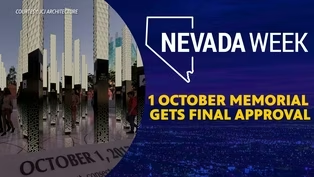
1 October Memorial gets Final Approval
Video has Closed Captions
Clip: S6 Ep9 | 8m 42s | Clark County Commissioners gave the final approval for work on 1 October Memorial. (8m 42s)
Providing Support for PBS.org
Learn Moreabout PBS online sponsorship
- News and Public Affairs

Top journalists deliver compelling original analysis of the hour's headlines.

- News and Public Affairs

FRONTLINE is investigative journalism that questions, explains and changes our world.












Support for PBS provided by:
Nevada Week is a local public television program presented by Vegas PBS