
Impeachment Deliberation, Vaccine Frustrations
Season 5 Episode 20 | 27m 29sVideo has Closed Captions
Congress moves forward with impeachment. Utahns frustrated by vaccine rollout issues.
Utahns react to last week’s riot at the US Capitol, as Congress moves towards an historic second impeachment of President Trump. State leaders implement new strategies to manage the Covid-19 pandemic. Lawmakers respond to the Governor’s budget and prepare for a unique Legislative session.
Problems playing video? | Closed Captioning Feedback
Problems playing video? | Closed Captioning Feedback
The Hinckley Report is a local public television program presented by PBS Utah
Funding for The Hinckley Report is made possible in part by Cleone Peterson Eccles Endowment Fund, AARP Utah, and Merit Medical.
Impeachment Deliberation, Vaccine Frustrations
Season 5 Episode 20 | 27m 29sVideo has Closed Captions
Utahns react to last week’s riot at the US Capitol, as Congress moves towards an historic second impeachment of President Trump. State leaders implement new strategies to manage the Covid-19 pandemic. Lawmakers respond to the Governor’s budget and prepare for a unique Legislative session.
Problems playing video? | Closed Captioning Feedback
How to Watch The Hinckley Report
The Hinckley Report is available to stream on pbs.org and the free PBS App, available on iPhone, Apple TV, Android TV, Android smartphones, Amazon Fire TV, Amazon Fire Tablet, Roku, Samsung Smart TV, and Vizio.
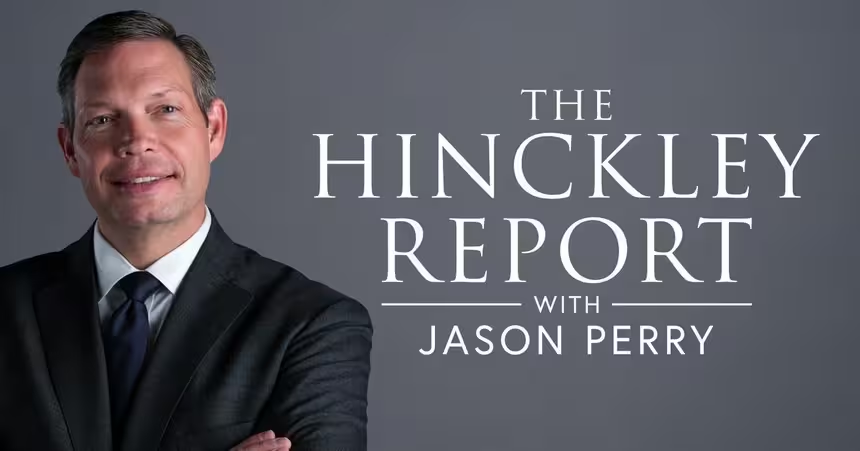
The Hinckley Report
Hosted by Jason Perry, each week’s guests feature Utah’s top journalists, lawmakers and policy experts.Providing Support for PBS.org
Learn Moreabout PBS online sponsorship♪♪♪ male announcer: Funding for "The Hinckley Report" is made possible in part by the Cleone P. Eccles Endowment Fund.
Jason Perry: Tonight on "The Hinckley Report" Utahns react to last week's riot at the U.S. Capitol as Congress moves toward a historic second impeachment of President Trump.
Lawmakers respond to the governor's budget and prepare for a unique legislative session.
And seat leaders implement new strategies to manage the Covid-19 pandemic.
♪♪♪ ♪♪♪ Jason: Good evening and welcome to "The Hinckley Report" I'm Jason Perry, director of the Hinckley Institute of Politics.
Covering the week, we have Sonja Hutson, political reporter with KUER; Max Roth, anchor with Fox 13 News; and Frank Pignanelli, political commentator and lobbyists with Foxley and Pignanelli.
Thank you all for being with us this evening.
This is such an interesting time in politics and there's just so many stories that are connected together, but I want to start with you, Max, a week and a half ago I had a chance to even talk with you as the rioters are storming the Capitol in Washington D.C. And since that time, a big event again with same kinda controversy with the impeachment proceedings.
Talk about those impeachment proceedings in the House really through the Utah lens and how Utahns are seeing this activity.
Max Roth: Well the impeachment charge, just one charge, incitement of insurrection, I think is the phrase and that's a very serious crime that they're saying he committed.
And that is because of the-- not just the speech he gave to the crowd before they marched on the Hill, and his family spoke there too, and his lawyer prior to that.
And but also because he had signaled that that would be a wild day through his Twitter account, January 6th would be a wild day in Washington D.C. And asked people to come and then from then until January 6th had consistently said that the election had been stolen, and that they would not have a country if they didn't, in his words and pardon the language but his words, fight like hell.
And so, that's where that charge comes from.
The Utah delegation all voted against impeachment.
We've heard specifically from John Curtis from the Third District, and Blakemore from the First.
Curtis saying that he does think that Trump bears some responsibility for what happened last Wednesday, and he co sponsored a censure motion.
Blakemore also saying that he was disturbed by those events.
I don't think that he specifically said that the president bear some responsibility, but he's been pretty measured in his remarks.
Our delegation hasn't been the fire breathers, but we haven't heard from Chris Stewart or Burgess Owens.
Jason: Yeah, we're still waiting on-- maybe it's worth getting into those words a little bit.
Sonja, I want to read a quote from Congressman John Curtis because it goes right to what Max was saying.
I'm curious how you are hearing about this through our Utah community.
Representative Curtis said, "I condemn the President's words and actions which contributed to last week's violence and encourage all Americans to similarly condemn.
I vote no to rushing impeachment and politicizing what could have been a serious and thoughtful bipartisan review."
This is what Max was talking about too and this is the line that they're finding is they're not condemning the actions, but talking about the process, the timeline itself.
Sonja Hutson: I mean, I think it's a very typical response for a Utah Republican, right?
Especially more moderate ones like John Curtis that really try to walk this line of, you know, being a Republican, being supportive of the head of the Republican Party, who is President Trump, while also sticking to, you know, not siding with him completely all the time.
And so, you have this walking this line of yes, what happened was wrong, but I'm not gonna go so far as to side with the Democrats to, you know, move forward with this impeachment that I think is being rushed and I don't like the process.
Jason: This is so interesting, Frank, because you are just so good on politics and you're connected also.
This is a hard line, Congressmen Curtis voted no on impeachment, but he's still getting death threats in the state.
Frank Pignanelli: He's still getting death threats-- the problem is is the impeachment.
The second impeachment has become politicized.
I believe that had something like this happen to the state Capitol, you would've had the Speaker of the House, the President, Senate, the two minority leaders in a joint press conference 'cause they immediately would've got together.
That didn't happen in Washington.
I don't think those people ever talk to each other.
Nancy Pelosi and Minority Leader McCarthy went their separate ways and started doing different things.
So it was not that chance to get together and say, okay, how do we deal with this?
Now because yes, you have the insurrection, but the end of the day, this is the issue that everyone-- for all of us who love and adore our constitution.
It was that process that was happening that was tryin' to be interfered with.
And so you have to deal with that.
So it's unfortunate that this has become politicized because then you have our delegation having to vote with Republicans.
Although some peeled off.
It would've been better if they could have got together and said it jointly this is what we're doing 'cause now it's become politicized.
Which is then going to spill over course next week into the Senate.
Jason: So how does this play in Utah, Max?
Because--go ahead, Sonja.
Sonja: I just wanna push back on that a little bit because when is impeachment not politicized?
I think that it's always a political process that takes place in a very political body, Congress.
And I think it's always going to be politicized.
Perhaps, I think you can make the argument, it's even more politicized now because of the climate that we find ourselves in.
I think it's always been politicized.
Frank: The last two impeachments, whether it was Clinton or Trump, you're right but this was an attack on the Capitol.
So it's not a he said she said.
It was very clear was happening.
There was an opportunity, I believe, when those hours after the attack had happened for both sides to say how do we deal with?
Maybe it wasn't impeach, maybe with a censure motion, things like that.
I didn't see any evidence of either party coming to say how do we deal with this together?
Then it became an impeachment process, which you're right is now very political.
Max: It was the most bipartisan impeachment in American history yet.
We've only had four but it was the most.
Nixon, if he had reached that point would have been the most, I think, but still I mean to have the third in power, the the Republican Party, Liz Cheney onboard with impeachment.
I mean, I don't know how do you-- what more do you do?
And especially when as they were even giving their speeches, Minority Leader McCarthy said, the president was responsible and needed to take responsibility for what happened on January 6th.
And I think that-- And so, he's saying that and yet voting against impeachment with the process argument, but you know, there was clearly some condemnation from both side, both parties sides.
I think the larger issue is that we have a country where millions of people are listening to and believing things that are just simply not true.
That are easily disproven if you are willing to trust and believe that that people in professional positions act out of goodwill.
Jason: Mhmm.
Mhmm.
Very interesting point to see.
'Cause that's clearly enough to mobilize a few groups of people.
Max: It's scary.
Jason: So to your point, Sonja, you had 10 Republicans who voted for the impeachment there in the House and, Sonja, talk about this piece here that both Max and Frank were talkin' about too because some of our-- even our delegations hitting that second point said, well, you know, this is like 48 hours to evoke.
Maybe what we should have had is hearings and an investigation as opposed to just running right into it.
Sonja: Yeah, I mean that certainly valid argument that you can make.
I think that's obviously the clock is ticking a little bit because Trump doesn't have very long in office and in fact not to jump the gun talking about what's next but the Senate trial is not going to start until after Biden is inaugurated and Trump is out of office.
And so, I think they may take some more time with that but fair argument.
I think that people on both sides of the aisle love to make the process argument you know think about the confirmation hearings for Amy Coney Barrett, those were you know, rushed through I think you could say by some.
You know they were done very quickly.
And I think probably both sides of the aisle are guilty of making that argument.
Max: And you know, it's an indictment.
That's what an impeachment is.
It's an indictment.
And when you think about the different kinds of crime, the Ukraine thing, you had a transcript, you had people who were testifying that there were nuances to that that required talking to people who were involved to get a real sense of what was happening.
Now whether this was a crime or not, leave that off the table for now.
What they're saying was a crime is right there.
So if there's something that obviously happens: guy robs the liquor store, he's on camera, he gets caught while he's running out with the loot.
You charge him.
You just take him and you indict him.
There's not a whole lot of investigation that needs to happen.
Well, everything that we're talking about is on camera and on social media in this case.
Whether it's a crime or not, you know, if it is indictment can be quick.
Jason: And not to mention the facts, the vote comes from the very people who are in the room where the rioters were there.
Sonja: It's personal for them.
Jason: Yeah, very personal.
Can I ask because Sonja, let's get what she's called what's next.
This hearing, this trial that's going to happen in the Senate.
This is a precarious position for our two senators.
Alright, how are they-- how are they going to walk this one?
What are you seeing, Frank, with Mike Lee, Mitt Romney.
Frank: We have a couple of things going on.
First of all, I think President Biden is gonna say something because he has a whole agenda he wants to pass and does he want half the time allotted to get his cabinet through and get all of the programs through.
Have them all chewed up by this trial.
So you've got that issue.
What is going to happen is this this happened in 2001 last time was a 50-50 split.
Although we have the vice president can make the difference, they'll come to a power sharing agreement in terms of committees and things like that because it is split.
So we'll have to decide that process.
While they're deciding that process, they're gonna get input in from the president and another saying what do we do about this trial?
Do we do it now or do we do it in six weeks?
Or do we need to have a trial because the person's out of office or do we wanna do other?
'Cause we can have a separate vote with a not hold office.
But what that does is that I would argue two things.
A divided government actually sets it up very well for moderates because you don't have the votes and even it so tightly divided in the House it actually gives a lot of power to the moderates like a John Curtis or like a Mitt Romney to go work the other side.
But at the end of the day, they're going to have to decide what do they do because there was an attack?
Let's take away the Capitol building.
There was an attack on the Constitution.
The was an effort by some people to disrupt what was a constitutional process in the Twelfth Amendment.
How do you deny that?
And how do you deal with it?
Just to blow it off is not gonna be enough.
So that's really where you kind of think you see you know where Mike Lee is a constitutional expert.
How do you maneuver around that?
Whereas I think when you see Mitt Romney who's voted for impeachment, it's probably a better position to do that whereas I think Mike Lee will become in many ways, the leader of the constitutional forces of how to do it.
So I think both of our senators are well placed to have some influence in these deliberations.
Jason: Sonja, did you have a comment?
Sonja: Yeah, I think Mike Lee is definitely the one to watch.
I would not be surprised if Mitt Romney voted to convict the president given his very strong speeches on the Senate floor on the night of January 6th, given how he voted in the last impeachment.
He was the sole Republican to vote to convict Trump on one of those articles of impeachment.
But I think that Mike Lee with his background as a constitutional attorney is really interesting, right?
And he's gonna make a lot of arguments that, I think in some ways kind of feel like a law school lecture, which is always really interesting to watch on the floor and you kinda saw that on the night of January 6th as well.
And so he's going to be the one to watch how he uses that background of being a constitutional attorney.
He talks so much about his reverence for the Constitution and how important it is.
And so I think that he's definitely gonna be one to watch.
And also you have the added layer of he's been a really, really close Trump ally for a few years now.
So it's gonna be interesting to see how those forces play off each other.
Max: You know I spent a lot of time listening to Conservative radio and reading Conservative blogs and Mitt Romney is under attack constantly.
And it is entirely about his positions in relation to the president and it's interesting because, you know, we talk about him as a potential moderate with a lot of power.
In the moderation is in effect, it's in personality.
He's very Conservative.
I mean, I don't know if there's any evidence that he's a moderate on anything other than the fact that he has taken positions against his party on this president so.
But it's, you know, he is-- it's very personal in these forums.
And it's, you know, it's scary.
It's this whole thing about this political atmosphere we have right now.
The other element that we have to--that needs to be thrown out there is the pardon.
Does the president pardon himself?
Which then becomes a process of litigation or as the Deseret News pointed out just a couple of days ago.
There is pressure on President Biden to pardon Trump that way like they did with Ford did with Nixon to say, yes, he may not like it but we have something-- we have things to do, let's move on.
That's gonna be up for discussion too.
Jason: Well, we'll keep following this story even here on "The Hinckley Report."
I want to jump into--it's a national issue, but with very local implications too on the vaccine, because I'm going to quote Frank Pignanelli, on this very show in the past you said this is going to be the year the politics of the vaccine.
Is that playing out?
Frank: Absolutely you see it on a national level and even a local level.
You pick up the paper today and do people screaming yelling get they couldn't get through to the County Health Department to blaming Spencer Cox.
Spencer Cox is doing a good job of trying to just unleash it in my opinion tryin' to figure out how it makes it all work.
You've got politicians on both the legislature and the counties, the County Health Department, and it's a rickety system right now, but they're doing their best to deal with it.
And so it's going to be very political deal, where it's gonna get really political is when more and more people are starting to tryin' to get it and it looks like it's limited.
That's where there'd be a lot of frustration level.
We got frustration with elected officials.
It becomes political.
Max: You know I got the call at-- in the morning from my father, because he was trying to register himself and my mom for the vaccine and couldn't get through, couldn't get through on the website, and I have to say from from that perspective, you do wonder how it is that we've known this was coming for months.
We have known for months that there was going to be a massive need to get vaccine to people.
And still we're making decisions on the fly at the last minute deciding oh no, it's no longer teachers or it is teachers.
Oh, it's no longer essential workers.
Its people over 75.
Oh no, it's not 75.
We're going to go back to 70.
And then you get on a website that could-- they could've had someone working on for 10 months almost and and it's not ready when they turn it on.
And that is a frustration.
Jason: Yeah, Sonja, tell us what you're hearing because that's a very valid point not only all these changes but even taking it out of the health care systems in the state moving these to local health departments, even that caused websites crashed.
It's all the things that Max and Frank were just talking about.
Talk about that for a moment and implications.
Sonja: Yeah, I mean, I think that like it's easy for us who, you know, work in news, work in politics to feel like oh, I understand what's going on with the vaccine.
I read about this every day, but when you think about people who do not work in news, who do not work in politics.
They have to try to keep up with all these changes that the governor is making and that's really difficult to do.
And going back to, you know, the websites crashing and things like that.
I think we also need to look at this through a little bit of an equity lens also.
If you have people who have bad internet access or don't have access to a computer at all.
Those people are going to have a harder time signing up.
They're gonna probably get the vaccine later.
This is something that the state knows, particularly with older people.
And they-- I think they are, they're sitting up like kind of hotlines you can do it over the phone.
But, you know, to that point why wasn't this done a really long time ago?
Especially when we knew that older people were going to be the ones to get it, you know, relatively early.
Frank: Part of this is something I've noticed in America when you look at our history, we're not good at top down stuff, because you know, the federalism, and of course, you have the local governments.
Whether it's war or other crises.
We're not good at the initial stages, but we catch up we do better.
I think that's what's gonna happen.
We'll figure this out.
We did with the polio vaccine.
In four or five months, it's gonna work well.
Jason: Let's talk about-- go ahead, Sonja.
Sonja: Yeah, just to, you know, Spencer Cox's credit, I mean, he came into office and was like all right, let's make some changes.
He rolled out this executive order that, you know, switched some things up.
Made the system a little more centralized locally within those local health departments, rather than having vaccine distribution go through medical providers.
You know, he came out and he made some changes right off about it.
Frank: I think going to the County Health was smart because the hospitals they're already burdened.
Max: And also it means that-- Sonja: Capacity is around 94%.
Frank: So, why not go to county?
Max: And then it's clearly delineating too I mean, you could-- someone from Davis County might go to the University Hospital, and then who's keeping track of who's been vaccinated, but those health departments they're county lines.
Frank: Credit to Spencer Cox for that.
Jason: Okay, so Spencer Cox has some more to do with this next legislative session, right?
I want to talk about a couple of those pieces.
Let's first talk about the session itself, starts next week on Tuesday.
Well, Frank, everything seems to be different about the session.
Wow, Covid's influence, but not just that but the possibility of violence.
Frank: Possibility of violence and, you know, usually people would just throw things at lobbyists, but now apparently it's-- they take it to a new level.
And yes, my job as a lobbyist has changed dramatically.
And of course, it's also more importantly, public inputs changed dramatically because it's gone from what we were looking at maybe, you know, kind of these hybrid models of communicating with lawmakers to everyone's locked up for at least for the first week and a half maybe.
No one and I mean, no one gets to the Capitol, but then it's still going to have a virtual sense because the pandemic.
And so, you know, we've all been up the Capitol.
I mean, it's a great, it's a fun place to be doing a session.
There was a lot of pandemonium, but you're able to pull legislators off the floor, talk, you get business done.
Those days are gone for this session.
It's very much a structured element of you talk to that legislative by phone or by zoom and things like that which still allows public access but it does change the dynamics of groups of individuals, especially citizen activists coming up interacting with their legislators.
And hopefully they find a way to make that happen.
Jason: Yes, Sonja, how are you looking at the session as, you know, a member the media tryin' to even get to these elected officials when probably not gonna be allowed there for a while?
Sonja: Yeah, we had a lot of really difficult discussions about how to cover this session.
My colleague Emily and I, and there's a lot also to weigh about public like your health and your safety and what you're able to do as a member of the media.
And kind of where we landed was let's cover as much as we can remotely because what good does it do to our mission to inform the public if one of us gets sick covering something in person that we could've covered online.
And then we can't do our jobs for a week or two all that well because we're sick and not feeling well.
And so that was kind of the conversation that we were having.
I think our plan also is still, you know, we're having trouble getting in contact with a lawmaker, which happens sometimes during the session.
They're really, really busy.
Then you know you can go up to the Hill and track him down and like oh, I know you're gonna be in this committee room at this time.
So I'll try to talk to you then, but it's gonna be really different.
And I think that like health and safety has to come first, at least for me, and that's kind of how I'm approaching it.
Jason: Go ahead.
Frank: So, one of the interesting questions along the political community is once this big lockdown is lifted and the public's able to go interact little bit, doesn't-- will there be an outbreak?
And, you know, if there's an outbreak, what do they-- do they shorten the legislative session or do they just gonna muddle through?
So that's one of the questions being asked.
Jason: Wow, gonna be so interesting.
Sonja: That's the lawmaker side of what I was saying, right?
Like if you have a big-- legislature and you have to like stop the session for a little bit, what good does that do?
And so obviously there--it's a little bit different like being a legislative body verse being a reporter but you know that's a consideration we have to view as well.
Jason: I look forward to your podcast during the session 45 days on KUER, right?
We'll be listening to how it goes and how you you navigate that inside the Hill.
Max, I wanna talk about the budget for a second 'cause it's gonna occupy the entire first week.
Base budgets, everything else.
The governor released his budget, but the legislature's already talkin' about this.
Stuart Adams, this is the session of the tax reduction.
Max: Yeah, yeah, and that's-- it's kind of shocking and this is a place where Utah is kind of living in a different world than much of the rest of the country.
I mean, we kind of do all the time anyway, but in this sense with the Utah economy's doing pretty well.
And so the budget is relatively flush at least come compared to other places.
They have about a billion more dollars in split fairly evenly between ongoing and part time money that they could spend.
Now they want to act like they have less in a way because they're worried that there's kind of a bubble there that's going to go away, but they're talking about spending more on education and also potentially borrowing more in bonding because it's so cheap to borrow money right now, especially with a state that has a high bond rating.
And so it's-- but the question is do you give a tax cut still at a time when there are a whole lot of needs?
And even though Utah's economy is doing well we have-- our unemployment rate is still about a percent and a half worse than it was a year ago and the people who are suffering are the people who could afford it the least.
Because the people who are losing their jobs are the people, who weren't making much to begin with.
In retail, restaurant, hospitality, that kind of thing.
Jason: Talk about the legislators are approaching this as a former legislator also as you look at this, you know, about a billion dollars of one time money on the table to be spent but some are legislators are looking at what Max called the bubbles sort of this this phantom amount of money that may exist in our economy because of the federal stimulus that came in.
Frank: There's a big concern about that.
So you're-- first of all they need to backfill some of the stuff they cut from, you know, that they did during the summer.
So you'll have to take some of that and then back fill that then move forward and say, okay, we're worried about any ongoing funding, ongoing programs because there may have been a bubble.
The second thing is they have-- there's still worry out there about a recession, if a national recession comes in.
And so does that diminish revenues?
But guys, you said the Utah economy is doing so well.
So-- we've got those dynamics then you have all the needs that are being pushed through because of the pandemic.
That there's not federal funding for especially on the economic sector.
So you have all-- and so, you hear about all this money and people said, we could brush and get our programs funded but then legislative tryin' to be conservative both trying to predict the future six months out and a year out.
So you can see all those different dynamics.
And there will be attacks could probably beat adjustment based upon the federal tax reform from a couple of years ago, but they want to be able to say that they have done that.
Max: You know what they're calling it now.
They're-- rather than the income tax they're calling it the productivity tax.
They're saying that you're taxing, you know, the productivity of our workers, which is it's an interesting thing.
They're changing the argument.
Frank: The thing to watch for the budget is this you have that Amendment G pass, which of course expanded the ability used income tax dollars-- Jason: From education broader.
Frank: For our for children.
It's interesting having some of these conservative talks when we want to approach the holistic approach towards the education and care of children.
So that's what they're trying to do and say, you know, we're going to pay for these programs through Medicaid or through different different programs for the social services budget as part of the whole package.
It's an interesting concept.
And it'll be one it'd be fun to watch and see how they're able to accomplish this and has really changed the mindset of many legislators.
Jason: So Sonja what these legislate--go ahead, sorry go ahead.
Sonja: Two things I wanted to talk about with Amendment G. So, first of all yes, definitely they had this whole conversation about lets help the child in a very holistic sense, but also we can't forget that this was also a way to deal with tax reform after that package really kind of exploded last year.
And lawmakers ended up repealing it to deal with what they're calling a revenue imbalance, where you have slowing growth of sales tax, but still income tax rising a lot and the income tax goes to the education fund.
And that's the simplest way I could think of to describe it.
It's a very complex issue, but so this was kind of a ways of replacement for that and lawmakers will tell you that because they're able to take some of that education money and put it towards stuff that the sales tax would normally fund that helps with that balance a little bit and Spencer Cox said in a press conference recently that, you know, this bought them a couple years.
And also I talked to the executive of preparations chair Jerry Stevenson last month and he told me right now they're not gonna be using that new mechanism.
At least there's no plans to the session.
Jason: That's gonna have to be the last comment.
Can't wait to see what happens.
Thank you all.
Max: Thank you.
Jason: And thank you for watching "The Hinckley Report."
The show is also available as a podcast on PBSUtah.org/HinckleyReport or wherever you get your podcasts.
Thank you for being with us and we'll see you next week.
♪♪♪

- News and Public Affairs

Top journalists deliver compelling original analysis of the hour's headlines.

- News and Public Affairs

FRONTLINE is investigative journalism that questions, explains and changes our world.












Support for PBS provided by:
The Hinckley Report is a local public television program presented by PBS Utah
Funding for The Hinckley Report is made possible in part by Cleone Peterson Eccles Endowment Fund, AARP Utah, and Merit Medical.