
The Importance of the Church in the Black Community
Clip: Season 50 Episode 8 | 12m 59sVideo has Closed Captions
The Importance of the Church in the Black Community
A look back at what inspired the collaborative Black Church in Detroit series to begin one year ago with a look at Dr. Henry Louis Gates, Jr.'s PBS documentary "The Black Church: This is Our Story, This is Our Song," which explores the 400-year history of the Black Church. Then, Stephen sits down with the documentary's producer and director Stacey Holman. Episode 5008/Segment 1
Problems playing video? | Closed Captioning Feedback
Problems playing video? | Closed Captioning Feedback
American Black Journal is a local public television program presented by Detroit PBS
The Importance of the Church in the Black Community
Clip: Season 50 Episode 8 | 12m 59sVideo has Closed Captions
A look back at what inspired the collaborative Black Church in Detroit series to begin one year ago with a look at Dr. Henry Louis Gates, Jr.'s PBS documentary "The Black Church: This is Our Story, This is Our Song," which explores the 400-year history of the Black Church. Then, Stephen sits down with the documentary's producer and director Stacey Holman. Episode 5008/Segment 1
Problems playing video? | Closed Captioning Feedback
How to Watch American Black Journal
American Black Journal is available to stream on pbs.org and the free PBS App, available on iPhone, Apple TV, Android TV, Android smartphones, Amazon Fire TV, Amazon Fire Tablet, Roku, Samsung Smart TV, LG TV, and Vizio.
Providing Support for PBS.org
Learn Moreabout PBS online sponsorshipSo let's start with how you came up with the idea for this series, "The Black Church."
In some ways, it's a very obvious part of African American life, but it's something that I think we kinda take for granted.
It's always there.
It's part of our lives from birth (laughs) in our community.
>>Yes, yes.
>>We don't often stop to think about the history and why it's important, and how it's become so important.
>>Well, this is the brainchild of Henry Louis Gates, who I will probably intermittently call "Skip."
I go between those two.
And he had written the treatment, had this idea of doing a series on the black church.
And I had the privilege of being brought on as a series producer and as well as a director for the series.
And it was my role to really help steer his vision into a four-hour program to really talk about the breadth and the width of the black church, particularly in the continent of America specifically.
Because we know that the religion and black church can kind of extend across the borders, but we really wanted to focus on what the institution was here built by black people.
>>I wanna talk a little about the arc of the narrative here with regard to the black church.
Of course, it plays a very pivotal role in early America.
And for African Americans, it plays a very particular role then.
I think it changes over time, of course, because history changes over time.
But talk about the telling that story and making sure that you could be faithful to the idea that even though these things change, and even though it looks different today than it did 200 years ago or 400 years ago, that there's this kinda continuity, I guess, in the role that it plays, and the importance that it has for us as a community.
>>I mean, what you said at the top of the interview is very true.
We all have a root in the black church.
Whether we continue to have that grow in our life, that's told over time.
And I think that's just the ongoing thread and the connective tissue of the story, whether it was our grandmothers or our grandfathers forcin' us to go to church, or whether it was just our friends whose parent was a pastor.
And so we knew we had to go to church in order we could hang out that Sunday afternoon.
So I think, for us, and I hope I'm kinda answering your question, is that just really finding that personal element and pulling on that, so that we can then just really develop that story and show the emotional as well as some of the hard stuff.
I mean, it's not a complete all everything-is-rosy story.
The black church is complicated.
There's still a lot of stuff that we're still struggling with today that necessarily wasn't at the forefront back then, but that also shows the evolution of it and just how it's willing to grow and willing to just take on some of those conversations.
>>Yeah, I'm curious also about the reaction and feedback that you've gotten from people about this portrayal of such an important part of African American life.
>>Overall, it's been very positive, which we're very thankful for.
A lot of people had not been at the church or in the church, it really triggered them and just jogged some really pleasant memories.
For other people, it was just like confirmation of just like, yep, that was my experience; that's what I knew, that's what I understood.
Of course, not everything is perfect, as I said, and we did have, one of the things is we should have covered this.
And that's always a challenge that you have in telling a story.
It's 400 years, you know, (laughs) essentially, 400 years in four hours.
And we also, too, got a little bit of pushback from a lot of black Catholics because they felt, certain individuals, I won't say they as a whole, but individuals felt that that was one story we didn't tell.
I joke with my colleague, the other director, Shayla Harris, who's actually from Detroit.
She was our resident black Catholic, 'cause she did grow up Catholic.
So I was like, well, we didn't really cover the story due to time, but also, too, due to the fact that we were focused on black churches and institutions that were independent of whites.
>>Well, it is amazing work and I think we're all really grateful that you did it.
Stacey Holman, thanks so much for joining us on "American Black Journal."
>>Thank you so much, Stephen.
And I just wanna do a quick plug if people still wanna- >>Sure.
>>Continue to watch it, it's on demand, and also streaming services on Amazon.
And you can, of course, get the DVD, so.
But thank you so much; it was a pleasure.
>>We kicked off our "Black Church in Detroit" series with a show about the historic role of the church in the fight for racial and social justice.
And later, we continue the conversation by focusing on the church as a center for change in the community.
Take a look.
>>Reverend Williams, I'm gonna start with you.
Activism is, I think, for you hand in hand with the pastorship of your church.
And so much of what you do, so many of the reasons that people know you, not just here in Detroit but around the country, are about activism.
So I'm gonna start with you talking about that marriage between the church, the black church in particular, and activism that's focused on social and racial justice.
>>Yeah, you know, look, the black church birthed Black Lives Matter, birthed activism.
It has been the mantra that we have held since we organized the African Methodist Episcopal Church.
Further, since we organized our resources, the First Baptist Church of Savannah, Georgia; oldest institutions that blacks have ever owned, not only in the sense that we were protesting or picketing, but we, at that time, we were providing.
At that time we were opening up our churches for underground railroad.
This is what the fabric of what we've been for black people since the inception of the black church, the historic black church, and it's what we plan to continue to be.
>>Yeah, yeah.
Pastor Barry, I know from your church that that activism takes on a very specific role in your community, and takes on a very specific role with young people in your community.
Talk about what that looks like.
>>Well, one of the reasons why the church has been so successful is because we combine your purpose and your activism with your spirituality.
One of the things that have been quite successful is the fact that we let everybody know that on so many different levels, Jesus Christ and his disciples, and a lot of people in the Bible, were actually activists.
They were standing up for what was right.
They were standing up against the status quo.
They were standing up in the face of evil, and they were lettin' people know that, with God, all things are possible.
And we, as the people of God, we have a role to play in manifesting that in this world.
So we have a particular role.
So our young people in particular, they look for their purpose in life.
And part of that is to stand up for the right thing.
We give them the opportunity to be able to do that.
>>Yeah.
Reverend Simon, what does this look like at Fellowship?
>>You know, when I thought about activism, I had to take it from an academic standpoint, of course.
I am at Fellowship Chapel, which is a very active church.
ETS is ecumenical, but social justice-oriented.
So when I looked at activism and when I teach it in my African American Black Religious Studies course, I talk about it from a historical perspective.
We came from Africa, and I don't mean we came, you were enslaved.
We come to America, and even within that transition, we have held on to what has been activism.
I see activism holistically in that all of our things that we do in terms of the black church is not just the religion.
It's not just understanding the Bible.
It's dealing with every phase of every black person's need.
So even when the slaves would leave the master's church and go to the Hush Harbor, and remember, they did not take that black Bible, there's a black Bible.
I don't know if you've ever heard about it, the slave Bible.
They didn't take that.
They sat down and they talked about how they were going to be active in terms of helping everybody that was part of that slave group through songs, 'cause they sang in the field to let people know they were going to be actively leaving for freedom.
They preached, they talked about the things that people need.
And historically, that has been the activism in black church.
>>What role are you called to play these days?
Bishop Ellis, I'll start with you.
>>Well, you know, I'm carrying on a, 25 years now, legacy from my father who pastored for 34 years.
And he was the first to move beyond the walls of the church in terms of a daycare center, and then a Christian school that went from kindergarten to the eighth grade, and then apartments, so duplexes that allowed people to live in affordable housing.
And then the credit union, federal credit union, federally chartered credit union.
And that was like, wow, we're a bank now, you know?
And so he was the one to see beyond the walls of the church and to see that people had more than spiritual needs, but they had natural needs.
And it kinda was a transition because, before he passed, I was the one that wrote the grant that received $5.3 million from HUD to build Ellis Manor that is here on the new site.
So it was kinda like a transition in the two years after we moved the first residents in, in '94, my father passed, made his transition.
And of course, five years later in 2002, we moved into this facility, six years later, I should say.
So I'm just carrying on that legacy.
And I used to brag here, in a good way, that we did more ministry here at our present site, outside of the church during the summer months than we did inside of the church.
And now we're pretty much doing almost everything outside of the church.
>>Reverend Adams?
>>Yes, and it's really divine providence that we would be on the show together, Bishop Ellis and myself, because his father and my father were contemporaries and colleagues, and very good friends.
And they did a lot of the same work, housing we developed.
Bishop Ellis was a forerunner to that in a lot of housing development around the church.
And we also continued that tradition, and we just completed a senior village right adjacent almost to Northwest Activities Center, $16.5 million project cooperatively with Presbyterian Villages of Michigan, providing apartment-style housing and cottage-style housing right there.
For those who did not want to live in the suburbs, they get to have quality housing in the city of Detroit.
Also, we have tried to ignite employment opportunities through economic development because of our forerunners.
They laid the foundation.
It's an ethos that we are walking in, almost like the scripture that says we live, move, and have our being in God, we live, move and have our being in this idea that church goes beyond Sunday morning.
>>Orlando Bailey, great to see you here on "American Black Journal."
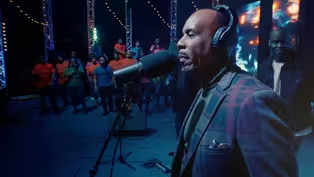
Bishop Charles Ellis III, Paul Porter Perform “Done For Me”
Video has Closed Captions
Clip: S50 Ep8 | 4m 3s | Bishop Charles Ellis III, Paul Porter Perform Original Gospel Song “Done For Me” (4m 3s)
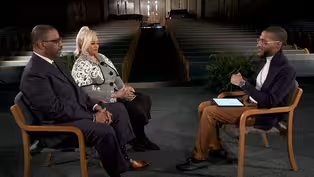
Sheard Family Talks C.O.G.I.C. Church Roles
Video has Closed Captions
Clip: S50 Ep8 | 14m 13s | Sheard Family Talks C.O.G.I.C. Church Roles and The Clark Sisters (14m 13s)
Sheard Family Talks C.O.G.I.C. Church Roles (Extended)
Clip: S50 Ep8 | 38m 25s | Sheard Family Talks C.O.G.I.C. Church Roles and The Clark Sisters (Extended Interview) (38m 25s)
Providing Support for PBS.org
Learn Moreabout PBS online sponsorship New Episode
- News and Public Affairs

Top journalists deliver compelling original analysis of the hour's headlines.

- News and Public Affairs

FRONTLINE is investigative journalism that questions, explains and changes our world.


 New Episode





 New Season
 New Episode
Support for PBS provided by:
American Black Journal is a local public television program presented by Detroit PBS