
Improving lives through transportation
Season 4 Episode 10 | 26m 46sVideo has Closed Captions
DOT Commissioner Diane Gutierrez-Scaccetti talks about her career in transportation.
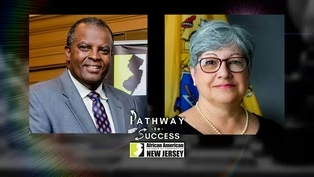
John E. Harmon, Sr., Founder, Pres. & CEO of the African American Chamber of Commerce speaks with Department of Transportation Commissioner Diane Gutierrez-Scaccetti about her family, growing up in Newark and her extensive career in transportation. Produced by the AACCNJ, Pathway to Success highlights the African American business community.
Problems playing video? | Closed Captioning Feedback
Problems playing video? | Closed Captioning Feedback
Pathway to Success is a local public television program presented by NJ PBS
Improving lives through transportation
Season 4 Episode 10 | 26m 46sVideo has Closed Captions
John E. Harmon, Sr., Founder, Pres. & CEO of the African American Chamber of Commerce speaks with Department of Transportation Commissioner Diane Gutierrez-Scaccetti about her family, growing up in Newark and her extensive career in transportation. Produced by the AACCNJ, Pathway to Success highlights the African American business community.
Problems playing video? | Closed Captioning Feedback
How to Watch Pathway to Success
Pathway to Success is available to stream on pbs.org and the free PBS App, available on iPhone, Apple TV, Android TV, Android smartphones, Amazon Fire TV, Amazon Fire Tablet, Roku, Samsung Smart TV, and Vizio.
Providing Support for PBS.org
Learn Moreabout PBS online sponsorship- [Narrator] Support for this program was provided by Horizon Blue Cross Blue Shield of New Jersey, Berkeley College, education drives opportunity.
Be inspired.
(light jazzy music) - Hello, this is John Harmon, founder, president, and CEO of the African-American Chamber of Commerce in New Jersey.
Today's guest is a very important person to the State of New Jersey.
Many of us take for granted just leaving our homes, getting on the highways and byways either going to work, going to school, or to some recreational activity, but there's a person in this State that makes that all possible.
I speak no, other than the commissioner of the Department of Transportation, Diane Gutierrez-Scaccetti to provide, you know, the vision, the implementation the execution to keep us all safe as we travel throughout New Jersey.
But before we get into, you know, the heart and soul of what you do every day, we wanna get to know a little bit about you, where you're from, big family, small family, and then a little bit about your educational background leading up to your professional career.
- So I was born in the Great City of Newark.
My mom and dad were born and raised on East Kinney Street.
They grew up across the street from one another so they knew each other as long as two people could.
And my sister and I were both born in Newark and I, she's older than me and I have a younger brother and he was born in Trenton where my parents eventually relocated from my dad's work.
We lived in Lawrence Township, but I spent many a summer out of school here in the city staying with my grandparents.
They were an extraordinarily influential part of my life who shaped me just as my parents did.
And so, East Kinney Street was, and still is a huge part of how I grew up and what I saw and what I learned from my grandfather, especially who I'm pretty sure if he had the opportunity to go to college would've been an engineer.
He was incredibly talented.
But interestingly, as a young child, he would always tell me how fascinated he was by the New Jersey Turnpike.
That's the road he would take to come and visit us when we moved to Lawrence Township and what an engineering marvel it was.
he wasn't alive to see me go to work for the New Jersey Turnpike.
But I often wonder what he would've thought about all of this had he been here to watch my career grow in transportation.
- Well, I'm sure not only your grandparents were, are proud of you or would've been proud of you and all that you've accomplished.
Your parents and, as well as your siblings and that.
But education-wise, where did you where did you go to school?
- So I did my undergraduate work at the University of Connecticut.
The University of Connecticut had a great business school.
It was interesting.
My guidance counselors did not encourage me to apply because they felt very much that a state school would not be necessarily focused on bringing in out-of-state students.
But having a dad who was Spanish, my grandparents immigrated here from Spain, seemed to give me a leg up in some sort of way.
And so I think about that as I think about recent Supreme Court decisions on affirmative action and the importance of it in our higher education system.
So decided though, when I did my graduate work I did it at night.
So I worked full-time for the State of New Jersey in the Department of the Treasury and I received my graduate degree going to school at night from Rutgers.
- So career-wise, you said you worked in the treasury.
What else did you do for the state of New Jersey?
And then you spent some time in Florida?
- I did.
So I started my career actually, John, in Mercer County working their affirmative action office- - [John] Mm-hmm.
- Under a gentleman by the name of S Bobby Bryant.
He was the affirmative action officer for the county where I learned an awful lot about making sure that our hiring was maintained with the goal of hiring minorities of women on our, in the County but also working with disadvantaged businesses.
At that time we referred to them as minority business enterprises to help them gain contracts with the County to, you know, learn about how to fill out the paperwork and make sure that they could be competitive.
I was there for about two years before I took a job over in the Department of the Treasury working for the General Services Administration at the time under the leadership of a gentleman named Jim Kennedy who was extraordinarily influential in the development of my career in government.
But in Treasury, I spent a lot of time really learning and understanding how government worked how we bought things, how we maintained things, how legislation was processed through the legislature, the grassroots of government that are really essential to success in government as far as I can tell.
- 21-plus years with the New Jersey Turnpike authority.
When did you envision one day potentially being the commissioner overseeing (laughs) all the transportation?
Was that ever a thought?
- Commissioner was never a thought and even executive director of the Turnpike wasn't a thought.
It, over time, after I finished graduate school, my boss at Treasury, Jim Kennedy, went to the Turnpike Authority to work.
And at that time, I left government and went to IBM as I finished my graduate studies.
And at about two years he called me, and he says, "You know, why don't you just come back and work in transportation?"
And so in November of 1989, I returned to New Jersey from North Carolina and spent 21 years at the New Jersey Turnpike Authority which to me was just the, a really pivotal to everything I've learned, not only about transportation but about government and organizations and how to make them run from the labor aspects to the contracting aspects, to the financing aspects and then obviously, to the building and construction aspects.
But as time passed, and I kept having opportunities to move up and sometimes across in what I was doing it really gave me the depth and breadth of experience, I needed to feel that I could be a good leader and was promoted to Deputy Executive Director.
And in 2008, when our executive director left, I had the opportunity to take the reins of the New Jersey Turnpike, thanks to Governor Corzine.
- Well, I tell you it was President Obama and I say this often, he says, "No one is successful by themselves."
And you, over the years, you've referenced a nu number of people who have contributed to your success and all that you represent today in your current role.
But when you got tapped on the shoulder from Governor Murphy to be nominated to head up the Jersey Department of Transportation again, what does that feel like?
(chuckles) - It felt pretty darn good.
I have to tell you, you know, after, when the Christie Administration took office, I moved on from the Turnpike.
He had a team that he wanted to put in place and that's absolutely his prerogative but had the awesome opportunity to go to Florida and become part of the Florida Department of Transportation running their Florida's Turnpike enterprise, their Toll Road Division.
- Mm-hmm.
- And so did that for quite some time, almost six and a half years when I got a call to come and interview with Governor Murphy for the role of Commissioner of the Department of Transportation.
But Governor and I interviewed, we had a lovely conversation and then just a few days later, I'd gone back to Florida and I got a call from Governor Murphy offering me the opportunity.
And it was exciting on a couple of friends, right?
But it also gave me a very unique opportunity that he was not aware of.
When I left for Florida, I left behind my mom in Lawrence and as she aged, she really needed more help.
And by coming back to New Jersey when I did, Governor Murphy gave me the blessing of spending my mom's last year of life with her.
- Wow.
- And that is... That's a priceless gift for which I will always be indebted because it meant the world for her to see me in this role and to have me home with her.
And it meant the world to me to be able to help take care of her in that last year.
- I think that's a great story.
You know, speak to your mission for New Jersey Department of Transportation and some of the core values.
- So the Department as a, has as its mission always to provide safe, efficient travel for both our commuters, our residents, our visitors, and our businesses to be able to deliver goods and services as well as to travel safely to visit friends and family on our entire transportation network in New Jersey.
And so when I look at how transportation works in New Jersey, it is a system.
While we have the DOT and then separately, we have the New Jersey Turnpike, and then separately we have the South Jersey Transportation Authority and we have New Jersey Transit.
It isn't a good idea for them to exist in silos.
- Mm-hmm.
- And so one of my major missions has been to bring them together, not organizationally, they still are independent agencies of the State from a planning and collaborative point of view, the goal is for all of us to work together to balance the system.
So it's important for everything at the Turnpike to work well because if we have an issue on A DOT road, that road has to be able to absorb the extra traffic that might come to it.
New Jersey Transit is critical to making sure people are able to safely take either bus or train service, Light Rail service or access link service because when they do that, it lessens the number of vehicles on our roadways.
It helps us balance what we need to do to move in New Jersey, we are the most densely populated congested state in the nation, and we have to take that into consideration as we continue to develop good transportation solutions for the State of New Jersey.
But it's more than just working with those agencies.
It's also about engaging our communities.
And so most communities look at DOTs as very, very large, very institutional organizations that come in with bulldozers and backhoes and we dig everything up and we turn your neighborhood upside down.
That really isn't who DOTs are anymore.
DOTs are far more focused on how we engage our communities and how we can be of assistance to them.
So we try very hard to take that very large organization of a DOT and shrink it down to something that is very relatable to our local and county governments and neighborhoods that require our assistance to get some of their projects completed.
(upbeat music) - So, Commissioner, we're gonna take a break here on Pathway to Success.
At this time, we're enjoying this conversation and so we'll be back in a moment.
(upbeat music) - [Narrator] The African-American Chamber of Commerce of New Jersey is your pathway to success.
We encourage you to visit our website at www.aaccnj.com or call us at 609-571-1620.
We are your strategic partner for success.
- Welcome back to The Pathway to Success.
I'm your host, John Harmon, founder, president, and CEO of the African-American Chamber of Commerce of New Jersey.
Joining me today is our Commissioner of New Jersey Department of Transportation, Diane Gutierrez-Scaccetti.
So let's start off with what is a typical day in the life of the Commissioner of the New Jersey Department of Transportation?
- Well, they're busy days, John.
Very busy days.
And so, for me, I usually start my day outta the house by 8:00, although it's not unusual to be on the phone before I leave.
And in the office.
Days that are in the office since COVID are consumed with Teams meetings or Zoom platform meetings, other work is being out and about spending a half a day for instance, in Bayonne with Mayor Davis, looking at what community issues he has that revolve around transportation or going straight across to see Senator Steinhardt, and tour Warren and Sussex County for a morning so that he can show me the kinds of priorities they have for transportation.
Next week, I'll be in Cape May with Senator Testa for him to do the same thing.
It's important for me to be out and about because visualizing the issues and spending time with those who live the issues is really what helps us to better understand how we serve our communities.
And that is critically important.
So a lot of my time is on the road, but as Chair of New Jersey Transit and New Jersey Turnpike Authority and South Jersey Transportation Authority, I spend, you know, days of the month traveling to those agencies for their board meetings.
I try to do as many in person as possible.
I think it's important for me to be there and to meet the staff and to spend time with the staff of these agencies.
So we feel appreciated and we being the collective, we, the group, they feel that they're valued by the Commissioner.
I always tell people it's a lovely title to have and it's what I do, but it's not who I am and I'm a person who grew up from the ground up.
So I try never to forget those roots.
And I try to spend as much time interacting with our teams as well as interacting with our communities as I possibly can.
- Everyone has their wishlist of things they want to accomplish.
What is the process of, for you, determining priorities?
- We use several different management data systems whether it's bridge management, pavement management, drainage management, systems that are constantly looking at the condition of our systems and prioritizing what we can accomplish with the funds that we have in a reasonable period of time.
So we try to look at those varying systems and develop projects that take care of a multitude of issues.
And then we look to do those that are of highest priority first.
One of the projects that comes to mind immediately, for me, is the interchange of Route 9 and Route 35 in South Amboy.
It's just a very, very difficult highly congested ramp system that needs to be improved.
Another really important project is the reconstruction of the Route 3 bridge over the Hackensack River.
That's a DOT project but the importance of that project is, it lies right across from the Secaucus Train Station, the Frank R Lautenberg Train Station.
We will build that bridge with the capacity to hold Light Rail so that at some point in time, we can take folks who use the Train Station by Light Rail across to the American Dream experience and MetLife and open up that facility to visitors from all over the region that won't have to drive their cars to get there which could be counterintuitive as a Commissioner of DOT.
You would think you want people to drive, but we don't.
We wanna balance the system and make sure that we have multiple modes of transportation options available to those who wish to visit New Jersey.
- One of the things that we have not talked about is the Gateway Tunnel project.
Where are we with that, and what would it mean to this region to have that project not only come online but be completed?
- This is a project of national significance, not just regional significance.
It is on a corridor that serves the largest GDP region of this country, connecting Boston to Washington.
We can't just look at this as what it does for New York and New Jersey but it is incredibly important for New Jerseyans who commute into New York every day for work or New Yorkers who commute to New Jersey to get a reliable, safe trip.
They need to get home on time, they need to get to work on time.
They need not worry every day if that train is gonna make it through these old tunnels.
And the sooner we get those new tunnels built, then we're able to go ahead and rehabilitate the old tunnels.
And that will be really the foundation of a very strong public transportation system for the New York, Connecticut, New Jersey region.
- So can you share with us some strategies that you've deployed to expand opportunities for small businesses minorities and women in our great state?
- So, two words that you used are incredibly important communication and strategy.
We have an incredible group in our civil rights division that spends all of its time working to ensure that federally certified DBEs and state SBE are able to participate fully in the construction contracts that we release at DOT.
It's really important that they look at them and understand the marketplace.
And that's a lot where your group comes in, John.
You spend a lot of time letting us know about your membership, how we can work with your membership through your various events.
And so, that is critical to how we bring our DBEs and SVEs into the fold of our construction contractors, right?
So big word of advice is if you are a small business if you are a disadvantaged business please contact the DOT and become federally certified as a disadvantaged business or receive your State Certification as a small business so we can incorporate you into that population of firms available to do the kinds of work that we execute at DOT.
That's incredibly important to us.
The other thing we do is we spend a lot of time looking at how we develop relationships with veterans organizations, women in construction, and other groups and associations that promote not just businesses but employees in the field.
- Could you just speak to any incentives that are part of the process to get more participation or to incentivize expedition on some of these projects so that businesses out there could be more aware of opportunities so they might be in a better position to win an award?
- So one of the biggest things that any of our contractors can do, and especially important for our small businesses and our DBEs to do is constantly be checking the DOT website where we do a six-month look ahead of all of the construction contracts that we intend to bid.
It'll give them an idea of the skills that we're looking for and, hopefully, give them time to really go through some partnering activities with some of the larger prime contractors.
But at the end of the day, one of the other things that's important for us to do is find ways to bring those contractors together with the small businesses, with these smaller DBE and SBE contractors so that they can be engaged, they can meet one another, they can develop a connection to them so that as bids come up, they can market themselves, and they can say, you know, to a heavy highway construction contractor, "Hey, I'm really good at, you know, doing basic welding stuff.
My firm is, you know, we do great welding work."
On this contract, it looks like you're gonna have that skill.
We'd like to partner as your DBE.
You know, part of it is it's a two-way street, right?
We can bring you together and then what we need to do is teach you how to market yourselves as best as you can to make sure that you make those connections with these contractors.
They need you, they need DBEs in order for us to meet our federal participation goals.
Without you, they're not gonna be successful bidding.
So it should give you some leverage as you market to go in and say, "Hey, these are our qualifications.
This is the kind of work we do, we can help you."
And as the more you do that, as a DBE or an SBE, the more work you get the better you build your resume, your contract history, so to speak, or your project history, the closer you'll become to graduating to be a prime contractor.
- I think that's some great information.
You know, as a woman in a profession that is largely male-dominated, I'm sure you've been well-recognized with numerous awards.
Is there one or two that really stand out that really meant more to you than any of the others?
- There was a woman named Erma Bombeck, she's a very funny woman.
And she had a saying that when something like, "I hope at the end of my life I go skidding into Heaven and stand in front of God and say, 'I'm ready.
I've used everything You've given me so I'm good.'"
My reward will come when I can look across New Jersey and say, "I think I made things better."
And there's no better award, reward, acknowledgment than we have improved the lives of a community, a neighborhood, a town, a county, or our state by providing transportation.
And when I am recognized for awards, the most important thing I can say, "They're really not for me," 'cause I don't do this by myself."
Those awards are meant for a team of people whether they were at the New Jersey Turnpike Authority, Florida DOT, or New Jersey DOT.
They go to the people that grind it out every day making sure that that system runs, and I just get the privilege of being their leader.
- Oh, man, I tell you your thoughts about the African-American Chamber of Commerce's mission and ways that we could work more closely together.
This is my final question for today.
- The African-American Chamber of Commerce of New Jersey is critically important to helping DOT connect to the community of small businesses and disadvantaged businesses in New Jersey that are looking for a chance to break into state contracting work or Turnpike contracting work.
You know, it's not easy.
These contractors, contracts are large.
They're not always easy for a DBE or an SBE to qualify for on their own.
And so we need to make sure that those opportunities present themselves.
And John, we do that together, we need to be part of that together.
And I think we can continue to look for even new ways to encourage our businesses not only to bid but to help them be successful.
- You know, that was a great response and we would welcome the opportunity to work with you and the great people at New Jersey Department of Transportation to attain, achieve, to satisfy, to just make all these mutual goals come to fruition so that we can make our state more competitive.
Just delighted today to have our Commissioner, New Jersey Department of Transportation here today.
- Thank you, John, it was wonderful being here with you.
- Until the next time on your Pathway to Success, this is John Harmon, founder, president, and CEO of the African American Chamber of Commerce of New Jersey.
Thank you, have a great day.
(light jazzy music) You know, it's a new day in America but the irony is it takes us back to the former America notwithstanding it's important to remind those that will listen, that Black people, Black businesses are an integral part to making America great.
(light jazzy music) Not only in past times, but current times.
America is only great when they recognize and leverage the talent that exists within the Black demographic of America.
It was President Lincoln who engaged Robert Smalls and Frederick Douglass, who offered up 170,000 slaves that ultimately led to the winning of the Civil War.
And we look at the assets of some of the world's largest insurance companies or financial services institutions, they accumulated those assets largely from a generational investment into slave trade using Black people as collateral for loans, Black people being assessed for their value, for their worth to strengthen balance sheets.
Blacks also played an integral role in electing mayors and governors and even the president of these United States.
The body of work, this a cumulative contribution to America at 1.6 to 1.8 consumers spend across America has underwritten a lot of lifestyles.
So the next time you seek to marginalize Black people in America, remember you're here today because Black people, notwithstanding how you've treated us, how you've marginalized us, we've still always been willing to extend our hand, to try to find a way to engage you and us in a collective relationship that will improve the coexistence for us all.
(light jazzy music) - [Narrator] Support for this program was provided by Horizon Blue Cross Blue Shield of New Jersey.
(light jazzy music) Berkeley College education drives opportunity.
Be inspired.
(light jazzy music)
Improving lives through transportation
Video has Closed Captions
Preview: S4 Ep10 | 30s | DOT Commissioner Diane Gutierrez-Scaccetti talks about her career in transportation. (30s)
Providing Support for PBS.org
Learn Moreabout PBS online sponsorship
- News and Public Affairs

Top journalists deliver compelling original analysis of the hour's headlines.

- News and Public Affairs

FRONTLINE is investigative journalism that questions, explains and changes our world.












Support for PBS provided by:
Pathway to Success is a local public television program presented by NJ PBS