
Here and Now
In Focus with Noble Wray: Tech and the Future of Policing
Clip: Season 2500 Episode 2507 | 36m 7sVideo has Closed Captions
Noble Wray on impacts of technology on law enforcement.
Murv Seymour talks with former Madison Police Chief Noble Wray at the Black Business Hub about impacts of technology — from body cameras to AI to drones to license plate readers — on law enforcement.
Problems playing video? | Closed Captioning Feedback
Problems playing video? | Closed Captioning Feedback
Here and Now is a local public television program presented by PBS Wisconsin
Here and Now
In Focus with Noble Wray: Tech and the Future of Policing
Clip: Season 2500 Episode 2507 | 36m 7sVideo has Closed Captions
Murv Seymour talks with former Madison Police Chief Noble Wray at the Black Business Hub about impacts of technology — from body cameras to AI to drones to license plate readers — on law enforcement.
Problems playing video? | Closed Captioning Feedback
Where to Watch Here and Now
Here and Now is available to stream on pbs.org and the PBS app.
Providing Support for PBS.org
Learn Moreabout PBS online sponsorship[percussive music] - Murv Seymour: Noble Wray, welcome to In Focus.
- Noble Wray: Thank you very much.
Glad to be here.
- I got to tell you, you and I have not seen each other since we did the Wisconsin in Black and White project.
Thank you for your service on that.
- Oh, thank you.
It was really good.
- Yeah, and for a lot of folks that don't know,you're a former police chief.
You've been in law enforcement for... - Now 40 years.
- Murv: 40 years?
- Mm-hmm.
- Wow.
And give me a little snapshot of what made you go into law enforcement.
What was it about law enforcement that made you say, "I'd like to commit my life to that?"
- Well, I originally started off into looking at being an attorney, going into politics.
But... - That was too much work, huh?
- It was too much-- yeah, too much work.
And, you know, at UW-Milwaukee, where I was going, they had a really good criminal justice program.
And I just got really into, you know, protection, justice, and understanding what those things meant.
- Yeah.
- Noble: And just connected with it.
- Yeah, and so, you knew you wanted to climb that ladder to get to the chief mode of things, or...?
- Well, about two years in after being a police officer, said if I leave this profession, I want to leave it at a minimum as a mid-manager, and that in most departments is a lieutenant or above.
- Yeah.
I love asking people things like, if you had a mission statement for, you know, the kind of work and the kind of philosophy you carry with yourself as you do your profession, what would that be for you, you think?
- My mission statement would be that we are here, here for people, and criminal justice and humanity are one and the same, and how do we make that work?
- Yeah, and you've been retired now for how long?
- I've been retired now for about 12, 13 years.
- But I get the impression you work just as much as you did when you were working.
- Yes.
- Murv: Why do you stay involved?
- I stay involved because it's part of my belief system.
It's-- I still believe that I can have an impact on helping people see what police officers see.
I had a unique perspective, not only a unique perspective as a police officer, but a unique perspective as an African American male.
And also, I've been very close to the community, so bridging those two has been really, really important in my life to ensure that this continues.
- Yeah, and one of the reasons I think you and I are sitting here now is because I bumped into you a few weeks ago when they opened up the center.
- The center.
- And just to give some context, we're at the Black Business Hub here on Madison's south side.
And I know you probably have done all kinds of things in this building.
- Absolutely.
On the board, also as another member of another board, the Rennebohm Foundation.
We gave funds for this building.
So, this is important.
I also worked as head of the Urban League as interim CEO and vice president.
- Yeah, you don't sound retired to me, man.
- No, no.
[both laugh] - But one of the things that when we were talking, you were telling me about you have a fellowship with the fellowship of law enforcement people.
And I found it really interesting when you talked a little bit about kind of what you guys do and what the mission of that organization is.
Why don't you tell us a little bit about that?
- Yeah, there's a fellowship that started two years ago, and it was-- it involved retired law enforcement executives as well as people from the university community, as well as current law enforcement professionals.
And what we wanted to do was to look ahead, see what policing was going to be in 2030 and 2050, 'cause there are a number of changes taking place.
One of the areas that we started to focus in on was the area of technology, given that it has had such a major impact in our lives in so many different ways, but specifically in law enforcement.
- So, when we say technology, are we speaking specifically to, like, AI technology?
- AI technology.
It is impacting every aspect of policing, everything down to how police reports are done, how surveillance is done, things like body-worn cameras, facial recognition, to something as simple as if you've got this information, how do you go to court?
How do you explain this information in court?
Do you have the subject matter experts?
Where do you store it?
Who has access to it?
So, this is kind of a quiet revolution that we feel that needs to be discussed more to make sure that the laws and justice are keeping up with the technology.
- And mission-wise, what would you say the mission here is?
Is it just simply to educate people?
- Our mission is to stimulate or be the catalyst for communities, both state, federal, and local, to start thinking about this in a way where they can kind of shape how balancing, on one side, public safety and on the other side privacy, because there are some major privacy concerns, major justice concerns.
So, our mission was to give guidance, start the conversation on guidance.
What does it look like when you have technology and maintaining trust with the community?
What does it look like when you have license plate readers, for example, and do you use that technology for everyone?
Do you use it on certain people?
Do you predict through analysis and data where that's gonna go?
Because there's always an impact to anytime we do something.
And we also wanted to highlight the fact that even though a lot of this technology is not only being used in policing, but anytime the government, anytime the government uses this type of information, there are constitutional principles that must be upheld, one of which that we'll probably talk about more and more is the impact on the Fourth Amendment.
- Yeah, and the Fourth Amendment, that deals with-- help me out here-- - Unreasonable searches.
- That's right, searching.
And when I think about, you know, the evolution of technology, and especially for a person like yourself who spent 40 years in this industry, it brings back, you know, I think about the things that, you know, that I've seen just in my lifetime, your lifetime.
I just kind of took some notes here.
I've seen things on cuffing techniques.
I've seen things on, you know, bulletproof vests changing, body cameras, license plate readers, facial recognition systems.
What stands out to you in terms of... - Well, when I started, things were a lot different back then.
I mean, most police officers were using revolvers.
You had to take your time and put the round in the gun.
- Like a musket?
Are you saying like a-- - [laughs] Like a musket.
You know, bulletproof vests were just coming into their own.
Now what you see is, you see vests that are worn on the exterior with all kinds of different things on it from lights to maybe a second handgun to extra rounds and things like that.
We didn't even have trauma plates, and a trauma plate was really important.
- What's a trauma plate?
- A trauma plate is what is on a bulletproof vest that when the round hits the bulletproof vest, that it reduces the damage to the heart because that's a major impact.
We didn't even have those kind of things.
Of course, we didn't have the great uniforms, we were wearing polyester.
Everyone had to wear, you know, the three-- the police cap.
There were no baseball caps.
That was not allowed.
And, so it was-- it almost-- it's almost laughable now what we have available to us... - Yeah.
- ...Than what we do right now.
- Yeah, and those tools are really, every time something comes out, I guess, the whole idea is that it makes law enforcement and enforcing the laws easier?
Is that the whole... - The tools should make communities safer, law enforcement easier.
But it still comes down to even back then, the tool that you used the most was a pad of paper and a pencil to get information.
The tool that you used the most was talking and engaging with citizens.
That is transcendent.
That will never change.
- I was gonna say, and do you think we've moved too far away from that because of technology?
- I think the risk is there, and what I'm hoping is that we're starting to create awareness on that we don't lose those things, things like building trust with the community, things like, you know, are we operating in a biased and nontransparent manner?
Are we listening to people when there are complaints?
Those are some of the things that I hope that we don't lose: the empathy for people.
When you have, like, technology, one of the things that you lose at times with technology is that it is an objective standard.
You know, you see the video, you see DNA, you see, you know, you see things that are there and-- but in policing, subjectivity, discretion, humility, empathy, and trust, those are the hallmarks that are in behind good policing in America.
- So, then when I-- You think about some of the things that you see out there now, especially with all the social media things that are out there, and you'll see things that are very easily manipulated, and almost to the point where you look at something and you have to ask yourself, "Is that real?"
It seems like there needs to be and should be some sort of a balance between, you know, the technology and the person that's managing that technology.
How do you see that?
- This is something that I think communities, law enforcement need to get together on, as well as the manufacturers of technology.
You can have video that will give a false negative.
Still we have not resolved this idea of women of color and small children showing a pretty good high percentage of false positives when we're looking at surveillance video or facial recognition.
So, those are some things that we should always be concerned about.
- What kind of thing would cause something like that to be happening, you think?
- It is-- It is-- It is-- It is the technology.
And when you talk to the experts in the field, the ones that are not only experts in the field, but the ones that are producing this, they have not resolved that.
However, one of the things that you always have to be mindful of is that even the manufacturers, all human beings have implicit biases.
So, sometimes those implicit biases can come through, through the manufacturer's work.
Sometimes implicit biases can come through through how the technology is deployed.
- What's your simple way of how you would describe what an implicit bias is?
'Cause I think some people don't understand what that is sometimes.
- Implicit bias is a-- is a bias that is not overt.
It is not necessarily of animus.
It is those things that we do subconsciously that we may not be aware of, but it adversely affects our behavior.
It adversely affects how we do things, how we make judgments, and how we perceive things.
So, that's how it impacts policing.
- Like a prejudgment kind of thing?
- It's a prejudgment.
It's a prejudge of what we do and what we see.
- That person is overweight, so that person likes to eat a lot... - Noble: Absolutely.
- And that's not true.
- Absolutely.
And the 800-pound gorilla in the United States is implicit bias based upon race.
That's the 800-pound gorilla.
That's what everyone focuses on.
But as you just mentioned, weight, age... - Height.
- Noble: ...language, height, all of those things... - Murv: Ethnicity.
- ...we prejudge.
And the one that we prejudge that we need to really get a handle on, and those are the socioeconomic factors.
Sometimes they cut across all of those categories.
When we see someone that is homeless, looks destitute, we, in the back of our minds, develop a detachment.
There are some telltale signs, some watch-outs for implicit bias.
One is if you start to see a group of people and thinking all of them do something a certain way or everyone does it this way, those are things that you may wanna do a self check because every human being is different.
And when you start to include everyone and saying everyone does it a certain way, that's when you become susceptible to treating people differently and prejudging.
- It sounds dangerous to policing.
Is it?
- It is dangerous.
And it is dangerous because you can prejudge.
I remember, as a rookie cop, prejudging a situation where, because it was a female involved, I assumed that she did not have a weapon, that she was not a threat.
But I have run into encounters where a female was involved and they had a weapon, and they were as just as much of a threat.
But I was prejudging the situation and that placed me at danger.
You have to evaluate the situation based upon what you have.
That is called individualized suspicion and making sure that you're calculating place, size, manner, how the person deports himself, how they're looking at you, and always more importantly, where their hands are.
- Yeah.
And when we talk about implicit bias in humans, is there such a thing when it comes to technology, especially AI technology, and how it's being facilitated?
- Yes, in a number of different ways.
One, implicit bias can come through in how it's deployed.
Let me give you an example.
If I start off and I deploy, say, you know, cameras in an area that are license plate readers, and I deploy that based upon, I've got information that there's a higher incidence of people violating certain things.
That may be true at the beginning, okay?
But if I don't come back and check that, that camera can start to produce a self-fulfilling prophecy, because what will happen is that it will continue to see the same people, and that will continue, even though it may have changed, that that's not the highest area-- highest percentage of area.
But because they're taking that information, we're looking at it saying, "Oh, this is the highest percentage."
The other way that it can become an implicit bias is how it is designed.
What is it designed to pick up on?
What are the features and what are the locations and what are the things that it is designed to do?
That gets a bit complicated, and I don't know if I can get into it in this particular moment.
But again, highlighting one of the telltale signs is anytime there is, like, a predictive analysis that takes place before it is deployed, that's when you should start taking a closer look at is there a bias inherent?
Because that's when discretion is used, human discretion, as always, opens up human error.
- Yeah, I can't resist this, but you and I joked earlier, before we kind of began this interview about the red cup, and I told you a story about me going to a Badger game when I first moved here, and I had water in my red cup, and the police officer made me put it out because they assumed that it might be liquor in there.
- Mm-hmm.
- Is that an implicit bias?
The fact that I have a red cup, that there is something in there other than water?
- That implicit bias can come in so many ways.
And the reason-- and I'll say why-- the reason why it's complicated-- One is why did they select you?
Two, to even ask you that question?
Just because the cup is red, you know, there's no reason to believe-- there's not a 100% reason to believe that.
But when, if someone is operating on this principle that any and all people with red cups have liquor in it, they have prejudged the situation.
- That's what I felt.
- Noble: You know, so, that's-- that leads to problematic policing.
And so, what we would ask that police officer to do is review what they do, ask themselves some questions.
But for this person having the red cup, would I have contacted them?
- Right.
- But for believing that every person with a red cup has liquor in it, would I have done what I, what I did, and would I have contacted this person?
Those are the questions that we can do it.
There are good people.
All people have implicit biases.
They're good people.
The thing is, we are bound to provide service in a fair and impartial manner.
So, that's the difference between a police officer or someone in government and just an everyday person, because I have the right to take away your freedom as a police officer because I can use force up to and including-- physical force up to and including, unfortunately, the potential of taking your life.
I have that constitutional, that burden of being.
And it's not a burden.
It is what we take that oath for, to do it in a way where I'm a guardian of democracy and not trying to get away with something or trying to be overbearing and tyrannical on those things.
It's an awesome power.
But you-- but it's only awesome when it's used correctly.
- Yeah, and you talked about license plate readers, tools that are used to kind of gather information.
- Noble: Mm-hmm.
- And during our pre-interview, you know, I learned about this technique called-- Is it flocking?
- Flock, mm-hmm.
- Murv: Explain what that is.
- A Flock camera is a camera that is deployed in certain parts of a particular geographic area.
And what it does is it picks up information and it goes back to a certain point.
Many times, it's a command center.
And what it does is it reads license plates.
It reads information about it.
And depending upon the technology, they're starting to be able to pick up and extract more information from that.
But, it can pick up by reading the plate, does this person have a violation?
Has this person been previously-- I mean, does this person have warrants out for their arrest?
All of that type of information is there.
So, the question with Flock cameras really comes down to this.
Are they there to be used after the fact when we say a crime was committed?
Then they come back and they look at it and say, "Yeah, "this person was driving in this area at this particular time.
This is was-- This is when the crime was committed."
I think people probably have a better feel for that.
It's just like the bombing incident in Boston with the marathon.
They went back and they started checking the cameras and they could start to piece together things.
I think most citizens understand that use.
Where it becomes a question is proactively how it is used.
So, if I'm using this information and then I act on it, even if you have not committed a crime right then and there, I go knock on your door and say, "Hey, you came through this intersection at such and such date and time."
This is a potential.
"And based upon the information we have, you have a warrant for your arrest."
So, people ask those questions, or you were here and you're being surveilled now.
People complain about the issues of privacy.
- Yeah, and what's done with that information once it's gathered?
What happens to it at that-- - That's another issue.
In the-- In most states, information has been historically treated-- and there are laws that govern how long you can maintain a record.
Where does the information go?
Who has access to it?
So, one of the other concerns that communities need to wrestle with is that if a third party has data and information and if the government has access to that, have they made that third party become a de facto part of the government because they're accessing their information?
But where is that stored?
What information do they have on you?
Don't you have a right to know what your government has on you?
These are questions that communities really do need to wrestle with.
- Yeah, and we know that some law enforcement agencies, departments around the state have been moving away from that system.
Why do you think it's so controversial and why would they move away from it, you think?
- I think, first of all, I think it was developed in many instances to improve public safety.
I'm not gonna conclude that that was not the reason.
But I think that right now, we're behind the curve.
We are behind the curve because we have not, as a community, provided what they should be used for.
What are the standards?
What are the standards of privacy that that community accepts?
How should the police department use it?
Some communities have gone, and what they've done is that they've pulled together stakeholders and they've discussed from every branch.
They pulled together people that are, you know, community members, civil liberties, they pulled together people that are subject matter experts, the manufacturers, and they have come up with some broad guidelines, and then the community starts to lay out for law enforcement-- here's some policies, here are some procedures, here are some ordinances that we think would work.
And they all have to be constantly improved.
But right now, we're behind the eight ball because we have not done that.
And so, we're reaching for this technology before we know its total impact.
And we're using it before we know the total impact.
- Yeah, and one of the numbers I heard, and don't quote me, but I went to a seminar last summer that talked about AI and how it was being used.
And I think at that time they were saying that, you know, it's only correct 80% of the time.
And so, is it okay for something that's, you know, wrong 20% of the time, is it okay to use that as a tool?
So, how do you weigh the value it brings in terms of what it brings to law enforcement versus the problems it creates from it being used improperly, you know, by the humans that control it?
- It's a very complex question, but a good one.
So, I gave the example of the Flock camera.
If someone is wanted for murder, you want that person off the street.
You want that Flock camera to be able to pick that up.
But let me give you an example that happens every day.
One, if you are under-- if you go to-- go on a cruise ship, your picture, your picture is taken, okay?
And that could be used in other ways.
Government could-- - Do you think most people assume and understand that that's happening wherever they go now?
- No, they don't, they don't.
I don't think they understand that the government can, at times, they can decide to subpoena that, that private entity could decide to give it to 'em.
They don't know that.
But that to me is-- can be more problematic.
However, in answer to your question, sometimes it's situational.
They do the same thing in many instances if you get on a flight.
But because the risk of a person getting on that flight and that plane coming down if that person takes that plane down, you're willing to take more of a risk.
You're willing to give up more of your privacy if the risk is higher or if it's effective and it's important to save lives.
If it's not doing those things, you're going, "Well, why am I giving up my privacy just for this?"
So, we have-- Those are the things, those are some of the things that we have to balance.
You know, are we just doing it because it's convenient for a particular industry or convenient for police?
So, that's one.
One of the things I do want to mention that I think really quickly is there is an economics to this that is important for people to understand.
There are agencies now that are sending calls, sending drones to calls to assess the situation, okay?
And then, once they assess it, they may decide to deploy a police officer or not.
- Isn't that safer?
- It can be.
And all of these have very positive impacts.
That's why it needs that scrutiny.
However, you flip that over and do you start to say, "Well, it's cheaper to have the drone do it "than to have police officers who I have to pay insurance, salary, benefits and all those other things?"
Now, those are major questions because we have grown accustomed to having human beings, and it should always be, making decisions about arrests.
Who gets the citation?
You know, what are the mitigating circumstances?
- I'd wanna know which one's gonna give me the best intelligence.
- You may wanna-- You may wanna know who's gonna give you the best intelligence.
And I believe it's the police officer.
The technology will give you the information, but the police officer will add those things that you can't ever add with that, you know.
- Yeah, but can a drone talk a person down from a hostage situation or a-- whatever that circumstance is?
I mean, there just has to be a human element.
- There has to be a human element to be able to do those things.
There has to be a human element to understand the context, to understand that human being, where they're coming from, to understand a particular area.
You can have someone-- You can have people violating park laws every night, and that drone will pick up on it and they'll say, "This is a problem.
You're violating that."
What they may not know is that there-- that a store may have closed, and this may be the only drugstore open at night, and people are violating that just to get to that drugstore.
So, you do need human beings to assess these things because just because something is wrong, the criminal justice system may not always be the correct way to deal with it.
And it takes judgment.
That's why.
That's why.
Justice is not blind.
Justice is blindfolded.
That means that human beings have to do things to be able to make sure that justice is meted out in an equal and fair way.
So, that's why Lady Justice has that.
That's why the balance is there.
You have to balance the scale with empathy.
You have to balance the scale with a whole host of issues that someone is surrounded with.
These are things technology can't do, and I don't think that we want a world right now where technology is making those decisions, just like no one wants a world that we're constantly being surveilled.
- Yeah, and speaking of the human influence on things, whose job is it to determine, you know, how these tools are implemented?
Is it the law enforcement agency?
Is it the community?
Is it state officials?
Whose job is it to say, "You know, this is a good idea, "we should have a robot that decides that, "hey, camera one, camera two, "those guys might do something suspicious in a month, and we need to be ready for it."
Like, whose job is it to choose whether, you know, that kind of, you know, superficial technology is being used, I guess?
- I think it is the stakeholders of the-- - Is that the people?
- That is the people, that is the ones that are the manufacturers.
They're the civil rights leaders.
There's government, government.
But the distinction here is that government has to lead on this one because we're talking about government issues.
- Well, some people are concerned about the government because they take the data and use it in ways that some of them don't even know about.
- And when government undermines trust, when they're not using it in a way of honesty, character, confidence-- when they don't have the confidence and they're not using it the right way, they've undermined trust.
So, I can't speak-- I'm not speaking to a government that is not working.
I am being aspirational, talking about if a government is working, they should take the lead.
They should bring people together.
They should talk.
They should bring all of the key stakeholders together and decide these key points of privacy of things like, you know, public safety, of trust, of all of this, 'cause all of those things are right there.
You know, the cost-benefit analysis of having a drone do it or a person do it.
All of those things are key to providing public safety in this country.
- Yeah, I wanna get this question here before we wrap up.
I mentioned Big Brother earlier.
You know, I think people understand that, you know, we're always-- there's a camera on us at corners and grocery stores, elevators, you name it.
Is that a good thing?
- I don't think so because-- for two reasons.
One, and I know everyone has cameras.
It's not just government, but I don't think it's a good thing, because it creates an environment where we assume that people are wrong.
It creates a surveillance mentality that people have to prove themselves right.
One of the the major principles of this country is that you are right until-- you are innocent until proven guilty.
Under these circumstances, if you're constantly under surveillance and something comes up, you have to prove yourself innocent.
If you show up as a false positive on a camera and you were there and you're a false positive, you're going to have to prove that you didn't do it.
And that is-- that turns the whole dynamic of some things that for 250 years was important to this country.
And that's shifting, that constant surveillance.
- And I also wanna ask you, what do you see as the biggest threat to policing, and what do you see as the biggest threat to the community and how it's policed?
- Biggest threat to policing is if somehow we cannot get the entire apparatus of government to start working on these issues, because the police will be left out there hanging, because the community will ask, "I need for you to keep my community safe."
But then when they keep the community safe and they make a mistake, then they're gonna say, "Were you using technology too much?"
So, the police, as the ones that are delivering the service, that will be on their-- that will-- they will carry the burden of having to deal with all of these issues.
So, it's important that if you have a law enforcement agency in your jurisdiction, that you help them and you pull together these resources to do that.
What was the second question again?
- What's the biggest threat to the community that's being policed?
- Biggest threat to the community that's being policed is that we lose our faith in humanity, that we start to believe that we live in a society that everyone is a criminal.
People commit crimes at a very low rate when it's all said and done.
We should not design systems solely for the purpose of catching people.
We should design systems for keeping the community safe, albeit which is very important, but we should also design systems that do the right thing and help people and help communities stay safe while maintaining the public trust.
- Yeah, and I'm gonna get you to look into your crystal ball on this one.
What does the future, considering we're here now, but what does the future of law enforcement look like in terms of technology and how it's being used?
What do you see?
What's gonna be the next big to-do?
- That's a tough one because just as I sit here, if I go back three years, everything that was related to technology has just expanded like you would not believe.
It is growing so rapidly.
We've got data centers that are powering algorithms that we could never imagine before.
So, it is hard to predict what's going to happen.
But we must try, if we can, to keep this human-centered.
Justice must be human-centered.
- From one human to another, Noble Wray, thanks for stopping by.
- Thank you very much.
I appreciate it.
- Murv: Appreciate you.
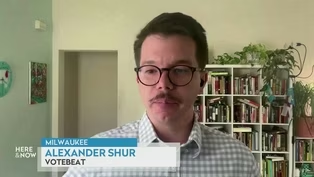
Alexander Shur on Vote Tabulation and Reporting in Wisconsin
Video has Closed Captions
Clip: S2500 Ep2507 | 5m 33s | Alexander Shur on a delay in Milwaukee's vote tally for the 2026 primary election. (5m 33s)

Here & Now opening for August 14, 2026
Video has Closed Captions
Clip: S2500 Ep2507 | 1m 1s | The introduction to the August 14, 2026 episode of Here & Now. (1m 1s)
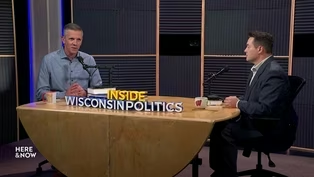
Inside Wisconsin Politics: The Governor Primary Spotlight
Video has Closed Captions
Clip: S2500 Ep2507 | 3m 8s | Inside Wisconsin Politics on Francesca Hong's close loss in the primary for governor. (3m 8s)
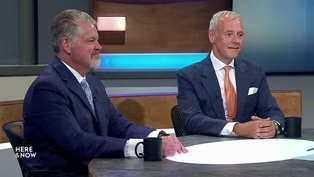
McCoshen & Ross on Wisconsin's 2026 Partisan Primary Winners
Video has Closed Captions
Clip: S2500 Ep2507 | 10m 45s | Bill McCoshen and Scot Ross on the outcome of Wisconsin's 2026 primary election. (10m 45s)
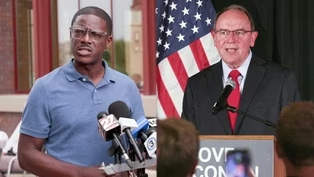
Recapping Wisconsin's 2026 Primary Election for Governor
Video has Closed Captions
Clip: S2500 Ep2507 | 3m 45s | David Crowley and Tom Tiffany started their general election campaigns for governor. (3m 45s)

Rev. Al Sharpton, Ben Crump Attend Corey Ruiz's Funeral
Video has Closed Captions
Clip: S2500 Ep2507 | 2m | Rev. Al Sharpton and civil rights attorney Ben Crump attend the funeral of Corey Ruiz. (2m)
Providing Support for PBS.org
Learn Moreabout PBS online sponsorship New Episode
- News and Public Affairs

Top journalists deliver compelling original analysis of the hour's headlines.
 New Episode
- News and Public Affairs

Today's top journalists discuss Washington's current political events and public affairs.
 New Episode
 New Episode
 New Episode
 New Episode


 New Episode
 New Episode

Support for PBS provided by:
Here and Now is a local public television program presented by PBS Wisconsin