
Inaugural GhostLight Gala, Black Artists Archive
Season 53 Episode 24 | 26m 46sVideo has Closed Captions
The inaugural GhostLight Gala and an organization archiving the legacy of Detroit’s Black artists.
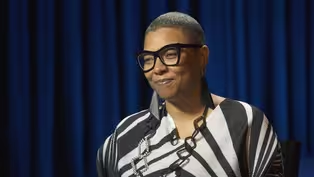
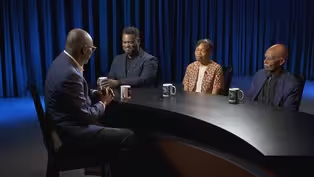
American Black Journal host Stephen Henderson gets details about the upcoming GhostLight Gala, which celebrates the arts and honors two prominent members of Detroit's arts community. Plus, Henderson learns about the Black Artists Archive, a new organization created by Dr. Kelli Morgan to preserve the legacy and cultural history of Detroit's African American artists.
Problems playing video? | Closed Captioning Feedback
Problems playing video? | Closed Captioning Feedback
American Black Journal is a local public television program presented by Detroit PBS
Inaugural GhostLight Gala, Black Artists Archive
Season 53 Episode 24 | 26m 46sVideo has Closed Captions
American Black Journal host Stephen Henderson gets details about the upcoming GhostLight Gala, which celebrates the arts and honors two prominent members of Detroit's arts community. Plus, Henderson learns about the Black Artists Archive, a new organization created by Dr. Kelli Morgan to preserve the legacy and cultural history of Detroit's African American artists.
Problems playing video? | Closed Captioning Feedback
How to Watch American Black Journal
American Black Journal is available to stream on pbs.org and the free PBS App, available on iPhone, Apple TV, Android TV, Android smartphones, Amazon Fire TV, Amazon Fire Tablet, Roku, Samsung Smart TV, and Vizio.
Providing Support for PBS.org
Learn Moreabout PBS online sponsorship- Coming up on "American Black Journal," we're gonna get the details on the upcoming Ghostlight Gala, an event that celebrates the arts and honors two prominent members of Detroit's arts community.
And we'll learn how the Black Artist Archive is preserving the legacy and cultural history of Detroit's African-American artists.
Stay where you are.
"American Black Journal" starts right now.
- [Announcer] From Delta faucets to Behr paint, Masco Corporation is proud to deliver products that enhance the way consumers all over the world experience and enjoy their living spaces.
Masco, serving Michigan communities since 1929.
Support also provided by the Cynthia and Edsel Ford Fund for Journalism at Detroit PBS.
- [Announcer] DTE Foundation is a proud sponsor of Detroit PBS.
Through our giving, we are committed to meeting the needs of the communities we serve statewide, to help ensure a bright and thriving future for all.
Learn more at dtefoundation.com.
- [Announcer] Also brought to you by Nissan Foundation, and viewers like you, thank you.
(upbeat music) - Welcome to "American Black Journal."
I'm your host, Stephen Henderson.
The Ghostlight Arts Initiative is holding its inaugural gala on June 29th at Detroit's Garden Theater.
The nonprofit organization promotes the use of creative performing and media arts as a means for social progress.
Its flagship event is the annual Obsidian Theater Festival, which launched in 2020.
Ghostlight Gala will celebrate the festival's works, and honor two notable members of the local arts community.
Joining me now is John Sloan III.
He's the Executive Director of the Ghostlight Arts Initiative along with the two gala honorees, Njia Kai, a well-known Detroit cultural arts producer and curator, and Dr. George Shirley, a history-making tenor with a distinguished career in opera and music education.
Welcome all of you to "American Black Journal."
- Thank you.
- So I'm not sure most people know about this effort of yours, John.
Tell us how you got started with it.
- Well, I mean, this really for me is the culmination of a lifelong struggle, right?
My love and passion for the arts and this burning desire that was implanted into me to make the world better when I leave it than when I found it.
And I've always believed the arts can be that, right?
We can use music, theater, dance, opera to show us who we have been, who we are, and who we can become.
And so the Ghostlight Arts Initiative is my way of trying to make that impact.
I moved back home from New York and on tour about seven years ago and launched this effort about five years ago now with the festival, the Obsidian Theater Festival as the kind of jewel of our programming.
- Yeah.
Ghostlight, tell me where that name comes from.
- So a ghostlight stands on a stage, right?
Whenever you walk into any theater, there are no windows because you wanna be able to control the light at all times.
And so the ghostlight sits right at the edge of the stage, and it's there when the theater is dark.
It's meant to shine a light, to provide a path.
Keep people from walking over the edge.
And artists can be a little superstitious.
And so the lore is that the ghostlight also keeps away all of the negative energy so you're walking into a space that is ready to create.
- Yeah, yeah.
So Obsidian has been around for five years now.
Talk about some of the, I guess, the highlights of that programming.
- Yeah, so we started in the middle of the pandemic.
- Yeah, right?
Perfect timing.
- Yeah, absolutely, to produce new work.
But we came out of a partnership between Ghostlight myself, Nnicely Theater Group, David Carroll, in trying to figure out a way to tackle 2020.
We all remember how difficult it was.
I think anything that I could say right now would just seem like a cliche.
I was stuck because I'm looking at protests, I'm actively protesting the murders of George Floyd, Ahmaud Arbery, Breonna Taylor, wrestling with the fact that it felt like half of the world realized racism was still a thing.
And then also as an artist feeling restrained, not really being able to do what I knew how to do to push back against that.
And the cathartic release that comes as an artist when you can work through that was something that was also kind of rubbing against me.
And so the festival came out as a way for us to say, "All right, how do we create a platform for this project for Black artists in specific to see their work produced and to have stories told?"
What we know is that when you have more writers of color with their work produced, then more youth of color are reading that work.
And you're seeing an accurate representation of them.
I had a professor in school that said, "There's nothing wrong with an Irish guy writing a story about a Irish family in an Irish bar.
There is something wrong with the system that says that that story is more valid than somebody else's."
And so the festival is our way of trying to level playing fields a little bit and to promote as much work as possible.
We've produced 28 individual productions over the past four, now five years, it is.
It's all in one weekend too.
So it's a Thursday through a Sunday, and it's 12 opportunities, four plays, a musical, a cabaret, and we rotate everything through three venues downtown and repping this.
- So these two honorees this year.
Tell me what is what it is about them that you think aligns with Ghostlight.
They're the best of who you wanna be, as directors, as artists, but more importantly as people.
And what was really important to us is to not just do a gala event to celebrate who we are, but to do an event to celebrate where we want the city to go, and how we want that to move.
And you can't do that without honoring individuals that have contributed so foundationally to where we are.
I know distinctly that both of these individuals have made me a better artist, but have more importantly made me a better person.
And there is a joy, I think, in being able to honor both of those things together.
- Wow, Njia, are you gonna get a better testimony than that anytime soon?
- He's hired.
- I'm leaving.
- Right, Njia, talk about your work and how it aligns with what John is trying to do and talking about, but also about the journey, right?
The struggle of an artist over a long period of time.
An African-American artist, an artist who's a woman in a city like Detroit.
This is a singular story I feel like in America.
- Wow, I'm humbled, of course, by the selection and by the reasoning that has been shared here.
I've basically been doing what Njia wanted to do.
I've basically been doing what I like to do.
And I'm so grateful that what I like to do is actually a contribution and has provided service, example, opportunity for a lot of artists here locally as well as from other spaces.
I do believe that arts are critical to development, to human development.
And so not having that is not an option.
And I don't see where human beings allow that to happen.
Even just looking at hip hop and techno and how these young people said, "Oh, okay, there's no arts in the schools, we're not getting opportunity to put our hands on musical instruments, the opportunities have been taken from us, so we're just gonna figure out how to scratch and bang and make it happen."
- [Stephen] We're gonna make noise on our own.
- We're gonna make it happen because there's something in all of us that wants a avenue of expression.
And for a lot of us who consider ourselves artists or who grow up to find out that we are artists, it's compelling, you gotta do it.
And so, yeah.
So I actually credit my mother for the most part, but my dad also, who my dad used to sing.
I just was so happy to remind Dr. Shirley that he and my dad were friends back in their Wayne State University days.
And my dad used to act and sing a bit.
Dr. Shirley went forward, my father became a minister.
So maybe there's still some of that talent, some of that talent's still being expressed.
But my mother especially, she used to arrange all of the teas and programs.
She would write the plays, she would direct, she would decorate.
And I was her minion, and I really enjoyed it.
And it got me into production.
I love almost any type of production.
I'm really there for it.
I love the process of having an idea and seeing it fulfilled.
- And execute it.
- And I love the community of it.
And so all of that feeds me., and I'm grateful.
Really, it's very humbling because I was doing this not selfishly, but very much self-satisfyingly.
And to know that it's a service that is appreciated is really, really, really great.
- Dr. Shirley, you are also, I mean, just an icon.
I mean, the both of you really stand out on the local landscape in terms of arts, and in your case also, arts education.
Talk about Ghostlight and receiving this honor.
- One of the great things about, one of the blessings being a teacher that you never know who's going to walk through your door as a student.
And a few years back, this young man came in who was a student at Michigan in the music theater, musical theater curriculum, and opened his mouth and out came this roaring lion bass voice.
And I thought, "okay, okay, okay, well."
And to see him go from Michigan and do the part of the lion on Broadway, and to have this wonderful career and then form Ghostlight, going beyond just being on stage, but giving back to the community, to young artists, what he was gifted with, what he was born to do.
That for me is just as exciting, maybe even moreso standing on stage doing something myself.
- Yeah, I mean, because you do both, you know, I always wonder which is more fulfilling, but it seems clear to you, - I started teaching music, choral music in the Detroit public schools in 1955 when I graduated from Wayne.
Started teaching at Miller High School.
And I've often said I had my job.
I mean, I didn't ask for it.
And my supervisor, a little feisty Irish woman named Marvel O'Hara, went to the Board of Education when she found out there was an opening at Miller High School for an emergency substitute.
I hadn't graduated yet, I didn't ask her to do this.
I didn't know.
But she went to the Board of Education and they gave me the job.
Where did that come from?
And so I had my job, my future wife and I were planning on getting married in August of 1956.
And Uncle Sam sent me a letter in May of 1956 saying, "You're going to be married to me in June."
Now Korea had ended, the draft is still alive.
And I said, "What is this about?
The Army's the last place I want to go."
But I had to go.
I believe in a higher intelligence, he's created everything.
Life works in mysterious ways.
For me to go into the Army was a curse, but it turned out to be a blessing.
- But it eventually brought you back, - Because it was a place that I was convinced to consider becoming a professional singer.
Opera, you gotta be joking.
We didn't have an opera program at Wayne.
Choral music.
And I love to sing it ever since Northern High School where we did "Messiah" every spring, every Christmas.
And people like Smokey, I mean Smokey was a few years behind me, but people like Morris Broadnax, who became an arranger at motown, and a composer, we sang together.
So the system of music education in Detroit was one of the best in the country.
- And it created all of these things that we now think of as.
- Barry Gordy knew what he had to grow.
- To pull from, right?
- So I have been blessed to be a teacher and a performer, again, in an art form that I, we didn't listen to the opera in my house.
We listened to Grand Ole Opry because my parents are from the South.
But it was a plan that was written for me that I had nothing to do with any more than I had something to do with being born.
I had nothing to do with that.
Or in any of the implants that I received through conception that have governed how I respond to stimuli from the outer world.
I'm just a blessed individual and I'm further blessed to have this happen.
- And this community I think is blessed by the fact that both of you are here.
I mean, I am someone who never fails the chance to try to just acknowledge that.
We are very special here in Detroit because of people like you.
All right, congratulations on the honor.
Congratulations on the project.
And thanks to all of you for being here.
- Thanks for having us.
- Thank you very much indeed.
- All right, up next, we're gonna get details on the Black Artists Archive.
But first, we've reached into our archives for this clip from a 1991 "Detroit Black Journal" conversation with actor and activist Danny Glover.
- On PBS, you were in "Raisin in the Sun," and you said you had never even read that book before.
And it's such a classic.
And even though it's 30 years old, it still stands up.
- Just look at him down there, just running around racing to work.
You look young this morning, baby.
- Yeah?
- Now just for a second, stirring them eggs, just for a second it was, you looked real young again, mm.
It's gone now, you look like yourself again.
- If you don't shut up and leave me alone.
- The first thing a man ought to learn his life is not to make love to no colored one the first thing in the morning, y'all some evil people at 8:00 in the morning.
- What did you enjoy most about that role?
- Well, you know when I started doing theater, Lorena Hansberry was considered anything prior to, and anything that did prior to that moment, 1967, or anything that did not express specific demands, revolutionary demands was considered reactionary, was considered that.
And so I didn't even, that wasn't even play a I read, I mean, the stuff I read was like "Pop's Daughter," or "How Do You Do Ed Bullins" or "Clare's Old Man Ed Bullins" and performed are Mary Baraka's "Mad Heart."
Talking about killing the devil woman.
I mean, certainly we placed that then we didn't understand the significance of "The Raisin in the Sun" and the whole continuum of African-American literature and theater.
And that it's a very classical play.
And that like most classical plays, it has enormous universality.
So we didn't know that, I mean, we didn't, we just put it down and put it aside.
- The Black Artist Archive was launched to preserve and celebrate Black art and visual culture.
The nonprofit organization is building a digital and physical repository that documents, collects, and safeguards the legacies of Black artists from Detroit in the Midwest region.
Here to tell us more is the archive's founding Executive Director and CEO, Dr. Kelli Morgan.
Welcome to "American Black Journal."
- Thank you, Stephen.
It's a pleasure to be here.
- What a wonderful idea.
Tell us where you came up with this.
- So it's been brewing for about really and truly my entire career to be honest, yeah.
And I've worked at various museums over the last 11 years.
I came home in '23 primarily because my mother and my aunt are aging and need handles, right?
And I worked at the Wright for about six or seven months, and while there, doing oral histories of so many of the older artists in the city.
And in having those conversations, would come up all the time.
Kelli, can you help me catalog or do you know anybody that can help me digitize?
So by the time five, six people ask, I was like, huh.
- There's an unmet need here, right?
- There's something here.
And I said I have a wide enough network nationally.
I said I think I can get it off the ground.
And so I went to Neil and I was like, "I love you dearly," right?
- Neil at the museum.
- Yeah, I said, "I'm gonna try to do this."
And he was just like, okay.
And so we are a little under a year old.
And it's tough, but we're trudging along.
- And the idea of course is not just to archive, but I would imagine to commemorate and celebrate in some way all of this material that we've created here.
I mean there's something about Detroit and our history that I think distinguishes us in some ways from other places in terms of the people who are here and what they've done.
- Yeah, very much so.
The way I call it like a professional genealogy, so the way people like Dr. Klee Taylor or Marian Stevens, even Dr. Shirley, right?
Who was on earlier went into the schools and just created this demographic, like this critical mass of people who are also doing really well in the arts across the different mediums.
And I kept getting conversations, or not conversations, questions, requests.
Dr. Morgan, I'm looking up this particular artist who was working in Detroit from 1957 and either the Wright had a very small file or no file at all, nothing at the Bentley, nothing at DIA.
And then the more I talked to Ms. Woodson and the more I talked to other artists, I was like oh, the work or the archives, like the evidence, primary sources, right?
Are in these storage units, are in people's homes, which would make sense.
Because people are still alive.
And so I said, "Well how can I create something that actually like delineates that out where people can actually trace these professional ancestors?"
- What do you imagine the end product here?
Where does it live and is it something that just ordinary people will be able to access?
- Yes, so we're in the process of building a very robust website that will actually integrate the database.
So anybody, yes, will be able to search it.
We do want a building.
Yeah.
We're thinking of doing a capital campaign next year because I have my eye on a couple of buildings around the city, yeah, because right now what we're doing is really taking our skillset and the framework to people with archives.
When we are contacted with people who have archives that aren't necessarily in the proper storage space, then I just kind of direct them to the right places that they can get it stored.
But hopefully, it will be a physical repository where people can actually come and see the materials themselves.
- I'm really curious about the interactions with the artists to try to help them organize these things.
Or maybe in some cases they are organized, I guess.
But just that moment of discovery of the value and the importance of what they have I think has gotta be really cool.
- They know.
- They already know, right?
- They super do, Stephen, they already know.
A really good example I can use is I see our partner Ali Wheeler and Alima Wheeler Trap.
They're the stewards of the Black Canon.
And they are the children of James Wheeler, who was a very well known activist historian.
And it's so interesting because they're totally aware, again, of how important the collection is.
But there are certain things that their dad had that they're just like, "that's just junk."
And I'm like, "Don't throw it that away," because they're trying to refine it so that their kids aren't kind of overwhelmed with it.
They're like, "We gotta get this stuff in order."
And I was like, "Don't throw that away."
So there was like this old tobacco can for instance.
And Alima was just like, "That's dad's old swill."
And I was like, "No, it gives people a sense of like who he was."
And she was just like, "Whatever, Kelli."
And so it's so interesting to have those kind kinds of conversations.
In the Black Canon case with descendants, you know.
But then we've been in conversation with Shirley Woodson and (indistinct) Reed about some of Mrs. Woodson's archive.
And actually we were talking just yesterday, and (indistinct) was like, "I got four boxes just of photographs."
And I said, "We can digitize them."
Yeah, and I said we can name it in honor of his father Edsel Reed.
And people can just look through because a lot of times you see like in the Black Canon collection, the candid photography, which has been really cool.
Mr. Wheeler was an actor in "Concept East."
So there are, again, candid photographs of some of the performances with Dr. Wright's mobile museum right there.
- Oh, you're kidding.
- Yeah, it's like, it's so amazing.
Yeah, and so Alima and I, I mean, it's been slow because we have other things, but we're gonna work on a show of that photography to really explain to your point earlier how often Detroit artists were working across genre, across medium.
- With each other, right?
- Yes, in neighborhoods.
- All of this came out of a community, not just individuals.
So very cool project.
We look forward to being able to dig through it.
Yeah, thanks for being here with us.
- Thank you for having me.
- So that's gonna do it for us this week.
You can find out more about our guests at americanblackjournal.org and you can connect with us anytime on social media.
Take care, and we'll see you next time.
(upbeat music) - [Announcer] From Delta faucets to Behr paint, Masco Corporation is proud to deliver products that enhance the way consumers all over the world experience and enjoy their living spaces.
Masco, serving Michigan communities since 1929.
Support also provided by the Cynthia and Edsel Ford Fund for Journalism at Detroit PBS.
- [Announcer] DTE Foundation is a proud sponsor of Detroit PBS.
Through our giving, we are committed to meeting the needs of the communities we serve statewide, to help ensure a bright and thriving future for all.
Learn more at dtefoundation.com.
- [Announcer] Also brought to you by Nissan Foundation, and viewers like you, thank you.
(bright music)
Black Artists Archive preserves and celebrates the legacy of artists in the Midwest
Video has Closed Captions
Clip: S53 Ep24 | 7m 43s | A new organization in Detroit works to preserve the legacy of African American artists. (7m 43s)
GhostLight Arts Initiative honors two Black arts trailblazers at inaugural GhostLight Gala
Video has Closed Captions
Clip: S53 Ep24 | 13m 41s | GhostLight Arts Initiative Executive Director John Sloan III discusses inaugural GhostLight Gala. (13m 41s)
Providing Support for PBS.org
Learn Moreabout PBS online sponsorship
- News and Public Affairs

Top journalists deliver compelling original analysis of the hour's headlines.

- News and Public Affairs

FRONTLINE is investigative journalism that questions, explains and changes our world.












Support for PBS provided by:
American Black Journal is a local public television program presented by Detroit PBS