Journey Indiana
Indiana Mysteries
Season 7 Episode 12 | 26m 46sVideo has Closed Captions
Indiana Mysteries: What's a Hoosier ? Muncie's 1973 UFO craze. Belle Gunness. Canal archaeology.
On this episode of Journey Indiana, dig into Indiana mysteries. Learn about Indiana’s original stumper: What the heck is a Hoosier? Find out what, if anything, explains the 1973 UFO craze that hit Muncie? Unearth the gruesome story of turn-of-the-century serial killer Belle Gunness. And join University of Indianapolis archaeologists working to demystify Indiana’s canal period.
Problems playing video? | Closed Captioning Feedback
Problems playing video? | Closed Captioning Feedback
Journey Indiana is a local public television program presented by WTIU PBS
Journey Indiana
Indiana Mysteries
Season 7 Episode 12 | 26m 46sVideo has Closed Captions
On this episode of Journey Indiana, dig into Indiana mysteries. Learn about Indiana’s original stumper: What the heck is a Hoosier? Find out what, if anything, explains the 1973 UFO craze that hit Muncie? Unearth the gruesome story of turn-of-the-century serial killer Belle Gunness. And join University of Indianapolis archaeologists working to demystify Indiana’s canal period.
Problems playing video? | Closed Captioning Feedback
How to Watch Journey Indiana
Journey Indiana is available to stream on pbs.org and the free PBS App, available on iPhone, Apple TV, Android TV, Android smartphones, Amazon Fire TV, Amazon Fire Tablet, Roku, Samsung Smart TV, and Vizio.
Providing Support for PBS.org
Learn Moreabout PBS online sponsorship>> Funding for "Journey Indiana" was provided in part by: >> The WTIU Vehicle Donation Program.
Proceeds from accepted donations of a car or other vehicle make this program possible.
Most vehicles are accepted and pick up can be arranged at no cost.
Learn more at WTIU.org/support.
>> Charitable IRA rollover gifts.
Individuals aged 70 and a half or older may make a tax-free charitable distribution from their IRA to WTIU.
Consult your advisor and visit Indianapublicmedia.org/support for more details.
>> WTIU sustaining members.
Committing to regular monthly contributions, providing WFIU and WTIU with reliable ongoing support.
Becoming a sustainer is one of the most effective ways to support public media.
>> And by viewers like you.
Thank you!
♪ >> Today on "Journey Indiana," we're investigating Hoosier mysteries.
Considered one of Indiana's earliest riddles.
>> Lots and lots of people, over a century plus, have spent a lot of time trying to find the origin of the word, and we failed and failed and failed.
>> Find out what was happening in the skies over Muncie.
>> I don't think it was out of the ordinary to have people seeing UFOs here.
>> Discover a bone-chilling case that left the public gobsmacked.
>> Even boys skipped school and came out on their bicycles to watch the digging out of Belle Gunness's farm.
It was wild and crazy.
>> And dig into a murky period in Indiana history.
>> It's a blind spot, in large part because it's kind of a maligned time in our history.
>> That's all coming up in this episode of "Journey Indiana."
♪ >> First up, let's talk about an original Indiana mystery.
What the heck is a Hoosier?
You would think that residents of Indiana would be known as Indianans or Indianians.
Nope!
We're called Hoosiers.
But what does this Midwestern moniker mean?
And where did it come from?
>> The word is two centuries old at least.
And in the early days, it sometimes meant an uncouth person, a kind of wild and crazy guy out here in pioneer Indiana.
>> However, by the 1830s, the word began to take on a new, more flattering meaning.
>> We see it in print in a newspaper in 1833, a poem called "The Hoosier's Nest," which is a wonderful poem.
>> The immigrant is soon located in Hoosier life initiated, erects a cabin in the woods, wherein he stows his household goods.
>> It's a very -- a very positive statement of the Hoosier's nest, the log cabin in which these so-called uncouth people actually build a good life, a family, a work ethic, and all the other values that we want to adore.
>> So by the mid-1800s, Hoosier was a common term for Indiana's upstanding residents.
But where did this term come from in the first place?
>> And the answer is, nobody knows.
And lots and lots of people, over a century plus have spent a lot of time trying to find the origin of the word, and we failed and failed and failed.
>> Though, there are many theories, such as early pioneers answering a knock on the cabin door with who's here?
Poet James Whitcomb Riley wrote a story about spectators of a frontier brawl picking up a severed ear and asking, who's ear?
And a recent Indiana House bill claimed that the state got its nickname from 18th century Methodist Minister Harry Hoosier.
>> None of them are verifiable.
None of them have documentation that a scholar, a historian would accept.
>> But how in the Hoosier is it possible that we don't know where such a widely used word comes from?
>> If we knew, we could make a million dollars.
From urban legends to historical legends, they just pop up, and sometimes they're based in fact.
Someone tells a story and it's true, and it just gets passed on and people forget the actual events, and they only remember the history.
>> The word Hoosier stuck around because it filled a need.
>> We were trying to make a cohesive group of people.
And I think that's what the word Hoosier does for us.
Okay.
We're gonna come together.
We're gonna be calling ourselves as one unified name, and it's no longer the hyper local.
It becomes coming together as a state.
>> Despite all that history, Indianan and not Hoosier was the state's official demonym right up until 2016.
>> If you've ever had to correct somebody who has called you an Indianan, today's the day to celebrate.
>> That's when Indiana Senator Joe Donnelly and then State Representative Todd Young convinced the United States government publishing office to make Hoosier the official term for all Indiana residents.
>> It's not just a classic movie.
It's not just the nickname for IU Athletics.
It's who we are.
>> Representative Young ran for and won a United States Senate seat in 2016.
He is currently serving his second term as a Hoosier senator.
>> Well, it was important, candidly, because we wanted to make sure that the language used to describe the people of Indiana was reflective of the language that Hoosiers actually use.
I'm always asked, but what is it?
It's somebody from Indiana.
Drop the mic.
End of story.
That's all you need to know.
>> And that's likely all that we'll ever know.
Hoosiers are Hoosiers, and that's just how it is.
>> I like the mystery of the meaning of the word Hoosier.
If anyone tells you they know, you ought to count your spoons because they're up to something.
We don't know, and I think that mystery makes us special.
I think that mystery is wonderful.
>> Next up, what explains the 1973 UFO craze that hit Muncie?
Let's find out.
♪ >> Muncie is sort of the typical Midwestern small city.
>> A very hometown feel, crossroads of America.
It's a good place to live and raise a family.
>> At first glance, Muncie seems like another small Midwestern town, but looks can be deceiving.
♪ >> There are a lot of weird and eerie things that have gone on in Muncie for very many years.
I don't think it was out of the ordinary to have people seeing UFOs here.
It had happened before, but in 1973, it was a much bigger deal.
♪ >> In 1973, something was happening in the skies above Muncie.
♪ What started as whispers turned into something much louder and much stranger.
♪ By October, these UFO sightings were so abundant that newspaper articles from the time read like a Hollywood script.
[ Siren ] [ Radio chatter ] >> Muncie went through sort of a UFO mania.
Throughout the month of October, there were hundreds of reports of UFO sightings in Muncie and Delaware County.
>> It just kind of seemed to explode for about five or six days.
>> One in particular, there was a woman who reported that an object had landed in her backyard.
And her neighbor reported hearing loud clicking noises at the same time as this occurrence.
And a sheriff's deputy came and spoke with her.
And he said, I don't know what she saw, but she definitely saw something because she was frightened.
>> Then it seems that the intersection of Wheeling and McGaillard was a hotspot because there were several sightings in that area.
♪ >> And just when it seemed strange enough, things got even weirder!
>> There was supposedly a call to police from something that happened near Wheeling, where people said -- the person who reported it said, "There are people out here that aren't people."
♪ And that one was always the really creepy quote that we found in the newspaper.
>> She had seen something silverly with scales is what she said.
So apparently the aliens landed.
♪ >> And panic ensued.
Like any good mania, word spread like wildfire.
>> A hundred calls to Muncie police, more calls to the sheriff's department.
Mostly it had to do with lights and moving objects, maybe lights low to -- to the ground.
It seemed to have to do with a lot of colored lights.
>> By late October, the sightings had become part of the town's identity, blurring the line between news and pop culture.
>> There was a Halloween costume contest at the mall that October, and a lot of people dressed in outer space outfits because of the whole UFO buzz that was going around Muncie.
We found an ad in the newspaper from November 9th, 1973, from the Dairy Queen that said, UFOs have landed at the north Dairy Queen and to come get a Horrible Creature sundae.
♪ >> The sightings continued for years, but the tone began to shift, more and more explanations began to emerge.
>> All the way up through 1977, there were stories in the newspaper, but gradually more and more of them had rational explanations for what they could be.
They found a piece of tinfoil was high in a tree and it was reflecting lights from neon signs from local businesses.
My favorite one was the UFO's explanation was an airplane that was flying overhead with a banner behind it that was advertising steaks for a local lounge, and that was the UFO.
>> The reports that came out, either concentrated on these helicopters or on weather balloons.
So maybe, maybe not.
♪ >> And while the skies eventually quieted, a new kind of light took over.
The bright lights of Hollywood.
[ Radio chatter ] >> The character that Richard Dreyfuss plays, Roy Neary, part of it is set in Muncie.
He has his UFO experience in Muncie in the film, and so the correlation between the two, because it's only four years apart from when the UFO mania hit Muncie and when the film came out, there's, you know, theories that that's why they chose Muncie as a location.
>> To some, they are just stories.
But for others, these moments are history worth preserving.
>> All of these stories, whether it's UFOs or, you know, unsolved mysteries, I think that has an important place in our history and something that people should know about and study just because it is part of our community's history.
We should sort of embrace that we have those stories here, because they also make us unique.
>> Next, the tragic and gruesome story of serial killer Belle Gunness and the mystery that still surrounds this case more than a century later.
[ Rooster crowing ] ♪ >> In May of 1908, Asle Helgelien confirmed his worst fears.
He had uncovered the remains of his missing brother Andrew.
♪ His body had been dismembered and buried in the hog lot of the Gunness farm in La Porte, Indiana.
N.E.
Koch, a local photographer, documented the grisly evidence.
♪ Just a few weeks prior, the house on the Gunness farm had burned to the ground.
Mystery began swirling even before the flames were extinguished.
The bodies of Belle Gunness, the farm's owner, and her three adopted children were found in the rubble.
Shockingly, the body of Gunness was missing its head.
Discovery of Andrew Helgelien's dismembered body sent speculation into overdrive.
What was happening at the Gunness farm?
More searches turned up more bodies, dozens of them.
A carnival atmosphere ensued, some 15,000 people showed up.
They came to watch La Porte County Sheriff Albert Smutzer conduct this ghastly investigation up close.
♪ >> They came out in horse and buggies.
They came in interurban trains.
Even people came in automobiles, especially wealthier people who could afford automobiles at the time.
Even boys skipped school and came out on their bicycles to watch the digging out of Belle Gunness's farm.
This was huge entertainment.
It was wild and crazy.
♪ >> And deeply tragic.
The remains of Jennie Olsen were soon found among the ashes, dismembered like the rest.
Belle Gunness had been telling people that her eldest adopted daughter was away at school.
Reality was ever so slowly sinking in.
Belle Gunness was not a quiet widow farmer.
She was a prolific and brutal serial killer.
Belle Gunness was born Brynhild Paulsdatter Storseth in Norway in 1859.
She immigrated to the United States in 1881.
At the time of the fire at the farm, she was twice widowed.
Her first husband, Mads Sorenson, died on the one day that two of his life insurance policies overlapped.
Poison was suspected, but no autopsy was conducted.
>> He came home from work, she said, and he wasn't feeling well.
He went to lie down.
He had been under a doctor's care for a heart ailment.
She said, well, I got some medicine from the pharmacist.
She said, I gave him this powder and then, of course, he ended up dead.
>> Belle remarried, this time to a man named Peter Gunness.
They used Belle's insurance payout to buy the farm in La Porte, however, Peter Gunness would soon be dead.
Belle claimed that a meat grinder had fallen from a shelf, striking him on the head and killing him.
♪ >> So that's what she said happened; however, it didn't just fall.
She clobbered him to make sure he was dead.
>> Suspicions were once again aroused, but no charges came.
Widowed once again, Gunness began posting personal ads in regional Norwegian language newspapers.
>> And the ad said, woman looking for partner, nicely located farm, would like to have a partner in same.
>> But there were stipulations.
>> Sell everything you own.
Bring only cash.
And don't tell anybody anything because this is a secret between the two of us.
♪ >> Many curious bachelors showed up to explore the offer.
They were rarely heard from again.
Based on examinations of the bodies found at the farm, the formidable Gunness likely bludgeoned the men to death.
>> And she would cut them up into pieces.
She cut off their heads, the arms and their legs, and then she would put them into gunny sack with quicklime to help preserve them until she could find a time for burial.
>> Gunness' greed and her ruthlessness seemed boundless.
>> I figure she killed at least 21 people.
She got an average of about $3,000 per person that came to the farm.
And if you take all them, I think she got at least $50,000 maybe all together.
So today's money, she probably got at least $1 million.
>> Her crime seemed clear, but one major Gunness mystery remained.
Without a head, it was impossible to positively identify her body.
The question lingered, had she escaped?
The alleged remains of Gunness were exhumed in 2007.
DNA tests, however, were inconclusive.
>> I was at the digging up of the body in Chicago and saw that skeleton and how it had been through a fire and the head was gone, the bits and parts of the body were burned off.
It's not her body.
I truly feel that she got away.
I don't think we'll ever find out any more details.
>> More than a century later, much is still left unknown about Belle Gunness and what drove her to commit such heinous acts.
♪ >> So I don't know what happened along the way to make her end up like this.
They say money is the root of all evil, and I think that's just what happened in this situation.
♪ >> Last, we'll join archaeologists from the University of Indianapolis as they try to demystify Indiana's canal period.
♪ >> Archaeologists Christopher Moore and Elizabeth Straub are digging into a mystery.
About a century and a half ago, this cornfield was part of the Wabash and Erie Canal.
This water superhighway traveled all the way from Lake Erie in Ohio, through Indiana, down to Evansville.
There are places where the canal is still navigable, such as the Wabash and Erie Canal Park in Delphi, but there's still a lot that's unknown about this unique period.
>> It's a blind spot, in large part because it's kind of a maligned time in our history.
There's a huge levy of tax money that was placed toward building things like the canal.
Unfortunately, most of the canal ended up not being profitable.
>> But that doesn't mean that this wasn't an important time in Indiana history.
>> The smaller towns like Delphi and Logansport and Wabash, Huntington, Peru, they were really, really tiny before the canal came through.
They were trading posts, basically, along the river.
They ballooned up after the canal came through.
The thing that brought most of our pioneering ancestors into this region, literally, was the canal.
>> The project is funded by a $100,000 grant from the Wabash River Heritage Corridor Fund.
Sites in Carroll and Cass Counties are being assessed.
The goal is to see which locations might be eligible for listing on the National Register of Historic Places.
>> And so ultimately what I'd like to see is a linear national register multisite that contains all of these Wabash and Erie Canal resources that we're finding, and that could be expanded in the future to cover the entire length of the resource.
So our work out there is primarily focused on trying to locate a section of the canal, excavate down to the bottom of the channel to see if there is anything that is left that would help us understand how the canal was constructed, so we can get a better feel for the way that the Irish dug the canal, what they did to the canal to keep the banks intact, you know, all of these sorts of things.
>> What Moore and Straub are looking for isn't profound.
In fact, it's often the stuff folks might have tossed out.
>> The main way that archaeologists can tell us more about the canal period and any period in history is that -- you know, unlike our histories, which tend to be written from a particular point of view, material culture, the objects that are left behind, they have a different kind of bias, right?
When you talk to somebody surveying you about your household consumables, for instance, you may not tell them about all the beer you drink, but the beer cans are still there in the trash.
And so archaeology can tell us about those kind of hidden things that maybe we didn't want to write down.
>> Today's big find is a lump of clay, likely left over construction material.
>> In areas like this, where the bottom of the canal is very sandy, they had to line it with clay.
And so this is probably some of the raw material that is left behind from that -- from that liner.
>> But a few miles away, at a small park next to the Wabash River, Moore hopes to learn about what day-to-day life was like along the canal.
>> That site is really interesting because it was a private residence that was converted to a tavern, and it was directly related to the function of the canal.
These taverns were located along the stretch to give people the opportunity to get off the boat, to have a good meal, to sleep in an actual bed that wasn't a canal boat bed, these sorts of things.
>> Preliminary digs here have been fruitful.
They've found items that speak to everyday life, such as ceramics, buttons and even jewelry.
>> In my opinion, the coolest thing we found so far is we found this crushed finger ring.
It has a red glass stone in it.
It probably wasn't a super expensive finger ring, but still it was somebody's ring.
You can imagine this on a person's finger, maybe put yourself into the -- the past.
>> And so with each new discovery, Indiana's canal period becomes a little less mysterious.
>> These little tiny fragments of the past that really open up -- they are vignettes into these bigger narratives about who people -- who our ancestors were and what their stories were.
And those stories are incredibly fascinating.
So, you know, archaeology helps us have a window into those stories.
It's never perfect, but, you know, it does help fill in some of the gaps in those broader histories that we have.
>> Thanks for watching.
We'll see you next time on "Journey Indiana."
♪ >> Funding for "Journey Indiana" was provided in part by: >> The WTIU Vehicle Donation Program.
Proceeds from accepted donations of a car or other vehicle make this program possible.
Most vehicles are accepted and pick up can be arranged at no cost.
Learn more at WTIU.org/support.
>> Charitable IRA rollover gifts.
Individuals aged 70 and a half or older may make a tax-free charitable distribution from their IRA to WTIU.
Consult your advisor and visit Indianapublicmedia.org/support for more details.
>> WTIU sustaining members.
Committing to regular monthly contributions, providing WFIU and WTIU with reliable ongoing support.
Becoming a sustainer is one of the most effective ways to support public media.
>> And by viewers like you.
Thank you!
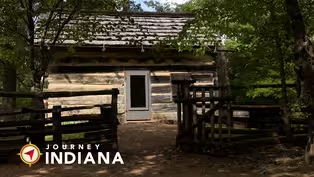
What the Heck is a Hoosier: the Mystery of Indiana's Nickname
Video has Closed Captions
Clip: S7 Ep12 | 4m 15s | Why are Indiana residents called Hoosiers? (4m 15s)
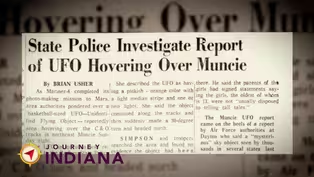
Close Encounters of the Muncie Kind: The Muncie UFO Mania of 1973
Video has Closed Captions
Clip: S7 Ep12 | 6m 34s | In 1973, the skies over Muncie, Indiana lit up with mysterious lights and unexplained sightings. (6m 34s)
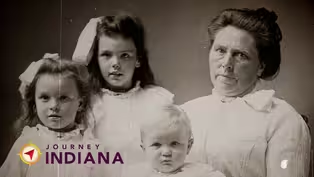
Video has Closed Captions
Clip: S7 Ep12 | 6m 35s | Belle Gunness was the most prolific female serial killer in United States' history. (6m 35s)
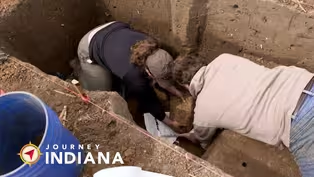
Mysteries of the Not So Deep: Digging Into Indiana's Doomed Canal Period
Video has Closed Captions
Clip: S7 Ep12 | 4m 59s | A new archaeological project seeks to learn more about Indiana's canal period. (4m 59s)
Providing Support for PBS.org
Learn Moreabout PBS online sponsorship












Support for PBS provided by:
Journey Indiana is a local public television program presented by WTIU PBS