
IndieWire Craft Roundtables: Composing
6/11/2026 | 26m 31sVideo has Closed Captions
Composers discuss their work in some of the biggest TV shows of the year.
Top creatives discuss composition from some of the biggest TV shows of year. Composers examine their work in “Murderbot”, “Spider-Noir”, “Alien: Earth”, and more.
Problems playing video? | Closed Captioning Feedback
Problems playing video? | Closed Captioning Feedback
IndieWire Craft Roundtables is a local public television program presented by PBS SoCal
IndieWire Craft Roundtables: Composing
6/11/2026 | 26m 31sVideo has Closed Captions
Top creatives discuss composition from some of the biggest TV shows of year. Composers examine their work in “Murderbot”, “Spider-Noir”, “Alien: Earth”, and more.
Problems playing video? | Closed Captioning Feedback
Where to Watch IndieWire Craft Roundtables
IndieWire Craft Roundtables is available to stream on pbs.org and the PBS app.
Providing Support for PBS.org
Learn Moreabout PBS online sponsorship♪♪♪ Jim Hemphill: Hi, I'm Jim Hemphill, features writer for IndieWire, and this is our crafts roundtable on composing for television, where music becomes the emotional thread connecting story, character, and tone.
From subtle cues to unforgettable themes, our guests help define how these shows feel.
Our guests today are Kris Bowers and Michael Dean Parsons, composers of "Spider-Noir," from "The Boroughs," John Paesano, from "The Madison," Breton Vivian, from "Murderbot," Amanda Jones, from "Alien: Earth," Jeff Russo, and the composer of "Monster: the Ed Gein Story," Mac Quayle.
I guess I wanna start by talking a little bit about some of the long term collaborations that a few of you have had with the showrunners on your shows.
Like for example, Mac, I think you've been working with Ryan Murphy for what, 11 years, something like that?
When you come on something like Ed Gein, how much advanced notice do you have?
What are the initial conversations with him like?
Mac Quayle: The circumstances really mirrored the first show that I did for him, which was "American Horror Story" season four, and I came on late in the process, they'd tried some ideas that didn't work out, and now they're running out of time, and I get a call, and I go into a meeting with Ryan, and he's like, "I need a horror score, I need themes, and we have, you know, almost no time."
So he's like, "I need you to do what you did on "American Horror Story" for us," 'cause it was the same thing.
I came in last minute, and it was exciting and terrifying.
Jim: Well, actually, I guess that raises a question I'd be interested in hearing from all of you, which is how early are you able to come on your shows, 'cause I know in some cases, like I think Jeff, you've been on "Alien: Earth" for years and one steps another, but then I'm assuming there are others that are more like what Mac is describing, where you're coming on very late in the process.
So how early did each of you come on your shows, and what state was the show in?
Jeff Russo: Typically with Noah, 'cause I've been working with Noah for almost 17 years, he will send me scripts right at the very, very beginning, and I'll start writing thematic material like, right off the bat, and then there was an amount of time that we stopped because we had to make "Fargo" season five, so we went and made "Fargo" season five and then came back to "Alien: Earth," and then it just--all the thematic material started to coalesce.
Kris Bowers: Having that much time away, how did that impact your approach when you came back to it?
Did it feel fresh?
Did it feel like you had to kind of get acclimated again?
Jeff: Well, it's interesting, things changed, right.
The first and second scripts were one thing, and I started writing, and then when he came back to it a lot of changes have been made to the first two scripts.
So I had time away and I got to rethink thematic material that I had already written, so I got to rethink that through.
It was actually really helpful in order to really grow the idea across the whole season.
♪♪♪ Breton Vivian: Do you prefer script or to the actual picture?
Jeff: I wouldn't say I prefer one or the other.
I think that it's really great to start with one and then end up with the other because you have a totally different way of looking at it, right.
So when you're looking at just the script, I'm only thinking of what is in my head and how that affects what I'm writing, and then when you start to see a picture, things start to change and things start to get rewritten or re-edited and moved around, so I like both.
Breton: I feel like you can come up with a ideas that you probably wouldn't have had you just started with the picture, you know, 'cause you--as you're away from it you're just sort of thinking very abstractly about the worlds.
Jeff: I think that's a really important, really important thing, and I wish more filmmakers would do that for us.
Amanda Jones: For "Murderbot" I actually read the book first and then saw the creators, so I just started writing music, and I sent it to them and I was just like, "Hey, I'd love to do this," and they were like, "Let's go," and so I started writing.
I had probably like, six to eight months of just creating ideas and just based on what I'd read, and then they sent me the script, and it was a long incubation period of just playing with, you know, like, synthy electronic ideas or like, kind of like, '70s like retro ideas, and it was just really playful and a lot of fun, and Skarsgard's performance was extraordinary, and you want to leave space for that powerful performance, so playing with a lot of just singular ideas like just pitch, weird frequencies, and silence, and just giving him that space to be awkward and strange.
Kris: Did they start cutting to your music since you had so much you were able to share early?
Amanda: Yes, they did, and same with the main title.
The main title was animated to what I'd written, which is pretty cool.
♪♪♪ ♪♪♪ Jeff: That definitely makes our job easier.
The editors probably don't like it as much.
Amanda: Oh, you think so?
Jeff: You start to give them music, and then now they're like, "Well, I was gonna put Hans in it, and I can't do that now."
Jim: And then, Breton, you've worked with Taylor Sheridan obviously before too, so with "The Madison," again, like how much advanced notice did you have?
Breton: I came on really late, so by the time I was on I could--I watched the whole thing and could tell the whole arc of the story, which is good, 'cause like, there was these big scenes that were really important to the story that I was like, okay, I've got to start subconsciously thinking about what I'm gonna do there, and it also helped me to think about, you know, I need a bunch of themes that are gonna be really important to weave throughout the story, and so I came on because he loves "1883," it's his favorite of the scores that we've done, and he just wanted something in a similar vein, and so in a way it is different because the story's very different, it's not people, you know, at war with each other, it's about grief, but there's that kind of through line between the two, and I guess it's trying to have that sound that is sort of of the universe but not the same, basically.
male: Everything okay?
female: No, Russell, I wouldn't say so.
male: What happened?
female: A lot of emotions, Russell.
They have no idea where to put them.
I'd give them some space so they don't try to put them on you.
Jim: John, with "The Boroughs," how did you come on board?
John Paesano: I came on relatively early.
You know, we were kind of going for this, I hate to call it throwback, 'cause I remember it like it was yesterday, 'cause it'd be like throwback to me, but I grew up on, you know, Horner and Newton Howard, and, you know, kind of the great maestros of the '80s and '90s and we really had this idea that we wanted the show to be kind of be in that world, and there was a feel to it, and I thought, okay, like it's one thing to come up with the music in that style, but a big part of that style is how the music was written to picture as well, and they didn't have all the technology and all the things that composers have at their fingertips today where they had to kind of, you know, read a script, look at footage, make, you know, a couple markers maybe on their manuscript where they wanted to hit certain things.
It was a very looser--much loose process than it is today with all the technology that we have, and so I wanted to kind of adopt that process in writing the score as well.
So, you know, we did a lot of sketches, a lot of suites, a lot of kind of, you know, big broad ideas, and we weren't so tied to picture, so the process started relatively early.
♪♪♪ ♪♪♪ male: Get down.
John: The goal for me with all these suites is I want the directors and producers and people involved to be able to shut their eyes, listen to the music, and kind of see their, you know, whether it's film or a show or however it is, and that's why those scores, I think, from the 80s and 90s are so colorful and they're so vibrant is because a lot of times they were written from the imagination.
They weren't concerned about dialogue and visual effects and all the things you have to be conscious of once you take that music and put it against the show.
It's kind of a minefield to write just straight against picture, 'cause you have to be conscious of all these different things that are going on with the screen, so coming up with your ideas and your big kind of, you know, big thematic ideas is tricky against pictures sometimes, and so kind of getting in there early, I think, helps that process a little bit.
Kris: We didn't have much time at all.
Yeah, we came in pretty late, and the good thing about that is we actually were able to watch the entire series, and like, they were picture locked when we came in so we were able to watch the whole thing and really get a feel for it, and, you know, when I first talked to Oren and the filmmakers, they had temp in there that was modern but really loop based, and the thing that was really challenging about it is that the series is really calling for music that is engaged with the picture and has not only thematic material, but also is scored to picture and advancing with the picture and with the arc of the story, and to try to do that and have some sort of modern sound to it, it felt like a challenge that was pretty impossible with the amount of time, and so I immediately asked to bring in Michael because I've been looking for something for us to collaborate on.
We've been collaborators for a while now and friends for a while, and I just have such respect for how Michael approaches things, and this idea of needing to be able to have music that respects both the noir "Maltese Falcon," you know, Bernard Herrmann, Franz Waxman style of writing along with modern production and like, weird unorthodox things, it felt like a great place for us to kind of jump into that.
Michael Parsons: Yeah, I mean, we knew from the very beginning that it was gonna be a richly thematic score, and it was almost scholastic in the sense that we were saying we're gonna have themes for every character, we're gonna have motifs for every character, we're gonna have scenes where one character's motif is playing while another is being hinted at via some kind of weird sound, so we knew seeing the whole series that we would be able to craft these arcs that even if you were only hearing maybe like, three or four seconds of that theme in the first episode, by episode eight when that character has a full transformation it really unfolds, and then another big part of our discussion outside of the thematic writing initially was setting because this takes place in New York, and looking at that rich, noir history we thought, man, we're gonna have to have a lot of kind of early jazz influence, and it was very interesting because the showrunner said, "You know, for me New York City is punk '90s guitar," and so that started to like, wait, this is not just a noir homage kind of score, this is like we're gonna take recordings and stretch them out, we're gonna record street trash cans and like, bucket drummers, and like, turn that into percussion and make it into this thing that's not just an homage, but is also all these different influences coming together.
♪♪♪ ♪♪♪ John: These scores are big, they're cinematic, they're orchestral, they have collages of everything in them.
Especially something like a Spider-Man, you're looking at like, a film score per episode, you know what I mean, in the sheer volume of music that you have to get through.
I mean, we really are, I mean, I don't think--I have a team.
I think a lot of people have other people involved in the process.
I always say that the behind the scenes in film music is--it's like visual effects.
I mean, it's wild the amount of people that lend themselves to these scores and that are involved with them, and you don't really get to see it.
With visual effects it's so visual it's on the screen, but music, great scores are ones you kind of feel and don't necessarily hear all the time, and so just it always amazes me just to get to the end of the finish line on these projects, 'cause just the sheer volume of music that has to be written in a certain amount of time is just, and we've had a lot of time I mean, but something like a Spider-Man, you guys don't have a lot of time.
I mean, it's wild to get through that amount of music, and just, you know, just it's always impressive.
Jeff: Between all of us, half of us sort of had a lot of lead up time, right, and we started at the script stage and thematic material and all that, and then the other half like, was brought on right at the last minute, which do we like more?
Kris: It really depends, I think I could--there's pros and cons to both for me.
I feel like with this, the great thing is that you don't really have time to think, and it's just like, responding and just trying things, and then I feel like sometimes, especially for me with a jazz background-- Amanda: You have to write improvisation.
Kris: Yeah, like kind of comes out and like, I feel like I can trust my instincts a little better.
Like you guys have said about, you know, having a lot of time, there's also the pleasure of being able to write something then come back to it a month later and be like, actually, I want to approach it this way or being able to see how something evolves over time, so yeah, I feel like, pretty mixed.
John: Yeah, I feel like, the same way.
I mean, it's funny, it's like a one size doesn't fit all, right.
Like, it all depends on who's in charge and who's making these decisions and kind of what their taste is, and that's why the working relationships, like you guys, you know, work with people over and over again, that conversation becomes much more maneuverable, so to speak, but if it's like a first time person, it can be a little bit tricky navigating that.
Jim: When you're working with a new director, how do you find that common language?
John: I always try to tell, you know, people we're gonna treat me like--don't treat me like a--treat me like an actor because technical music information is not gonna help me with anything.
I need to know more emotional and what they're striving for in a scene or a show or like, what feel do they want.
Mac: I've had experiences where directors and producers, they appear pretty uncomfortable in this role of like, trying to tell me what it is they want, and some people will tell me, "I don't know anything about music," but, and they'll say that like, repeatedly, and over the years I've just--I've come to think that we're kind of intimidating, you know?
It's like we're like, these wizards, we have this magical music that we create that people don't understand, and the other parts of the filmmaking process, they know more about it.
It's like acting, there's the actors and the camera and the editing and the sound, you know, but the music is this other thing, and so not--I mean, there's many directors that are very comfortable, but I've definitely worked with some that are just like, "Okay, this is--this--what is this sorcery?
I don't know how to interact with this person," so it's been kind of amusing.
Jeff: We're certainly like therapists, trying to get an understanding as to what makes people feel one thing or another, and I've had that conversation with filmmakers before as well, like, asking the question, what is it that makes you feel happy or what is it that makes you feel sad in terms of music, and I'm talking about like, anything.
Do you like to listen to Taylor Swift, and that can sometimes help, but we are magicians.
Amanda: It's definitely easier to work with a director that knows what they want, but someone that doesn't know what they want, I just kind of dig in, just like, try to figure out where they are in life, like what do certain terms--like what does jazz mean to them?
What does hip hop mean to them?
What are their favorite classical artists or whatever?
What are they listening to now, like what's on their playlist, you know.
It may not be what the sound of the show is.
It just allows me to understand like, who they are and how they think, and having like, a better grasp on that will then make the creative process easier.
John: It really is a collaboration, and what you're saying is so important.
Like, you have to be able to vibe with who you're working with to have those free conversations.
The scores that we all kind of love, there's also, besides the composer who wrote it, there's a whole other bunch of opinions that go into that piece of music that ends up being the way it is, so film scoring really is a team sport.
Mac: That's a great collaboration.
I mean, to get the notes that makes it better, something that you wouldn't think of.
I mean, we've probably all gotten some of the other kind of notes.
[laughter] Mac: I mean, I'm just--I feel like I've been so fortunate that I work with people that give me good notes, you know, and it makes it better.
Jim: Well, it's similarly in "The Madison," I've got a question for you about writing to the performance because the interesting thing about your score is your score is doing a lot of heavy lifting on that show in terms of kind of conveying the internal state of this character, the Michelle Pfeiffer character who's grieving, and, you know, your music is almost like this additional form of expression for her.
So, you know, tell me a little bit about that, about finding a musical language for that character and how you were influenced by what she was doing.
Breton: She's such an incredible actress that I just--there would be scenes where there's tentá doing a lot of the heavy lifting and really I didn't need to do much, like just something to hold that performance sort of in place really, and to just sort of under--have an undercurrent of score underneath her and let her do her thing.
Like, the last thing I wanna do is be like, everyone listen to the music.
This is, you know, this is what we should all be listening to, not her performance sort of thing.
So a lot of her performance was helping me strip back the score.
I was playing around with breaking the theme up and just having little fragments, so it's almost like the score is feeling grief as well and coming to terms with what's happening, you know, and kind of in shock as well, and it's only until she starts getting through it all and starts understanding--having a better understanding of her loss and her grief that I can start to bring the score back in and have it tell a bit more of the story sort of thing.
Amanda: Yeah, capturing like, the internal state of Murderbot, Alexander Skarsgard's character, was really, really important, and so the way I ascribed that feeling was with a Roland Juno-60, it's an analog synth.
I wanted to find something, and there's a bunch of analog synths that do this, but something that could just kind of go rogue, and that's the same sort of plot for "Murderbot," it's like, this robot that's gone rogue, so just having this synth that just kind of has a mind of its own and is creating these sounds, which is like--which is complimenting Murderbot's internal state and just--there's that, but he's also like, finding his humanity as he becomes more sentient.
So blending like, synth with organic instruments, but specifically just finding instruments that were just as similar to synths.
Like, there's like an instrument that I would use that I had in my library, a sangban.
It's like, a Korean kind of like, reeded instrument, and they can go so high and it's such a piercing crazy sound, but then you can like, bend the pitch, and then same with like, the synth, you can do the same thing, you can get these crazy high frequencies and then bend the pitch, and I would like, double them, and it would created the craziest like, semi-tonal like, dissonances, they were kind of coming apart and coming back together, and like, it was crazy, and that anxiety that it induced was like, just paralleling his journey of like, having to make eye contact with certain crew members and just being more human, and it was just so cool to play around with that and.
Jeff: We did kind of the same thing.
There was a--'cause there's a nostalgia to the feeling of the scores from "Alien," and I needed to figure out how to incorporate some of that while continuing to make it sound modern.
So there's all kinds of synths and all kinds of esoteric instruments.
As I was saying, this thing called the bassdesmaphone, which is this instrument that was built by a company in Switzerland.
It has a very evocative low sound combined with the orchestra, and we went to Abbey Road and recorded Abbey Road to get that sort of big cinematic sound that you also might equate with these movies, you know.
That first movie was one of the great horror movies and the second one is one of the great action movies, and we kind of needed to do both of those things, so there's big percussion and a big orchestral sound, but we went with tape for tape delays, which is what they used in that first movie, and giving a little bit of the tip of the hat to that kind of stuff was really, really, you know, important to-- John: Oh, all that old school tape delay stuff is really cool.
Jeff: And I did--that's how I was able to nod to that score, was the tape delay on the horns, which was a lot of fun, a lot of fun to do.
Like, once we found it, it was like, oh yeah, there it is.
That's it, that's the thing, let's do that.
Jim: That's something that you do really well, Mac, on your show is that thing of like, finding a parallel language for the music for the character.
Mac: I didn't do what you mentioned, the stress test of the theme, you know, to see like, what was gonna do--what was gonna happen.
I just was like, okay, I need a creepy theme for Ed and his mother.
and I'm hoping it's gonna be able to do some other things, and the creepy part, this is what I started with, that's what I presented to Ryan after two days and recorded live, and they were like okay, and then sure enough, I had--I took it for a funeral scene and I made it sad, and it worked.
I'm like, whew, okay, and then it was like, dramatic and then later on I needed an uplifting version, and I reharmonized it a few major chords, and boom, it--and it worked, so I kind of lucked out that the theme could do all those things.
♪♪♪ ♪♪♪ Mac: Because yes, it's a horror show, but Ed is a very damaged--he was a very damaged person, and so Ryan wanted the audience to be able to feel a little bit of something for him, even in spite of all the horrible things that he did, and so I was a little conflicted about that myself, but I--that was the job and, and it--I think it did what Ryan asked.
Jim: How do you see your role in terms of kind of unifying the tones of the show so that like, the score, it all sounds like it's of a piece, but you're also servicing all of these kind of different genres and tones that are being crossed together in this stuff?
Kris: When we first came on because we didn't have time to kind of create this theme suite that helps us prove what the range of the sound is gonna be over the course of the whole show we decided to look at strong thematic moments for a handful of characters across the first couple of episodes.
Michael: Once you have the right themes and the right textures and each character may have their own unique sound palette, suddenly everything kind of just starts to work, and that panic over like, oh my god, we're in episode one, how are we gonna get to the end, and suddenly you go, I don't know what to do with this scene, but if I take this character's texture, and I take this character's melody and I start to superimpose them, if you've done your job right I find that that kind of lets you find that path more quickly, and it's not the kind of thing that you expect an audience member to track over time or to perceive, but, you know, it's something that when we do it and the showrunner and the filmmaking team feel our passion for it, I think it just kind of subconsciously makes it all feel that much more like, internally logical in a way.
Jeff: We have so many choices now.
Like, when you think about the, you know, composers that we're talking about, from Herrmann and all of the great film composers of the '40s, '50s, '60s, '70s, like, they didn't have near the amount of choices that we have.
So we sit in a room, and we basically have every sound known to man, right, and we can put any of it in our scores.
So we have a lot more decisions to make than they did, so they had a lot more confidence because they had only that to work with.
Mac: I love being able to restrict the choices.
In Monster, it was just a handful of instruments and it just felt it didn't need something.
It was cello, violin, percussion, a lot of like, crazy percussion, piano, and a few woodwinds, and then that was it.
Like, I wasn't dipping into the infinite sound well, and it was just--it's so nice, 'cause then it's like, well, there's the palette, it's very simple, that's all I need to do, I don't have to go, and it--I don't know, it makes it so much easier for me.
I don't get to do it a lot, 'cause, you know, that infinite sound well is very tempting.
Kris: Did you decide on that restriction at the beginning or did it kind of evolve into that that feels set, now I'm not going to touch it anymore?
Mac: No, it evolved, you know, it took like, the first episode and then we had it, and it was like, this is pretty much--we hadn't added the woodwinds yet, that came in like, episode two or three, and then it was like, that's it, it doesn't need anything else.
I think I had like, one synth pad and two cues, and that was it.
Everything else was organic and I just--it was working.
Jeff: Right, once you find it you can sort of relax.
It's that moment where all the lights are out, and you're feeling around.
You're like, oh, okay, I could use that, I could use that, I could use this, I could use that, I could use this.
Okay, now I really need to narrow it down.
That's the frightening part, and then you get it in that--after that first episode or whatever, and so much of what we do is feeling around the studio in the dark, you know, where we're all just trying to figure it out as we go.
There isn't one sit down and like, I know exactly what I'm going to do here.
That almost never happens, right?
We spend so much of the time building a score never knowing what the end or where the end is gonna be until the end is then in front of you, and you're like, oh my God, I'm done.
John: Or they say good projects are never finished, they're abandoned.
That's--for me too that's always the hardest.
Like, I'm--to have the confidence to be able to put down just some basses and a piano in a scene and go, that's it, that's perfect, that's what I need to do, that's brutal to get through as a composer when you have all this education, this information, and, you know, you're thinking of all the great scores you grew up with, and you have to kind of like, put these--it's just a really difficult thing to have the confidence to just do what the scene needs and not overdo it, 'cause I've overdone it before too, and that's always a bad feeling too when you--I remember I wrote a great--I wrote a score that I thought was incredible, and I remember I went to the premiere of it, and I'm in the audience going, oh my God, there's that damn theme again, and just huge.
I'm just like, oh my God, who put this--who let this go in, you know, and so you do, you rely on your filmmakers as well to be that kind of stopgap as well, and you hope you get enough people behind it, but it's tricky.
It's hard to have that confidence when you're in a bubble like that and you're just kind of working, and 'cause it is a very kind of solitary job.
I mean, you're kind of on your own for a lot of it, and I've kind of surrounded myself in my process with people that I try to encourage to tell me if something is bad, but it's tricky.
Yeah, it's tricky business.
Jim: Well, just as all scores are eventually abandoned, it's time to abandon this roundtable, but this has been great.
Thank you all for doing this.
Your work on each show is really incredible.
I appreciate you taking the time to do it.
♪♪♪ ♪♪♪ ♪♪♪ ♪♪♪ ♪♪♪
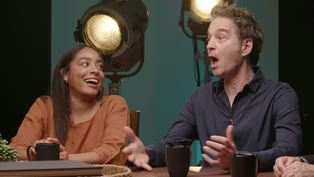
IndieWire Craft Roundtables: Composing (Preview)
Composers discuss their work in some of the biggest TV shows of the year. (30s)
Providing Support for PBS.org
Learn Moreabout PBS online sponsorship New Episode
- Arts and Music

Innovative musicians from every genre perform live in the longest-running music series.
 New Episode
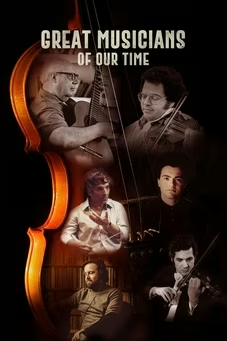
- Arts and Music

Intimate portraits of six of the most influential and celebrated classical music artists.
 New Episode

 New Episode


 New Episode
 New Episode
 New Episode
Support for PBS provided by:
IndieWire Craft Roundtables is a local public television program presented by PBS SoCal