
IndieWire Craft Roundtables: Editing
6/11/2026 | 26m 31sVideo has Closed Captions
Editors discuss their work in some of the biggest TV shows of the year.
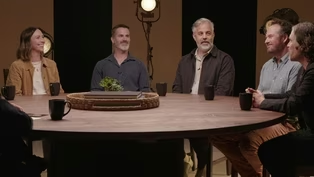
Top creatives discuss editing from some of the biggest TV shows of year. Editors examine their work in “Beef”, “Shrinking”, “Hacks”, and more.
Problems playing video? | Closed Captioning Feedback
Problems playing video? | Closed Captioning Feedback
IndieWire Craft Roundtables is a local public television program presented by PBS SoCal
IndieWire Craft Roundtables: Editing
6/11/2026 | 26m 31sVideo has Closed Captions
Top creatives discuss editing from some of the biggest TV shows of year. Editors examine their work in “Beef”, “Shrinking”, “Hacks”, and more.
Problems playing video? | Closed Captioning Feedback
Where to Watch IndieWire Craft Roundtables
IndieWire Craft Roundtables is available to stream on pbs.org and the PBS app.
Providing Support for PBS.org
Learn Moreabout PBS online sponsorship♪♪♪ Jim Hemphill: Hi, I'm Jim Hemphill, features writer for IndieWire, and this is our craft roundtable on editing, the craft that shapes performance, pacing, and storytelling in television.
It's where structure and emotion come together, often in ways the audience never sees but always feels.
Our guests are from "The Pitt," Mark Strand; from "Beef," Lauren Connelly and Laura Zempel; from "Shrinking," James Renfroe; from "John Candy: I Like Me," Shane Reid; from "Jury Duty Presents: Company Retreat," Christian Hoffman; and the editor of "Hacks," Jon Philpot.
I was trying to think of like what these shows had in common because, you know, we've got documentary, we've got whatever "Company Retreat" is, whichever--hybrid, and so I guess I wanna start by just kind of asking what for you were the overall guiding principles in terms of tone on each of your shows.
Let me start with you, Mark.
Mark Strand: On "The Pitt," that's the thing that is most important to us is not veering into melodrama.
It would be so easy to do.
There are so many medical dramas out there in which that that's sort of the bread and butter, and that's what they're sort of cashing in on.
And so trying to ground it in reality, as all these shows do, except for yours, is of utmost importance and how we do that on "The Pitt" is we are bouncing every feeling through our doctors, and so they're diagnosing issues and they're trying not to be a part of the emotional journey of their characters.
Obviously they can't help but be a part of that, but rather than getting in between two patients and patient's spouse, that moment will be observed from our doctors' points of view, and that's sort of how we sort of at least take one step away from that.
And those are the people we care about the most anyway.
They're our characters, and so it's really how it's affecting them, and so we try to ground it that way.
speaker: [inaudible] if they have a OR ready.
speaker: About time.
speaker: Maybe he's been grading down a bit more.
speaker: Looks like it's taken a turn for the worse.
speaker: Eclampsia, refractory seizures, HELP syndrome with anemia, and thrombocytopenia.
speaker: Agh, about as bad as it gets.
speaker: Defib.
speaker: Chest compressions, nasally, charged at 200. speaker: Prep the belly, get a baby warmer.
Jim: And how about with "Beef," and, you know, the interesting thing about "Beef" Season 2 is, it is, you know, it's spiritually similar to "Beef," but also quite different in terms of the rhythms of it and the tone and everything else.
Lauren Connelly: You know, for me, one thing that really drew me to "Beef" was that I love to laugh in, like, the darkest of moments.
For me, when I'm telling a serious story even about my own life, I will crack a joke, and I think that's something that "Beef" and Sunny does incredibly well, and I think that, you know, tonally keeps it out of melodrama.
I mean, I think there is an amazing relatability to all of the characters that he's created and the way that, you know, we edited them.
And you still relate to them despite how crazy the stuff is happening around them, and you can see how something, you know, really small can escalate and it--even though it seems really unlikely that would ever happen, somehow it kind of felt like, oh yeah, that could totally happen.
Laura Zempel: Right, and I think the biggest challenge from Season 1 to this new season is Season 1 we had two main characters.
This season we have four, maybe six, like, there were so many more characters to balance, and their humor, their relationships, the eroding of their relationships and drawing the parallels as the younger couple becomes the older couple.
There was so much to keep in mind, but I think because the scripts and the story has such an undercurrent of humor, it keeps it from tipping into melodrama.
speaker: Stop, stop it.
Jim: Well, that--and that's something you have to deal with on "Shrinking" also is the sort of multiple ensemble storylines and keeping those in balance.
James Renfroe: If I feel like I'm dipping into something that feels too saccharine and it feels not real, then I generally try to avoid those performances.
Similarly, from a comedic perspective, I try to keep in mind what my ceiling is, what characters are allowed to reach that ceiling, what characters aren't allowed to reach that ceiling.
And from a dramatic perspective, I try to keep an eye on where my floor is.
So if there is something incredibly tragic, it's okay to sort of get closer to that bottom, but you can't live there, and you don't want to score it heavily, so that you are, like, turning what would have been a dramatic moment into a melodramatic moment, and sort of balancing all those tools and those moments.
[all singing] speaker: [singing out of tune:] One step closer.
Oh jeez.
speaker: That was so, so early.
speaker: Yeah, I know.
I'm sort of off my game.
I don't normally meet someone's whole family and whole daughter on the first date that also happens to fall on their dead wife/mom's birthday, so.
I don't know.
speaker: She's super-weird.
I like her.
Jim: Well, and with the John Candy documentary, you're making a movie that is a movie about a very funny guy, but then also the movie itself is very poignant and, like, how are you riding that line and what did you want the kind of overall emotional effect to be?
Shane Reid: It's different than everyone on this panel because you're playing with nostalgia and you're playing with, like, everyone's sort of decade-long, multiple decade-long feelings about a certain figure in their life.
So, it's easy to dip into melodrama, and John can be a big well of it in a way, but the mold that we tried to follow is we want it to feel like a John Candy film at the end of the day.
So you wanted it to balance the humor, the charm, you know, just similar to "Beef" you can like, the minute that it gets too saccharine, you can cut to John in a scene of "Stripes" and level the audience back out and, you know, it needed to feel cinematic in scope and then, you know, you're uncovering more layers of a man that you find out is a lot more fragile and dealing with a lot more demons than we knew, and that's a sensitive subject, and you're dealing with his children and his wife who have never been on camera before.
It was a very careful balance of keeping it light, keeping it heavy, and then allowing you to also just feel like you're on the ride of a film and specifically a John film that, like "Planes, Trains," it does, it carries you through all those emotions.
Rita Davidson: I remember us sauntering by and her trying to get a look, casually look, at John.
speaker: They set my mom and dad up on a blind date.
speaker: When you took your wife on the first date, where did you go?
John Candy: I think we went to a movie as our first date.
Yeah, we didn't get along on our first date.
It was a blind date too.
And I don't think we got along that well.
But I wasn't gonna show her, I was gonna show her, you know, it's--how dare you not like me.
Jim: Now "Jury Duty Presents: Company Retreat."
One thing I love about this show is that I do think it's like, it's hilarious, but it doesn't go for cheap laughs.
Like, it really is very empathetic to this guy, and it's like it doesn't really ever have laughs at his expense, at the one guy who the joke is ostensibly on.
So, talk a little bit about that, like, what your philosophy was and the showrunners and everything in terms of, like, how they wanted to present the satire in terms of who they're making fun of and who they're not.
Christian Hoffman: I mean, it's the hero's journey, so, he's our hero and yeah, you're-- the joke's never on him.
It's--that's never funny, you know, to be pulling a joke on a guy, a real guy.
So as far as, like, the satire around him, like, really is trying to balance it not being too bonkers or wild or broad.
This season's probably a little bit broader in the sense that this is a bunch of people who know each other and they have these built-in relationships that he's walking into, but our lens is always through what is, you know, Anthony thinking, where is he going?
What's--where's his point of view?
So that's ultimately what you're always steering it back to is him and what is his journey, what is his feeling right now, and making sure that's always first and foremost, and whenever you're kind of veering too far away, you can start to feel it.
You're always trying to--trying to gauge, like, are we spending too much time with these other people, this other conversation, and how do we work it way back to him and make sure that we're, you know, we're seeing it through him.
Kevin: Will you marry me?
speaker: Oh, Kevin.
I can't, no, no.
Kevin-- Kevin: What?
speaker: No, no, I know what we said, and that--it's a really cute movie, but I mean, Kev's-- we've never even been on a date.
Kevin: Oh no, we went out to dinner the other night for your birthday.
speaker: Yeah, but it was me and you and eight of my other girlfriends, Kevin.
What?
Kevin: Oh, okay, no, no, but we love each other.
You say "I love you" all the time.
Jim: And then with "Hacks" this season, now you're going into what's the final season, I guess.
How much is that on your mind in terms of editing the final season?
Jon Philpot: I mean, with this final season it was a big deal and, you know, this was a huge plane to land and wasn't exactly easy.
I know that they were pretty stressed out in the writer's room trying to figure it out.
And you know, they write this really quick and we edit it very quickly, but you know, the two of them, they're like this intergenerational duo, and it varies from season to season, you know.
In Season 1 they were pitted against each other and then they fell in love and they fell out of love and now they're back in love in this final season and there's kind of--it's kind of a beautiful thing to like be with them and have these comedic moments that don't feel like they're biting one another, you know?
There's like, the comedy.
They can, like, pick at one another and it's funny and you're not feeling like, you know, they're going after each other.
speaker: Your hand--your hands are bigger than mine.
Are you--are you kidding me this entire time?
Are you kidding me?
Deborah.
Deborah: I can't believe you never noticed.
Mark: Are you getting performances that are from 9 to 6 and you're just trying to balance them against each other to not only be the funniest version but also the, you know.
James: There was a moment where Jason's sort of over and Gabby's on the couch and she's sort of talking about the end of her previous relationship and is, you know, I think it was the second or third episode, and she was just bawling, an incredible performance, but wasn't right for the scene.
So then I was finding smaller performances and building something that felt a little bit more believable for the world that we're sort of existing in.
Mark: So are they directing and performing with a variety for it to be molded or are they generally going for a trying-- they're shooting for a target and-- James: I think they're shooting for a target.
You know, when people ask about improv, nobody's ever coming into a room and nobody's saying, "Okay, well, Jason and Jessica, you're having a fight about coffee, go."
That's never happening.
There might be a moment where Jessica, who's great at improv, sneaks in an extra line, and those three words make the joke a little bit funnier or make it feel a little bit more character connected.
And so then I, in my editor's cuts, I like to include as many of those as possible, partly so I don't know that the actors ever watch, but I want to encourage them to keep going.
It feels like it's a fresher set environment if there's still a give and take in that regard, but I think they're trying to inhabit their characters, and I'm trying to say which of those characters fits in the world, and I think that's been true on any project I've worked on, really.
Jon: It's fun to push it though.
It's like, it's nice when the showrunners are, like, game to be, like, all right, let's see if we can like kind of goof off here.
Like, in Season 4 there was this, like, very emotional scene with Deb and Ava in the back of a police car and the mayor pulls up, and one of them suggested, like, what if her horn is La Cucaracha.
And I was like, "Okay, cool.
Yeah, we can do that."
Like, it's like jumping a little bit, but it worked.
It did, like, end the scene, like a very dramatic scene in that--in this way where you're like, "Okay, it's cool."
Like you can, it's nice to have that, like, flexibility where you can go do something super-dramatic and that's something.
Lauren: I think one thing that helps us figure out tone on "Beef" is one of our main focuses is whose scene is it, especially in such a large ensemble.
Whose scene it is can help tell us if it's gonna be a more comedic scene or more dramatic scene and helps us make a lot of those choices.
There's a scene actually in one episode, it's in a Chinese restaurant, and the scene actually starts, it's Austin having lunch with Ashley and Eunice and it starts on him and we pull out this wide shot and see that he's between these two women, and this is the scene in which we are all starting to realize he's kind of into Eunice, and so the scene starts off as his scene, but what we did that's a little unique to the language of "Beef" is that we actually kept his coverage dirty.
And so you see every shot of him, even though we're really focused on him, you're seeing a woman on either side of him.
And then once his girlfriend Ashley starts to realize, "Wait, whoa, wait a minute," that scene actually turns into her scene, and we actually go clean on her and really focus on her reactions now to the rest of the conversation.
And that whole scene, every choice was so deliberate, every look, every look back and forth, making sure every eye line to this woman, to that woman, was exact.
There's definitely some sneaky VFX in there too, super fun.
So that really helps us, I think, balance the tone on "Beef" is focusing on what are we trying to tell in that exact scene and whose part of the story is this?
Laura: Yeah, and I think also with Austin played by Charles Melton, he's probably the most comedic of all of our actors.
And so he was the biggest kind of conversation of like, is he too broad?
Do we bring him down or do we push it more?
And there was, like, I think we are similar where we're like let's rein it in and, like, kind of keep everyone in this bull's eye and then, you know, everyone comes back from set and they're like, "Oh I remember this thing that was so funny," or "Oh, this cracked us up on set," and so we pepper those little moments in.
But I think, you know, a lot of people have told me that he's their favorite character, so.
Christian: He's my favorite character.
Lauren: Yeah, yeah, he's great.
Laura: He's just hilarious.
Christian: It's always believability, right?
Laura: Yes, and that's the thing, it's like, do I buy this?
Is he--am I laughing at him or like with him because he's so kind of clueless?
He's like a little puppy dog.
Christian: I mean, comedy in general, right?
Like, keep one foot on the ground, but you know, as long as you do that, I always feel like you can buy some pretty big things happen, like, so you can get some craziness happen as long as there's a believability of like, no, that's plausible, yeah, I've had friends who have done that.
Like, some crazy friends.
Lauren: I wanna meet your friends.
Mark: So, without multiple takes, and as people are, maybe they are going too broad and maybe the believability starts to break down, are there people in their ears?
How do you guys modulate that on your show?
Christian: Yeah, there's people there.
Jake, our director, is in the ear of a lot of the actors.
He might be telling 'em to push.
He also might come to an end of the day and we have these like little meetings at the end of the day and be, like, "Listen, he's a little shaken after today.
We kind of pushed it a little too far, so tomorrow, let's kind of pull back in the morning.
We'll do a lot of, like, boring stuff."
Shane: What's the danger of that, that he'll find out what's going on if he gets--he's so shaken is, he's starting to catch on to something.
We need to pull it back?
Christian: To question things a little bit, you know.
Lauren: He also quits his job.
Jim: I was gonna say there was a point in the show where it did feel like he had the option of leaving and-- Christian: Yeah, what do you do, yeah.
But I guess you have to put yourself in that position though of, like, would you leave?
Like, do you think really there's a show going on and you're like, it's you, it's my, you know, our lives like you wouldn't think like, "Oh, this is a show."
Yeah, so, yeah, I mean, it's people often say like how does he not know, you know, like, but like if you put yourself into that position, like would you know, would you call it out?
Would you be like, "Wait a minute guys, all this is baloney and you guys are all actors," you know?
Shane: Yeah, because you guys seem absolutely crazy.
Christian: It's insane.
I feel like it's not, really insane.
Mark: Well, that woman gave him an out in episode 2.
Jim: Right, that's what I was--yeah.
Mark: And I was like, "He could have taken the out.
What do you guys--" I mean, obviously she would have found a way to redirect him, but it's great to have that moment to give him the out so when he buys in, we can at least accept that that's where we're--that's the journey we're going on.
Christian: It's a high wire act the whole time.
Shane: Yeah, sustaining that tension is great over the course of it.
It was fun.
Jon: It's kind of funny that that's like, that's ambient and that totally like, makes all the comedy, like even just the little things better.
Like, when there is tension kind of like simmering, when you know that something's wrong, it's like it makes a joke, like, pop out because you're just-- you're like... as a viewer watching it, ready for the destruction.
Christian: Multiple emotions into something, you know, like any scene if you can get people like laughing, crying, or feeling tension, you're like, all right, we're doing a great job.
Jim: Well, in terms of what we've been talking about in terms of like balancing the ensembles and different storylines, like on "Company Retreat," there's a lot of stuff on the show where it's the actors and Anthony is not a part of the scene.
What are the factors that go into deciding when you're going to use that kind of stuff versus just focusing on Anthony's point of view?
Christian: You're trying to use it sparingly.
I mean, it's my least favorite part, probably.
I'm being honest about it, you know.
Like, I always want to see through his lens, and I want him involved in everything, so we're cognitive of that, very cognitive of the fact of like, if we're jumping away from him, I wanna be like, "The clock is ticking, you know.
Like, we gotta get back."
So you're doing it for story, a lot of times, you know.
Like, we need somebody to fill us in on what's happening here so we have them during the-- they've been pulled away by the dock crew and they're telling us what's happening, and hopefully it's new information and it's, you know, moving the story forward.
James: Were any of those reshoots to fill in gaps, or-- Christian: We don't do any reshoots.
So we're just kind of like you get what you get, you gotta be happy with it.
Jon: It's editorial magic.
Christian: It's a lot of editorial magic.
Everyone's got a storyline, you can imagine.
So, a lot of those don't get fully represented on the screen.
You can kind of tell that a little bit, you know, unfortunately.
Jon: So you could probably crush a reality show.
Christian: I don't know.
I don't wanna do a reality show.
I did--this has pathos and it's really about the individual and how much--the good decisions he makes and there's something that is like magnetic about that.
Like, you gravitate towards that.
Watching this person have--make these decisions not based on themselves but based on what's good for the group is, like, it's really powerful.
And then you add some comedy around it and it's good TV.
Jim: When you talk about how you dispense information and it being stuff that we haven't seen before actually leads me to a question about the John Candy documentary which is you're making this movie theoretically for people who range from being John Candy super-fans who've seen every episode of SCTV and every movie he ever did to possibly younger viewers who maybe have never seen him in anything and, like, how do you straddle that line and make sure the movie's working?
Shane: I didn't really want to get involved in it originally because I struggle with identifying myself as a documentary editor.
I've cut two, but they're--it's just not really where I go.
It's a lot of work.
I have a lot of documentary editor friends, and it's a lot.
And I'm sort of looking at-- James: I love the picture for my puzzle, the editor and what it is.
Laura: It's a writer, yeah.
Shane: I kind of came in looking at it like, you know, I don't know, I'll pitch you guys some ideas.
And then when I got into it, then I felt very responsible for John, and I felt like I was then the core audience member for-- to bridge those two things that you're talking about.
Like, I have a wealth of knowledge, but I'm also, I was pretty young when SCTV was out, so I didn't--I wasn't like, I was formed in some ways by it, but you know, the audience that was like my parents' generation were like really watching it and they were very aware of like all the, you know, inside humor and what they were doing.
And so, I'm like, I'm discovering John too for the first time, and it was mostly me and a VFX editor, my friend, my friend Dom Rolandelli, who I met on "Deadpool," and it was just the two of us in a room and we'd just be--and he was a huge John Candy fan.
We'd just be making each other, like, cry and laugh and discovering all these things and it was like writing that in a room made us understand whether or not the film was working mechanically, and then you really knew when we were doing test screenings, and the first few test screenings we had, we had mixed audiences, and some were younger and had not known a lot about John and were, like, fascinated, felt like they'd made a friend, felt like they'd lost a friend, and older generations felt like they were reigniting feelings that they've had from a long time ago.
Mark: Did that amount of ownership, did your satisfaction with your cuts or with how they were received, was that different for you?
Shane: The first test screening was like everyone else was happy because they were getting answers that they wanted from the film and I was just in the corner like... Just destroyed and feeling responsible for everything.
I don't know about--I've not-- I've actually not done any episodic television.
I--so I'm--my hat's off to all of you guys because that works amazing, but--and I've not seen a show roll out like that.
I've only had some theatrical releases, and my anxiety when those come out is like out of control.
I feel responsible for everything.
So when I'm tearing like John's story out, to see the film be well received is great, but that anxiety level is what keeps me honest, I guess, you know?
It keeps me, like, doing honest work and not phoning it in.
Lauren: It's interesting that you say you feel responsible because that's how I feel as an editor.
I mean, I really look at editors as the guardian of the story, and it's a really important role, and we really need to protect the story that's there and bring it to life and make sure, obviously, everyone looks good and sounds good, as well.
But that's how I look at editing.
It's, you know, this guardian role.
Christian: We should get a lot more credit, that's for sure, because we all do feel responsible.
Ultimately I carry it with me around all the time.
Laura: For sure, definitely.
Shane: For sure, your wins and your losses, like, I've presented things that are--fall so flat and you, you know, and you take the sting, and then you pick yourself back up and you're like, and you start going, "Okay, maybe I'm not right," and you get your ego out of the way and you go back in.
But if you don't care to do that, I don't really know that you're doing a good job.
Mark: But certainly on episodic, you are that guardian, right?
More so than any of the journeyman directors who are coming in, and they're literally guest directors, they're guests in the story, they're guests in the world, and you're trying to modulate those performances and tone and style between those different hands that are on it, and so that really is part of what we're doing.
James: That's one of the things I like the most about episodic television is, like, we have this new director come in who wants to put their fingerprint on it, but it has to exist within the world.
So whether it's the tone and you're balancing comedy or melodrama, you're protecting-- I'm not just protecting Jimmy, I'm protecting Jason.
I don't want--nobody wants to see Jason.
People want to see Jimmy, right?
People don't want to see Harrison pop through.
They want to see Paul.
They want to see Harrison as Paul, but each of those characters have to be protected and defended.
Each of those deliveries of lines has to be protected and defended and how they physically look.
The point shouldn't be to just laugh or to just cry.
It should be to care about the characters, care about the world, care about their story arcs.
Who is the scene about?
What's the purpose of the scene, and anything that sort of distracts from that, I think is important to sort of, you know, pinpoint and then either avoid or target.
Laura: Well, I think the other thing I really like about episodic TV is, you know, we are both here from the same show and it was just Lauren and I in the cutting rooms, and everyone is gone on location, and so we're getting footage, and so we're popping back into each other's rooms and going, "Hey, is this actor too broad?
Are you leaning into this?
Are you leaning away from this?"
So it's like we are also forming the consistency between each other, and having people around who get the show, who have great ideas, good taste, like, we're bouncing things off each other constantly, so then by the time our producers and directors see the episodes, hopefully there's a little consistency.
And I think that is the nice thing about episodic TV is I feel like TV is such a team sport and features feel a little more like an individual sport, so.
Lauren: And I think how they shoot now too, I mean, "Beef" was completely cross-border, and so we needed to present a cohesive season at once, and we needed to make sure that we were presenting that so we had a good starting point, you know, when everyone came back to the post offices, so if we hadn't been together and able to collaborate with one another--I'm so grateful how collaborative Laura is--so it was just really like a wonderful experience working together, and I just think it's really nice when it's really a team.
Laura: We are talking to Sunny a lot as we go.
This season, I had to send in the pilot very quickly.
I think I had two days' notice before it was like, "Hey, this has to go to Netflix by the end of the week, so we're gonna work on it with you while we're shooting and give notes over the phone.
And, you know, like, temp score the entire thing."
So that was really helpful because that sort of laid the foundation.
And then I'm going into Lauren's room being like, "Get rid of all the strings.
We're gonna--" Lauren: Get rid of everything we were doing so far-- Shane: It would be like detrimental to--it would be awful to like temp score a whole--I mean, it would throw the whole show off in a different direction if you're not--I got nothing to write.
[crosstalk] Lauren: Luckily, we found out we'd only done a few episodes' worth by then.
So then we kind of got-- Shane: Yeah, then you get on the page and [inaudible].
Jon: I mean, it does move a lot faster in post, and you get to meet a lot more people.
That's one upside.
You get to hang out with a lot of people, and that's primarily what this gig is.
It's like just low blood pressure hanging out with people and trying to, you know, make sure the show is as awesome as it can be.
So that part is wonderful, but yeah, it is, it's fast.
You gotta move fast and get it, hopefully, get it right the first time.
Jim: This has been great.
Thank you all so much for coming and talking with me about your work.
I mean, I really admire all these shows, and it's been fascinating hearing you all talk about it.
So thanks.
Laura: Thank you so much.
♪♪♪ ♪♪♪ ♪♪♪ ♪♪♪
IndieWire Craft Roundtables: Editing (Preview)
Editors discuss their work in some of the biggest TV shows of the year. (30s)
Providing Support for PBS.org
Learn Moreabout PBS online sponsorship New Episode
- Arts and Music

Innovative musicians from every genre perform live in the longest-running music series.
- Arts and Music

Join the legend for a musical journey through the people and places that shaped her career.


 New Season




 New Episode
 New Season
Support for PBS provided by:
IndieWire Craft Roundtables is a local public television program presented by PBS SoCal