
IndieWire Roundtable: Casting Directors
1/7/2026 | 26m 31sVideo has Closed Captions
Casting Directors discuss their work in some of the biggest movies of 2025.
Top creatives discuss cinematic artistry from some of the biggest movies of 2025. Moderated by IndieWire features writer Jim Hemphill, Casting Directors examine their work in “Jay Kelly”, “Avatar: Fire and Ash” and “After the Hunt”.
Problems playing video? | Closed Captioning Feedback
Problems playing video? | Closed Captioning Feedback
IndieWire's Craft Roundtables is a local public television program presented by PBS SoCal
IndieWire Roundtable: Casting Directors
1/7/2026 | 26m 31sVideo has Closed Captions
Top creatives discuss cinematic artistry from some of the biggest movies of 2025. Moderated by IndieWire features writer Jim Hemphill, Casting Directors examine their work in “Jay Kelly”, “Avatar: Fire and Ash” and “After the Hunt”.
Problems playing video? | Closed Captioning Feedback
How to Watch IndieWire's Craft Roundtables
IndieWire's Craft Roundtables is available to stream on pbs.org and the free PBS App, available on iPhone, Apple TV, Android TV, Android smartphones, Amazon Fire TV, Amazon Fire Tablet, Roku, Samsung Smart TV, and Vizio.
Providing Support for PBS.org
Learn Moreabout PBS online sponsorship... ♪♪♪ Jim Hemphill: Hi, I'm Jim Hemphill.
I'm a features writer for "IndieWire," and I am very excited to introduce our first-ever "Craft Roundtable."
Today, we have the casting directors behind some of the year's most memorable and powerful performances.
Our guests are Jessica Ronane, who cast "After The Hunt;" Nina Gold, who cast "Jay Kelly;" and Margery Simkin, who cast "Avatar: Fire and Ash."
Welcome, everybody, before we start talking about the specific films, I have kind of a general question, because as I was preparing for this, there's one thing that came up among all of you, which is the role of luck and happy accidents.
How important is serendipity in what you do, and how do you sort of leave yourself open for the circumstances that are going to deliver that to you?
Margery Simkin: I think it's always an important part of the process.
You know, we try to stay as open as possible.
That's the way you do the job well.
In almost every project, there's something that happens where somebody says a name, or you see somebody on a television as you're walking by it, and you think, "Oh gosh, that person would be good."
You know, I think it's an important part of the whole creative process.
I think it's not just in our area, but in every area where accidents happen, and you have to stay open.
Jake Sully: You cannot live like this, baby, in hate.
Jessica Ronane: I agree, I think serendipity plays a really big part because you stay kind of always on the lookout and kind of collecting the whole time, because that's part of the joy of what we get to do.
Alma: About what?
Kim Sayers: All of it, the student, the professor.
Alma: I think-- Nina Gold: Yeah, I think it's the same in casting as in the whole of life, probably.
Luck and timing are everything.
It's a kind of ongoing thing.
You know, one is for years trying to amass knowledge, and meet new people, and have thoughts about who people are, and then when the moment is right, that person that you saw, you know, 17 years ago in something suddenly is in the right place at the right time, and that's really great.
Ron Sukenick: You're up there.
You're down here.
You're in here.
We did this together.
Jim: Well, in terms of amassing that knowledge, how do you all stay on top of new actors?
I mean, how much do you watch?
Where do you go to plays?
What are the ways that you stay on top of discovering new talent?
Jessica: I mean-- Margery: All of that.
Jessica: Yeah, yeah, absolutely.
I mean, it's my favorite part.
There's an overwhelming amount to watch and see, and I think that's really difficult.
And I think we probably all work with teams, who we also rely on their particular taste and their energy.
Theater is a large part of my work, and so I find that a great sort of melting pot.
Nina: In London, certainly, theater, going to the theater a lot is an incredibly good way to just see lots of acting.
There's a big turnover of new people coming out of drama schools in England.
And I guess in America as well.
Margery: Yeah, and they do presentations at the end of the year.
And now it's great because they put those online, so you know, you can keep up that way.
But also, I rely a lot on the reps.
You're reminded, somebody will say to me, "Oh, that person was in such and such a play," and I'll remember that performance.
You know, there is a real community and give and take on that.
Jessica: Yeah, and the London drama schools at the moment are very international as well, so I think that's kind of interesting, in that you're not really even just coming across sort of local British actors.
You're really finding actors from around the world, and I think that's the same in New York as well.
I mean, the schools I visited.
And I think that's super interesting and possibly a kind of new development.
Margery: I mean, I'm gonna jump in and say one of the things I hate the most is when somebody says, "Did you discover so and so?"
And you know, you may have seen them in a play years before, but not had a role for them.
And I feel like we have opportunities for actors more than discovering.
Nina: Also, casting wise anyway, the world is really getting smaller.
I mean, we all have so much more access to people from everywhere and more ability to find out who's doing what.
It's really good, and interesting, and diversifying.
Jim: Now, one of the things that all three of your movies have in common is they're all with very strong auteurs, and I'm kind of curious to hear about how you work with the directors.
Now Nina, you had never worked with Noah Baumbach before, right?
So what were your initial discussions with him like?
Nina: Totally great.
I mean, he's so interesting, and clever, and funny, and so kind of immersed in every detail of the writing and the filmmaking, and also has an incredible breadth of knowledge about actors.
So, it was just really wonderful.
Jim: Well, one of the casting coups in that movie for me were the actors who played the young George Clooney and Billy Crudup.
Like, I thought they were incredible.
Talk a little bit about how you found them.
Nina: With Charlie Rowe, who plays young George Clooney, 'cause he's--we've--I mean, we've probably known him since he was what, like 12?
When he was in--he did a lot of acting as a kid, and then just kept going, got better and better.
And I mean, obviously, there were some physical requirements which he served.
We met and auditioned a gazillion people, basically.
And he really, you know, owned it.
Jim: Now, Jessica, you have worked with Luca several times, right?
So, talk a little bit about that relationship.
I mean, I've interviewed him a few times, and he's a very interesting guy.
Like I feel like he comes at everything from a slightly different perspective, you know what I mean?
I mean, he's a very original thinker.
Jessica: Yeah, I find him fascinating, and I feel really fortunate to have crossed paths with Luca at a time when the world was closing down in 2020.
And I was introduced to Luca fortuitously, and he needed help with a project.
It was a really inspiring communication, and I think now when Luca asks me to read a script, I always know it's going to be something surprising.
He seems to veer from world to world, and that's kind of fascinating.
I get excited, 'cause often there's an opportunity, then, to access my sort of collection of actors that I'm waiting for that moment to find them something brilliant.
He's very open-minded.
He's very interested in actors.
He's looking to get inspired by somebody, and it's a wonderful thing.
Jim: Well, with something like "After The Hunt," when you come on board, I'm assuming that like Julia Roberts is probably already attached.
So in that case, how does that inform the way you go about casting the rest of the movie when you have someone like that who's like a big movie star, who you already know that's sort of the anchor for the movie?
Jessica: Yeah, well I think like these guys, I'm sure, you know, you're on at that unique moment where there's very few other HODs started, and so you have kind of like a little window of time in which to try your best to challenge the ideas, or to, you know, bring something to the table.
I think with Julia already attached, you know, it's quite a small cast, actually, so there were a few roles that we could be playful in our thinking for just a moment before the whole thing would grow.
We started talking about the role of Maggie.
I had a chance to sort of demonstrate the landscape, you know, what that could be.
But Luca's also always meeting actors in different ways across his body of work and within his world, and so I always know there's a slight race against time before somebody he's getting into wins the role, and I've not actually managed to do my job.
So I kind of have to really push at that time with each of those roles, actually, to analyze everyone.
Jim: You both laughed, so do you--have you found that with other directors as well, that there's a kind of race against time?
Margery: Well, yeah.
And also if there's somebody that they have in mind that is a star, and you also have a limit of, you know, it's about availability.
It's about cajoling.
It's about working with the schedule.
People don't get how much we cajole.
Jessica: Yes, and there's risk as well, isn't there?
Because it's like there might be somebody they really want.
There's a chance that's not going to work out, and you have to have a plan up your sleeve and kind of be ready, even if everyone's feeling optimistic.
It doesn't always-- Margery: There's always got to be a plan B, always.
Jim: Have there been examples of times in your career when you were able to convince a director to take on your choice when maybe they were resistant to it?
Margery: Yes.
Nina: Yes.
Jessica: Surely, yeah.
Nina: But we couldn't--none of us are possibly ever going to tell you any details, because it would be too hurtful to both the actor and the director.
Jim: To people like me who are outside of all this, you know, I look at casting directors.
I think, "Oh, that's like the most fun job in the world.
You're just making lists of actors, and casting them, and watching movies, and things like that."
How much of the job is this kind of more logistical problem solving, and negotiations with directors, and agents, and actors, and availability, and like how big a part is that?
Nina: I mean, some days you think, "God, literally it's all about putting out fires.
That's all I do."
And then some days it's, you know, really inspiring, and about a proper process, and kind of really interrogating that there's a huge number of possibilities, and you eventually have to bring it down to one person.
Margery: But it's also all that other stuff.
It's the, you know, looking at the tapes you're going to pass along and editing.
And you know, when you're doing the big things with big directors, like what we're talking about now, that's less of an issue.
But on a lot of our other projects, I'm sure it's the same for you guys, you know, you're talking somebody into things.
That's why I feel like cajoling is, you know, 50% of my job sometimes.
Jessica: Holding the enthusiasm of the agents back a moment as well, because they obviously want to, you know, have their chance.
And I think, you know, just all of that kind of that management.
I really relate to what Nina said.
it can be a white knuckle ride.
And yeah, you're kind of balancing quite a lot, spinning a lot of plates, but I think that's an adrenaline rush to some.
Margery: Yeah, yeah, no, it's fun.
I mean, but I mean everything, budgeting, schedule.
You know, you find the right actor, but they're on something else, or they're in a play, and they're not going to be done until, and can we shoot them then?
And you know, all that stuff we get involved with that I think people, even the people that we work with sometimes, don't know everything that we do.
Jim: Now, the "Avatar" movies are kind of an interesting situation because you did the first one back whatever, 2009-ish, something like that?
Margery: You tell me.
Jim: And then now, am I correct, were 2 and 3 both shot at the same time, or back to back, and so were you casting both of those at the same time?
Margery: I cast them both at the same time.
Yes, I finished this job seven years ago.
Jim: Okay.
Margery: I know.
Nina: Well done for being able to remember anything about it.
Margery: I do, you know, it's amazing, you know.
Jim: Well, so when Cameron comes to you, and he's, you know, gonna do "The Way of Water," what kinds of conversations does he have with you about the demands?
I mean, I would think casting something like that is a little bit different than just casting a typical movie because it's like, well, these aren't going to just have to be actors who can give good performances.
They have to give good performances underwater and dealing with all of this technology.
Margery: Yep, but really, it's the same.
And I get asked this all the time, and it's the same because you're looking for great performances.
You're looking for great actors.
And then, yes, after we winnow it down, you know, after we get to who we are really interested in having, then there's the swimming test, and the, you know, all of those kinds of things.
But that stuff can be learned and being right for the part can't be.
That takes precedent.
And I think the thing that people don't understand about Jim, because they think about all the technology, he really cares about the acting and the performances.
And he's a really good director dealing with the actors, and you see it in the auditions.
Again, I think that's a thing people, they think of him for all the, you know, visual effects.
But he really gets that if you don't care about the characters, you're not going to care about the movie.
And to care about the characters, you have to have people that are right.
So he's really, really particular and incredibly collaborative.
Jim: And what kinds of circumstances do you all try to create during the audition process, both to make the actors comfortable, but also for you to get the best sense of what they can really do?
Because you know, I've heard a lot of actors talk about how acting and auditioning in some ways are two entirely different skill sets, and you can have somebody who's good at one and not as good as the other, and you know, vice versa.
So what do you try to do in the room to like create the best environment?
Margery: Yeah, you go first.
Jessica: I mean, I'm happy to.
I think the example that comes to mind for me was actually working with Autumn de Wilde on "EMMA."
because the young cast for that film, we chemistry read everybody and in different configurations.
And I think I felt on that one, you know, these were relatively young actors, albeit, you know, actors who were doing very well.
And still, it's a strange circumstance to be put through your paces in this quite kind of intimate setting, and I remember Autumn was very, very conscious of creating a room that felt right for that environment.
But also, I think we're always aware of what happens outside the room as well on arrival.
You know, you've got someone coming.
I remember one of our actors, you know, had just had a new baby, for example.
Or you know, someone's rushing from another audition, and you kind of have to create an environment where they can breathe, and relax, and get into the right frame of mind, and feel supported before they step into that circumstance.
And I think, I mean, it's obvious to say, but I think that can make or break that really crucial moment, and trying to sort of be a very good sort of housekeeper kind of, you know, to look after everybody.
It feels really important in those moments.
I enjoy that.
Margery: And even when we're doing it online, when we do callbacks, we call them the day before, and we set up the space for them, so that they feel comfortable in that weirdness of it.
You want to do whatever you can do because, selfishly, if they do their best, then you're closer to getting what you need.
It's not, I never thought of--there's some sort of cliche about, you know, the stern casting people saying no all the time.
And the truth is, we all want to say yes.
Nina: And it's, 'cause it is a, you know, hellish thing to put oneself through, let's face it, to try and create an environment when it's as kind of unstressful as it can be is the object.
And also to create an environment to when people can just try different stuff and feel okay about trying something that doesn't work.
And then you try something different, and just to be able to work through different possibilities and really have a go.
Jim: Do any of you actually have an acting background?
Margery: I don't.
Nina: No.
Jessica: I mean, you know, I was a dancer originally.
I did classical dance from a really young age, and then I wanted to act before I decided not to.
And so definitely when I came to casting, I was very aware of what I wanted it to feel like for other people at that time.
Yeah, definitely affected me.
Jim: Yeah, it was interesting, the point you were making about, you know, you might see somebody, and then 17 years later it's the right part, and you cast them.
But I'm thinking, like the actor doesn't know that.
Like they don't know that, you know, it's 17 years in the future, maybe-- Jessica: They're playing a long game.
Yeah, for sure.
Margery: But I mean, I don't really know--I mean, I think about this at every project.
I don't know how actors do what they do, how they come in and do it, really, because I'm not an actor, and I've never been.
And then, and I am so, and especially with the "Avatar" stuff, you know, these parts are pretty--some of them are pretty extreme, and they're not allowed to take any of the material out of the space, and you know, all of that kind of, those limitations.
And they are so brave, and I'm really grateful for how brave they are.
And even the people that, you know, didn't work, everybody came in and just threw themselves into it in the first one and in these as well.
Jim: Well, that's interesting.
I didn't even think about that, that with the "Avatar" movies, they are probably so secretive.
It's not like you're giving people pages ahead of time or anything like that.
So, I guess, like what do you give the actors, and how do you know that you're sort of making the most of it?
Margery: Well, in the first one, we were in a building, and they were in the lobby, and they could come back as, you know, as many times as they wanted to work on the scenes.
Then when we did "The Way of the Water" and "Fire and Ash," we had scenes from the first one that we used for some of the roles, just to, for some of the smaller roles, just to use them, you know, as sides to get a sense of somebody.
And on the bigger roles, many of them got to read sides or the scripts, but they were literally put into dressing rooms, they had bathrooms, with a PA on the outside.
And if they had to go out for a smoke break, they had to hand over their script, I mean, because we were in a bigger space.
And people, again, I gave them the, you know, the freedom to come back as many times as they want, and some people came two or three times to work on stuff, and then we would work on the scenes.
Jim: Well, and in "The Way of Water" and "Fire and Ash," you've also got some child actors in those movies.
I mean, how does that affect your process, or is it any different from what you do, dealing with casting adult roles?
Margery: Well, we, you know, put out the call around the world, anywhere people spoke English.
So we ended up with someone from the UK, and someone from New Zealand, and someone from Canada.
And initially, we did a first pass with them just sending in tapes and talking, and then doing any material they wanted to do just so I could, you know, sort of see what skill set they had as we started, because you know, you got to winnow it down somehow.
And then as we got down, when we got down to our finalists, we brought them in, and it was a version of what I just described.
They had as much time as they wanted.
Jim: I'm curious to hear from each of you, if you remember, what was the most difficult role to cast on each of these movies?
Jessica: I think probably the role of Alex.
We cast Lio Mehiel, but that role was very specific, and I think the writing demanded such an authority and a strength.
We really wanted to do our homework and search properly.
But I would say that was probably the case for the other young students.
Again, really writing driven, 'cause I think they had, you know, they have to plausibly pass as these very uniquely clever and selected students within such an environment.
And yet they have their vulnerabilities, and their curiosities that, you know, felt, it just felt like such an opportunity for some young actors that I think, for me then, that that becomes, if you want to say hard.
It's not really hard, but it becomes crucial.
Yeah, those roles for me.
Nina: The part that I just kept ignoring and thinking, "God, surely this part doesn't actually have to exist," was the part of Adam Sandler and Greta's son in the movie.
And he was described as being five years old and saying, you know, difficult things to say, and I was thinking, "Oh God, no, please.
God, I can't."
And just, I couldn't.
And then we cast Harold, Noah and Greta's son, who was totally brilliant, and it was not a problem at all.
But it was the part that used to keep me up at night for a long time.
Margery: The part of Varang, which is the Ash Queen that Oona Chaplin is playing, because it was so pivotal, but we also needed somebody that had the strength that Zoe Saldana--I mean, it's not the same part.
But it's, in my mind, it was sort of a counterpart, and she's so powerful.
And Stephen Lang, who has a lot of--who plays Quaritch, who has a lot of scenes with her, is also pretty potent.
So, I needed a match, you know, and people were so brave.
I mean, so many people came in and were really, really terrific.
I, again, I'm really grateful for the time and energy and effort that people took to come in.
And you know, some people who don't usually audition came in and auditioned, and you know, it was pretty amazing.
But she kept sticking out to us, and I think--I have gotten to see her stuff, and it's quite remarkable.
People will remember that all of these people in all these roles are people, are actors.
It's performance capture.
It's not animation with voicing, and I think that's been a struggle.
People haven't really appreciated that it's, I mean, literally, the thing I say to the actors when they're auditioning is, it's like hair, makeup, and wardrobe gets put on after you do your performance.
And it also takes people that are so into their character that they can go into a big gray space, not unlike this, you know, with gray boxes for the set, and these ridiculous sort of, you know, they look like wetsuits with helmets, and two cameras in front of your face, and dots all over your face, and still work with another actor, and connect.
And it's quite extraordinary to see, and she was amazing.
But it was, that was a long road.
Jim: This is the first year the Academy is recognizing casting directing, which is kind of insane, but to me speaks to the fact that maybe a lot of people don't really understand what you do or appreciate it.
And I'm curious, from all of you, what do you want people to understand about your job, or what do you think are the biggest misconceptions about it?
Margery: I think the biggest misconception is that we're just list makers.
You know, they don't get the sort of breadth of it, and the creative element, and the collaboration with directors, and then all that other stuff that we have to do to make it.
I mean, you make the choice, and then you have to make it happen, however that is.
And there's a lot of stuff involved with that, but I don't think people really get that, you know, that we're closer, in a weird way, to editors, you know, where you show a director different options, and then have a conversation about what works and how that fits into the whole.
Nina: Yeah, I think we're doing a very similar creative process to the editor, or the costume designer, or the cinematographer, in that we're assembling the creative possibilities, helping to choose them, and make the right decisions.
And it's the same, but just with, you know, people.
Jessica: Yeah, and I think you're enriching a director's process and opportunity as well, in a way that, I think a misconception might be that you're sort of putting a star onto a project.
Of course, that can be a part of it, but actually, it's all the work you do when you're not necessarily on that project as well.
It's this endless kind of thirst for knowledge, a love of actors, to the extent that you want to know more and more and more.
And that wealth of knowledge should become why a director needs you and relies on you.
And I think it's such a privilege to start at the very beginning when there's so few people there, to be able to offer up information that might otherwise be impossible for them to have.
It's a relentlessness in achieving all of that.
It's very inspiring to hear from other casting directors, and casting directors I really admire, and to learn, you know, the nuance of everyone's individual kind of practice.
But I think we all take it very seriously, and we all feel the weight of that privilege.
Yes, it's an incredible moment in that sense.
Margery: And I also, I'm going to say one more thing because I can't shut up, you know.
I think if you think about movies, and with all due respect to all the other departments, if a movie is incredibly beautiful, but you don't care about the characters and the casting is bad and awkward, you're not going to like that movie.
And if the characters are great and engaging, then it's okay if it's not as pretty.
You know, I think between the writing and the casting is sort of the heart of a project.
And if those two things don't work, the project doesn't work.
And so it's, you know, it's great that we're finally, somebody's finally saying, "Oh yeah, they do do something."
Jim: Well, I completely agree.
This has been great.
Thank you all so much for joining me and talking with me.
This has been terrific.
Margery: Thank you.
Jim: Thanks.
♪♪♪ ♪♪♪ ♪♪♪ ♪♪♪ ...
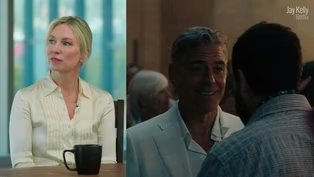
IndieWire Roundtable: Casting Directors (Preview)
Preview: 1/7/2026 | 30s | Casting Directors discuss their work in some of the biggest movies of 2025. (30s)
Providing Support for PBS.org
Learn Moreabout PBS online sponsorship

- Arts and Music
The Best of the Joy of Painting with Bob Ross
A pop icon, Bob Ross offers soothing words of wisdom as he paints captivating landscapes.













Support for PBS provided by:
IndieWire's Craft Roundtables is a local public television program presented by PBS SoCal