
IndieWire Roundtable: Cinematographers
1/7/2026 | 26m 31sVideo has Closed Captions
Cinematographers discuss their work in some of the biggest movies of 2025.
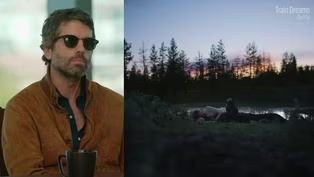
Top creatives discuss cinematic artistry from some of the biggest movies of 2025. Moderated by IndieWire features writer Jim Hemphill, Cinematographers examine their work in “Train Dreams”, “After the Hunt”, “One Battle After Another” and “The Testament of Ann Lee”.
Problems playing video? | Closed Captioning Feedback
Problems playing video? | Closed Captioning Feedback
IndieWire's Craft Roundtables is a local public television program presented by PBS SoCal
IndieWire Roundtable: Cinematographers
1/7/2026 | 26m 31sVideo has Closed Captions
Top creatives discuss cinematic artistry from some of the biggest movies of 2025. Moderated by IndieWire features writer Jim Hemphill, Cinematographers examine their work in “Train Dreams”, “After the Hunt”, “One Battle After Another” and “The Testament of Ann Lee”.
Problems playing video? | Closed Captioning Feedback
How to Watch IndieWire's Craft Roundtables
IndieWire's Craft Roundtables is available to stream on pbs.org and the free PBS App, available on iPhone, Apple TV, Android TV, Android smartphones, Amazon Fire TV, Amazon Fire Tablet, Roku, Samsung Smart TV, and Vizio.
Providing Support for PBS.org
Learn Moreabout PBS online sponsorship... ♪♪♪ ♪♪♪ Jim Hemphill: Hi, my name's Jim Hemphill.
I'm a features writer for "IndieWire," and I'm thrilled to welcome you to the "Craft Roundtable" for cinematography.
Very excited, I've got cinematographers of some of my favorite movies of the year here.
We've got Adolpho Veloso, who shot "Train Dreams;" Michael Bauman from "One Battle After Another;" William Rexer from "The Testament of Anne Lee;" and Malik Hassan Sayeed, who shot "After the Hunt," so welcome, guys.
Malik Hassan Sayeed: Thank you.
Adolpho Veloso: Thanks very much.
Jim: You know, I was looking at these movies and they're all so different, but one of the things they all have in common is they're all very character-driven.
And in all of them you find like a great visual language for expressing character.
And I'm curious, for example, Adolpho, what kinds of conversations did you have with the director about finding a visual language to sort of express the main character's state of mind?
Because he doesn't talk very much.
It's a very, very internal movie.
Adolpho: Yeah, we really wanted it to feel like you're watching someone's memories, almost like you found that box full of pictures, and you're trying to piece those pictures together.
And they're kind of out of order, and you don't know exactly if that's what actually happened, or if they just posed for that picture.
The same way you have your own memories that you're not, you weren't sure if that's what really happened, or if you just remember it that way.
So we really talked a lot about it, and then we came to the aspect ratio, shooting 3:2, which is basically still images aspect ratio.
So, we thought that maybe that could connect to the audience in a way that it feels like you're watching your own pictures on your phone or your old family photos.
We also talked a lot about natural light and how to make it feel, even though it's a period piece, connectable to the audience.
Gladys Grainier: It's all going by so fast.
Robert Grainier: Bye-bye.
speaker: Bye-bye.
Jim: Well, what you're saying about a period piece and still having it be immediate leads me to a question for you, William, 'cause "Testament of Anne Lee," I feel like it's kind of an incredible movie in that it feels like you're just dropped in the middle of this world where there were no cameras, there was no technology, and you're somehow sort of catching it on the fly.
So you have that same combination of it being period accurate, but immediate, and I'm wondering if that was something that was important to you and that you discussed with the director.
William Rexer: The camera is an active participant.
The camera really is a believer in Anne and a follower, so it's constantly engaging.
And that's what being really present, and that was really important to us.
And Mona and I talked about that in terms of the overall look.
We didn't want it to ever feel like a television show or a contemporary movie, so we really, we looked at baroque paintings, and we looked at stuff that's outside of that world and outside of normal cinema, and used that as sort of our references.
So the combination of the Baroque style and the immediacy of being an active participant, those are the two things we talked about wanting to play with.
Jim: Well, now speaking of visual references, Malik, I'm curious to hear what kinds of conversations you had with Luca on "After the Hunt" about visual references and influences, because I know both of you guys, I know from having talked to you before, like super cinephiles, and probably have a lot of common references in terms of the movies you love.
So, what were some of the films and filmmakers that you were talking about with him that you saw as possible inspiration or reference points for?
Malik: Well, there were two references that he gave me, which I was very excited about.
I mean, the whole movie is about restraint, and I think that the references themselves were restrained.
And it's Sven Nykvist and Ingmar Bergman, 1971, 1961 to 1972, and then Gordon Willis from 1977 to 1988, and we just functioned inside of that space.
So, wanted to--the film to feel like it came out of that, the period of Gordon Willis, but with the relationship that is created by way of the mise en scene with Ingmar Bergman and Sven Nykvist.
Because it's a lot about faces and kind of emotional ambiguity that's created, and kind of like an emotional voyeurism like that was just there as they were trying, we're taking this ride with these characters.
Gordon Willis has always been a North Star for me, so that was, you know, okay, I love that I get to revisit Gordon Willis.
Yes, and of course Harris is Gordon Willis adjacent, you know what I mean?
Like, so it was Harris and Gordon Willis for me.
And then Sven Nykvist, I took a--I was able to take a deeper dive on him.
I mean, I've always, he's always in the pantheon, but we--I spent more time with him and Ingmar Bergman, and that was a really exciting journey.
Yeah, so it was "The Silence" and "Persona" were probably the two seminal pieces with them that connect to our film.
Jim: Yeah, I'm not surprised to hear you say that about Ingmar Bergman and Sven Nykvist because I'm a huge Bergman fan, and that was, when I saw your movie, I did think a lot about in terms of the close-ups and the faces, there was something very reminiscent.
The power of it was very similar to Bergman.
And also, somebody else I thought about watching the movie was, and maybe it's just the academic setting, made me think about Virginia Woolf, but also "Carnal Knowledge."
And it just was interesting because obviously Julia Roberts worked with Mike Nichols, and there's this sort of, whole sort of Mike Nichols-inflected thing in the visual language, too.
Malik: He did, that wasn't mentioned, but I know that the writer, Nora, she engaged, she-- that was--those were references for her as she was writing the script.
Maggie: It's the right thing to do, isn't it, to tell someone?
And you know, given your history.
Alma: What does that mean, my history?
Jim: Now, Michael, you've been working with Paul Thomas Anderson on a few films now, but with this one, I mean, I don't even know where you get started.
It's such a, like, epic undertaking.
What are the first conversations he has with you?
I mean, I know he's been in some way or another thinking about and writing this movie for decades.
So when did you first hear about it, and what did he first tell you?
Michael Bauman: I think it was really like, it kind of comes out in drips and drabs.
He started talking a bit about it around when we're even doing "Licorice Pizza," of just like, this is kind of what--it wasn't a lot.
It wasn't a lot of details, but kind of working with him, and you're seeing some of the source material he's using, and you can kind of see which direction he's going, you know?
And so he's just piles of books and other references that were kind of like a lot of the building blocks for the film.
You know, when we got into like really talking more visuals about it, it was a lot about '70s cinema.
It was a lot about like "French Connection."
That was definitely our guiding light.
And you know, "Last Detail," a lot of these kind of like movies of that period and that grittiness of what that energy.
Like it wasn't just so much the look, but it was just like the energy of some of those movies, especially "French Connection" and trying to capture moments as they happened.
And that was really a lot of kind of where the conversation started, that we just did a lot of tests just to see, with this division format, how we could achieve some of those goals and what worked, what didn't.
You know, that's the great thing about testing.
You can fall on your face and good things come from that.
Jim: Well, you get something that I love about that movie, which it feels like you're catching life on the fly, but there's also a very precise visual design to everything.
And I'm curious to hear from all of you about how you kind of navigate that balance.
Like how--where's the line between how much you come in with a preset plan, and how much you leave yourself open to responding on the day and to things that might come up in the moment?
Michael: There's a lot of like, okay, this is the space we're going to be in.
And it was more about like lighting spaces, and then picking up the moments as they'd happened.
Because a lot of what was going on with the casting, too, in the film was there was a lot of folks in there who were not actors, who were--or didn't come from the kind of background that a lot of the principals did.
There are unique qualities about them that you'd want to make sure you could capture, and that just involved like, okay, let's get an environment where we're lighting a space, and they can interact and capture that kind of like natural energy that was going on.
So that, for us, was a lot of just being open enough in our-- in how we're approaching it to roll with whatever is going to come down the pipe.
William: We were sort of the opposite because we only had 34 days to accomplish everything, so there's not a frame that we hadn't pre-visualized on with Artemis going through and saying, "Okay, this is what our world's going to be."
But we lit very similarly, where we lit environmentally and source motivated by candles, or daylight, or moonlight.
So it gives that feeling of that, but everything was precise.
Like we knew every one of the dance sequences, everything was completely planned out in advance.
Adolpho: Did you storyboard, or?
William: We didn't storyboard.
We really did it with Artemis.
You know, we did a shot list in New York.
And all the dances, we would go and rehearse in New York and plan them.
And then every location scout, we would go, and Mona and I, Mona would play all the parts, and I would really take that frame.
Because we knew on the day, you know, 30 some odd days in 4 countries, there wasn't time to do--to sort of wing it.
Malik: Yeah, well, we did the opposite.
Well, similarly to lighting the rooms, I love what Harris said.
You know, when someone says something that concretizes an idea that you have, that you know is the truth when he says he lights the room, you know, which I love.
That's how we approached it because Luca doesn't storyboard.
He doesn't shot list, and he'll change day to day.
And so the tech scout was complete.
We didn't shoot a single thing we shot on the tech scout.
But one thing, one great thing about Luca, which is he's at mastery, I think, flow state level because he edits, and he shoots the edit.
He doesn't cover anything.
He shoots the edit.
He's a one-take guy.
And we have amazing actors who nail, I mean, Michael and Julia, I mean, killed it in one take.
Andrew would want a second take or third take, and he would have to catch up.
I felt it was like Kyrie, you know, and like a young phenom, you know what I mean?
Like Kyrie's going to slow motion, and the phenom just gotta keep up, you know?
When I was younger, it would have been daunting, but I actually found it very refreshing, especially coming out and doing a lot of commercials where the storyboards just get stale, and--'cause he was reacting to the performances.
He was just intuitively reacting to what the performance in the rehearsal was giving him, and then we had to follow him in that way.
And so it was a fun exercise to do it like that.
William: The film doesn't feel that way.
The film feels-- Malik: It's very, it feels very--someone said it feels-- really good friend of mine who knows me intimately, creatively, says--it was different from me.
He said it felt brutalist, but I think it's just where we are in our evolution that it feels like that.
But we just played in the moment, which was fun.
It was a fun exercise, you know?
Adolpho: Yeah, ours was a bit of both.
I think we planned a lot, and we created a lot of rules, visual language rules.
And we had to plan a lot because we were using only natural light, so we actually had to plan a lot with all departments to be able to be in the right places at the right time.
But also, always with our eyes open to whatever was happening.
And because we were working that way on actual locations, the sets were all built on location, we had planned something to be inside, and then just, we would look outside, and, "Oh my God.
Look at that.
Something amazing is happening outside."
Or even like, "The scene is not working here.
Let's just go outside and see if that works better."
So we had a lot of improvisation on that part, too, like just not only within the spaces, but also within the action.
Like the actors would always bring ideas.
And Clint, I think I learned that a lot with him.
Like he's always really sure of what he wants, but he's so open, and he's always kind of embracing and encouraging people to bring something different.
We constantly, whenever like shooting with kids especially, or animals, we would just embrace what they gave us.
So it was a bit of planning a lot to be able to improvise, yeah.
Malik: But I guess it's because you're on location.
You have to plan.
Yeah, we were on stage, so I guess that makes a big difference, you know, to be able to do that.
And maybe that's why he wanted to shoot on stage.
William: Yeah, you could control what time of day.
Malik: Exactly, exactly, exactly, yeah.
Adolpho: No, we couldn't, but because we didn't have lights, that gave us also the flexibility to move around, because then you didn't have like a whole set of lights, or tide, or a track.
Malik: That's great, exactly.
That's great.
William: That's crazy.
Jim: Well, what you were saying about having to be in close collaboration with other departments, I mean, that's something else that struck me about all of these movies, is they all feel like movies where all the departments were in a very harmonious relationship.
I was wondering if you could all talk a little bit about collaborating with the other department heads.
William: We worked as a team.
We lived together in Hungary.
You know, we would have meals and be looking at swatches together at 11 o'clock at night.
We did the old style of going every night and watching dailies together even, too.
So we would have dinner, even if it was 11 o'clock at night, and the lab would stay open for us and project our dailies, and we would drink wine, look at things that are coming up in two weeks.
So we--there was so much planning, and living together, and sharing.
And our costume designer, our production designer, myself, and Mona, it was an endless dialogue.
And it really worked out really well because of that.
I do think that all of our projects had incredible leadership, you know, and Mona's leadership was insane.
She just led with so much passion and so much endless energy that it's infectious.
And I'm sure PT is the same way, and like, I mean, it's just like I think we all benefited from that type of leadership, which then takes all the departments and truly makes it infectious, you know?
Michael: I think the way you just said, I was gonna say the--we watched, also did film dailies every day.
And because the communication was--it was challenging at times because we were in so many different cities.
And a lot of times, like Flo, who's the production designer, would be like at the other end of the state or in El Paso, and we're stuck in, you know, Eureka or some other place.
They had to set up a projection system that would just cart around, you know, the different hotels we were all staying at because we're all kind of like in a similar vein.
Everyone was all together.
Two Super 35 projectors and a VistaVision projector, and you're just watching that every night, but it's really great for just everybody taking a breather, looking at the footage, a great opportunity for everyone just to kind of reflect on the work and just, you know, get some distance from it, but then just keep soldiering on.
Adolpho: Do you guys feel bad watching dailies?
Because for me, it's so nerve-wracking.
I feel like everybody's judging our work because everybody's seen everybody else's work, but then suddenly this is a time for people to judge our work.
And you're just there like hoping that people don't-- Michael: I mean, what's great about, like usually when they set it, when Paul sets up dailies room, it's very specific requirements.
One of them includes an incredible bar.
So that's always a good way to get--to set the tone.
But then also, he's always also always playing with the music.
So like, Jonny Greenwood is sending score ideas over, and so he'd be playing that at times and seeing how that fits with that.
And so you'd be in there, and it was never like, "All right, just roll it and we'll just be quiet."
It was always like there's something cranking.
It's kind of like almost like a live DJ session going on, you know, as you're watching the footage, which just loosens the mood a bit, you know?
William: We had them both on set.
Daniel Blumberg, our composer, was on set playing even for dramatic scenes while we're rehearsing what was going to become the score.
So everybody's getting in that mind.
Michael: That's like "Dogme 95."
William: It was really fantastic.
He's in the movie as an actor as well, so like, but he's always sitting there with a keyboard playing.
And then in daily, it's the same thing.
He would be up there, and he'd be playing.
So it's, you know, we are circus freaks, and this--when the circus is--when you have a good ringmaster, you know.
Malik: It's incredible.
William: Yeah.
Malik: What--speaking, I actually have a question about the scene with Benicio del Toro when they're going on through the space.
Did they--did you guys have the music?
Because the music is so-- Michael: That roof part.
Malik: Well, at least the score is so harmonious with like the-- what's happening in the scene.
Did you guys have it beforehand, or he scored it later?
Michael: I think he definitely has it during when we're watching dailies.
And that scene was an interesting one because that was like, so they shot that in El Paso on the second floor of an abandoned building.
And the reason we were there is because we wanted to look out these windows and, you know, be able to tie in the exterior and the interior around the second floor.
So that entire set, Flo designed it, you know, multiple apartments, the hallway, all that.
But it was all assembled, and they had to build it in LA, stand it up, and then ship it out to El Paso.
And Andrew Cahn, the art director, was--they didn't-- because it was a historic building, didn't know if he could remove the windows, so he had some two guys go to Home Depot and cut a 4 foot by 9 foot section of wood and see if they could navigate it up the stairs, so he knew how big the set pieces could be built, so he could definitely assemble it on set.
William: I love that sequence.
Malik: Yeah, it's incredible.
The music, the set, you know, that score is incredible.
William: The Benicio sections is just--and the integration of all the characters working in the different jails and the restaurants.
It's just brilliant.
Michael: Yeah, and it was always this mix of like actors, professional actors and folks who are non-professional.
Like for example, in the jail when that--when he's getting interviewed by the woman, and she's like, "Did you take your diabetes medication?"
"No," and she just worked there.
She wasn't--and it was just like--she just started hitting it out of the park.
And it was like, there was a lot of that in the film, even the scene when Avanti, the bounty hunter, takes Willa to the camp to drop her off.
He had to cast somebody else.
That guy drove the picture car vehicle and had been with us for the whole thing.
And then Paul's like, "You know what?
I think you'd be better."
And the guy's like, "Wait a minute, what?
You want me to act?"
And I just remember the day he started.
He was just like, "Okay, it's gonna be fine.
It's gonna be fine.
Just do it."
Jim: That's so funny.
Yeah, that guy, when I saw the movie, I was thinking like, "Where did Paul Thomas Anderson find this guy?
He's great."
Like, "Why haven't I seen him before in anything?"
I'm wondering, for all of you, how you see your role in terms of creating an environment on set that's going to get the most out of the actors or make them the most comfortable?
Like, is that something that you guys think about and consider?
Or is it like, no, that's the director's job?
Adolpho: For me, 100%.
Like this is really scary for me.
Like being in front of the camera, it's just like, I've met--I don't understand how they do it.
So, I'm always trying to make it easier on them, even though they might not find it hard because they do their jobs amazingly.
But I always imagined that if I was in that spot, I would rather have a smaller footprint around me.
So I'm always trying to work in a way that I don't have a bunch of stuff around them.
I have a kind of an empty set somehow.
It's just a camera on me there sometimes.
I think it's one of the good things about working with natural light.
You don't have a lot of stands around them.
They are like, on our movie, they're pretending they're living in the 1920s, and they are around an actual campfire, not around LED lights that are flickering like a campfire.
And also to allow them some flexibility, Clint is a director that really loves to improvise and allow them to improvise.
So I feel like it kind of all goes the same route.
And that was amazing because so many, I think, beautiful moments in the movie came from these little pieces that we just improvised.
So I feel like, for me, just because of the way I react to being in front of the camera, I'm always trying to avoid that for them, too.
Malik: I think you--I think we all wanna just work in a good energy space, you know, and not have it be toxic.
For me, it's always important to--for the energy around me and what I can manage to be good, and my team.
Like we function in an unspoken way, 'cause I think it always starts at the top.
And it was important from Julia.
From the beginning, she had us come to her house to do the makeup, hair and makeup test, come to San Francisco.
We rented out a space, and they did the rehearsals at the same time with the actors, and she cooked and had everybody on the couches with the dogs.
And Andrew said it later, like that set the tone for the energy on set, where--and she's very maternal and very nurturing.
And she created a nurturing space because they knew they're gonna have tough material to engage between actors, and it was infectious with us.
And so I feel like it was--it created a really good vibe and energy on set.
And to me, that's, in my opinion, those things get recorded on film.
Like the energy of the space gets recorded on the film.
The space itself, like what's-- I think it's one of Ozu's cinematographers believed that whoever touched the camera, because it's metal, because film is metal, their energy gets on the film.
But I just really do feel like the energy gets recorded, and so we had that on in our space.
And it allowed us to be, with Luca, to be able to channel in the moment to like react creatively, that we needed that.
We needed to be free.
By way of the producers was, I have to give them credit, they allowed us, you know, they gave us a space to do that, so we can say, "Okay, this is how I'm reacting to this right now.
We just have to do the measurement."
We take a little longer to do it, you know, to honor the truth of the moment.
William: I think we as the cinematographers have a huge responsibility in setting that and creating that space that you're talking about, you know?
And if we're not prepared, if we're haphazard, if we're coming in with bad energy, or bad mood, or bringing stuff to it, or if we employ people around us who are doing that and don't stop it early, it really can contaminate a set very, very quickly.
With "Anne Lee," I was blessed with both Mona and Amanda.
I mean, Amanda after, you know, a dance sequence, the one where she's giving birth, you know, nine, ten takes of that, and she's exhausted.
And we say, "We need one more," and then she turns to us and says, "Okay, but you have to do this for me as a favor," and she whispers in my ear.
I go talk to the sound recorders.
She does one more of these takes, and this is an intense dance sequence, and it's hungry, and it's like 100 degrees in the space.
Finish, and all of a sudden, this dance party music comes on, because that's what she wanted.
And she turns the whole thing into a dance party and gets now, for 20 minutes, has every crew member out there dancing, and she's dancing with everybody.
She knew that all those other dancers needed a release.
She needed a release.
The crew needed to be rewarded.
And she, that type of leadership, you know, and setting energy.
And then we have the responsibility to protect that, so yeah.
Malik: Love it, love that.
Michael: I think it is about that, just like creating a space that people can feel comfortable to work in.
I mean, and it does start with the top, just like you said about Julia.
I mean, Leo was like, on this thing, he was, you know, Paul really wanted it to be like an indie movie.
But you know, of course, he didn't really write that kind of a film, so it's like.
But he was, I mean, he was all about like, again, I think it's because he felt if you bring in the machinery of like what that kind of production would be, it's not going to be the energy that he's looking for.
And I mean, he even came to me at one point, and he was like, "Hey, what do you think?"
He goes on eBay, and he buys three of those little Tota light kits.
And he's like, "Hey, what do you think if you lit the movie with this?"
I'm like, you know?
And I'm like, "Okay, so what's he saying by this," you know?
Because obviously, you know, that stuff was like, and we've all worked at that stuff.
And it's like, you know, whoa, and the cast was on board with it.
I mean, like, you know, normally it's like some of the caliber of the stars would give like a big footprint.
And you know, everyone was like, we're in small trucks.
You know, the cast is like in little like vans, sprinter vans, and they'd just hang out and be ready.
I mean, I can't--the number of times I walked by Sean Penn asleep in his truck with his feet up on the thing was like no big deal.
And they thought he would just hang, and then he'd just be ready, and then just pop out and do it.
And that kind of allowed us to maintain that kind of energy.
And I think when it starts from there, and then it just kind of, like you said, it infuses into the set, and everybody just rolls with it.
Adolpho: How do you feel that the VistaVision affected them in terms of the noise, and?
Michael: Yeah, that was interesting.
I mean, you know, look, I mean it's, that's the thing.
You're trying to take this format that has its own limitations, I guess, or not limitations, just peculiarities to it, and the noise is a big thing.
And it's like definitely when we did tests, at first it was like, all of us were like, whoa.
Certainly some scenes in the film that we shot Super 35, and that was mainly because, in Vista, because you're using twice as much film, you only got four minutes a take.
And a lot of it was also about supporting the improvisation that was happening, and so there are certain scenes that we'd roll Super 35 because you could get an 11-minute take out of a mag, which was really critical for some of the performances.
And he doesn't shoot stage, really, so Paul doesn't like stages.
He likes practical locations, so trying to jam the camera and some of these things.
It was an adjustment, I'll put it that way.
I mean, the thing is noisy.
Adolpho: And you shot dialogues always with the camera in general?
Michael: Yeah, sometimes we'd do it with both systems, depending on what it was.
Yeah, it was just trying to find the balance of what would work, and then also working with the post-sound guys on like what they could get away with, because they can, you know, as we all know, they can perform some incredible magic, you know?
William: But you didn't sacrifice energy or movement in that movie with the bulky camera.
You still have, you know, it really feels free.
Michael: Yeah, I think it was just like, to what you said earlier, it's about building the right team.
When you have a team that's down with the plan and is like, "All right, let's do it," and open to it, because like, you know, the camera department was like--every other department was like, "Don't bring anything.
Don't bring anything," except the camera truck was packed.
You know, you got all the film, the two camera systems, and he loves lenses.
You know, so you've got like a ton of glass and all this, and it was just, yeah, it was a stressor for that department, you know?
Jim: Well, I can honestly say I think the work all four of you did this year was just amazing.
I love the cinematography in all these movies, and I really appreciate you taking the time to come out and talk to me about it, so thank you.
Malik: Thank you.
William: Thank you very much.
♪♪♪ ♪♪♪ ♪♪♪ ♪♪♪ ...
IndieWire Roundtable: Cinematographers (Preview)
Preview: 1/7/2026 | 29s | Cinematographers discuss their work in some of the biggest movies of 2025. (29s)
Providing Support for PBS.org
Learn Moreabout PBS online sponsorship

- Arts and Music
The Best of the Joy of Painting with Bob Ross
A pop icon, Bob Ross offers soothing words of wisdom as he paints captivating landscapes.












Support for PBS provided by:
IndieWire's Craft Roundtables is a local public television program presented by PBS SoCal