
IndieWire Roundtable: Editors
1/7/2026 | 26m 31sVideo has Closed Captions
Editors discuss their work in some of the biggest movies of 2025.
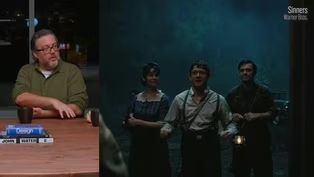
Top creatives discuss cinematic artistry from some of the biggest movies of 2025. Moderated by IndieWire features writer Jim Hemphill, Editors examine their work in “A House of Dynamite”, “Hamnet”, “Sinners”, “One Battle After Another”, “Springsteen: Deliver Me from Nowhere”, “Dead Man’s Wire” and “BLKNWS: Terms & Conditions”.
Problems playing video? | Closed Captioning Feedback
Problems playing video? | Closed Captioning Feedback
IndieWire's Craft Roundtables is a local public television program presented by PBS SoCal
IndieWire Roundtable: Editors
1/7/2026 | 26m 31sVideo has Closed Captions
Top creatives discuss cinematic artistry from some of the biggest movies of 2025. Moderated by IndieWire features writer Jim Hemphill, Editors examine their work in “A House of Dynamite”, “Hamnet”, “Sinners”, “One Battle After Another”, “Springsteen: Deliver Me from Nowhere”, “Dead Man’s Wire” and “BLKNWS: Terms & Conditions”.
Problems playing video? | Closed Captioning Feedback
How to Watch IndieWire's Craft Roundtables
IndieWire's Craft Roundtables is available to stream on pbs.org and the free PBS App, available on iPhone, Apple TV, Android TV, Android smartphones, Amazon Fire TV, Amazon Fire Tablet, Roku, Samsung Smart TV, and Vizio.
Providing Support for PBS.org
Learn Moreabout PBS online sponsorship... ♪♪♪ Jim Hemphill: Hi, I'm Jim Hemphill, features writer for IndieWire, and I'm very excited to introduce this craft roundtable on the art of film editing.
We've got a fantastic panel of people here, seven editors from seven great movies: Kirk Baxter, who edited "A House of Dynamite;" Affonso Gonçalves, who did "Hamnet;" Michael Shawver, who did "Sinners;" Andy Jurgensen from "One Battle After Another;" Pamela Martin, who edited "Springsteen: Deliver Me From Nowhere;" Saar Klein, who edited "Dead Man's Wire;" and Luke Lynch, editor of "BLKNWS: Terms & Conditions."
All of these movies have very strong directors that you're working with, but in your case, you're working particularly closely with Chloé, the director, because as I understand it, she basically did her own cut before she even brought you on board.
Affonso Gonçalves: Yeah, Chloé's the co-editor of the--like, we edited together.
The way Chloé--I think in all her movies, she did always, she does the first pass, and this one, we talked about it.
She says, "I wanna cut it, don't watch any footage, don't watch anything.
I want you to, when you come in, watch my cut first."
I watched the cut, and then we talk on the phone and we discuss what she had.
I think because she's so specific, she's so particular about performance, so she wanted to do the first pass the way it is in the script, and then I came in, and I had a little more freedom to do different things, and then she came back to London and we started working together, but it was super fun.
It was great.
It was a great relationship we had in the cutting room.
Jim: Well, the performances in that movie were just absolutely incredible.
That just feels like a movie that the editorial process must have been so delicate because there's so many silences, there's so many sort of internal moments that the characters are having.
Affonso: Yeah, and it's a movie that you have to be careful not to rush anything because the silence are important.
The time that passes are super important, and I think Chloé sometimes, I think she likes the wide shots, and she likes the masters; even going in, tried to keep some of the silence that exists in the masters, sometimes even a stretch, silences and pauses and stuff like that.
Also sometimes when to not cut, because they're so incredible together, and there's coverage there, but it's there, so you can't really use because it's so incredible and powerful and real what's happening in front of the camera on that shot.
So for all of us, the job is actually to know not to cut, just to let it, you know, exist.
William Shakespeare: Will you be brave?
Hamnet Shakespeare: Yes.
William: Will you be brave?
Jim: Similarly with "Springsteen: Deliver Me from Nowhere," I mean, also a very kind of internal journey movie.
I mean, a lot of that movie is basically a guy alone in a room, which I would think in some ways is very difficult to figure out the rhythms of that and how to cut it.
Pamela Martin: We had to find the right balance of what was too much, what was too little.
You know, it took a lot of trial and error to get it down to the length it needed to be and to keep it compelling and interesting.
You know, we knew when we were screening for friends and family, when we finally got the feedback that people like really loved the stuff in the house.
Like, a test screening would say, "We love this," we're--we knew it was working.
We used to have a lot more of "Badlands" in the film, and it was too much for the film to hold, so yeah, there was a lot of experimentation in that area in particular.
Bruce Springsteen: I don't need to be perfect.
I just want it to feel right.
Jim: Saar, with "Dead Man's Wire," you've got an interesting sort of challenge because it's like a compressed time frame, kind of a compressed location.
I mean, it jumps around a lot, but a lot of it is just this hostage situation.
What are the pleasures and what are the challenges of cutting a movie, you know, sort of has those limitations?
Saar Klein: I was really scared when I first read the script and realized a lot of the film is just two guys in a room, but in a subtle way I think Gus and the cinematographer changed things around a little bit so it was visually interesting, and really, it was just the performance, you know?
We--spoiler alert, but I mean, there is a shotgun involved, so that made it a little bit easier because there's always the threat of death.
It was a good challenge, but it was a lovely thing just because the actors gave so much.
Tony Kiritsis: I'm a man that's fighting for everything that he owns, sir.
Jim: Luke, with your movie, you're almost like creating this entirely new visual language or something.
Well, first of all, your movie didn't even start out as a feature film, right?
Luke Lynch: It began as an art installation.
It was a two-screen art installation that Kahlil Joseph conceived, which was basically his attempt to articulate a version of the news that he would want to watch, and in the process he kind of challenges sort of whatever notion of what journalism or even kind of news could be.
He felt like pretty much any information worth learning or knowing is news, and you know, it's called BLKNWS, and it very, very much is sort of intended to kind of be a, you know, sort of articulating the Black experience in America as sort of a core foundation of what it was interested in studying.
95% found footage.
They did a couple of days of like a shoot, and everything else is just created in the edit.
Shaunette Renée Wilson: Mostly arts and culture.
Lately I've been doing a lot of profiles.
Luke: The approach for a feature film wasn't really all that different.
One of the ways that Kahlil's articulated I think really well is that if classical cinema is sort of is akin to classical music in the process of something that you write, you assemble, and you rehearse, and then you execute, this is sort of jazz, free-form, total break of structure, of anything familiar, and so we're pulling from the experience of us loving, growing up watching movies, and the things that films can do, but sort of going down the more emotional journey of it and how it affects us, abstract nature of storytelling, how you can actually say a lot indirectly.
The way he approached the movie is kind of like an album.
It's--he sort of hopes that it gets dissected the way albums do, and he loves the idea of people pausing and stopping and talking in the movie theater, and like, kind of just let it flow over you the way you've let an album flow over you, and you don't dissect it or articulate or try to understand it, you know, necessarily the same way you would watching a movie: "What was it about?
What were they going for?"
You know, kind of all that kind of stuff.
Jim: Well, and now with a movie like "Sinners," the possibilities aren't limitless like that, but you know, one of the things I love about that movie is you kind of get all these movies in one.
It's like, it's a horror movie, it's a great drama.
It's got a love story in it, it's a musical.
Depending on where you shift the emphasis, it can be more or less any one of those kind of movies.
How many different iterations were there for you as you were going through, and how did you arrive at the final shape?
Michael Shawver: You know, I think what was new for Ryan and for myself on this was we didn't have sort of a structure to help guide us, right?
"Fruitvale Station" was the last day in a guy's life.
"Creed" was a Rocky movie.
"Black Panther" was a Marvel movie, so we could talk to those filmmakers, we could watch them for a reference.
With this, it was--the movie was so personal to Ryan.
You can't really put it in a box, so it was really trusting ourselves.
It was trying different versions, and Ryan would come in every day with three, four different versions of the movie.
You know, the first cut was about three hours and it worked, and then 2:45 and it worked, 2:30, 2:15.
We had a 90 minute version of the cut, you know, because as we were test screening, we got the note, "Get to the vampires faster, get to the vampires faster," but you know, in this movie, the vampires are not the antagonists.
The horror of this movie is actually the lives that they're living and the economic status, the racism that they face, the oppression.
The 90 minute version, it started with them getting to the juke and cut out most of the "get the gang together" part.
I mean, at that point I told Ryan, "I don't wanna put my name on this movie" as a joke, but I was also very serious, and he--it sort of communicated to him like, "Yeah, okay, we're not gonna do this."
You know, I told him, you know, "If I'm gonna--if I was an audience member and paid my hard-earned money and I was gonna see a gangster movie in the 30s with two Michael B. Jordans and some vampires, I wanna enjoy this world.
I wanna live in this world," and you know, Ryan did this thing.
When something's that personal to you, you might try to hold on to it tighter, but he actually did the opposite, and he--so all the departments, he let us have more agency in everything, whether it was music or cinematography, and let us kind of lead him in ways because he admitted he's like, you know, "I might be too close to this, so I really need you to tell me what's in," you know, "what's in this movie."
It's scary.
I didn't--you know, I didn't--when I locked this movie, I didn't think I did a good job, and it wasn't until I sat with the crowd at CityWalk, and you know, at Universal, and felt the energy in the room and that people were having an experience.
Stack: Y'all ready to drink?
Y'all ready to sweat 'til y'all stank?
Jim: "One Battle After Another" is kind of a similar situation where it's an epic that has action, that's got comedy, that's got these personal stories.
I'm wondering if you had a similar experience in terms of the trial and error sort of figuring--shifting emphasis and sort of changing what kind of movie it was.
Andy Jurgensen: Yeah, definitely, we were modulating everything.
You know, the humor, there's so much that you have to set up, you know, with the French 75, with their dynamic with Perfidia, so--and you know, also with Lockjaw as well.
So it was interesting how the beginning evolved because you also want to kind of let people know it's okay to laugh, and then of course, like, after the prologue we're going 16 years later, and then it kind of--the tone changes again, you know.
But at the core of the story was still like this father-daughter relationship, so that was like always our North Star was to like keep that intact.
Bob: I need to find my daughter.
speaker: Well, then call us back when you have the time.
Bob: You just, did you just-- Jim: "House of Dynamite," that movie is like such a gift in a way to an editor.
I mean, a gift, and probably a horror because it's got so many interesting kind of conceits.
I mean, the fact that there's like the real-time stuff and the shifting perspectives and all that.
I mean, what did you see looming ahead of you as the things that made you most excited, and maybe the things you were most afraid of?
Kirk Baxter: I mean, it's complex.
It was a frightening read because of its content, and it was frightening because I knew it would be challenging, but I read it kind of going, "Did you write this for me?"
Like, it seemed just like a layup for a film editor because the whole thing is about, "Okay, I'm gonna let"--you know, as a chef, it's like, "Let's do--let's cook duck three ways."
You know, it's--it was, let's repeat the same thing with different characters in the same time thing, and the whole movie's about pressure.
The idea that this missile's flatlining and heading towards us, you know, regardless of if you're enjoying a character's moment, it's like, "Oh, you like this bit?
We're moving on.
You wanna know what happens to that person?
We're moving on," and it's just that constant push.
I love that, love it.
speaker: Admiral Miller?
Admiral Mark Miller: That's me.
speaker: We need to move you to the PEOC, sir.
Jim: And I'm curious how much you played around with the repetitions.
I mean, were there things that weren't repeated in the script that you did repeat, and vice versa?
Kirk: I repeated a lot more than what was scripted 'cause I found it so enjoyable to experience the same thing from a new perspective.
There were like key phrases, like "a bullet with a bullet" I wanted to experience again, because the way Kathryn shot, it was sort of chapterizing things going, "Okay, the audience learned that in chapter 2, so we're going to pick up from that moment in chapter 3 and carry on," and it was this graph of time, and I sort of blurred the edges a lot more.
Like, the president in the helicopter at the end, just before it goes to calling his wife in Africa, when we put that on his face and experienced it again, even though the audience knows every single word that's being said, like, it highlights this idea of sole authority, and the words of "I need a minute" when you know he's got two minutes to impact, and then you go to Africa, and you're watching, you know, elephants, and you know, he's like "Hello!"
to his wife, it's like, what, what?
You've got two minutes, dude, so like putting certain things before a scene stopped them feeling languid.
You know, it didn't affect the time of what took place in Africa, it was just how it's served up to you.
Jim: Really, a lot of these movies, the use of music is so important.
I mean, the scores in these movies.
Talk a little bit about working with the music and the sound design for your movies.
Like, are you working with any of the actual music you're gonna be able to use?
I know like, for example, PT has worked with Jonny Greenwood so long, I'm imagining he probably brings him on fairly early in the process.
Andy: So one of the things that we do is we actually have daily screenings during the shoot, like, at the end of the shoot day where we're reviewing the footage big.
Even then, Paul's getting music from Jonny.
You know, sometimes we're watching footage, and then he'll just plug his phone into the speakers, and then we'll watch the dailies like with an idea that Jonny has, so we really didn't even cut with any temp music for the movie.
We just had so much material.
Jim: Pamela, I'm curious what your relationship was to Bruce Springsteen's music before you did this movie.
Were you a Springsteen fan, or was it something you acquired the taste for doing this?
Pamela: I grew up in New York so I was around at that time, but I was not a huge Bruce Springsteen fan.
I was into other music, other types of music.
My husband, however, was a big Bruce Springsteen fan, so one of his birthdays I bought him Bruce's autobiography, and after I read it I was so taken by his poetry and his story, and I started deep diving on the music then.
It was, funny enough, a couple of years ago when Bruce went on tour, I said to my husband, "I know you've seen him a bunch of times, but I've never seen him.
He's a legend, we have to go," so I went to see him.
We went to see him perform, and a week later I got the call to meet Scott Cooper about this job.
Jim: I know that Springsteen was on set a lot and was very heavily involved with the movie.
Did he ever come in the editing room and--he did, what was that--what were those conversations like?
Pamela: It was great.
I mean, we spent some time with him.
He came in a couple of times and talked to us about it, sat in the edit room.
In one place, he said, "How come you didn't put that joke in?"
which is, you know, when Paul Walter Hauser's character says, "I love 'Born in the USA,'" which he ad-libbed and was one take, and I didn't even think I had it on mic, and it was only in a wide shot, and I was like, "Well..." That moment is golden.
Like, you know, while Bruce was in the room, I'm like, "Let me try it.
Let me see if I can make it work.
Let me dig out the ISO tracks and get the right--see if I can get it loud enough, and--" but it was, it was really amazing having him in the editing room.
You know, we weren't making a Bruce Springsteen biopic.
We were making a movie about a man going through some really rough stuff who happens to be Bruce Springsteen, and I know for him this movie has done a lot for him and his family, sort of I guess making things go full circle.
Jim: Well, you know, saying on the subject of music, in "Hamnet" you have that beautiful piece of music towards the end of the movie.
Affonso: "On the Nature of Daylight."
Jim: That's it, was that there from the beginning, or-- Affonso: Yeah, it was actually--Chloé likes to play music on the set, and this is--they were about to shoot the end of the film, like the play, the "Hamlet," and she felt like she didn't know how to end the film.
She didn't know how to--there was something missing.
On the way to the set, Jesse Buckley sent it to her, that Max Richter piece, "On the Nature of Daylight," but the cool thing is Max was actually touring at that time.
Like, when we were cutting the film, he was touring, but he would come to his place in the Cotswolds, and he would call Chloé like, "Okay, I'm here.
I'm here for two weeks.
Let me work on it."
So he would keep sending us--so we barely had to tempt him because basically the music we used, it was his music, and he'd give us something.
He'd send something that me and Chloé would sit and listen, and then immediately call Max.
It was like, "We like this, we don't like that," and through the whole time, he's like, he kept saying, "I can try to replace 'On the Nature of Daylight.'
Let me try, let me try," and he did many times, and then we put it in, and it just doesn't have the same feeling, and Chloé's like, "It doesn't matter.
I don't care that this has been used before, it just works so well."
It was great to have him just constantly sending like new styles, and we would adjust the cut to the music like, "Oh, this is great, we can hold this."
Michael: You know, making this movie was very much organic in the sense that it's like walking into a room and admitting that you know nothing so that you can learn what it is, and learn everything and let it speak to you.
When they shot the big pieces--you know, for example, the "Pale, Pale Moon" sequence, you know, that was recorded as the length of the song, but scripted, there were several scenes within that whole structure that when I first cut it together, it was four times as long as the actual song was, so you know, you gotta find intercuts, and Ryan said, "Hey, can you take all this and just cut it to the length of the song?"
It was one of those situations where when you have parameters, it kind of gives you a little more freedom at times.
I started to find, okay, well, she jumps up and down on stage, you know, with this big part in the movie, and there's a scene that was scripted a little bit different timing where guys are beating up this guy and kicking him in the back, and I said, "Well, that's, you know, a party outside where people are stomping and a thing in the back room where people are stomping.
That makes sense to go together, so how do I, you know, work all this together?"
And then, you know, when Pearline was on the stage and she does this kind of creepy dance and crawls around, and you know, leans back, I line that up with Mary and Stack in the back room where we've already set up that she's--you're pretty sure she's a vampire and he's in trouble, and so going back and forth and keeping, you know, matching these moments spiritually and the tone of them was sort of how we let it.
Jim: You know, Luke, again, I know your film is like largely a found footage stuff, but like, what are you doing with sound to sort of like add this total other dimension to it?
Luke: Yeah, everything, yeah, it's as important as the picture, the process of the sound design, you know, and that's part of the process, you know, working with Kahlil over the years that we've developed together, that we love and enjoy, and he would love pushing the limits of--you know, I work in Premiere, adding reverbs on reverbs on reverbs on reverbs, and trying to abstract sound and play with it just like we're playing with the picture as much as possible.
Anything that looked like a traditional edit, even a cut, he would reject, and just inherently, so trying to understand kind of what scripted narrative would look like kind of was a big challenge.
I remember spending a couple of weeks with this footage that was shot in Ghana, and I just picked a piece of techno music and did a, like, a freestyle kind of very just like, you know, from the stream of conscious edit that ended up becoming a cornerstone kind of a certain section of the movie where it kind of just all kind of came out at once, and then, you know, that techno piece just happened to be on a playlist I had from music that I was listening to, and you know, that's how that entered the movie.
Jim: Well, I'm thinking about found footage, and there's sort of an archival footage aspect to your film with "Dead Man's Wire."
Saar: It wasn't intended initially, but I had a bunch of footage from a documentary, and I had the raw footage from the news networks, and a lot of times I looked at Bill Skarsgård's performance, and I was like, "I think it's like a bit over the top," and then I would examine the actual original footage, and I realized that he was playing it really low-key because the real guy was out of his mind.
It was incredibly useful for exposition because people needed to know like how many days, and what happened about Tony's grievance with the bank about the land, and that, I just found the actual stock footage.
We were able to do the exposition with real footage, so it didn't feel like exposition.
Jim: Now, what you were saying about Bill Skarsgård's performance kind of leads me to a question that I wanna ask you, but then I wanna kind of open it up to everybody else.
How much as an editor do you feel like you are being kind of guided by what the actors are doing, and how much are you guiding the performances?
Saar: I think you're guided by them, and if you have a great performance, you just follow it.
You know, I used to work with Malick, and Malick once told me like, "If you work with a great actor, it's like you're skiing behind a powerful boat.
Just hold on," and that's I think all you really gotta do.
You gotta just follow them, and you have to find the right performance because a lot of actors give you a lot of different, you know, options, you know, but I think you always follow the actor, for me at least, you know?
Kirk: It's reactionary to them.
The whole thing's reactionary.
You build around them.
Jim: Aside from just the fact that it's, you know, you probably have like a--you're given a deadline or a release date or whatever, like, how do you know when to stop?
Like, how do you know when the movie is done, when you've got it?
Kirk: Yeah, what's that?
"They're never done, just abandoned."
Affonso: To me, what happens is you keep cutting.
There's like this cut first, and then you watch the next one and it's worse, and it keeps getting worse.
It'll be like, "Oh, wait, two weeks ago we unlocked this picture, we just didn't know, it just kept going."
That's the experience I've had like more often than not.
It'll be like this--it was done, we just didn't know.
We just sort of kept trying.
Saar: With Gus in this one, we showed him a cut early on.
He was like, "Yeah, I like it.
It's great," and I was like, "Well, we need to just do all these things," and he was sort of like, "Why?"
Like, he didn't want to over-refine anything.
I think there's like an energy in things being kind of rough, and I'm always like, to make something look bad, you gotta spend a lot of time.
You know, it can't just be a mistake.
You gotta kind of work it, but I think he really wanted to preserve a little bit of the energy that you get when something is a little bit off and a little bit crooked.
I do believe that some films are overworked and overworked and too polished, and you lose the sort of the unknown quality of the original idea and the spark that you kind of had.
Kirk: Yeah, the job is to get them--you're directed to love their movie and to like their film, and when they've reached that place of feeling that it's honest, and then it's, you know, it's hard to move it.
Saar: But there's a thing about, like, I think when you edit, like you--you're editing a lot for other editors in a way.
You're editing for everybody else, but there's little details and little nuances that only other people that you work with will appreciate.
It's kinda like being a musician, and there's some things that you do that nobody--most people won't care about.
Pamela: Well, it's a gut feeling.
It's a gut feeling of "something is out of tune" because everything we do is musical.
Dialogue is musical.
That's how--a large part of how we judge performances too, and so, you know when there's like one note out of tune and something's a little off, and you know when you're done when you've sort of exhausted all of those little bugaboos, and I think it just sort of reveals itself of like, now it's time to put our pencils down.
It just feels like the right time, and you can kind of walk away and say, "This feels like the best version."
Michael: Yeah, what you're saying about a gut feeling is interesting because I think with our experiences with other movies and watching other movies and understanding the language and how things should feel, editors kind of know how a movie should be, but we just--not consciously.
Like, we don't know "cut to this shot, to this shot, to this shot," or this timing, but there's something inside that once it hits it, you're like, "Huh," that--like, you just relax, and you know, when we're in picture lock mode, it's like our gut's telling us, like, I don't know if you all experience this, but like, when you're one step closer, you have like maybe ten cuts left in the movie you gotta do.
Once you hit that one, it's like, ooh, I'm a little excited now, and then, ooh, because you know, we're the first audience, right?
And so, we sort of have to reverse engineer what that whole audience, the emotional blueprint, the journey we want them to go through.
Andy: One thing I was gonna say kind of as the antithesis of what other people are saying about the perfect cuts.
Sometimes Paul will say to me, he's like, "That cut's too perfect," and kind of challenging me.
It opens up other opportunities, or you just--maybe you leave in some little mistake or something.
There's just like a humanity to a scene because it's not perfect, you know?
We don't do split screens.
We don't do speed effects or anything like that.
We just try to make it work through the cuts, and sometimes just leaving some of these like little mistakes in, it just--it gives you something.
Luke: You know, like, for me, one of my favorite parts of--which, I would love to kind of hear about your process... Saar: Road.
Luke: The road, man.
Like, I mean, it's just a road, but it's playing with lenses and movement and timing, and the suspense that you're kind of building, and like you're clearly effectively evoking a lot of emotion.
Andy: You know, there's a lot of footage, you know, we shot from all the different perspectives, so it really was just like I made selects.
I would, we--I was just choosing the best things.
It was really long for the longest time, and actually sending it to the sound department early helped a lot, so we could kind of give each of the cars like their own sound like as their own character.
So even though it was really long, then I could just take that really long sequence and chop it up and still use their stems to kind of still have that same feeling, the layering on that sort of orchestra sound going like up and down over some of the different hill sounds.
So it's just fine tuning, fine tuning 'til the very last day of the mix.
Luke: And was the POV aspect of it, was that sort of designed from the beginning, or is that kind of found in the edit?
Andy: It was part of the design, yeah.
In fact, when Paul was like first trying to figure it out, he was, he--I think they kind of figured this out when they were doing their scout, and he just took his iPhone, and was like zoomed in, and kind of got the idea that if you attached a camera and zoomed in, you could get these kind of like ups and downs.
Took a lot of work, but you just--that's the kind of thing where you just really have to go through every single shot to find the best stuff.
Saar: How long did you work on that scene, like a couple of months?
Andy: I mean, ultimately, yes.
You know, we all have that thing where you're just like sitting in the theater, and you're just seeing when people are leaning forward and seeing, "Okay, what's--when does it feel too long?"
at that point.
You know, we also wanted to make sure that it kind of gave you that little bit of a sense of motion sickness, but you didn't go past the line.
It had to be right to that line.
Saar: Did you test that with different types of people?
Andy: Basically, I sat in front of our big projector that we have, like this close to the screen, and just like kind of gave myself a fake IMAX experience.
Luke: Yeah, I saw that in IMAX, man.
It was a lot, yeah.
Jim: Well, they're all great, and you all, I'm just so impressed by your work, and I really appreciate all of you taking the time to come and talk with me about it.
This has been great, so thank you.
Pamela: Thank you so much.
♪♪♪ ♪♪♪ ♪♪♪ ♪♪♪ ...
IndieWire Roundtable: Editors (Preview)
Editors discuss their work in some of the biggest movies of 2025. (29s)
Providing Support for PBS.org
Learn Moreabout PBS online sponsorship

- Arts and Music
The Best of the Joy of Painting with Bob Ross
A pop icon, Bob Ross offers soothing words of wisdom as he paints captivating landscapes.










Support for PBS provided by:
IndieWire's Craft Roundtables is a local public television program presented by PBS SoCal