
IndieWire Roundtable: Production Designers
1/7/2026 | 26m 31sVideo has Closed Captions
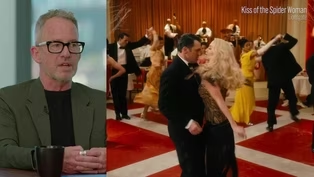
Production Designers discuss their work in some of the biggest movies of 2025.
Top creatives discuss cinematic artistry from some of the biggest movies of 2025. Moderated by IndieWire features writer Jim Hemphill, Production Designers examine their work in “Hedda”, “The Testament of Ann Lee”, “Train Dreams”, “Kiss of the Spider Woman” and “Avatar: Fire and Ash”.
Problems playing video? | Closed Captioning Feedback
Problems playing video? | Closed Captioning Feedback
IndieWire's Craft Roundtables is a local public television program presented by PBS SoCal
IndieWire Roundtable: Production Designers
1/7/2026 | 26m 31sVideo has Closed Captions
Top creatives discuss cinematic artistry from some of the biggest movies of 2025. Moderated by IndieWire features writer Jim Hemphill, Production Designers examine their work in “Hedda”, “The Testament of Ann Lee”, “Train Dreams”, “Kiss of the Spider Woman” and “Avatar: Fire and Ash”.
Problems playing video? | Closed Captioning Feedback
How to Watch IndieWire's Craft Roundtables
IndieWire's Craft Roundtables is available to stream on pbs.org and the free PBS App, available on iPhone, Apple TV, Android TV, Android smartphones, Amazon Fire TV, Amazon Fire Tablet, Roku, Samsung Smart TV, and Vizio.
Providing Support for PBS.org
Learn Moreabout PBS online sponsorship... ♪♪♪ ♪♪♪ Jim Hemphill: Hi, I'm Jim Hemphill, features writer for "IndieWire," and it's my great pleasure to welcome you to our "Craft Roundtable" for production design.
I've got a great group of production designers here to talk about their work, starting with Cara Brower from "Hedda"; Sam Bader, production designer of "The Testament of Ann Lee"; Alexandra Schaller from "Train Dreams"; Scott Chambliss to talk about "Kiss of the Spider Woman"; and for "Avatar: Fire and Ash," Dylan Cole and Ben Procter.
Welcome, everybody.
I guess I wanna start a little bit by talking about--we'll get to you guys in a second, but first I wanna talk about the period because all--everything else that you guys have done is--they're all period films.
You kind of walk this interesting line between period detail and accuracy, but also a certain amount of poetic license, and I was wondering if each of you could talk about how you saw that line and sort of how you wanted to navigate that.
I guess we could start with you, Cara.
Cara Brower: So when I met up with Nia, I thought that that was going to be the goal was being really period accurate, and she told me right off the bat that she didn't want that at all.
She wanted to make a period film that was really unique and had its own voice and didn't look like anything else.
I then did my research because I wanted to find a way to ground it in reality.
And I dove deep into the socialites of the era, and then I could see that some of these houses were really flamboyant.
And so then that gave me the ability to feel like I had the freedom to do something that wasn't expected, and so we were very loose with everything.
We still tried to make it feel like the '50s, but we layered a lot of different eras in, you know, modern paintings and, you know, we had contemporary wallpaper that felt period.
We had a lot of art deco furnishings because they feel so timeless.
We just felt like we had the freedom to play.
Hedda Gabler: Where should I start?
Jim: Scott, how about you?
Scott Chambliss: Completely opposite story.
We've got two, as you know, there are two different periods here.
We've got a jail story that's set in the early 1980s in Argentina and the other story is essentially an MGM musical from the late '40s, 19--early 1950s, and our director Bill Condon's goal was very specific.
He wanted us to make our musical as close to those period musicals as we possibly could, including shooting them in the same manner, single camera, and using as our style guru Vincent Minnelli and his films, and then for the prison drama it was the complete opposite of all of the artifice of those musicals.
Here, we wanted to get very detailed, very realistic, and completely oppressive, the goal there being able to have two very different stories at an equal dramatic pitch.
The musicals are complete flights of fancy, and they're bright, colorful, and they have all of the kind of theatricality and design shorthand of those old movies, which is not like how we design them now, but it's very period.
And with the prison drama, that's operatic and it's melodramatic.
In both cases, being authentic to the period was very important.
Luis Molina: There go the lights.
Jim: And how about for "Testament of Ann Lee," what was your approach to period and what kind of research did you do?
Sam Bader: You know, you're in a fully pre-photographic era.
And you know, there's a lot of the like lighting and compositional references like Caravaggio and Rembrandt to a certain extent, but Mona initially really wanted to adhere to the like organizational lived logic of how people lived and worked at the time.
You know, we had flourishes that were a little more impressionistic, a little more stylistic.
I think for the design it was excavating the way people curated their lives in the 1700s from the 1740s up to the 1780s.
We looked at a lot of, you know, William Hogarth woodcuts and Paul Sandby and a lot of other, you know, Francis Seymour guy and a lot of these kind of, you know, painters of lived reality at the time.
When we decided to be more embellishing, you know, we had so much Shaker iconography, the gift drawings, the paintings of their villages, and we wanted to make sure we incorporated as much of that visual logic into the sets, even if it departed from, you know, the more austere utilitarian reality of their existence.
female: To receive the greatest love that one can experience.
Jim: It's interesting that you're sitting next to each other because both "Ann Lee" and "Train Dreams," you feel like you're--like a camera dropped into this world where there are no cameras and shouldn't be any cameras.
Alexandra Schaller: So we wanted a very documentary-like quality to the movie.
We wanted the design to feel invisible.
I did a lot of research at the outset.
I was attached to the project for quite a while and so I used that time to really learn about the period, and we're talking about a very specific world which is the niche world of logging at the, you know, the early 20th century.
So I learned everything about it.
We listened to a lot of oral histories from the time because, you know, he's--he builds a cabin out in the woods and so we wanted to figure out what would it actually be like to live there and we wanted to recreate that.
A lot of the movie is from one person's point of view, and it's really like his interior landscape, and there's a lot in Denis Johnson's novella and in Clint and Greg's script, there's a dream-like quality woven through the narrative.
And so I think that allowed us to take it to a little bit more of an elevated place, but always grounded and tactile.
speaker: I feel I do.
Jim: Now for the Avatar movies, what's the division of labor between you guys?
Were you working together?
Are you each working on different components of the design?
Dylan Cole: Yeah, it's definitely different components.
We come at it from totally different cultural standpoints.
So basically, I'm all things Pandora, the environment, the Na'vi culture, the creatures, and Ben is all things Earth with the human vehicles and the tech sets and all the human fun implements of death.
Ben Procter: The joke version of that is that he makes all the pretty things that drive the ticket sales, and I get to burn all that -- with really cool machines.
That's the silly version.
Dylan: You know, ours is a period film as well.
It's just period 2154.
Alexandra: So, the future is a period?
Ben: Yes, you know, I do logging just in the 22nd century.
Dylan: The way I would categorize this is imagine having to do like a 1920s Paris film, but you don't know what Art Nouveau looks like.
So first you need to design Art Nouveau, then pick which of those elements you want to put in your film.
That's kind of like what we're doing in doing all the different Na'vi cultures.
Jim has something in his brain, and he'll be the first to say he has a blurry vision of what he wants and it's our job to bring it into focus.
There's immense amount of research.
There's a common misconception that in science fiction, like, oh, it's easy, you can just make it up.
I strongly disagree with that.
On our films, you know, we're very, very research-based and, you know, we always say like it's not a sci-fi fantasy film, you know, it's you know, John Landau used to jokingly call it science-fact even though we have floating mountains.
If we design something too alien or too unrecognizable or designers just go nuts, then it's either distracting or you can't relate to it.
Ben: You know, what I would say is that I think the way the audience responds to Avatar is that they love the stories, they love the characters, but they also just love the world, right?
They respond to it as an alternate reality that somehow is made so palpable to them by the experience of watching the movie to where they feel that they've really traveled somewhere, they want to go back.
I think the reason people respond to it is it's not just a free-flowing fantasy.
Like, we don't have an unlimited palette in which to just play around.
We're always grounding it, whether it's a technology thing or it's a biological thing.
We're always trying to make it be something that could really exist because unconsciously people then treat it that way and then they care about it more.
Part of what we're doing, you know, as sort of stewards of the visual franchise is to teach a way of thinking about design through a lens of reality so that all these new team members come into that fold of, like, trying to imagine on that level of sort of integrity and specificity, and it's just great to see their eyes light up and, you know, that they have an opportunity to add to this canon that is this world that we're building together.
male: This world goes much deeper than you imagine.
Jim: Well, your point about, you know, transporting people to another world, I mean I feel like that's what all these movies do.
Again, like I feel like that you're just completely immersed in these complete other worlds, and I look at these movies and I don't even know where do you begin?
When you get a script, what's the first thing you do and what are the first conversations you have with the director?
Cara: After I got Nia's brief of what she wanted to do, I started doing the two things simultaneously: figuring out what the design was going to be and why.
And pulling references, like all you guys, to sort of ground everything.
I knew that the house was going to basically lead the way, because when Nia writes a script, she's collaborative with the design and she wants me to bring a lot of ideas, but she writes how she wants to shoot it and how she sees the geography of the house, and she was very specific with a lot of things.
She wanted a lake with the house in the background so you could see, you know, the lake from the house and vice versa.
She wanted a grand staircase, grand entry.
She wanted a library.
She wanted to be on the roof.
She wanted to drop a chandelier practically in the house and you know, of course, everybody is like, "and we wanna find it in the radius of London."
So I just knew that it was going to be a real challenge, especially because she also said to me she didn't want to cobble a couple of houses together, she wanted to find one house.
And I vetted 200 houses, and it really did take that full year to find the right house, so that was the most important thing to me was just finding the right canvas for--Nia kept calling it a theater troupe, for her theater troupe.
Jim: Did you immediately know when you found the house, that was the house?
Cara: Oh yeah, I only had a photograph of the outside of the house and then a kind of a weird photograph showing a part of a conservatory and I just thought, "Oh," because it looks so romantic on the outside, I thought, "Oh, this is gonna be interesting."
We got there and I just knew that was the right place and I was texting Nia and she was in New York and I said, "We've found it."
I was texting her photos.
She said, "That's the place.
That's the place."
She signed off on the place without even going to it, just from the photos, and thankfully we found the right place with all the right owners because they let us take everything out.
They let us paint, they let us build sets in there.
They were totally game to do everything.
Jim: Well, in terms of finding locations, Scott, you know, I'm, I mean, I'm assuming all the musical stuff is all built, but for the prison in "Kiss of the Spider Woman," where did you shoot the prison stuff?
Were you in an actual prison somewhere and how did you find it?
Scott: Yeah, the--our prison was built in the 1890s.
It's a big scary old, gigantic, crumbling, pigeon-infested place that had been stripped after they closed it.
The story is set in Buenos Aires, Argentina, and they didn't have available any prisons that had the kind of dramatic heft that our story needed.
Across the water in Montevideo in Uruguay, there was this gigantic old scary place that hadn't been shot in before, much, and was certainly in no shape to just walk into, but it had that operatic quality to it that made it a dream choice.
Actually, the scale of it, everything about it, was just right.
We knew we would have to do a lot of work to make it fit our story.
When it closed down, they pulled all the hardware out.
There were no jail doors.
It took a lot of customizing, but it was essential that we use that one.
And that drove the rest of our locations being found in and around Montevideo, which was perfect as well because there was so much history there that doesn't exist in Buenos Aires so much anymore, it made a really good cheat city for us.
Jim: In "Ann Lee," so much of that movie is putting you in her perspective, and you know, this sort of state.
I don't even know how to describe this state she's in for most of the movie, it's-- Sam: Miasmatic.
Jim: Yeah, and so, again in terms of the production design, how much are you thinking about this being kind of a reflection of her state of mind?
Sam: You know, it is a story being told to you by an outside narrator of the kind of myth of her, in a way.
The design of this film is, you know, a reflection of the kind of serenity and the kind of like harmony with nature she's trying to create in the latter parts of the film.
We knew when we were designing Manchester that it wanted to be muddled and darker and murkier and people living on top of one another and this kind of like dense messiness of pre-industrial England, and that by the time you get to New York it wants to be cleaner lines, more dusty and powdery like a Hammershoi painting, and that everything wants to feel kind of new and clean cut, and then by the time the movie, you know, takes you up into the woods and you watch this settlement be built from scratch and you watch how people literally, like, chop down trees and square off posts and, you know, put rabbit glue into the window panes, like, you want that to feel like a reflection of the vision that she had and the kind of journey that she took her followers on to find a type of paradise that is made by them, if that makes sense.
Jim: Yeah, completely.
Well, and then in "Train Dreams" again, you know, you sort of touched on this, but it's from the point of view of this one guy who is very, you know, not verbally expressive.
I mean, it's a very internal movie and so what kind of-- Alexandra: Almost no dialogue in the movie.
Jim: Yeah, so what kind of work do you feel like you have to do in terms of the production design to express what he's not expressing verbally?
Alexandra: There's so much of that, and that was very important to Clint when we first spoke about the project, that the environments had to do a lot of the expressing of his internal landscape.
You know, when Clint and I first spoke, what we talked about is, yes, there's the period accuracy, but what we wanted to focus on was how does Grainier feel and how do we want the audience to feel throughout.
And so that was our sort of North Star for making all of our creative choices, and that affected how Adolfo would follow him with the camera, and the environments that we chose and the settings that we would create.
It was a very challenging film because it was a very small budget and none of that stuff exists anymore.
I mean, we're talking about logging old growth forests that have been destroyed, and we scouted and scouted for the perfect, most beautiful forests, and we're like, "Where are they?
Oh right, we cut them all down."
And so we found ourselves having to build a lot of trees.
One of our main sets is a cabin that we see through several iterations.
And it's, firstly, it's a home for a family, and that is a very practical home because it has it's, you know, his wife Gladys stays there while he goes out to log, and so it's the home of a frontier woman.
Everything is very functional and practical, and then he rebuilds the cabin at the end.
It's, you know, overgrown with greenery, taken back by the land, and so we were trying all the time to work in concert with the natural environment.
Jim: Yeah, I mean that cabin set is incredible and, you know, I really found myself kind of daydreaming in a good way into the movie thinking about like what each item was for and that kind of leads me to a question for everybody which is how do you see your responsibility or the role of production design in aiding the performances?
Alexandra: I personally think it's integral.
I come from theater and I come from immersive theater and so the actors touching the objects and the audience also touching objects in the space is part of my sort of creative learning.
And for a movie like "Train Dreams" where we wanted this documentary approach, everything in the house had a function and the cabin we built completely realistically out of real logs as an original cabin would have been built back then.
There were no flywalls, nothing like that.
Ben: On Avatar, we like to give the actors almost nothing to work with.
We give them like a Lego world of gray blocks and give them the hardest acting challenge that you can imagine.
We make proxy sets.
They need to be as accurate as possible for, you know, hand contact and foot contact and things that are that will drive the motion and at least communicate to the actors what they can and can't do.
It's got to be descriptive of the environment to the point where they can kind of play around and-- Dylan: To counter that a bit, we do try and give as much as we can in those proxy sets to aid in, as much as possible.
An example in "Fire and Ash," are one of our new clans, the Windtraders.
They have a huge, it's basically like a flying galleon in the sky under a living jellyfish airship, basically, but it's ultimately like a tall ship and has a deck and a below decks and a bunch of rigging.
We built that as a full set taking up our entire capture stage so you could run the length of the whole thing above and below decks and we have big action sequences on it.
You know, Jim being Jim, wanted to know exactly how to fly this thing.
So you're flying a creature.
We had all this rigging worked out that actually in theory worked, but we went so far as to like, Jim's like, "Okay, but if we're tacking left, what lines are the crew laying out?
What are they pulling in on the fair leads?"
And so we literally made a manual of how you would fly this thing for each take.
It's like, "Okay, we're going straight, we're going into the wind, we're leeward, we're--" you know, so all this stuff.
It's a constant push and pull, and that's where we just lean on the, you know, amazing imagination and trust of our performers and actors.
Ben: Indeed, and of course, we have underwater performance capture too, right?
So, what we're providing there is stuff that not only, you know, provides for all the contacts and context for the action, but we also have to be worrying about safety, right?
We have to give the performers the opportunity to do some emergency egress if they have to.
So credit to the actors who really do the hardest job in Hollywood.
I mean, the fact that those movies can make you cry, at least for me they can, and those people were wearing crazy technological apparatus when they gave those performances is kind of stunning.
Sam: I mean, I think you guys have all touched on a lot of common themes.
I think I view the job as making these actors feel like they're in a home that feels very familiar to them and, you know, with "Ann Lee," where it's a musical, we're doing 360-degree spaces in, you know, 1750 Mancunian mansions that don't exist in Budapest so it really does feel like understanding the choreography and the movement and how much you have to explain, you know, an expansive space that, you know, similar to you was on like a fairly austere budget.
But no, I think when you're doing, you know, to the extent that all of this is a type of period film, you need to bring an actor into a space and make it so that they understand the kind of time and the reality that they're living in when it's not immediately familiar to them.
Cara: Yeah, it's all world building, whether it's period and sci-fi, and that's what's so fun.
Scott: That's true.
The only thing I would add to that is it, and it may sound a little bit like reverse engineering, but the habit I developed early on is I read the story and as I think about the environments, my first question is what is it about the world here that is making these characters behave in the manner that they are.
And why--why, you know?
You think about any kind of space, whether it's something simple and domestic or it's the big scheme of the big world, whether it's futuristic, historic, whatever, this--the world is so specific and it's most directly reflected in what the characters are doing and experiencing.
I look at that and I understand that the characters are acting from pure emotion.
And that makes me reflect back on the world itself and that's my entry into it.
So by the time the design is accomplished and the sets are there, if they are gonna be there, and the actor walks in, there's an inevitability to all of it.
So I--it sounds ridiculously metaphoric, but it's also true.
Dylan: What you said about inevitability, it reminds me of a quote: "Good design is like the end of a good story.
It should be unexpected and inevitable," right?
And that it's just, "Oh yeah, well, of course it's that."
Well, we say, "of course" now, having gone through the very difficult process of figuring out the "of course," you know?
Alexandra: Yeah, that's really funny.
I also--I did a movie a couple of years ago that's set in the future, and it's--it was very, you know, and I kept saying, "Oh my goodness, the future is a time period, you know, we have to--we're going to a place."
And everybody has, and I wonder if you guys have experienced this, but everybody has an idea about what the future looks like, right?
It seems like there's like a common understanding in the zeitgeist of what the future is.
Sam: And it's based on the present in some way.
Alexandra: Based in the-- exactly, because that's what we have, right?
We just have our--we have our experiences to go off.
What was helpful for me, which I guess you guys do too for each of your different cultures, is we created the rules of the world, and everybody, the whole movie, the actors, everybody were, you know, knew what the rules were, and whether that's 3 rules or 500 rules, that was sort of the guiding principle.
It means there's always something to come back to, to keep everybody connected to what we're doing.
Dylan: Yeah, of course, there's so many different brands of sci-fi and futurism, so it's like it's, of course, tailored to that script and so it's like what are we doing?
It's not just futuristic because that's just too open.
Sam: One thing that really helped us in "Ann Lee," we're in Budapest, we're trying to create New York and upstate in the woods and Manchester, and we're looking at, you know, again hundreds of locations, and I just found, like, period maps from the 1740s of Manchester, you know, New York in the 1780s, blew them up, you know, 60 inches by 80 inches, posted them on the wall and did like a kind of detective, you know, we're putting location photos where we say we are in the movie, which I think does kind of like holistically, like, bring all this back to, like, where is the actor when we bring them to, you know, a old back lot and walk them down through like a catwalk to get to somewhere.
It's like, no, you are on the outskirts of Manchester, walking to the infirmary which would not have been, you know, in the city center and so, yeah, I guess, you know, the question you had asked earlier about, like, where do you start?
I mean to me, it's like you start with all of these things concurrently to a certain extent.
Like, you read the script, you try to figure out what it's telling you emotionally and intellectually.
You, I mean for me, it's like you pull references, you literally just--I literally just draw something that's in my head even without a real understanding of what it wants to be yet and then just let the like lifeblood of reference kind of like cross pollinate with whatever you're drawing in your head to, yeah, just start rough and work down into the details and into the fidelity.
Ben: Sometimes those first intakes turn out to be pretty good.
No, it's kind of funny.
It's like I'm kind of visualizing this, whatever.
I don't know why I think that.
And then you look at the research and you realize, oh my God, I've been unconsciously absorbing something that came out just now and it's absorbing to what--it's responding to what's on the page, and it actually is not bad.
Sam: No, and I do like, like, a very gestural Bible that's just like these references, it doesn't have to be specific, and then you put it away and you start to do, like, a set by set, like this is every single space.
And then somehow when you're like two-thirds of the way into prep, you're like are hitting a wall and you go back into the original thing and there's some, yeah, non-literal kind of abstract idea that's sitting there and you're like telling your future self that the whole time.
Ben: I was gonna respond to what Scott said.
You know, in a certain way you're articulating the idea of looking at the characters almost as animals and that the sets and the environment that they're in is like a habitat almost.
It's like how does the behavior of the animal explained by its habitat?
Anyway, I was just reflecting that back to what I do on all the hard surface stuff on Avatar and that, you know, I have all these human characters that are just--they're just kind of bad guys.
Let's be honest, right?
They're either corporate bad guys or they're whalers or whatever they are, and for me to sort of inject some meaning and some fun into designing this stuff for them, I have to kind of think of what they do, through their eyes, right?
And I had came up with this term, high performance cruelty as a sort of design motif, which sounds horrible, but that's kind of the direction for a lot of the things I do for Avatar, so the whaling ships and all the boats and all the equipment, whatever, it looks cool.
Like, I want it to look cool to me because those guys are excited to use that stuff and they're all jazzed to be out on the sea and it's the salt spray and all this kind of stuff, and so it's my way of bringing-- instead of it just being kind of a gray dull villainous kind of quality, it's--it gives it its own flavor based on what you're talking about.
Cara: Yeah, I always try to do that too, just do my interpretation, you know?
I'll pick the thing that I like and sort of--it's not, it's-- that's the whole way it makes it fun.
Scott: Well, those are the gifts that we bring to the table too.
Cara: Yes, it's your taste.
Scott: I mean, we're envisioning the story through our own eyeballs and brains, so.
Alexandra: That's what I think is magic about production design, right?
Is I feel like if we were all given the same script and the same director and the same funds, it would--the movie would look completely different, you know, and that's what's so nice about it.
Jim: Well, I'm just in awe of what all of you do, and I really appreciate you taking the time to come out and talk to me about it.
So thanks so much.
This has been great.
Ben: Thank you.
Dylan: Thank you all of you so much.
♪♪♪ ♪♪♪ ♪♪♪ ♪♪♪ ...
IndieWire Roundtable: Production Designers (Preview)
Preview: 1/7/2026 | 30s | Production Designers discuss their work in some of the biggest movies of 2025. (30s)
Providing Support for PBS.org
Learn Moreabout PBS online sponsorship













Support for PBS provided by:
IndieWire's Craft Roundtables is a local public television program presented by PBS SoCal