VPM News Focal Point
Indigenous Virginia | March 14, 2024
Season 3 Episode 4 | 26m 46sVideo has Closed Captions
Preserving Indigenous history at Jamestown; the impact of casinos and reviving language.
We uncover the legacy of Indigenous Tribes in Jamestown and learn what’s being done to preserve this history. What is the impact of casinos on tribal communities and how are Tribes working to preserve Indigenous languages?
Problems playing video? | Closed Captioning Feedback
Problems playing video? | Closed Captioning Feedback
VPM News Focal Point is a local public television program presented by VPM
The Estate of Mrs. Ann Lee Saunders Brown
VPM News Focal Point
Indigenous Virginia | March 14, 2024
Season 3 Episode 4 | 26m 46sVideo has Closed Captions
We uncover the legacy of Indigenous Tribes in Jamestown and learn what’s being done to preserve this history. What is the impact of casinos on tribal communities and how are Tribes working to preserve Indigenous languages?
Problems playing video? | Closed Captioning Feedback
How to Watch VPM News Focal Point
VPM News Focal Point is available to stream on pbs.org and the free PBS App, available on iPhone, Apple TV, Android TV, Android smartphones, Amazon Fire TV, Amazon Fire Tablet, Roku, Samsung Smart TV, and Vizio.
Providing Support for PBS.org
Learn Moreabout PBS online sponsorshipANGIE MILES: The story of Jamestown, the first permanent English colony in America, is changing.
An archaeological dig is bringing up proof from the past that differs from what you may have believed.
Also, the fight for Indigenous peoples to be recognized officially for who they truly are is a battle they say they can't afford to lose, and a rebirth of native language.
VPM News Focal Point explores Indigenous Virginia, straight ahead.
Production funding for VPM News Focal Point is provided by The estate of Mrs. Ann Lee Saunders Brown.
And by... ♪ ♪ ANGIE MILES: Welcome to VPM News Focal Point.
I'm Angie Miles.
It was 1492 when Christopher Columbus encountered the people he called Indian, whom we now call Native or Indigenous.
Researchers are learning new information daily as they piece together the true story of how Europeans and Indigenous people once lived in proximity.
The benefits that come with federal recognition and the quest to save an ancient language are topics for discussion as we focus on Indigenous life in Virginia today.
Nationwide, more than 500 betting facilities are money makers for about 250 different tribal groups.
In Virginia, before the 2019 General Assembly approved casino gambling, the Pamunkey Tribe had proposed building a casino in Norfolk.
Those plans are still pending, while tribes from other states have established themselves in Virginia.
ANGIE MILES: It was 2021 when the Eastern Band of Cherokee Indians, based in Cherokee, North Carolina, voted to join forces with Caesars to bring a casino and performance venue to Danville.
This was an addition to EBCI's portfolio of gaming facilities across multiple states.
MICHELL HICKS: When you think about, you know, our responsibility with running our own hospitals, running our own school systems, the tribe has to create revenue to support all of these services, health, education, public safety.
We have approximately 6,000 employees in the Cherokee area.
ANGIE MILES: The temporary facility in Danville brought in more than 145 million in revenue in the first eight months, beginning in May, 2023.
City Manager, Ken Larking, says local leaders and area businesses are banking on a boom.
KEN LARKING: People are excited about new visitors coming into the community.
I think businesses are seeing an uptick in various activities.
We've got several people that are employed there that are making decent money and, you know, able to support their families and support the lifestyle that they'd like to have.
So it's having an impact.
We estimate upon, you know, year three or so of a full operation of their full casino resort, that there'll be about 39 million dollars of new revenue per year into the community, into the city's general fund budget.
ANGIE MILES: Prior to Danville, the Eastern Cherokee had expressed interest in Bristol, but a company owned by the Seminole Tribe of Florida won that deal, and the Hard Rock opened in July, 2022, as the first casino in the state.
A permanent facility is set to replace Hard Rock's temporary space later this year.
The first permanent location to open, that was Rivers, in Portsmouth in January, 2023.
So far in Virginia, only the federally recognized EBCI and Florida Seminoles have facilities operating today.
ANGIE MILES: Virginia designated five localities to receive casinos, Danville, Bristol, Portsmouth, Norfolk, and Richmond, requiring approval from local voters.
So far, Richmond has twice rejected a casino, and currently, Fairfax and Petersburg are actively expressing interest.
The National Indian Gaming Commission says Indigenous gaming generates more than $40 billion each year.
ANGIE MILES: In recent years, Virginia's tribal groups have made strides in a number of areas, including reacquisition of tribal land, but what hurdles remain?
We ask people of Virginia what they view as persistent challenges for our Indigenous neighbors.
HAILEY HERNANDEZ: History just being rewritten or washed away because like I said, not a lot of people are willing to do that extra research to see who was here first and then what happened once people came here and decided to take over, and the actual harsh truth about what happened to them.
MARQUITA LIVINGSTON: Being pushed out of Virginia, them being pushed away from their land and losing their land.
KENDRA CARTER: Land grab, a lot of their communities are being taken by eminent domain or by big businesses that are bringing other businesses and just building up and taking their land.
CHERYL LUNSFORD: One of the greatest challenges probably is that just the dying out of their culture and not being able to share it.
I think we have two museums locally.
We need more support for the museums and more awareness.
ANGIE MILES: Museums and awareness of history are very much the point of our next story.
Historically, Jamestown had been associated with the story of European colonization in the Americas.
It hadn't been a space that fully captured the experiences of Mid-Atlantic Indigenous peoples, but ongoing archaeological work at Jamestown has uncovered a rich and deeply intertwined story about Native inhabitants and colonists.
News Producer Adrienne McGibbon shares how these discoveries are leading to a better understanding of those who had stewarded this land for centuries.
(water sloshing) ASHLEY SPIVEY: My mother, who is Pamunkey, did not take us to places like Jamestown or Colonial Williamsburg, because at that time, we did not see ourselves represented or reflected there.
KEITH ANDERSON: There was pieces here and there about the Indigenous community, but it wasn't prioritized.
ADRIENNE McGIBBON: For 400 years, Indigenous people were largely left out of the story told at Jamestown.
The Paspahegh Indians had been living here for centuries when European settlers arrived and built James Fort in 1607.
The fort was inside the Powhatan chiefdom, which stretched from the James to the Potomac.
The Paspahegh are gone now, but their story is not lost on Indigenous people today.
TANYA STEWART: There wasn't anything talked about how we were treated, how we were killed off.
ADRIENNE McGIBBON: But Jamestown is updating its story to more accurately reflect the history of those who lived here.
CHIEF KEITH ANDERSON: Well, they've done a great job over the last 10 to 20 years recognizing the importance of the Indigenous community in Virginia.
ADRIENNE McGIBBON: For Nansemond Chief Keith Anderson, the archaeological work that's happening around James Fort is essential to understanding the native contribution.
CHIEF KEITH ANDERSON: There's a very significant amount of artifacts from the Nansemond Tribe that are here that have helped us really regain a sense of pride and belonging to the Commonwealth.
ADRIENNE McGIBBON: There are more than 4 million artifacts in Jamestown's collection, all cared for by Senior Curator Leah Stricker.
LEAH STRICKER: These artifacts provide a tangible connection to history, a tangible connection to people of the past, whether that be the colonists, the English colonists who came here, or those who were here many thousands of years before then.
ADRIENNE McGIBBON: Evidence of what really happened here, in the form of projectile points, pottery, tools and beads.
TANYA STEWART: Well, I'm a beader at heart.
ADRIENNE McGIBBON: Tanya Stewart is a Chickahominy tribal elder who teaches ancient native practices.
TANYA STEWART: What they have found at Jamestown, it helps us learn about the tribes that were there before, the trading that was done, how the natives and the soldiers at the fort, how they interacted.
DAVID GIVENS: Native peoples were living and sustaining the colony at times, and that's not a story that you often hear in your history books, but we are seeing it with the archaeology.
ADRIENNE McGIBBON: David Givens oversees the archaeological work at James Fort.
The property is managed through a private-public partnership between Preservation Virginia and the National Park Service.
DAVID GIVENS: The archaeology of Virginia Indians across our state is very rich, sometimes misappropriated, sometimes whitewashed.
ADRIENNE McGIBBON: The evidence seems so clear that Jamestown decided to revamp its museum to better tell the Indigenous story.
DAVID GIVENS: We wanted to make sure that we were telling the story, that entanglement story, in a meaningful way.
ADRIENNE McGIBBON: Now that archaeology is setting the story straight about what happened at Jamestown, the next question is, who should decide what happens to the artifacts unearthed here?
ASHLEY SPIVEY: It's not just a subject of study, it is a literal representation of the people that we are descended from.
ADRIENNE McGIBBON: Ashley Spivey is Pamunkey Indian.
Her work focuses on preserving tribal history.
ASHLEY SPIVEY: And so when you find something in the ground, that's not just an object for study, it's an object representing our histories, our stories, and our families.
ADRIENNE McGIBBON: New federal rules that went into effect earlier this year give tribes control when it comes to public displays of native artifacts.
Some large national museums have closed spaces to consult with Indigenous peoples about their exhibits.
DAVID GIVENS: This one that's got the orange in it.
ADRIENNE McGIBBON: Givens says, at Jamestown, the work of interpreting history is ongoing.
DAVID GIVENS: Everything that we dig up and everything at the site, we're only stewards of that shared history.
ADRIENNE McGIBBON: Chief Anderson, who's been informally advising Jamestown, says the state's federally recognized tribes should be involved.
KEITH ANDERSON: Those respective tribes have a seat at the table from the onset, and that the tribes, anthropologists or scientists are invited as well to be a part of that process.
ANGIE MILES: In 2022, the National Trust for Historic Preservation named Jamestown one of the most endangered historic places in the U.S. because of impacts from climate change.
For additional coverage of how rising tides are washing away the historic site and its artifacts, go to our website, vpm.org/focalpoint.
ANGIE MILES: VPM News Focal Point is interested in the points of view of Virginians.
To hear more from your Virginia neighbors, and to share your own thoughts and story ideas, find us online at vpm.org/focalpoint.
ANGIE MILES: The Racial Integrity Act of 1924 in Virginia was intended to prevent interracial marriage, to protect and preserve the white race.
Indigenous peoples were affected by this law in ways that caused generations of struggle and pain.
In a deeply symbolic sense, the process of achieving federal recognition is a way to reclaim their identity.
Multimedia Reporter Billy Shields reports.
WAYNE ADKINS: We talk all the time about wondering what our ancestors would say if they could be here now, and see what has transpired, what has been accomplished, and just how proud we think they would be, hope they would be and- BILLY SHIELDS: When Wayne Adkins looks across this Providence Forge Cemetery, he sees markers for the remains of many of his tribal kin.
Adkins, his First Assistant Chief of the Chickahominy and he knows the history well.
WAYNE ADKINS: And we acknowledge them all the time.
We say, without them we wouldn't be here.
BILLY SHIELDS: And some of the names on these graves have also appeared in one infamous spot in Virginia's history, a list kept by Dr. Walter Plecker.
WAYNE ADKINS: It had the names of many of the tribal families.
If you go look at that list now, it's the same family names that you'll see in our tribes today.
BILLY SHIELDS: Indigenous groups call it the Walter Plecker Hit List.
Plecker was Virginia's first state registrar serving from 1912 to 1946.
The list appeared in the letter Plecker wrote, to registrars across Virginia, ordering them not to allow people with these names to be classified as Indigenous.
WAYNE ADKINS: That was only a small part of something that's called eugenics, that was worldwide.
BILLY SHIELDS: Eugenics was a movement intended to purify populations of people through sterilization, selective breeding, and other means of control.
In the 1943 letter, Plecker refers to the state's Indigenous people and notes, "We see the great mistake made in not stopping earlier the organized propagation of this racial falsehood."
Plecker gave instructions on how people were to be classified at birth as either white or Black, but not Indigenous.
BRAD HATCH: And what that law essentially did was created two groups of people in Virginia.
You could be either be identified as white or colored, and so at that point, anybody that was Indian had to fall into one of those two camps.
BILLY SHIELDS: And he listed specific surnames of families who did consider themselves Indigenous.
Plecker's work became known as paper genocide, a continuation of Virginia's infamous racial integrity law that went into effect 100 years ago.
He was a known supporter of that act, which derived from the eugenics movement.
It was a denial that many of the Indigenous people in the state even existed.
It is harm that many Indigenous people in Virginia are trying in part to reverse through federal recognition.
Being recognized as a legitimate tribal group is one key to unlocking grants and gaining sovereignty.
The Chickahominy have federal recognition, but for the Patawomecks, it's a different story.
CHIEF CHARLES BULLOCK: As you pan around this Potomac Creek area, all the land you see around Potomac Creek was a, our ancestors trod this land every day.
They never seen another human being until they, you know, made contact with John Smith, or John Smith, made contact with them.
BILLY SHIELDS: In an area just outside Fredericksburg, Chief Charles Bullock points to the lands around Potomac Creek.
Although many members of the Patawomeck Tribe own land adjacent to the creek, there are no longer tribal Patawomeck lands.
CHIEF CHARLES BULLOCK: All of the land that once, we inhabited it.
It just kind of went by the, it's gone by the wayside.
BRAD HATCH: Part of our issue is an issue that a lot of Indian tribes face.
The whole point of colonization is to erase the Indigenous presence on the landscape.
It's a whole lot easier to take other people's land if you come into a place and say like, "Well, these people don't exist and they never existed."
BILLY SHIELDS: The Patawomecks are in the midst of their own journey toward federal recognition.
A journey started some years ago, initially, to recover human remains of their members from the Smithsonian with who negotiations are ongoing.
CHIEF CHARLES BULLOCK: The health and educational benefits that's going to benefit our tribes, our tribal members in the future.
So that's huge.
BILLY SHIELDS: It is a process that can take decades, because it entails meticulous documentation regarding membership, governance and identification.
And there are three different ways to go about doing it, judicial, administrative, and legislative.
ABIGAIL SPANBERGER: When it comes to the Patawomeck, kind of the core central piece of our discussions has been that there's this tribe that was among the very first tribes to come in contact with European settlers when they arrived in what is now the United States, and what is now the Seventh District of Virginia.
And they have gone through the long and lengthy process of ensuring that the Commonwealth of Virginia understands their history, honors it through recognition as a state recognized tribe.
But the United States government doesn't yet recognize their history.
BILLY SHIELDS: Congresswoman Abigail Spanberger is sponsoring a bill that would offer recognition to the Patawomecks.
CHIEF CHARLES BULLOCK: She kind of took the bull by the horns per se, and took the ball and run with it.
And she has been a champion for the Potomac Tribe.
BILLY SHIELDS: Spanberger says, A common misconception is that the main purpose of federal recognition is that it will open the door to establishing casinos.
ABIGAIL SPANBERGER: I think it's actually really unfortunate from an overall perspective of understanding history that so many people are conditioned to think, you know, Native American tribe or recognition of a Native American tribe equals a casino.
BILLY SHIELDS: 2018 was a watershed year for six of Virginia's tribes when President Donald Trump signed into law a bill recognizing tribes like the Rappahannock, the Nansemond, and the Chickahominy.
Since that time, several tribes have been able to reacquire and protect the ancestral land from development and as sovereign governments provide services for members.
WAYNE ADKINS: The biggest things is just the resources that are now available that we didn't have before.
And some of that is financial, some of it is more technical assistance on how to operate programs or how to run your government or just various other things.
But a lot of it is about financial resources.
BILLY SHIELDS: Before the Chickahominy had to build its tribal center with donations from its members, now it has access to federal grant money.
WAYNE ADKINS: It validated who we are.
I mean, so many people had lost faith and said, "It'll never happen.
You know, you're wasting your time, you're wasting your money."
(chuckles) And we just kept the faith.
BILLY SHIELDS: The Patawomecks are still doing just that, keeping the faith that their people will be officially recognized.
CHIEF CHARLES BULLOCK: No one has that crystal ball.
I know from past history that it's, the timing has to be perfect and we're just, we're in the mode of hurry up and wait.
BILLY SHIELDS: Waiting for validation of who they are and always have been.
ANGIE MILES: In 2015, the Pamunkey became the first tribe to earn federal recognition.
Three years later, the Chickahominy, Eastern Chickahominy, Monacan, Nansemond, Rappahannock, and Upper Mattaponi all earned that distinction.
Four tribes are still recognized only by the state, the Cheroenhaka, Mattaponi, Nottoway and Patawomeck.
ANGIE MILES: Archaeology continues to play an important role for Virginia's tribes.
It can support the process of obtaining federal recognition, and that federal recognition helps to preserve land that is rich with archaeological materials.
Joining us today is an anthropologist and archeologist who's spent his life studying the Monacan Indians, UVA Professor Emeritus Jeffrey Hantman.
Thank you for speaking with us today.
Federal recognition has been elusive for Virginia's tribes for a long time.
Several did manage to achieve the goal in 2018, but archaeology played a role in that.
Talk a little bit, if you will, about how that came to be.
JEFFREY HANTMAN: Number one is documenting the length of time, with material culture, the length of time that Native people have been here in place, that this is their ancestral territory.
There have been a lot of errors, purposeful errors placed into the census record for Virginia, both state and federal census, and those records took away Indian history, so there is no Indian history.
These people never were Indians, and they have no claim to federal recognition.
Archaeologists working with the tribes helped to undo that illusion and, actually, purposeful lie.
ANGIE MILES: Can you talk about some of the specifics of the material that you've uncovered over the years that said to you, oh, this is definitely proof, for example, that the Monacans were here?
Rassawek is an example.
JEFFREY HANTMAN: Rassawek is two things, briefly.
Number one, it was the chiefest town for the Monacan people.
That was Rassawek.
It was the capital.
The Monacan people wanted to protect Rassawek, but there was an interest and a very strong effort by local government to build a water feeder, to build right over Rassawek.
It was the first time that federal recognition came to the fore, and the power of federal recognition, because the Monacans were able to use federal law to say, "This will not happen.
This is a sacred site.
The ancestors are buried here.
It was the chiefest of our towns, and it should not be disturbed."
(upbeat music) ANGIE MILES: You can watch the full interview on our website.
ANGIE MILES: Language is one way we connect with our family, our culture, and our traditions, and across the nation, Indigenous communities are reclaiming their native tongues.
Next up, we meet three women who are working to bring back their ancestral language, weaving together the past and the present to restore their linguistic heritage.
For that report, we turn to Multimedia Reporter Keyris Manzanares.
KEYRIS MANZANARES: Indigenous peoples have deep ties to William & Mary's campus.
The land was originally claimed by native populations, and prior to 1723, Indian boys attended residential school at the college's Wren building, and later Brafferton.
Now, in a space where Indigenous peoples were stripped of their cultural heritage, including language, this group of women has chosen William & Mary as a meaningful place to meet, to awaken what was once lost.
RAVEN “BRIGHTWATER ” CUSTALOW: Unfortunately, through assimilation and the genocidal practices, both physical and paper genocide, our people in this area haven't spoken fluently in at least 200 years, I would say.
So all we have left are a few, maybe a thousand or so words, if that.
KEYRIS MANZANARES: Raven “Brightwater ” Custalow grew up on the Mattaponi tribe reservation in King William County.
She's committed to advocating for preserving Indigenous heritage.
RAVEN “BRIGHTWATER ” CUSTALOW: I think most of us can probably say a maybe short introduction.. wingapo (hello), (welcome) nitapewak (my friends), kenah (thank you) anah (goodbye), those sort of like basic words that you would use in like everyday language.
KEYRIS MANZANARES: During meetings, Custalow, along with Diana Gates and Young Brinson who are cousins from the Cheroenhaka Nottoway Indian Tribe research words and pronunciations as they start trying to put the puzzle of Virginia's Algonquian language back together.
YOUNG BRINSON: The culture of Virginia has always been steeped in Algonquian culture, and I think that's why we've been led to it.
And so it's just cool that we are all coming together now to really lift this off the ground and get it started because we're making moves and I love it.
KEYRIS MANZANARES: The group is in the beginning stages of language revitalization.
And while they may never be fluent, they hope future generations will be.
DIANA GATES: Native children who are surrounded and enveloped in the warmth of their community and their culture, they're connected to their tribe.
Through speaking their language, the rates for substance abuse, suicide, they go drastically down, high school graduation rates go drastically up.
KEYRIS MANZANARES: Because Virginia tribes were colonized much earlier than those out West, Gates says reviving their language can feel isolating.
DIANA GATES: We were colonized in the early 1600s.
We had a boarding school called the Brafferton, which is located here at William & Mary, and it's all of these sort of historical elements of stripping away, piece by piece, culture and language that it's really healing for us to say, well, these parts of us aren't dead.
RAVEN “BRIGHTWATER ” CUSTALOW: I feel like language transcends the physical space.
It even transcends into that spiritual place.
When my time here is no longer and I join my ancestors in that spirit world, can I greet them and will they understand me?
And that's a big part of why I do what I do, is I want that connection to them and I want to be able to speak their language.
KEYRIS MANZANARES: Reporting for VPM News, I'm Keyris Manzanares.
ANGIE MILES: One tribal member we interviewed for this program shared that it feels in recent years there is a power shift happening as Indigenous Virginians are increasingly considered, consulted and empowered to live life more on their own terms.
We hope this episode has identified for you some of the ways that's been occurring.
Please refer to our website, vpm.org/focalpoint, for more stories, including the full version of our interview with archaeologist Jeffrey Hantman, and our extra story on the threat water is posing to Jamestown.
Let us know what you think about our coverage and share your story ideas.
Thank you for watching.
We'll see you next time.
Production funding for VPM News Focal Point is provided by The estate of Mrs. Ann Lee Saunders Brown.
And by... ♪ ♪
Archaeology helping to preserve sacred spaces
Video has Closed Captions
Clip: S3 Ep4 | 8m 29s | Archaeology is providing Virginia’s tribes with protection for their sacred spaces. (8m 29s)
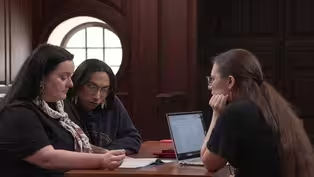
Video has Closed Captions
Clip: S3 Ep4 | 3m 21s | A group of women from native tribes in Virginia are working to revive Algonquian language. (3m 21s)
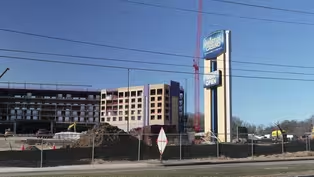
Indigenous tribes bring casino gaming to Virginia
Video has Closed Captions
Clip: S3 Ep4 | 2m 11s | Virginia localities have introduced casinos and more are on the way (2m 11s)
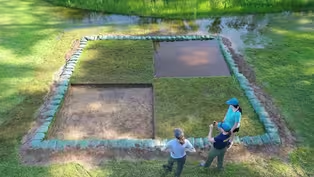
Jamestown under threat from rising water
Video has Closed Captions
Clip: S3 Ep4 | 3m 1s | Rising water from climate change threatens to wash away Jamestown. (3m 1s)
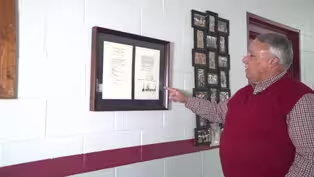
The Quest for Federal Recognition
Video has Closed Captions
Clip: S3 Ep4 | 7m 3s | Several Indigenous tribes are trying to gain federal recognition, but it isn’t easy. (7m 3s)
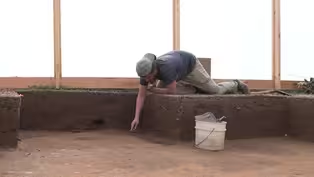
Uncovering Indigenous history at Jamestown
Video has Closed Captions
Clip: S3 Ep4 | 4m 28s | Archaeology is setting the story straight about the shared history at Jamestown. (4m 28s)
Providing Support for PBS.org
Learn Moreabout PBS online sponsorship
- News and Public Affairs

Top journalists deliver compelling original analysis of the hour's headlines.

- News and Public Affairs

FRONTLINE is investigative journalism that questions, explains and changes our world.












Support for PBS provided by:
VPM News Focal Point is a local public television program presented by VPM
The Estate of Mrs. Ann Lee Saunders Brown