
The Influence of Money and Power In Our Justice System
Clip: 3/18/2023 | 19m 3sVideo has Closed Captions
The Influence of Money and Power In Our Justice System
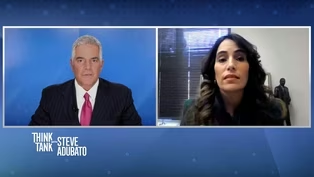
Steve Adubato is joined by Elie Honig, CNN senior legal analyst, author, and former federal & state prosecutor, where they discuss the high-profile cases that inspired his new book, "Untouchable," and the ways money and power play into our legal system.
Problems playing video? | Closed Captioning Feedback
Problems playing video? | Closed Captioning Feedback
Think Tank with Steve Adubato is a local public television program presented by NJ PBS
The Influence of Money and Power In Our Justice System
Clip: 3/18/2023 | 19m 3sVideo has Closed Captions
Steve Adubato is joined by Elie Honig, CNN senior legal analyst, author, and former federal & state prosecutor, where they discuss the high-profile cases that inspired his new book, "Untouchable," and the ways money and power play into our legal system.
Problems playing video? | Closed Captioning Feedback
How to Watch Think Tank with Steve Adubato
Think Tank with Steve Adubato is available to stream on pbs.org and the free PBS App, available on iPhone, Apple TV, Android TV, Android smartphones, Amazon Fire TV, Amazon Fire Tablet, Roku, Samsung Smart TV, and Vizio.
Providing Support for PBS.org
Learn Moreabout PBS online sponsorship- We are honored to be joined once again by our good friend Elie Honig, who is the author of ""Untouchable," and CNN legal analyst.
Good to see you, Elie.
- Steve, thank you for having me.
Always great to be with you.
This feels like a homecoming.
You're the king of New Jersey media, I'm a Jersey guy through and through, so I love chatting with you about this.
And you're gonna understand this book in a way that not everyone will, because a lot of this is New Jersey, New York, you know, connections that we make here.
- And Elie has such strong New Jersey roots, Rutgers connection, New Jersey connection.
Often when you see him on CNN, you see the "from Metuchen, New Jersey".
- Metuchen, New Jersey, that's right.
Putting Metuchen New Jersey on the map, exit 10.
- You got it, hey, listen, "Untouchable," the core message in this book as it relates to our justice system is?
- So look, this is a big question that people have been asking forever.
How do powerful people get away with it?
I've been asked it a million times.
That's why I wrote this book, and the answer is really, it comes down to three factors.
One, our system itself has various advantages, loopholes, whatever you wanna call them that favor powerful, famous, wealthy people.
Two, the smart and savvy bosses out there, whether technically bosses or not, know how to exploit those vulnerabilities, and three, prosecutors don't always do the best job.
Prosecutors sometimes pull up short, pull up lame.
Even though I was a longtime prosecutor in New York and New Jersey, I'm quite critical in this book of tactics that we've seen from various prosecutors over the years.
So when you take those three factors and combine them, I think that's as close as we can come to an answer, a comprehensive answer as to how so many powerful people get away with it.
- So in Elie's book, by the way, we're taping literally a couple days before the book is out.
Check out Elie's information.
We'll make sure people can get to the book "Untouchable."
So here's the thing.
You talk about figures like Donald Trump, Jeffrey Epstein, Harvey Weinstein, Bill Cosby, but then you've got Bill Clinton, and let's do this.
We're taping at a very funky time.
You can include President Biden in this as well as it relates to classified documents.
We don't know how it's gonna play out.
Here's my question.
You've said that in many ways that the judicial, that the justice system deals with some of these high powered, very often influential, sometimes money, influence, relationships, that they act like mob bosses, and you make it sound like we need the RICO statute that Giuliani used back in the day and others to get to the real league.
Like, is it that comparable?
- You know, what jumped out to me, Steve, is I was an actual organized crime prosecutor in New York City, so I actually prosecuted Mob Bosses.
I know sometimes- - Southern district?
- Southern District New York, that's right.
So I did Genovese, Gambino family cases, and I tell a lot of those stories in the book, A, because they're fun and interesting and entertaining, but B, because as I went back through them, I saw so many parallels to the tactics that powerful people actually use.
I'll give you one example.
Everyone knows that rich people can pay for your dream teams of lawyers, right?
OJ Simpson's a famous example.
I talk in the book about how a big reason Jeffrey Epstein beat his first set, he didn't beat, but he got a very, very light disposition down in Florida when this case first came up in 2008 was he hired this team of Alan Dershowitz, and Ken Starr, and former US attorneys that just overwhelmed the prosecutor down there, Alex Acosta, who went on to become one of Trump's cabinet members, and then resigned because of this.
So everyone knows that rich people can and do pay for high powered legal teams, no big revelation there.
But here's a little more subtle thing that jumped out at me.
I noticed that in my mafia cases, it was very common for the bosses to pay for and provide the lawyers for everyone on the indictment.
So I tell a story about a case where the 14th guy on the indictment wanted to flip, but he couldn't, right?
And we list them in order of most to least powerful, not alphabetical.
He wanted to flip, but he couldn't, because his lawyer was being paid for by the bosses, and he knew if he flipped, he'd be in trouble.
So you know what he did?
I don't wanna give too much of the story away.
He sends his girlfriend to us as a sort of backdoor courier, and we had to go through this complicated process to get him an unconflicted lawyer.
Okay, that's a mob tactic, but that's also an everyday tactic that corporations, big companies use all the time.
Now, it's not necessarily evil or wrong.
Sometimes, a lot of times, people wanna have their lawyers paid for, but what it does do is it makes it harder for those people to cooperate.
I mean, we saw examples of this with Donald Trump with Cassidy Hutchinson, right?
She was the star witness in the January 6th hearings that went on.
She's now been talking to prosecutors.
She wasn't able to come fully clean until she broke free from her Trump funded lawyer and got herself an independent lawyer.
Then she became a powerful witness, but that's rare, and that's hard to do.
- You know, Elie, as I'm listening to you and thinking about the implications of this, I mean, using the cliche a two-tiered justice system.
Well, no, I don't wanna say, you know, S-H. Well, yeah we know that, okay.
There's a two-tiered justice system, but you're talking about that the tiers are so far apart that those who do not have the means, that do not have the money, that do not have the influence, do not have the relationships, and can't lawyer up everybody around them.
- Right, that's one great- - What about the rest of them/us?
- Yeah, so that's one great example, I think, of a subtle tactic that these folks use.
There are so many other things.
I'm gonna give you another example, and again, this is not an opinion.
If you look at the Justice Department's manual, we call it the Justice Manual.
It used to be called the US Attorney's Manual.
It specifically says that if you're working on a case that's likely to draw a national media attention, you have to run that case up higher and higher levels of approval, and in the book, I give two examples.
One of them was when I was a federal prosecutor in New York.
We had a mob case where one of the people caught up in a gambling ring with the Gambino family, I don't say his name in the book.
I won't say it here, maybe I'll tell you afterwards in Steve 101, was a famous major league baseball player.
Okay, I say in the book, you would know his name if you followed baseball.
If this was not a famous person, we wouldn't have even thought twice about it.
I would've handled the case.
I would've made the decision myself as a fifth year prosecutor, whatever I was at the time.
- You would have brought the case, you would have brought the case?
It happened- - I don't know.
No, I think it's a close call whether I would've brought the case, but the point is, it would've been up to me, and nobody would've reviewed it or weighed in because- - Did you have to kick it up?
- Exactly.
- Did you have to kick it up?
- Yes, because it was a famous, influential person, it went up and up three or four levels higher than me.
And as just a mathematical proposition, the more higher levels of review, the more chances there are to say no, to say I don't see it.
And I'll give you a Jersey example here from my time at the AG's office, and I can say this because it's public.
We did a whole series of Sandy fraud cases, right?
People who put in for benefits after super storm Sandy.
Yeah, hurricane super storm Sandy.
There was millions and millions of dollars made available to people who had lost their homes.
There was a specific program designed for people who had lost their primary homes, okay?
If you have nowhere to live.
What happened was we brought at the AG's office, over 100 cases, probably over 200 now, of people who lied in that application, either, the most common scenario was they had a shore house that they lived in two months a year.
They claimed that was their primary, and you know, but that's a fraud, right?
Because it wasn't meant for that.
- It was for primary homes, not secondary homes.
- Exactly, so we were churning these cases out of Trenton and getting, you know, guilty pleas across the board until we came across a case for a staffer, and this is 2013 or 14, in the office of governor Chris Christie.
Now Steve, I know you will remember the political climate in New Jersey at the time.
Chris Christie was our governor.
He was gearing up for president.
- Former US attorney.
- Former US attorney.
He was getting ready to run for president, and super storm Sandy, his response to it, that was a key factor that he was pushing in his campaign.
Now, it's not his fault he didn't know about it.
This was a fairly low level.
This wasn't, you know, but if someone who worked in the governor's office, you can, I forget the name of the person, but it's, it's public.
It's Google-able, and again, these cases, we were just churning, churning churning.
But when we had this one that was gonna land in the governor's office, it came up to me at the head of criminal justice.
It went up to the AG.
We spent months, literally months agonizing over this case, whereas if this was not a person close to the governor, working for the governor, we would've just been like, yep, yep, go, go, go, boom, boom, boom.
We brought the case, but with much more scrutiny, yeah.
- But here's the thing, the other cliche, nobody is above the law.
The Richard Nixon case, President Nixon case was supposed to tell us that his vice president, at the time indicted, has to drop off the ticket.
Spiro Agnew, Trump, not above the law, Clinton, not above the law.
- Yeah.
- Et cetera, et cetera, et cetera.
But you are saying that in many cases, that is an expression, it is a cliche.
It is not a fact that the implication, Elie, of what you've written in "Untouchable," by the way the workbook is "Untouchable," go out and get it, is that there are people above the law.
- Yes.
- And if they're not above the law, that in order for the law to work and the justice system to work as it's supposed to, there are lots of hoops, and barriers, and obstacles that just do not exist with the vast majority of the rest of us.
- Exactly right, exactly right.
And you know, I say in the book like, look, we prosecutors, we love our cliches, we love our sayings.
Nobody's above the law, without fear or favor, but that's not really true.
That's what we aspire to, and largely achieve it, but not when it comes to the most powerful.
And I'm glad you mentioned those historical examples, because one of the big questions that we're all grappling with is, can and should a president ever be charged in this country?
What do you think?
- It's obviously never happened.
I think a former president, yes, if he's committed a crime, can and should be charged.
- How about a sitting president?
'Cause right now as we speak, we're gonna date ourselves.
There's a special prosecutor, if I'm not mistaken.
- Two, to Biden and Trump, yeah.
- Do you distinguish between prosecuting a former President Trump, versus a sitting president as we speak, Joe Biden?
Go ahead.
- I do, yes, I think those are different outcomes for me.
- Make the case.
- It's fine.
Yeah, so here's the thing.
DOJ, it's often said DOJ cannot indict the sitting president.
That's not quite right, as I point out in the book.
The more accurate way to say it is DOJ has long decided that it doesn't want to try to indict the sitting president.
This date's back to Watergate.
DOJ did research back in the '70s, '73, and wrote a memo saying it would be unconstitutional to indict the sitting president.
Now, it's really not a legal document.
It's a public document.
It really doesn't get into legal.
It really is just a question of but how the heck would our country operate if we had a president under indictment?
And I think that just as a practical matter, to indict a sitting president would cause our executive branch to maybe not grind to a halt, but massive complication, and by the way, the solution should be either that president gets impeached and removed from office and then prosecuted, or you wait till he is out of office and then prosecute him.
And I argue in the book that the statute of limitations, the time limit should be frozen while the president's in office now.
- But Elie, I'm gonna push back.
Before you're go any further, I'm gonna push back.
- Sure.
- Because Richard Nixon resigned.
- Yes.
- But if it had been a different political environment and a culture, and Congress was in fact had people in it who were Republicans who did not stand up to Nixon and tell him, "You've got to go," but it is the way it is today, say that members of Congress were not going to move on the president, to impeach or attempt to impeach the president, or to have that president resign.
How could you then say that prosecuting that president is not a viable option if there is no other option?
- So Nixon, of course, was never prosecuted because of the pardon from Gerald Ford.
- But it was a coverup that he could have been prosecuted for.
- Oh, it could have been, absolutely could have been.
And I actually went back and did research, and it was, you know, it's almost a foregone conclusion now that he wouldn't have been, but he actually, it's quite clear to me now looking back that he probably would've been prosecuted.
- Okay.
- I think the answer is this is an intersection of politics and law, and we had a situation like this.
We just had a president who was impeached twice, not convicted either time, in the second one, especially the January 6th, despite overwhelming evidence.
I think the answer is, if we have a situation like this where people are unwilling to remove a president of their own party, which may well be the status quo from here on out, then prosecutors have to wait till the person's out of office, either finishes his term, because if you play out, how would it work?
Are we gonna have a trial of a sitting president?
Are we gonna have an imprisonment of a sitting- - What about a former president's planning for running president again with a current president under investigation, who's likely to be, and we don't know how it's gonna play out, the opponent of that previous president who's now trying to run again in 2024?
- Yeah, that's exactly the scenario we're in right now.
I think as a matter of policy, look, this is a good example.
You can't indict.
Look, we don't know whether Joe Biden committed a crime.
We don't frankly know whether Donald Trump committed a crime at this point.
- Should he be investigated by a special prosecutor outside- - Yes.
- The Attorney General and the Department of Justice?
- Yes as to both.
- Go ahead.
- Donald Trump, I think for fairly obvious reasons, both with respect to January 6th and the documents, I think there's more than enough of a basis there for prosecution to be necessary.
I think special counsel's the right move.
I actually fought Merrick Garland for taking way too long.
My last chapter in the book is called "Waiting for Garland," play on "Waiting for Godot," or "Waiting for Guffman," if you're more into the recent satire.
He's taking way too long, but he's finally done the right thing.
Now, you hit on an interesting point there.
As we get closer and closer to the 2024 election when Trump's gonna be in it, I don't think, there is no legal bar to that, but it makes the task of getting a conviction way more complicated.
As to Joe Biden, absolutely has to be a special counsel.
The reason you appoint a special counsel, it's not punishment for somebody.
It's because there's a potential conflict of interest.
And if you say there's a conflict of interest in prosecuting Donald Trump, because he might run against Joe Biden, then there's sure as heck is a conflict of interest for Joe Biden's DOJ investigating Joe Biden.
And now we have this news about Mike Pence that's come out as well, classified documents in his house, so we'll see what DOJ does.
- So here's the thing about President Biden, and it's not just President Biden and former President Trump.
It also ties our judicial system and the legal system to our political environment.
So when the argument is, hey, wait a minute, you can't potentially prosecute Donald Trump if you're not gonna potentially, well, what are you gonna do with Biden?
Wait a minute, aren't the case as individual?
No, no, but we have to look at it in the political environment.
Okay, fine.
Then I turn around and say, as a student of media, as someone who often coaches people not in government, but in the private sector on their leadership skills, which there's a point here, trust me, to be more forthcoming, disclose yourself, don't be on the defensive.
I'm sitting there going, why is the Biden administration not?
And why didn't they disclose what they knew when they knew it?
- Yeah.
- And the response is, well, the lawyers told them.
That's a ridiculous legal strategy.
You hand it over to the appropriate parties.
You don't share it with the American people.
Drip, drip, drip, and I'm arguing not a political strategy, but a leadership strategy, which is a smart communication strategy, is get it all out there.
And I'm told by my lawyer friends, "Steve, you don't understand how it works.
You can't do that, because the lawyers would kill you for it."
I'm thinking- - No - Is the legal strategy and the leadership strategy/political and communication strategy that far apart?
I know there's a question there somewhere.
- I disagree with your friends there.
I actually think that in this instance, the PR strategy, the leadership strategy, and the legal strategy are aligned.
And the problem is, the good news is Biden apparently tried to be transparent and to come forward.
The bad news is he's done an inept job of it.
His team has done an inept job of it, right?
Making incomplete announcements, and by the way, the public reporting is that DOJ took note of those incomplete, arguably misleading statements, and that's one of the reasons they appointed- - But Elie, I'm sorry, I'm sorry.
When the President says, President Biden says.
"I'm doing what my lawyer told me to do," seriously, that's why your elected president to do what your lawyer told you to do?
That doesn't sound forthcoming to me.
- Yeah, I mean, look, the good advice here would've been like let's make sure we get a handle on all of this and then put it all out there all at once.
By far, I totally agree with that.
Look, and you raised another interesting point.
In a vacuum, on paper, one can note the differences, factual important factual differences between the Trump scenario and the Biden scenario.
One can also note many similarities.
There's both, and what a prosecutor should do by the book is go evaluate them, and it could well be that one is chargeable, one is not.
However, I'm a big believer, and I argue in the book, you know, as they say in sports, they don't play the game on paper.
Even Merrick Garland, who tries to put himself out there as the world's least political person, he's political.
He's been appointed to the federal bench.
He was nominated to Supreme Court.
He was nominated as AG.
You don't get that if you're not political.
He has to be aware of the appearance and the reaction of the public if one gets charged and the other doesn't.
I'm not saying they both have to end up in the same boat, but he can't be ignorant of that reality.
- Perception matters.
- Yes, it does.
- Elie Honig, New Jersey's own, Metuchen's own.
- You got it.
- CNN senior legal analyst and the author of a compelling new book called "Untouchable."
Elie, my friend, thank you for joining us.
I'm sorry for keeping you so long, but that's what happens when the conversation's so interesting.
Thanks, my friend.
- Thanks, Steve.
Thanks so much, it's always, we can go forever.
Good to talk to you.
- You got it, stay with us, we'll be right back.
- [Narrator] Think Tank with Steve Adubato has been a production of the Caucus Educational Corporation.
Funding has been provided by The Turrell Fund, supporting Reimagine Childcare.
RWJBarnabas Health.
Let'’s be healthy together.
New Jersey Sharing Network.
The Healthcare Foundation of New Jersey.
The North Ward Center.
PSE&G, PSC.
Wells Fargo.
And by NJ Best, New Jersey'’s five-two-nine college savings plan.
Promotional support provided by NJ.Com.
And by BestofNJ.com.
- I'’m very grateful that I'’m still here.
- That'’s me and my daughter when we went to celebrate our first anniversary.
- With a new kidney I have strength.
- They gave me a new lease on life.
- I'’m still going everywhere and exploring new places.
- Nobody thought I was going to be here, nobody.
- I look forward to getting older with my wife, that'’s possible now.
- [Narrator] We'’re transforming lives through innovative kidney treatments, living donor programs, and world renowned care at two of New Jersey'’s premiere hospitals.
- They gave me my normal life back.
It'’s a blessing.
- [Narrator] RWJBarnabas Health.
Let'’s be healthy together.
The Teacher Shortage and its Impact on Early Education
Video has Closed Captions
Clip: 3/18/2023 | 8m 6s | The Teacher Shortage and its Impact on Early Education (8m 6s)
Providing Support for PBS.org
Learn Moreabout PBS online sponsorship
- News and Public Affairs

Top journalists deliver compelling original analysis of the hour's headlines.

- News and Public Affairs

FRONTLINE is investigative journalism that questions, explains and changes our world.












Support for PBS provided by:
Think Tank with Steve Adubato is a local public television program presented by NJ PBS