
InFocus 109 - Mental Health Awareness
5/27/2021 | 26m 47sVideo has Closed Captions
Examine how COVID-19 has affected mental health trends.
Examine how COVID-19 has affected mental health trends and explore options for finding help and balancing daily stress.
Problems playing video? | Closed Captioning Feedback
Problems playing video? | Closed Captioning Feedback
InFocus is a local public television program presented by WSIU
Support provided by:

InFocus 109 - Mental Health Awareness
5/27/2021 | 26m 47sVideo has Closed Captions
Examine how COVID-19 has affected mental health trends and explore options for finding help and balancing daily stress.
Problems playing video? | Closed Captioning Feedback
How to Watch InFocus
InFocus is available to stream on pbs.org and the free PBS App, available on iPhone, Apple TV, Android TV, Android smartphones, Amazon Fire TV, Amazon Fire Tablet, Roku, Samsung Smart TV, and Vizio.
InFocus
Join our award-winning team of reporters as we explore the major issues effecting the region and beyond, and meet the people and organizations hoping to make an impact. The series is produced in partnership with Julie Staley of the Staley Family Foundation and sponsored locally.Providing Support for PBS.org
Learn Moreabout PBS online sponsorship(upbeat music) - Welcome to InFocus.
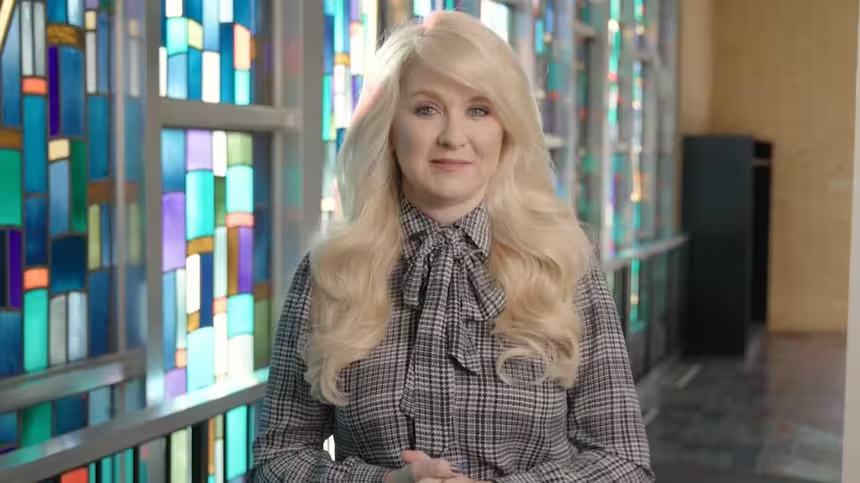
I'm Jennifer Fuller.
In this episode we're marking Mental Health Awareness Month.
The past year has been difficult for all of us and it's also shown in many ways the importance of mental health and awareness in our daily lives.
Here in Illinois there are 22 Living Rooms, set up to receive individuals who may be suffering from anxiety, depression, even a crisis.
These are free walk-in welcoming facilities where help is available from someone who's been there.
Mark McDonald visited The Living Room in Quincy.
- So, this is Quincy's Living Room.
- That's right.
Welcome to our Living Room.
- And it's operated by Transitions of Western Illinois.
- Yes, we've been here since October 5th.
That was our opening day.
And we're inside of the Horizons Social Services building, downtown Quincy.
- [Mark] What sets this apart from other places where people would go to get mental health services?
- Well, I think the biggest thing is that people can walk in, anytime that we're open, and they, they don't have to get services in the clinical sense.
They can just hang out.
They can come in.
They can visit with the people that are here, the staff and the other guests that are here, and there's no pressure to be working on treatment goals or things like that.
- Mm hm.
And the whole point is to make it feel like a living room.
- It is like a living room.
- Like a comfortable place where you can talk to a friend.
- That's right.
- Let's go into the office and take a look around and then we'll sit down and talk about what actually happens here.
- [Jessica] Okay.
So we do have a small staff office.
This can also be used if a guest wants to come in and talk privately with a staff person.
They have the ability to do that in here.
We also have some storage and we have our snacks and our soda in here.
That's one thing that we like to have is plenty of snacks and soda and coffee for our guests.
- If you did have overflow this is a place where people could come and you do frequently get busy enough - to use this space.
- We do.
We do.
There are some days that we have eight or 10 people here at one time.
- Oh my goodness.
- And so it does get busy and we do spread out even into the foyer.
And, and so the people have plenty of room to, to - Well that makes it kind of hard.
If, if you have privacy issues that makes it kinda hard.
You really would like it to keep it at one to two people, wouldn't you, at a time.
- That would be nice, but we, you know, it's a, it's a good problem to have when we're busy.
But we, we do have options.
You know, the Horizons staff are very helpful.
So once they're done with lunch at one o'clock or so then we can also move into the cafeteria if somebody needed a little more space.
So they, they do accommodate those needs.
- Now this is, it's open from Monday through Friday from 12 noon to 8:00 pm.
- Yep, that is right.
- Now, who is here to welcome these people and to talk to them and sort of assess what they might need?
- We typically have three staff members here at any given time.
Two of them are Recovery Support Specialists so the first person that a guest will meet when they walk in the door is a Recovery Support Specialist.
- [Mark] Now, what does that mean?
- That is a person with lived experience with mental illness, as well as having had treatment.
And we hire them when they're, when they're somewhere in the recovery where they're ready to give back.
- So they know what these people, in many cases, have gone through - They do.
- because they've been themselves.
- They have been there themselves.
They've received treatment.
Some of them have been in the hospital before and done many of the things that our guests have had to live through.
- But they're not Mental Health Professionals?
- No, they are not.
- For, for, but you have somebody on staff who is at the same time.
- We have, one person will be here anytime that we're open, that is a Mental Health Professional, that's somebody with a bachelor's degree that has some clinical knowledge about mental health and how to provide treatment.
- Mm hm.
What sort of issues or situations do people find themselves in when they come in here?
- You know, I think at the beginning we had a lot of people who had some housing instability and homelessness.
So we helped a lot with that.
We connected people to the homeless shelters in Quincy.
We've had people come in with food insecurities.
We've helped them connect with food resources in Quincy and right here at Horizons Social Services.
People come in, they, they've been isolated because of the pandemic.
And so they really just need that connection with other people.
We've helped people look, find jobs, practice for, interviewing skills.
We've helped people connect with food stamps and social security resources, those types of things.
- And these are things that, that Transitions has done over the years.
These are services you provide elsewhere as well but The Living Room, that catches these people too, right?
- That does.
- That walk in off the street.
They're uncomfortable for some reason, or they may be having a crisis.
What if you, what if somebody comes in here, is actually suicidal or is having some kind of a crisis?
- Well, we would assess that as soon as they walked in the door, hopefully.
We have the Mental Health Professional here that could, could assess that.
And we always have a supervisor that's on call.
That's a master's level staff person that could either come down and talk to that person in person.
We could do a virtual call, which has been very handy to learn how to do since the pandemic started.
So we can provide whatever level of service they need, you know?
And, and I'd like to mention that The Living Room is a alternative to the emergency room for people in a mental health crisis.
And so there are times when people need to be in the emergency room for safety but there are lots of times where we can intervene and that never has to happen.
We can help people get to the emergency room if that's where they need to be.
- Yeah.
Yeah.
COVID has, has really affected people in many different ways but like you say, being isolated and, you know not being able to resume their normal life.
Do you foresee this going on for a while or do you think once we get, once we get COVID behind us that there'll still be a need for The Living Room and, and places like it?
- I sure hope so.
And I definitely think that we, we have a place in Quincy.
I think we've established ourselves over the last six or eight months.
People look forward to coming here.
Some people come every day.
You know, just in April we had 16 new people come.
So even, you know, just, you know, in the last month we continue to have new people who are finding us and they're using our resources - [Mark] Um hm.
16 new people.
And in fact, you've probably served nearly 100 people, individuals and they, they come back, don't they?
- Yes, absolutely.
- [Mark] Yeah.
- Yup.
- Well, thank you so much for the, for the tour here.
This is very interesting.
I think we mentioned that there are about 22 of these Living Rooms in the state and, and they were not all in response to COVID.
Yours, for instance, you, you wanted to open this up before COVID ever happened.
- Right.
COVID kind of threw a wrench in things, slowed us down a little bit, but yep, we had written the grant and planned for this before COVID ever started.
- Yeah.
Well, thank you.
- Thank you.
- Healthcare workers have felt the crush of COVID-19 in perhaps more ways than others.
As some leave the field, others are working to prepare new graduates that will take their place.
Steph Whiteside has more.
- Most people look at this, at nurses and all healthcare providers as heroes through this pandemic.
So I think that it encourages them and energizes them and motivates them to want to select this career path.
- [Steph] At John A. Logan College, instructors use labs and dummies to give students hands-on learning.
Like everything else, the pandemic changed that.
- I believe, you know, for the students, you know, our, our program is naturally stressful anyway, being a nurse is, is not an easy path to take.
And when you are, are hoping that your class is going to be face-to-face and all of a sudden you're thrown a curve ball, and you find out that you have to be at home online for two weeks and try to get the same experience in the classroom.
Yeah, it's a very, very stressful time for them to learn a new learning method.
- So, first is the fact that they were always worried about being quarantined.
Many of them work in healthcare now and so they would be, they would have high exposures.
And so just being outside of the class really stressed them at the beginning.
So the fact that we were able to offer our classes in that setting so that they didn't miss any school was a great way to alleviate some of that stress and help them be successful.
- It is very stressful.
Especially to watch residents die that had been in the facility for a long time and you've grown a strong connection with.
It has been mentally exhausting and physically exhausting, but with multiple support of your co-workers, you've made it through.
You made it through those tough days.
- Throughout the pandemic, instructors did their best to continue essential hands-on learning.
- So I was very fortunate.
I was able to do my clinicals in the very early part of January.
I felt it was very important for these students that are graduating in May to be in an acute care environment during this time.
And so by going to clinic at an earlier time in the semester, I was able to get them to the facility under my umbrella of my license and you know, hopefully they were able to see what acute care is like in the moment.
Rather than maybe waiting until after they graduate before they see their first real patient.
This semester, our students were able to partner with our local health department, Franklin-Williamson Bi-County Health Department, and they gave over 30,000 immunizations in the last few weeks.
I feel like that helped spin it so that they felt more in control and had this positive effect on our community.
- You know, the thing about nursing and I think what I love about nursing is, it's never the same any day.
And that's what I love about it.
But not everybody likes that.
Some people like normalcy and some people like a little less chaos in their lives.
And so again, I felt very fortunate to take them to the hospitals so that they can at least see what they're walking into and decide if that's even the route that they want to go.
There's so many avenues in nursing.
Not everybody has to go to an acute care facility.
They can choose an alternate route.
- Nursing is a stressful career at the best of times but the pandemic has worsened that stress.
A survey done in December of 2020 found one in five nurses were planning to leave bedside care or the profession.
Learning self care is a part of the education nurses receive at John A. Logan.
- Nursing is very rigorous and we've continued to have that rigor within our program.
We have done our very best to communicate with the students via email and, through our learning management system, our courses, to make sure that they're getting real time information.
And delivering to them what we can, to the best of our ability.
- So this is actually something we talk about in the very first week of nursing school.
And having appropriate stress relief, it doesn't matter if you're going to nursing school during a pandemic or not.
There are still a lot of stressors that come along with it.
And so we talk about eating healthy and drinking plenty of water and exercising and finding those things, whether it's meditation or yoga or exercise or reading that really individually helps students alleviate those stressors and, and be more successful.
So, we talk about it the very first week, they all try to find things that will help them be successful.
- So, that took me a while to get a hang of, but actually at the beginning of the COVID I picked up running and then I got into the gym a lot, just having healthy habits and something that I could go and take my anger and frustration out at.
The gym was really the place.
- Despite the pandemic, staff say none of the students quit the program and they've seen even more people consider enrolling - Mentally.
The biggest thing is it's scary.
If you have the right amount of fear, it gives you the drive to do the best you can.
- InFocus in Carbondale, I'm Steph Whiteside.
- Experts point to physical activity as one way to maintain a mentally healthy lifestyle.
Our producer Abby Asher caught up with one person who took that to heart just as the world was becoming more and more chaotic.
- [Woman] If you ever want to do something really hard decide to do a 100 miler.
It's, it's definitely a mental and a physical task.
The mental is probably the most challenging part of it all.
Just to keep moving for that long of a time is a big deal.
And then takes a really long time.
It took us, it was myself, my husband and one of our running friends.
We decided to do this for 2020 since all the races had been canceled.
This race had a virtual option.
So we decided to make the best of the year and do something that we'd remember positively for 2020.
And it took us 27 hours and 14 minutes to complete.
It's really nice to get up in the morning and see the sunrise.
So you get that beauty of watching the sunrise.
You get the warmth all day long from the sun.
And then in the evening you get to see a beautiful sunset and just see how all of the shadows go away.
And now you're in a whole different world.
So the trail even changed just depending on what time of day you were in.
And the people changed and cars driving by on little sections where there were.
It was, it was nice to not have to think about your day-to-day life and just, what do you need at that moment?
I needed personally, a lot of foot care.
I got severe blisters that I had to stop for almost every 10 miles after mile 40.
Lots of hydration.
We had four cases of water because the water had already been shut off on the trail.
So we had to provide our own water.
Lots of caloric intake, as well as clothing.
We had different friends meet us at different points on the trail, just to keep our minds occupied.
Once it got really high miles and especially late at night you just start dwelling on what's the bad.
If I was having a down moment they might be up and we really just kind of fed off each other's positive energy the whole time.
And we started looking at the forecast and there was a big storm coming.
So we, we kept worrying about the rain and when it was going to come.
"Hey, have you seen, you know, it's supposed to be raining by now.
Is it gonna rain yet?
Oh, nope.
Nope.
It moved off.
It moved off a little bit farther."
We finished and literally five minutes after we finished, it started pouring.
I mean, we kept up intervals faster than what we should have the whole time.
We, we kept pace better than we should have the whole time.
It just, it was really and truly a miracle that we finished when we did because nobody would have kept going in the rain.
And there's things that happened that you don't know why they happened.
Were we meant to run this 100 hundred miles then?
Maybe.
I mean, whenever they say that people have a runner's high, they aren't lying because you finished.
And you're, it's something that you never thought you could accomplish.
And it's a big deal.
I don't care about how fast I can go.
I just want to prove to myself that I, I can do this.
And in high school, when we did the mile in our gym class, I flunked it.
Flunked it big time.
I just thought it was stupid.
I'm like, what does running have to do with education?
This is dumb.
There is no reason why me being able to complete a mile in under X amount of time is gonna make me a better citizen or a better employee for somebody whenever I grow up.
But in a way it kind of does because you do, you learn self discipline, which is a big thing, and resilience, which we all need.
I mean, if you don't make it, you pick yourself up and you try again.
That's kind of life in general.
Pick yourself up.
Try again.
And one of these days you'll make it.
- The arts have also provided outlets for people to express themselves.
And as Julie Staley shows us, the Decatur Area Arts Council has found new ways to inspire people and help the community.
- The pandemic has stopped the world, but not much has slowed down here at the Decatur Area Arts Council.
They may have slowed down due to COVID restrictions but Decatur Area Arts Council hasn't let it last long.
- Like everyone else in March and April, we just completely shut down.
We have had to cut back our hours, not only our part-time people, but also, also our full-time people.
May was also quiet and we kept planning.
What can we do beyond May?
And we decided the least we can do is open our gallery.
And we decided as long as we follow COVID protocols, people social distance and wear their mask, they can come in in twos and threes and fours, in small groups and participate in enjoying the artwork.
- [Julie] Not only did they open their doors but they've had record success at bringing people into the gallery.
Their LEGO exhibit brought in 800 people.
- We stepped outside of the box of fine art and we had an exhibit focused on LEGOS and the creativity through LEGO, because art or creativity, isn't specifically about fine art.
It doesn't have to be sculpture or painting or fine photography.
People can be creative in a lot of different ways.
And LEGO actually crosses all generations and, and you name it.
And so we had a gallery full of LEGOS and then we ended up with probably the biggest attendance of any exhibit that we've had since I've been here.
- They also tried something new with their traditional fundraiser, stepping outside of the box to raise money for Corks and Forks by sending people out to eat.
- [Jerry] The Decatur Area Arts Council is taking the show on the road.
In order to support our local restaurants here in Decatur who have been supporting our Corks and Forks event for the last 20 years, We encouraged people in our community to simply go out and dine at their favorite restaurant to support them because local restaurants have really struggled over the last year.
- [Julie] The Decatur Area Arts Council is not going back to what they used to do.
The future is all about what they treasure the most, being creative with what they do.
- So we decided we needed to pivot.
And at that point, we decided to simply focus on Decatur.
So we had a major exhibit June and July that focused on the last 50 years of Decatur.
The, the years that the people who were still living would remember fondly.
And a lot of people had some great items to bring in that everyone who came to the exhibit thought, "I remember that place.
That was great.
I, I had so much fun with that."
- [Julie] They found that people have healed from the effects of the pandemic, through art, whether it's record attendance at events or rising numbers in art classes for homeschool or online students.
- I think it's been a struggle for everybody.
I think artists that can create on their own, musicians, visual artists, and others like that have probably been doing what they can.
You know, taking this time to, to think about growing their perspective and what they create and how they create it.
But those artists that perform, it's been tough.
Theater performances, musical performances, you name it, dance.
It's been tough because they're unable to, to get out there.
There are a few that will do small performances outside where people can comfortably and safely social distance, others have streamed to, to whatever success that might bring but it's been pretty hard overall for the arts community, this whole COVID thing.
- And their next event is right here for the International Arts Exhibit.
For InFocus, I'm Julie Staley.
- The International Arts Exhibit starts June 4th at 5:30 pm.
It features arts and culture from Mexico with food, crafts, and performances to celebrate the Mexican culture.
Rural communities tend to have limited options for seeking mental health care but technology is helping to change that.
Benji Jeffords has that story.
- [Benji] Once COVID-19 brought everything to a halt, people began to get creative to access different services, including mental health.
With everything moving to a virtual format for safety, Mental Health Professionals had to do the same.
Dr. Matt Buckman is the Executive Director of The Stress and Trauma Center in Eldorado.
He recently participated in a virtual rural health summit addressing the effects of COVID-19 in rural mental health.
Dr. Buckman says getting treatment in rural communities can be problematic for a variety of reasons.
- Sometimes what we're finding is that even pre-pandemic, right?
We have a shortage of providers.
We have a shortage of licensed providers and, and constantly working to try to build a pipeline to get more individuals in the profession.
And also looking at some of our para professionals, some of our individuals with lived experience, these are all initiatives that we were looking at a scarcity of resources.
And barriers, such as transportation and barriers, such as just geography or even barriers around individuals living in one community but having to go to a different community.
Even if I can go there, sometimes from community to community, we can have differences in culture, belief systems, and access that is more than just physiologic, physical access.
- [Benji] Dr. Buckman says technology and virtual appointments open new doors to access services and avoid the barriers that previously prevented those seeking help in rural areas.
- I like how we're thinking, like from a rural perspective, and rural mental health for children and families, that some of these same experiences have been there.
Some of the same challenges have been there and now COVID-19 has really exacerbated that.
Has really increased the importance of we need to tackle this but as it became an everyone type of challenge that affected people differently, depending on where they are and what type of situation they might be in, the context of their life.
What we ended up finding was options became more available, right?
For the, in that increased access, and when we get into tele-mental health and tele-psychiatry, whatever we were looking at is like, you know, I'm not sure I'll always want to be able to do this.
I'm not sure if I want to.
We all had to do it.
We all had to find a way.
And we, it turns out it's, it's still an option.
It's a possibility.
- [Benji] Dr. Buckman says sometimes service providers need to partner up to benefit the people they serve.
- One of the avenues that I see as, as one of the innovations and one that I think a lot of rural communities are doing is how do we co-locate?
How do we collaborate together?
How do we bring the services to where the families are, where the youth are?
This can be schools, this can be healthcare clinics, primary care practices.
How do we go to them and, and show that we're willing to be the ones that take the burden off of the family.
That we go and we provide supports wherever we can, whenever they want those supports.
- [Benji] Dr. Buckman thinks collaboration with community partners is the best way to communicate to rural communities what services they may have access to.
- Oftentimes we're working on the same things.
Many times we can integrate, collaborate.
But many times I'm sending stuff back and home, home in backpacks, where we're sending that out or in lunch programs.
Where rural schools, just across the nation, have been open more than some of our more urban partners, right?
So a lot of our schools are in.
Many times my friends and colleagues that were living in Chicago, that they would talk about not being able to go to school whereas we maybe didn't even shut down.
Like the school my daughter goes to, we went the entire year.
We never stopped going.
In this school year.
- [Benji] In Harrisburg, the 2020-2021 school year began in person while other communities chose to start remotely.
West Side School, Principal, Eric Witges says keeping school in-person helped the students adjust to uncertain times during a pandemic.
- I think the big thing that Harrisburg is that, what we're proud of, is that from the first day of school we had in-person kids and we were able to make it work.
And we've had some challenges.
We're not perfect by any means, but we're proud to have those kids in school.
We're proud of what we've accomplished here to date.
And we know that through our staff and through our parents and through our community that if we work together, and we know we will, that we're going to make a big difference in the lives of our kids.
- [Benji] Dr. Buckman agrees that people need to engage with each other and be around each other.
Even during a pandemic.
- Like a person still matters.
Even six feet away, I can still build a relationship.
But I need to know that person.
I need to know who it is.
Even if it's a 30 second conversation.
That's powerful for our consumers, our families, to get to meet people and realize "Man, I am just as flawed as everybody else", right?
We're all just human beings trying to be human beings and trying to help each other along the way.
- [Benji] For InFocus, I am Benji Jeffords.
- And as we bring InFocus to a close, we look at a free outdoor concert series that's all summer long bringing people together in the Springfield area once again.
The Levitt Amp concerts started in 2019.
They had to cancel in 2020.
June 3rd it'll all start again for people of all ages.
- This past year was really hard.
What, you know, we weren't able to go to see the things and enjoy live entertainment.
The downtown festivals, the indoor performing arts, the MUNI, everything was shut down.
And we're just really excited that this year we have found a way to bring the community back to see live music at the Y-Block.
We know that everybody realizes the importance of being together and seeing each other face-to-face, mask or no mask.
So we want everyone to feel comfortable, to enjoy live music downtown, with the beautiful backdrop of the Governor's Mansion.
- Opening night will feature gospel soul and hip hop artists Soultru, Aaron Cole and Kaleb Mitchell.
- [Teri] I'm sure that the Springfield community is as eager as the Levitt Amp Planning Committee is to be back in person.
Even if you're waving across the grass at friends that you haven't been able to connect with in the past 13, 14 months.
- Thanks for joining us.
For the entire InFocus team, I'm Jennifer Fuller.

- News and Public Affairs

Top journalists deliver compelling original analysis of the hour's headlines.

- News and Public Affairs

FRONTLINE is investigative journalism that questions, explains and changes our world.












Support for PBS provided by:
InFocus is a local public television program presented by WSIU