
InFocus 202 - Access to Healthcare
10/28/2021 | 26m 46sVideo has Closed Captions
InFocus talks with state and local healthcare leaders to learn how to boost access.
InFocus talks with state and local healthcare leaders to learn how organizations across Illinois are working to boost access to care. Also in this episode, The African American History Museum in Springfield is featuring a limited exhibit of the Negro Baseball League. The exhibit runs through October 30, 2021.
Problems playing video? | Closed Captioning Feedback
Problems playing video? | Closed Captioning Feedback
InFocus is a local public television program presented by WSIU
Support provided by:

InFocus 202 - Access to Healthcare
10/28/2021 | 26m 46sVideo has Closed Captions
InFocus talks with state and local healthcare leaders to learn how organizations across Illinois are working to boost access to care. Also in this episode, The African American History Museum in Springfield is featuring a limited exhibit of the Negro Baseball League. The exhibit runs through October 30, 2021.
Problems playing video? | Closed Captioning Feedback
How to Watch InFocus
InFocus is available to stream on pbs.org and the free PBS App, available on iPhone, Apple TV, Android TV, Android smartphones, Amazon Fire TV, Amazon Fire Tablet, Roku, Samsung Smart TV, and Vizio.
InFocus
Join our award-winning team of reporters as we explore the major issues effecting the region and beyond, and meet the people and organizations hoping to make an impact. The series is produced in partnership with Julie Staley of the Staley Family Foundation and sponsored locally.Providing Support for PBS.org
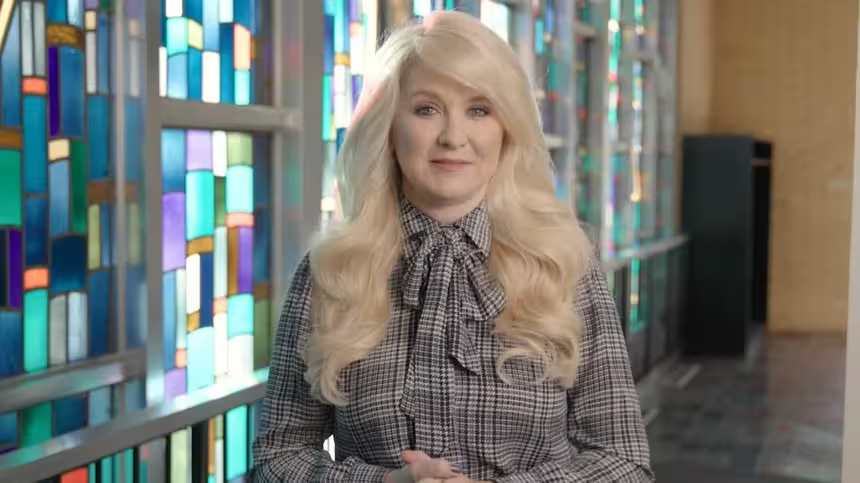
Learn Moreabout PBS online sponsorship(upbeat music) - Welcome to InFocus, I'm Jennifer Fuller.
Rural healthcare faced numerous challenges even before the COVID-19 pandemic, from geography to technology, education and more.
It's often difficult to connect patients with the caregivers they need.
One person who's spent much of his career trying to bridge that gap is Eric Hargan.
The Pulaski County native served as deputy secretary of health and human services under presidents George W. Bush and Donald Trump.
He says access to care is vital to the health of a community.
- We're gonna have to work on building out the workforce and particularly everything even down from nurses, right?
So people that are doing, that are techs, people that are aides, people that are gonna be able to, and getting people to stay in the workforce and to stay in rural areas and to stay engaged in healthcare, because that's been a real lack over the decades.
And so these are really important elements to address, and there's a lot of recommendations in there and a lot of things that rural providers can do and things that they can take advantage of, opportunities that are built down there.
- We were talking about burnout within healthcare, long before COVID came along.
Nurses and others who were overworked and in many cases, underpaid.
And in addition to that, as you said, the techs, the aides, the others that help keep those systems running, we're running into problems being able to pay for day-to-day necessities while still working full-time whether it was childcare, things like that.
What needs to happen in terms of getting folks into the pipeline to train them for these jobs?
But then also, as you said, keeping them engaged and keeping them employed so that those services can remain.
- Well, there's many answers to that.
Some of it has to do with making sure they get the right training and training in rural areas.
So people, if they're trained in a rural area, many times they stay there, but if you end up sort of sending them to a city to have them trained, they may start out in that city and they're kind of lost to the rural system.
So it's important to keep them in the rural area where they're training and that's from doctors and everyone else in the system.
That's one key element in here.
Another, and this came from a report that I just, I sponsored and dropped out, I think a day or two before I left office on entry-level healthcare workforce.
And there's a lot in there that's built out, but a lot of it has to do with career ladder, with the fact that people want to see advancement and they want to feel like they're advancing and that they have a path to career fulfillment staying in this space, so that they don't feel like they're kind of stuck in a place that they have ambition within the healthcare field, that there's a route for them.
And that it's understandable where they can go and where their career can go.
Those are two of the things, there's a lot there.
So, but that's two, I think main takeaways that I got from the study that we put in place.
- I know you've recently signed on to the board with SIU School of Medicine's population science, something that really takes a look at these needs and things that need to happen.
Colleges and universities are constantly looking at how they need to update their training.
And I know the school of medicine is very focused on rural medicine and making sure that doctors are trained here so that they'll stay here.
Do you find that that model is working?
Are there things that the SIU School of Medicine is doing that maybe could be used elsewhere across the country?
- Well, I think that, this is one of the things that I think we're gonna be talking about in the advisory board and in new capacity is talking through a lot of the issues to make sure that places like Southern Illinois, my home, get adequate representation in here.
People forget 55 million Americans are in rural areas.
It's about one out of every six American lives in a rural area.
And so this is not a small population and there are not as many places, I think, as there should be like SIU that are really engaged in this, focused on this, there hasn't been as much attention.
Most of America used to be rural, but that was at a much different stage of the evolution of American medicine.
We're facing a much different infrastructure in American medicine, a different technological level that we're at right now.
And in many ways, that has to be brought back into rural America.
And it's those kind of innovations, does it sound very innovative to say "We should train the doctor in a rural area"?
It doesn't sound innovative.
And yet it's something that people had to study and realize this is important, doctors and other professionals are very sticky in the first place that they go to.
They learn their patients, they learn their communities.
They develop relationships with people and that's important in them deciding where they're gonna go.
- Southern Illinois University School of Medicine plays a big role in reaching patients in rural areas.
It's a part of the school's overall mission, in fact.
The center for rural health partners with communities and organizations to help develop programs that improve access to care.
Especially since the pandemic began, there've been increases in overdoses and people seeking mental health care.
- And we have seen that, when Narcan is readily available, the overdoses decrease.
So again, the department of human services has created a program, it's called the, the DOP, the drug overdose prevention program, and we are a DOP site.
So it enables us to get pretty much as much Narcan as needed and provide education in the communities and distribute Narcan.
So we've been doing it every two weeks throughout SIU, and we're starting to go throughout Southern Illinois.
Well, when someone overdoses, there are just a few minutes before they can actually lose their lives.
And so having that available, as many places as possible, will save lives.
- For Narcan in particular, putting it in the communities can help prevent deaths in areas where first responders may not be able to get there in time.
Meanwhile, when it comes to farm families, the hope is to try to address a stigma around seeking help and then connect people to care.
- We have to think about the health of the whole child or the whole person.
So with our farm family resource initiative, we're able to provide a 24 hour hotline if someone is in crisis and needs help.
And with that, if they reach out and they do need help, then we're able to connect them to a provider for six counseling sessions.
But if it's something that's impacting that farm family and impacting their mental health, but maybe it's a financial issue and not necessarily a suicidal ideation, then we're able to connect them to whatever resource they might need and then offer, being able to offer the connection to the hotline by text.
Those kinds of things to help.
- Telehealth is a method of visiting with a doctor remotely.
It's particularly useful if a patient has mobility issues or lives in a rural area, where access to a doctor isn't practical.
The use of telehealth has advanced enormously and as Mark McDonald found out, much of its growth was spurred by the pandemic.
- Laura Kessler, things are available now to patients that we were only dreaming about 10 years ago.
People can see a specialist now or a nurse practitioner or anything in between from their home, in some cases from a nearby clinic.
But there's all these sort of adaptations that are going on.
And largely because COVID pushed this whole movement ahead, didn't it?
- Yes.
- How did it?
- So prior to the pandemic, seeing a patient at another facility was something we'd been doing and it worked well, but someone still had to go to another clinic.
Now, with COVID, we quickly set up a telehealth to the home program or what some might call direct to consumer program and patients are able to stay at home, stay at their office.
It eliminates barriers like childcare issues and transportation, time off work.
They can sit in their office potentially at work and just have the 15 minute or 20 minute visit with a doctor and then save all that travel time and sitting in a clinic area and all of that.
So it's really provided a lot more access to patients.
- I mentioned that COVID pushed this thing along.
You have some very impressive numbers from the telehealth services that were provided before COVID and after, what were those numbers?
- So prior to COVID in calendar year 19, we had 2000 telehealth visits, and that was our traditional program.
In calendar year 20, we had more than 65,000.
And if you look at the first year of the pandemic, March, 2020 to February 21, we had more than 77,000 telehealth visits.
- Oh my goodness.
You know, I don't know how you did it, but I mean, everybody must have really said, okay, this is, well, I know how you did it.
Everybody had to do it because the need was there, right?
- Yes, and with the pandemic starting in March and May was a stay at home order.
We tried to keep people out of the clinic as much as possible.
So if they didn't absolutely have to come in and be seen, we tried to keep them at home.
Maybe if they're immunocompromised, elderly, pregnant, anything that might, we want to keep them even more so from getting some sort of illness.
No reason to come into the clinic if not necessary.
So we try to keep-- - We're gonna demonstrate two things here today, they're your two most popular modes of access.
One is on either a smartphone or a tablet or computer at home or from office, wherever you want to be.
And the other one is from a clinic site where you have a cart like this one set up and you would have, in most cases a nurse, someone with the patient to demonstrate certain things to the doctor who's on the screen at a remote location.
- Yes.
- But let's start with the iPad or with the phone and see how that works, because that's probably the most convenient way, isn't it?
So, doctor, what did you find out from my lab results?
- Hi, Steve, I just got your results.
They were faxed over to me from the lab and it looks like you do have a lot of white cells in your urine, which tells me that you do have an infection.
I also looked for a culture and you have an infection with e-coli, which is the most common bacteria to cause urinary tract infection.
So it looks like we can treat it with some oral antibiotics and I'll be happy to call in those antibiotics, based on the information that I have from the lab.
And I can find out which antibiotic would be most effective and call that into your pharmacy, which you can pick up.
I'd like to see you back in clinic, we can do this over telehealth.
I understand this has been convenient for you, so we can have a follow-up visit over telehealth and we can see how your symptoms are at that time.
- [Mark] Or patients may choose to go to a nearby clinic where a cart like this would connect them to their doctor.
- [Laura] Hi, Dr. Sundareshan, how are you this afternoon?
- I'm doing well, how about you?
- [Laura] I'm great.
Today we have a patient here to see you, should be on your schedule.
He's presenting with some symptoms, not sure that they might be COVID or not, and was hoping that you could talk through that with him and help decide what the next steps are.
- Sure, sure.
I just want to make sure he is in a negative pressure room.
- [Laura] Yes.
- And you are wearing an N95 under that surgical mask.
Is that right?
Okay, great.
I just want to make sure.
And so, I'm looking at the schedule here.
Mr. Smith.
So tell me about how long it has been that you've been sick.
- [Mr. Smith] About three or four days.
- Okay, what's going on?
- [Mr. Smith] I have a little bit of a fever, a cough, some headaches.
- Okay, have you measured your temperature at home?
- [Mr. Smith] I have.
It's been about 100 degrees, between 100 and 101.
- [Dr. Vidya] You have any chills with your fever, too?
- [Mark] After thoroughly interviewing him about his symptoms, Dr. Sundareshan has a plan.
- Okay, so I think we're gonna order a chest x-ray as well.
We'll send you home with a pulse oximeter.
A pulse oximeter is a small device, which you can put on your finger.
It's pretty simple.
It comes with the explanations.
It's very simple and monitor your oxygen levels on that.
We'll send you home with a thermometer and a pulse oximeter.
If you don't have a thermometer, we'll send you, send you home with both, okay?
Make sure you check your temperature about two to three times a day and check your oxygen levels every six to eight hours, okay?
- You and SIU have covered almost the entire state.
You have people that have taken the telehealth services from what, 98 counties, that's remarkable.
- Yes, and that's been since the (mumbles) of the pandemic.
So since March of 2020, we have served patients with the home county of 90 of the 102 Illinois counties.
So something we're very proud of that we can provide access to that many people around the state.
- To make a telehealth appointment, you do it like you would any other appointment.
Call your healthcare provider and tell them that you would like to have a telehealth appointment or you can do it online.
You can contact them by email.
InFocus in Springfield, I'm Mark McDonald.
- Another issue facing rural areas is a shortage of healthcare providers.
The Illinois Health and Hospital Association recently found that rural counties have nearly 50% fewer physicians than urban areas.
One program is helping to address that shortage by giving future doctors the opportunity to attend all four years of medical school in Southern Illinois.
- It's so important for our students to see the modeling of that physician in a rural community, meeting those challenges in a model where they're collaborating with their patients to overcome them together.
My name is Jennifer Rose, and I'm a family practitioner in Carbondale and West Frankfort, Illinois.
And I'm here today because I am the director of the Lincoln Scholars Program with SIU School of Medicine.
I also work for the family medicine residency program, here in Carbondale.
So I have my hand in a lot of medical education that goes on here in the Southern Illinois area.
(calm music) So the Lincoln Scholars Program is a newer endeavor into rural education for SIU School of Medicine.
It's essentially a rural track of a medical doctorate program for medical students at SIU.
And the entirety of the education is done in Carbondale and around the areas of the Carbondale campus.
- Because I've grown up in rural area my entire life.
And I only live 84 miles north of here.
So I could stay close to home and do what I wanted to do anyways, rather than going all the way up north.
- [Jennifer] We let them get here, figure out where the bathrooms are and they start delving into clinical medicine right away.
- I started going to Eldorado and working in a clinic and it was definitely nerve wracking 'cause I'd never done anything like that before.
My background was in research here.
So I had never had any clinical experience.
So I thought that was very, kind of just special to this program.
You're immediately submerged into this rural clinical work.
(calm music) - So normally rotations occur third year for a normal medical school program.
With our program, our first year, we were with the PA program down here in Carbondale and throughout their first year, they learn hands-on like how to do exams.
And then we also, on Thursdays every week would go to our family practice providers.
And we started learning how to do procedures and talk to patients within our first year.
And now in our second year, we've started those rotations that normally occur third year.
(calm music) - But it can be isolating to be a physician in a rural area.
And so building that support and that networking to reach out to others when you need help, because you can't necessarily refer that patient to another physician without impossible hoops for that patient to jump through.
And so you have to do a little more sourcing on your own.
As a physician in a rural area, you try to provide as many of the services as your patient needs right there, where they can get them from you.
(calm music) - All of our rotations are in different portions of the community, like throughout Southern Illinois, we're in Eldorado, Fairfield, Litchfield, Carbondale.
We're down in Gallatin County school district.
And we've been able to be well accepted by everybody.
And it's very interesting to see all the different interprofessional relationships we can build with the psychiatry, psychology program at the mental health in Eldorado with the PA program and with a lot of the nurse practitioners in the area as well.
- And being within these rural areas, very small areas, you see a lot of different things and a lot of people working in unison.
So you're not just working with doctors, you're working very close with PAs, nurse practitioners and you get that interprofessional work that's really valuable.
(calm music) - And what we tend to see is that physicians, just like most of us, get comfortable in areas that we are able to train and learn.
We develop a sense of comfort.
And so by creating this opportunity for these students to get all of their training in a rural, underserved area of medicine, we're allowing them to learn the challenges that are unique to rural medicine.
To watch someone role model, handling and overcoming those challenges and to feel comfortable and inspired to stay in those communities that they're already drawn to.
- I'm just kinda trying to find where I kind of fit right now, but I've always leaned towards just going into primary care and going back home to practice because that community kind of shaped me and I want to give back to them the way that they gave to me.
And so that's the whole reason I'm doing this.
- You can find more about the SIU School of Medicine's rural health initiative by going to their website.
Baseball season may be winding to a close, but the heart of the game beats throughout the year.
Julie Staley takes us inside a special traveling exhibit that aims to broaden the story.
- Baseball is America's pastime, but its history isn't complete until you include the history of the Negro leagues of baseball.
(crowd cheering) - It's a fascinating array and an unbelievable history, not just about baseball, about civil rights, about social issues.
Just about the time starting in 1920, when Rube Foster organized all of the various teams.
- [Julie] By the 1920s, baseball had legendary talent like Babe Ruth, Ty Cobb, Lou Gehrig, they represented some of the best of America's pastime, but they didn't represent every American.
- Back in the 1800s, believe it or not, there was some integration in baseball play.
But then again with the change in America, reconstruction, the early part of the 20th century, which was the emergence of Jim Crow and the collar line.
African-Americans were not allowed to play again with whites, as they did, say, early on.
- [Julie] The history of black baseball goes back almost as far as baseball itself with black teams organizing after the civil war.
The reach went international to countries like Venezuela, Puerto Rico, the Dominican Republic and Mexico, but the father of black baseball is regarded as Andrew Rube Foster.
He came from Cuba and started the Chicago American Giants.
In February of 1920, he formed the Negro baseball league.
- And these were teams from cities, from work situations, from colleges, just teams that barnstormed across America.
So he thought, "Why don't we organize them into a financial structure?"
And that ended up putting together the Negro leagues, which was American league and a national league.
Very similar to what the MLB is like today, but they were passionate about playing ball.
They wanted to play ball and they wanted to play it with the best talent.
I mean, if you're a talented athlete, you want to play with talented athletes, you want to be around them.
- [Julie] Negro baseball league teams played the first games at night.
They had to play at ballparks when the major league teams were not on the field.
- Many of them rented their stadiums when their teams were away to the Negro league teams.
They packed them.
They made a lot of money on what would have been a closed venue.
You had to keep the game cheap enough so that the working class black citizen could pay for it.
So they didn't charge top dollar, but they would pack them in.
They had baseball cards, they had, they signed autographs, they had programs.
They had the whole nine yards.
It was almost a mirror image, many cases of what was actually going on in the MLB.
- [Julie] Even though their money was welcome at the stadium, players were not always welcome at businesses outside of the stadium.
- They could not go to any of, most of the restaurants along the way.
But what was very interesting was because they couldn't, it also caused many black enterprises to develop.
You had hotels that would take them, in cities where they could stay.
So they were African-American hotels that blossomed, we call them bed and breakfasts, but they had places like that.
Restaurants were piped up, that they went in and ate in.
And of course they were celebrities.
So these restaurants really gained, economically.
So they had a great impact on the economics of the time.
- [Julie] It all changed with one player in 1945, Kansas City Monarchs, Jackie Robinson was signed to play with the Brooklyn Dodgers.
- And they were excited about Jackie Robinson making the break.
But the unfortunate thing when Jackie, well unfortunate in a sense when he broke into the majors was the demise of the Negro leagues.
Because again, you could go to the major league ballparks.
African-Americans were so excited when he made that plunge that they of course wanted to follow those teams.
- [Julie] Now, major league baseball had a new following, more minority players were signed on, away from the Negro league.
The revenue that supported those teams faded away.
Today, there is a long legacy of players in the Negro leagues, including several with connections to central Illinois.
- I think most folks have heard about Satchel Paige, but he has a Springfield connection also.
He was the vice president for the Springfield Redbirds, which was a minor league team.
Not only was he a player, but baseball was really his life.
So to speak.
- [Julie] Springfield's Comer Cox Park was named for one of the Negro league players.
He eventually was president of the Springfield Urban League.
- [Interviewee] Comer Cox was born in 1905 in Georgia.
He played with the Cleveland Cubs and the Nashville Elite Giants in 1930 and 1931.
We had a player whose name was George Neal, and he was an infielder.
He played for the Buxton Wonders.
The Buxton Wonders was not, probably one of your more noted teams in the Negro league, but it did give fame and glory to Buxton, Iowa.
Thanks to George Neal who was born right here in Springfield.
- In December of last year, major league baseball officially incorporated the stance of Negro league players into their records.
Every Negro league player since 1920 is now considered part of major league baseball.
The complete exhibit ends October 30th, but the local items will remain here on display, indefinitely.
For InFocus, I'm Julie Staley.
- Well, that'll wrap things up for this edition of InFocus.
You can find this and other segments and episodes by going to wsiu.org.
I'm Jennifer Fuller.
From the entire InFocus team, thanks for joining us.
(upbeat music)

- News and Public Affairs

Top journalists deliver compelling original analysis of the hour's headlines.

- News and Public Affairs

FRONTLINE is investigative journalism that questions, explains and changes our world.












Support for PBS provided by:
InFocus is a local public television program presented by WSIU