
InFocus 203 - Celebrate Thanksgiving
11/25/2021 | 24m 14sVideo has Closed Captions
Hear the voices of people working to bring communities together.
In the last 18 months, we've all learned about the importance of togetherness - even if it has to be virtual. We'll look at traditions and how they have changed and hear the voices of people working to bring communities together.
Problems playing video? | Closed Captioning Feedback
Problems playing video? | Closed Captioning Feedback
InFocus is a local public television program presented by WSIU
Support provided by:

InFocus 203 - Celebrate Thanksgiving
11/25/2021 | 24m 14sVideo has Closed Captions
In the last 18 months, we've all learned about the importance of togetherness - even if it has to be virtual. We'll look at traditions and how they have changed and hear the voices of people working to bring communities together.
Problems playing video? | Closed Captioning Feedback
How to Watch InFocus
InFocus is available to stream on pbs.org and the free PBS App, available on iPhone, Apple TV, Android TV, Android smartphones, Amazon Fire TV, Amazon Fire Tablet, Roku, Samsung Smart TV, and Vizio.
InFocus
Join our award-winning team of reporters as we explore the major issues effecting the region and beyond, and meet the people and organizations hoping to make an impact. The series is produced in partnership with Julie Staley of the Staley Family Foundation and sponsored locally.Providing Support for PBS.org
Learn Moreabout PBS online sponsorship(upbeat music) - Welcome to another edition of InFocus.
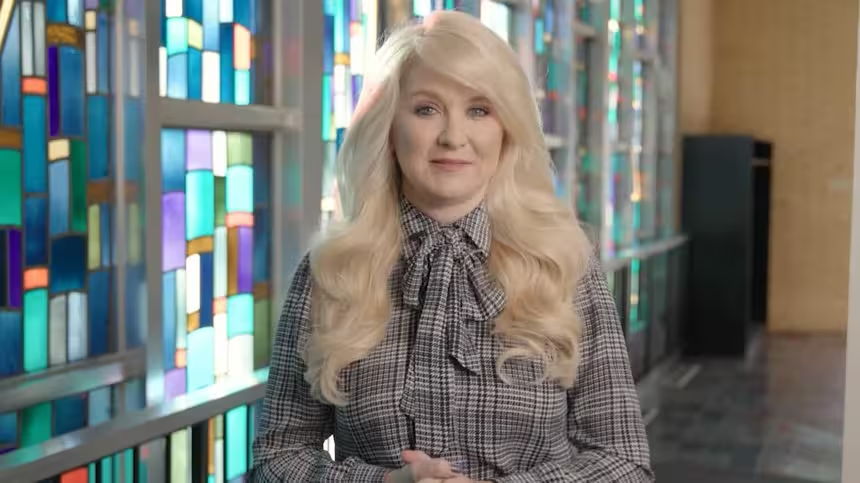
I'm Jennifer Fuller.
I hope you're enjoying the start of the holiday season.
COVID-19 has certainly changed our way of life over these nearly two years, but for some, those changes have been more difficult to adapt to.
While many people are starting to get back to normal.
Those with loved ones in congregate facilities, still face uncertainty, thanks to continued COVID-19 concerns.
We spoke with several families whose loved ones live at the Murray Developmental Center in Centralia, about how they're handling the holidays this year.
- Well, she turned 50, uh, last year too.
So that was hard.
'Cause I was really expecting we were gonna have this great party and all of this stuff.
And instead, I mean, I did send stuff and they all decorated and they got dressed up and they had cupcakes, but I wasn't there for it.
- [Announcer] The Murray Center in Centralia is home to about 250 individuals.
- Many of them are severely and profoundly medically fragile and disabled.
And then we also have a large group of individuals that are more high functioning, but they have some severe behavior issues.
Many of them have lived previously in community group homes, but they've come to Murray.
- [Announcer] The pandemic has been hard on everyone, but for those with family in a facility like the Murray Center, there are even more challenges.
- One day they just tell us, you can no longer come in.
And the next time we got to see our loved ones, was four months later.
And the day they told us we could come, the next day, that very night, someone tested positive, one of the staff, so then we had another two weeks, we had to wait.
And when we did go to visit, we had to sit six feet away.
We could not touch them, hug them, kiss them.
We had to wear PPE, had to be outside.
And you could only, you had to schedule every visit.
- I did talk to her on the phone quite a bit.
She makes her little noises into the phone and I talk.
So I guess maybe that helped a little too, but I just, you never really know what she understands or what she doesn't understand.
- How do you explain to someone like our son who functions like a nine month old, all of a sudden his mom is not coming anymore and his dad, and he doesn't see him.
It was just really horrible.
And finally, in March, a whole year later, March 31st, we finally were able to take our loved ones out for a ride or take them off campus.
And when our son Mark looked at me and we walked outside, the look on his face he got in the car, and he just grinned for 45 minutes.
'Cause we went for a ride, you know, and sang Christmas songs, which he loves.
But I mean, he had no idea and it was really difficult, even more so I think in a way for those individuals that are more high functioning because they couldn't go anywhere.
And this is a very active group.
There was dances at the center all the time.
There's always activities, and most of all of that was stopped.
- [Announcer] The past year was especially hard on new residents and their families.
- So he'd been there just over a year when the pandemic started.
So he was in a really good routine with coming home, and that wasn't real good.
It was hard to explain to him why he couldn't come home.
- It was a very, very tough transition for us.
Because like I said he was home with us for a long time and it was not something we had ever planned on doing.
I have twins that are 19 also.
So we have four kids, and we've just always taken him everywhere we went, and he's always for the most part, been pretty good, but still, you know, fully disabled and a lot to take care of on a regular basis.
But so when we put them in there, it was really hard, very hard.
And we were pretty much told you'd be able to see him whenever you want.
You could come in the middle of the night, you would have access to this, to that, you know, different doctors, specialists, you know, fast forward six weeks, he was in there.
And then obviously we all know what happened with pandemic and we pretty much didn't really get to see him for a year.
- [Announcer] Families and residents did their best to keep spirits up.
- She's addicted to Pepsi.
So I've been instacarting Pepsis in.
So they get dropped off at the front, and they make sure she gets them.
But yeah, usually that's something I do.
I show up with cases of Pepsi, you know, I carry it in and the chips and the cookies, because she's obsessed with cookies.
- You know, this pandemic, I've been a trooper right through it.
- [Announcer] The holidays have been especially rough.
- We have been cooped up in the cottage, really not doing nothing, hanging out with my friends and all that.
Talking on the phone with my dad, asking him kind of when he's going to come see me and all.
- We usually bring Christmas to her.
We show up Christmas morning, we bring pancakes or donuts and we open her presents.
And then when she's done with us, she shows us on our way.
So it was really hard, 'cause we didn't get to experience anything with her.
- [Announcer] While Illinois opened up in June those in congregate care facilities like Murray still face restrictions.
- And it's been very, very frustrating , because as soon as they get out and they're starting to do things like now they're starting little back to workshop.
They're starting to do things.
Well, then when the staff comes positive with COVID, they've got 14 days quarantine again, where they have to stay on their unit.
They can't really go anywhere.
So it just keeps starting over and over.
And I think for them and all of us, we just wanna get back to normal.
We had huge plans for a Fall Fest, which I've had every year at Murray, of course we didn't last year.
It's a huge, big deal, we have hay rides.
They dress up for Halloween in their wheelchair, decorating contests.
Well, that was planned for right before Halloween.
And then someone came with a COVID.
So all of that was canceled.
So their Halloween was pretty much canceled, and it was horrific.
I mean, they don't understand why really some of them, so Christmas, we are hoping, that's all we can do.
- [Announcer] While the Murray's center's families and residents have high hopes.
The coming holiday season remains uncertain.
- Well, of course I'm hoping Max is gonna be home with us.
What's the next holiday, (clears throat) What's the next holiday Max?
(mumbling) Christmas?
Thanksgiving?
- Cooking.
- Yeah, I do a lot of cooking on Thanksgiving.
Christmas, are you gonna come home and see mom?
- Yeah.
- Yeah, this year you're coming home to see us, aren't you?
You're gonna get a lot of presents.
- Aunt Cathy, I hope grandma Ruby and Aunt Cathy I see you for Thanksgiving and Christmas on the 20th.
I love you, I love everybody.
- For Murray families, the plans remain uncertain because COVID cases and quarantines can happen without warning.
Traditional holiday shopping, crowds and stores, sales.
The search for the popular gift is trying to make a return to normal this year.
And while holiday shopping can be fun, it can also be stressful.
And this year it may trend even more towards stressful because of terms like inflation, supply chain problems, and product shortages.
They're all becoming more and more a part of our everyday vocabulary.
Mark McDonald spoke to two men who know the retail side and found that this year, your choices may be fewer.
Your bill may be higher.
Your shopping should be earlier.
- [Mark McDonald] 2021 is anything but a normal year for retailers.
But one thing hasn't changed, the holiday shopping season is crucial.
- It is still a huge thing for retailers.
Now, it is not what it used to be.
I mean, black Friday got its name because that was the point in the year at which retailers started to make money.
They spent the rest of the year operating in the red.
Clearly we have seen even prior to the pandemic where that date has gotten earlier and earlier, and frankly, recovery of costs or operating the black has gotten a bit later than that.
But yes, it is still an extraordinarily important period for retail.
- [Mark McDonald] Noonan's true value in Springfield has been in business for 75 years.
Matt Noonan's been in the business all his life.
He says the company hasn't seen supply problems like this since right after World War II.
- No, I think what we have may be pretty much all we're gonna get.
This type of product, the Christmas decorations and so forth for this season, we only get, what we order in February.
So we're really anticipating how things are gonna go in February.
And so those orders are placed and a lot of stuff comes across the water very often from the far east.
And so what we have here now is what we're gonna get.
If there's anything that's on the water someplace, we won't see it.
- Yeah.
- Primarily, the suppliers have canceled orders that are hanging out there, that they know they're not gonna get.
So we're not gonna see it, true value isn't anticipating too much more.
- [Mark McDonald] We've all seen the pictures of cargo ships loaded with shipping containers, waiting to be offloaded at California ports.
- The pandemic force factory shutdowns.
They also caused port shutdowns.
And then you had just-in-time inventory chains, which took, started taking place in, you know, in the late '80s, as Toyota corporation was the company that first pioneered that approach, had no slack really in the supply chain.
And so we were seeing all of that come home to roost here in this pandemic.
On top of that, then you have labor shortage as well.
So even if you wanted to hire more dock workers to unload ships, you have a limited number of slots in ports, right?
So there's poor infrastructure that plays into this as well.
You've seen some companies, some larger companies like Target, Home Depot, Walmart, who have even gone about either purchasing or renting their own dedicated ships so that they can choose where to pick it up from and where to drop it off.
But even that has limited capability because there's only so many ports that can take it.
And there's only so many offloading spots.
- You know, buying has always been complicated for a retailer, because you have to buy in advance, sometimes seasons in advance, and plan on when it's gonna arrive and how you're going to market it.
It's even trickier now, isn't it?
- It certainly is primarily because you know, things aren't coming in on what we consider a regular schedule.
The other issue that we've seen is like everybody else, the trucking industry has had problems.
So sometimes they're short on drivers to bring the merchandise.
We've had delays on deliveries only because there wasn't somebody there to drive that truck to our back door.
Eventually everything goes on truck, you know.
- [Mark McDonald] Product is not the only thing in short supply.
This year, labor is also an issue.
- Then, as you mentioned with the labor shortage, not only retailers, but others are offering significantly higher pay and bonuses and benefits to attract and try to keep workers.
So those who say, will just pay them more, we already are, but there's a limit to what you can pay.
And, but we're seeing $18 to $20 an hour right now.
That gets to a point where you can't do more than that, but that also gets absorbed or part of it at least gets absorbed into the costs of goods and services.
So those have all put pressures on.
- [Interviewer] Is there a shortage?
If you need to hire help this season, is there a shortage?
- There has been, yes.
And I think there still is.
I mean, at this point there still is, people that are anxious to work are not that readily available, either because they don't think they make enough money or they want a different kind of job, or they don't wanna work the hours.
You know, we're open seven days a week.
We take four days off every year, Thanksgiving, Christmas, New Year's day and Easter, that's it.
Those are the days that we're actually closed.
Other than that, we've gotta staff those days.
- [Interviewer] Yeah.
- We have learned how to staff them leaner than we might have in the past.
And so we can do a lot of things, the way we lay out our stores.
So we can do a lot of things with a minimal amount of staff, but there is a minimum, you know, there's a bare minimum.
So when we get into rental, we've got to have a good number of people that know what they're doing.
That's not something anybody can walk in on.
They got to know about the product and how to use it, and be able to show people.
- [Interviewer] Yeah.
- So that's always been a challenge.
But it seems to be more of a challenge in the past 18 months.
- [Interviewer] So what does it mean for your shopper?
The person that's going to go out after Thanksgiving and expect to find what he or she wants.
- Well, I think there's two things.
One in terms of price, I don't think you're going to expect to see quite the same aggressive discounts that you've seen in the past.
Again, you'll see some promotions, but I don't think they're going to be as aggressive as they were in the past.
Prices are going to be a little bit higher probably, and that we've already seen some reflection of that marked up anyway, so I don't think you're gonna see significant additional markups, but that's already been reflected.
But then it becomes a question of access.
And I guess my guidance to everyone has been for weeks, if you haven't already started, you're already late.
Get started now.
Whether you're shopping at a brick and mortar store or whether you're shopping online, it is not too late to start shopping now.
- [Mark McDonald] When supply goes down, costs usually goes up.
Another pandemic related lesson we'd rather not learn.
InFocus in Springfield, I'm Mark McDonald.
- Many people are excited about a return to theaters and other performance venues this season.
This month, we're honoring the opportunity that we're grateful for.
To have these talented actors as a part of so many shows on various stages throughout Illinois.
We hear from some of the area's most talented black actors who are a vital part of bringing stories to life in area audiences.
Producer Julie Staley with Spencer films brings you this story.
(upbeat music) - My Uncle Pat's name was Patrick Henry Chappelle.
He started the Rabbit's Foot Minstrels or the Rabbit's Foot Vaudeville show.
At one particular point in time, he was considered to be the black PT Barnum.
It was just really important because it launched the careers of so many African-American people who wanted to make it in show business who saw something bigger for themselves.
Like Bessie Smith and also Ma Rainey.
♪ He's gone away.
♪ ♪ Yeah, I got what it takes ♪ There have been different people within the Chappelle family who have pursued careers in entertainment in some way, including my dad, actually for 24 years, he actually was the drummer for blue singer Coco Taylor.
I feel like it's a way of our ancestors kind of speaking through us and allowing us the chance to tell these stories by utilizing our talents.
But it sometimes seemed like there was a lack of opportunity unless you look a certain way or unless people have seen you in a lot of things.
(singing hymns) You know, almost immediately when I auditioned for Memphis, that was not the case.
Like I was actually given a chance and nobody looked at me or looked at me differently, nobody treated me differently.
I was paralyzed at one point.
So I also experienced vocal paralysis during that time.
So I hadn't really sung a note in like two years.
My nerves were on edge, I can say that, but once the curtain was open, it was a really empowering feeling.
So it's really important that we know these things particularly so future generations know them as well.
But it's also important to tell those stories without, you know, without the trauma and without the violence that comes with it, because we lived through that enough.
- A lot of the roles I've played have either been servants.
They've been comedic relief.
They've been the fun, crazy sidekick, or the super religious black brother.
But I didn't ever get to play someone who isn't broken.
I always have to play someone broken and that's, you know, black actors are more than that.
I'm tired of playing your slave.
I'm tired of playing your servant.
I'm tired of playing your black brother.
I just want to play the character.
I want to play somebody who has substance, who isn't broken, who's healed.
I ain't with tenderness and kind of passion.
We make it seem like black people, civil rights, slaves era, you know, all these black people like they were helpless, but black people had to learn to be resilient, how to be independent.
And I want to see that more in theater.
Shows where the truth isn't hidden.
It's a mirror that you put up to society.
You say, this is you.
- I am a historical actor, at the Abraham Lincoln Presidential Museum.
I do a show called Ghosts of the Library.
And in that nine minute show, we are narrating the story of Lincoln and his artifacts.
In addition to narrating these artifacts, we also talk about the history, the pain, the death, that permeated that time.
I need to be careful about how I say this, because I don't want people to think that oh I'm ungrateful because I'm definitely in a very fortunate spot, but I need people to recognize that the story that I get paid to tell is one of the darkest moments in American history.
And I have to continuously walk into a place of trauma in order to tell that story, whether I'm speaking about slavery or not, that period of time is always connected with that original sin of slavery.
And because we're in Lincoln's town, Lincoln's land, we constantly tap into that narrative, into that story.
And it's very draining.
There've been times that I've honestly wondered like, okay, how am I going to make it through this performance without like having an emotional reaction.
There are very few opportunities for black folks in general, minorities in general, that are not trauma based.
And it's hard, it's absolutely difficult, because yes, we have this amazing rich, beautiful, enduring and resilient culture and these resilient narratives, but at the same time, how can we continue to grow and be beyond that?
♪ I can feel the cold creeping in my bones ♪ - I know for me being a young black woman, it means a lot when we're able to do shows that reflect on either black stories or, you know, involve people of color in any shape, form or fashion.
It means a lot to be able to express ourselves through music.
- In the past, there have been so many people that I think could have blown that part out of the water if given the chance.
And a lot of them feel discouraged because they don't get that opportunity.
Or they're, they're not made aware of what's going on.
And I would like to see more of them get the time to shine.
in local community theater scene.
- [Brianna Gude Price] But I do like the direction that theater is moving as a whole, I do like the direction of the color blind casting.
And just solely base, they basing it on their talent.
- I think our community has come a long way.
I think we've gone through enough, we've come so far.
And I think even today, this is still just the beginning of a long haul to get where we deserve to be as anybody else.
(light music) (audience cheering) This community, it was an instant welcome.
Landing the role of Peter Pan, I mean, it was just like, typically they were casting females in that role.
And as a man of color, I almost felt like I was breaking that mold in a sense that, you know, times are changing and people are awake and people are open-minded to difference.
♪ I, I wanna be in the room where it happens ♪ ♪ The room where it happens ♪ To see these shows like Hamilton, and, and then you go to film and you see Bridgerton and, and all these diverse cast, like, it's amazing to feel included, without a hint of racism being involved.
- My thoughts of you never end.
- Color blind casting is slowly but surely coming, becoming the new norm.
- And representation matters as the saying goes, representation matters, so when you see, you know, cast full of people of color, you know, from our perspective, it's like amazing.
Like, it's just like, oh my gosh, like, this is just, oh, you know you to just come back.
- It's like an adrenalin rush.
(band singing) - Black creators, don't just need the space to dream.
They need the insurance to dream.
And what I mean by that is more than support, more than encouragement, more than promotion, more than exposure, more than capital.
We need actual engagement, and people willing to be uncomfortable enough to engage.
- You have strength, you have a community, you have backing, you have it in you, go reach your promise, go reach your potential.
Don't let people hold you back.
(choir singing) (audience cheering) - Many of these actors are now returning to the stage.
As venues open up during the pandemic.
They look forward to your continued support of the arts.
The holidays are always a busy bustling time of year.
We hope you're able to get some quality time with friends and family this year to celebrate, and share with one another.
We're thankful to share these unique stories with you, here at InFocus, from all of us, happy holidays.
We'll see you next time.
(light music)

- News and Public Affairs

Top journalists deliver compelling original analysis of the hour's headlines.

- News and Public Affairs

FRONTLINE is investigative journalism that questions, explains and changes our world.












Support for PBS provided by:
InFocus is a local public television program presented by WSIU