
InFocus 206 – Childhood Cancer
2/24/2022 | 26m 46sVideo has Closed Captions
We talk with medical practitioners about fighting Childhood Cancer.
WSIU’s team of reporters talks to medical practitioners about the latest innovations in the fight against childhood cancers. Learn how nonprofit organizations are supporting local families in the battle to beat cancer.
Problems playing video? | Closed Captioning Feedback
Problems playing video? | Closed Captioning Feedback
InFocus is a local public television program presented by WSIU
Support provided by:

InFocus 206 – Childhood Cancer
2/24/2022 | 26m 46sVideo has Closed Captions
WSIU’s team of reporters talks to medical practitioners about the latest innovations in the fight against childhood cancers. Learn how nonprofit organizations are supporting local families in the battle to beat cancer.
Problems playing video? | Closed Captioning Feedback
How to Watch InFocus
InFocus is available to stream on pbs.org and the free PBS App, available on iPhone, Apple TV, Android TV, Android smartphones, Amazon Fire TV, Amazon Fire Tablet, Roku, Samsung Smart TV, and Vizio.
InFocus
Join our award-winning team of reporters as we explore the major issues effecting the region and beyond, and meet the people and organizations hoping to make an impact. The series is produced in partnership with Julie Staley of the Staley Family Foundation and sponsored locally.Providing Support for PBS.org
Learn Moreabout PBS online sponsorship(calm music) (upbeat music) - Welcome to "InFocus."
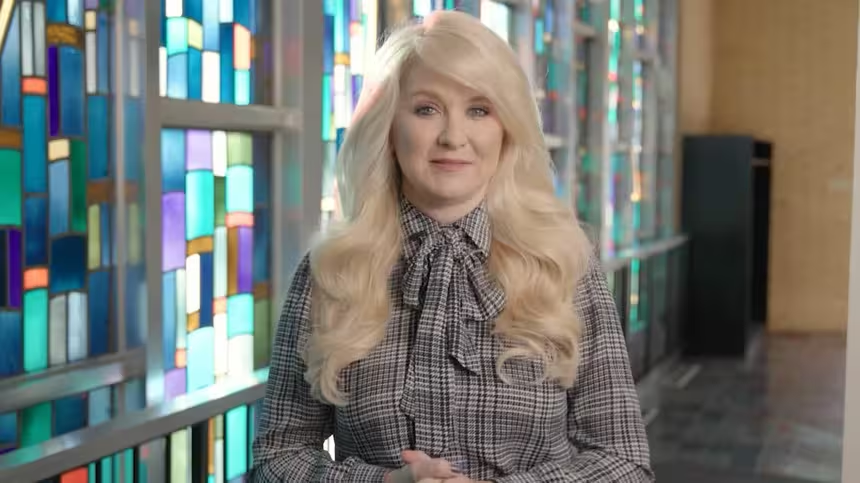
I'm Rosslind Rice.
Cancer is the number cause of death by disease for children.
Although billions of government dollars are spent on cancer each year, only 4% of that funding goes to help childhood cancer.
Many organizations work to bridge that gap.
We take a look at the oldest St. Jude Children's Research Hospital.
They've been working for 60 years to help save the lives of their young patients.
Their motto is no child is denied treatment because of race, religion, or the family's ability to pay.
The hospital is located in Memphis, Tennessee, but their clinics and fundraising offices throughout the country work to find new avenues for saving lives.
Julie Staley shows us more about their work.
- Fundraising has had to change for many charities because of the pandemic, but for St. Jude Children's Research Hospital, it's brought a new future for the way they raise money for childhood cancer.
- [Vintage Narrator] A real dream has come true.
For this benefit premiere launches a drive for a new hospital sponsored by the film star Danny Thomas here arriving with his family.
Years ago, Danny vowed he'd built a hospital if he ever became famous.
- [Julie Staley] 60 Years ago, the dream of fighting childhood cancer became a reality when movie star Danny Thomas started St. Jude Children's Research Hospital and its foundation, ALSAC, the American Lebanese Syrian Associated Charities in Memphis, Tennessee.
At that time, childhood cancer had a 20% survival rate, but St. Jude has changed that.
Because of their research, overall cancer survival rate is now at 80%.
For acute lymphoblastic leukemia, the most common type of childhood cancer, the survival rate has in increased from 4% to 94%.
Amy Jones is one of those statistics.
She was diagnosed with ALL at age 11.
Her single mother had nowhere to turn.
- All these years later, I still vividly remember saying, mom, does this mean I'm gonna die?
And as any parent would respond, she just kind of choked out, I don't know, 'cause she didn't wanna lie to me.
And she, for the first time in my life, didn't have any answers for me.
And so my doctor kind of interrupted her and said, we don't know the future, but we do know that St. Jude Children's Research Hospital is the absolute best place for kids like your daughter, so that's where we're gonna send you.
And my mom, being a single parent her whole life, my whole life, said, I don't know how I'm gonna afford it.
And immediately my doctor said, it's St. Jude, you don't have to.
And I will never forget the look on my mom's face as you could almost see the weight kind of lift off of her shoulders.
She kind of fell back against the wall and slumped down and just started to sob.
And it was in that moment that I realized, okay, this is something different, like St. Jude's gonna be a different place.
- [Julie Staley] Amy's treatments helped her get back to a normal life as a teenager, but it wasn't for long.
At age 15, the cancer returned.
- What I didn't realize is because it was a relapse protocol, things were gonna be stronger.
My medication made me five times sicker.
I was in the hospital way more and just had some pretty serious, significant days, some touch and go moments.
But I, through the grace of God and through the help of St. Jude was able to make that another two and a half year protocol, and I was able to go through my high school graduation.
And about two weeks later, I had my last chemotherapy.
And I have then been able to go to college, been able to get married.
- [Julie Staley] The pandemic hasn't slowed down research, but fundraising has been hit hard.
Staff have had to abandon most of their traditional events to raise money, but St. Jude has a different approach to reach out to donors.
- I think it's all about meeting people where they're at, for sure.
I like to meet face to face with people, but I have definitely picked up the phone more now.
You meet them individually and be like, okay, what excites you about St. Jude?
Is it the proton beam therapy?
Are you interested in the research?
Are you more interested in the red wagons that replace wheelchairs?
- If St. Jude can figure out a way to do all these protocols and fight these tremendous diseases, we've been able to figure out ways to do fundraising.
So, we, like most of the world have been relying on lots of virtual, lots of digital platforms.
Finding ways to connect with people through social media and finding ways that we take maybe something that they're already doing and are able to incorporate.
- [Julie Staley] Some of their biggest supporters aren't donors, but volunteers.
And St. Jude hopes to engage them in a new way.
- So we wanna empower them, give them the resources that they can do to fundraise and be proud of what they've done, and get to celebrate them somehow.
So we have different ways of doing that.
And I think that's the biggest takeaway from all of this is that we have some really great people, and let 'em fly.
- [Julie Staley] Only 4% of federal funding goes to childhood cancer.
St. Jude is not the only organization working toward cures for children and help for families.
There are dozens of charities and hospitals working to make a difference, but after 60 years, St. Jude is the largest and longest running organization of its kind.
However, it isn't free of criticism that they're not doing enough to help.
- You do.
I mean, there's always an excerpt, there's always people who say, okay, well, they may pay for this, but they can't pay for all of that.
And I think just to be able to continually share my testimony, to continually share my story and for every patient who's able to speak to just what St. Jude has done for their life, and I think also for the families of patients who didn't win their battle, who still come back and say, no, we may not have had the outcome we wanted, but St. Jude still gave us time.
And I think when you listen to the stories and realize that they're genuine and that they're so life changing, you realize, okay, well, that part is true.
And then I think what makes it so powerful is the fact that yeah, I didn't have to worry about anything else.
I was able to just focus on getting better.
My mom was just able to focus on me.
- [Julie Staley] St. Jude ranks among the top charities to donate to from watchdog groups.
They've repeatedly been named one of the best hospitals in America by U.S. News and World Report.
- The doctors and researchers do not have to worry about money at all.
It is seriously laboratory to bedside.
So not only are these doctors treating the patients, they're also doing the research.
So they're are doing both things, which doesn't happen at many hospitals.
- Their fundraising dollars are already committed.
St. Jude has pledged over 11 billion in the next six years for research and treatment.
Foreign focus, I'm Julie Staley.
- When it opened in 1960, St. Jude was the first fully integrated hospital in the South at a time when segregation was common in the region.
Today, they serve patients of every background.
St. Jude is the only pediatric research hospital that's been awarded a Nation Cancer Institute Support Grant.
Treatment of childhood cancers has made remarkable progress, particularly in recent years, as Springfield pediatric oncologist claims a diagnosis of leukemia in the 1960s was like a death sentence.
But now that child has nearly a 100% chance of survival.
Mark McDonald sat down with Dr. Gregory Brandt for this interview.
- Dr. Greg Brandt, for those of us on the outside looking in at pediatric oncologists, it must be a very disturbing and difficult field to be in watching kids in this situation.
But at the same time, since you've been in this field, you've seen a lot of improvements and a lot of progress as well, haven't you?
- I have.
I get that comment a lot, that gosh, it's gotta be a tough job.
Sometimes it is, some days it is, but generally it's much more satisfying than it is depressing.
- I talked to you earlier and told you that I'd like to focus on progress, hope, and looking toward the future for a better go for kids who are diagnosed with cancers.
And you said, there's lots of hope on the horizon.
Give us a rundown.
- So if we look back at the history of the most common malignancy that we deal with, pediatric acute lymphoblastic leukemia, this was a deadly disease.
It was a death sentence in the 1950s, 1960s.
And steadily since then, survival has been increasing and increasing and increasing, generally through the addition of more chemotherapy, different ways of giving chemotherapy, different durations of therapy.
But most recently, with the addition of new technologies, immune mediated, using the body's own immune system to eradicate its own cancer.
- [Mark] How does chemotherapy affect or how does it trigger the immune system?
- So the chemotherapy doesn't do this.
We engineer the body's immune system to attack the malignant cell.
- [Mark] Now this would only work in tumors, is that right?
Or would it work also in the blood cancers?
- It works very well in the blood cancers.
We're still trying to develop this technique for solid tumors.
That's a little slower in development currently.
- [Mark] When you are treating a blood cancer like leukemia, - Yes.
- [Mark] What does the chemotherapy actually do?
- These cancer cells are rapidly dividing, and what the chemotherapy does is trick those cells into taking them as byproducts for making the structures that cells need to live.
And then by tricking those cells into taking them in, it's like a time bomb.
And so there's side effects with chemotherapy.
Sometimes normal cells take up these bombs that we put in there, but generally it's the faster dividing leukemia cells that are damaged more so than regular cells.
- You mentioned the fact that you've been able to, you in the field, have been able to declare victory in some cases.
- Yes.
- Tell me about the victory.
- So there's a subset of leukemia patients that we have been able to define based upon their age, their white count and how well they respond to upfront therapy.
And we've demonstrated with by treating a number of these patients that they are going to do well, they are going to survive with a minimal amount of chemotherapy without fear of relapsing.
- You mentioned the age.
What is the age?
Is there a magic age where kids are more tolerant or where chemotherapy's more successful?
- So what we consider a standard risk or average risk leukemia patient is between one and 10 years of age, anything outside of that, they fall into higher risk categories.
- [Mark] So let's say you're referred a patient who's between one and 10 diagnosed with leukemia, what is our hope?
What is our percentage of success going forward with that patient?
- So the standard risk population currently has a survival of between 90, 95%, depending upon other parameters.
- And has that improved recently?
- It's improved steadily from 1960 on.
As I said, in 1960, they all died.
And now, like I said, there's a group that's 100% survival.
The largest group probably has a 90, 95% survival.
- Wow, that's terrific.
That's gotta really feel good, doesn't it, when you know that you're working with that?
- It feels really good.
And even better than that, those few that do recur, we now have treatments for them that don't involve continued chemotherapy, continued pounding.
And that's immunotherapies that are discussing.
- Yeah, that's wonderful.
- It's our hope that we can move those into more frontline in the future, but that's gonna take some doing.
- Doctor, thank you.
- Thank you.
- Dr. Brandt says new technology including using the body's own immune system to fight the cancer has him and others in the field feeling very optimistic about the future.
Numerous organizations have a mission of helping children and their families fight cancer.
10 years ago this month, an 11 year old boy named Austin Wade lost his battle with cancer after a year and a half.
His mother decided to have his spirit live on by creating the Austin Wade Foundation.
Benjy Jeffords has her story.
- [Benjy Jeffords] When Austin Wade was nine, his mother noticed changes in his handwriting and balance.
In fifth grade, his teachers started noticing changes in his academics and physical abilities, suggesting he see a neurologist.
Immediately after a CT scan, Austin was diagnosed with a glial neuronal tumor.
It's across between two stage four cancers.
One invades the brain, the other travels down the spinal cord.
10 years ago, Austin Wade lost his battle with brain cancer when he was 11 old.
Austin's mother, Denise Diercks started the Austin Wade foundation to honor his desire to help others in need.
- Very giving, loving.
He was friends with everybody.
If you asked him to name who his best friends were, he'd say, I don't have one best friend, everybody's my friend.
He was always helpful.
Always giving.
Everybody loved him.
There was no enemies for him.
He was the kind of boy that would just do anything for anybody.
- [Benjy Jeffords] The foundation assists Southern Illinois families that have a child battling cancer.
Each family receives $2,000 to use however they see fit because there are many expenses involved caring for a child battling cancer.
- For gas money, having to stay in hotels, not to mention regular expenses that come with battling cancer.
Medications, co-payments, regular bills that don't stop just because you're staying in the hospital with your child all have to be still be covered.
So we decided that that would be a great way to honor his memory.
- [Benjy Jeffords] The foundation holds a golf scramble every year as a fundraiser to help Southern Illinois families with kids battling cancer.
83 have received help from the Austin Wade Foundation.
Diercks says, no one fights alone.
- When I get an application, it's very bittersweet.
It's very hard to read, but I'm glad we can help.
So I write everybody a personal letter along with the check that we send.
And I always volunteer my ear to listen and let 'em know that there's somebody there that knows what they're going through.
- [Benjy Jeffords] Diercks says they try to have a special guest every year at the golf scramble.
- We usually try to get one of our recipients from the year before to or from one of our past years to come and hit the first ball just to show everybody that their money goes to a good cause and that we really do help people and they can see who they help.
And that way it kind of makes everybody feel good on what they're doing and what they're spending their hard earned money on.
- [Benjy Jeffords] Derek says her experience and the foundation help others who are going through difficult situations like she did.
- It's not always an easy thing to do, but it's what I think is needed.
And I would've loved to have that just to talk to somebody whenever I was going through it.
Somebody that knew what it was, how it felt, what was going on.
I had lots of support, don't get me wrong, but it would've been nice to talk to somebody that knew how I was feeling at the time and could've help guide me through it better than just kind of going through it blindly.
- [Benjy Jeffords] For "InFocus," I'm Benjy Jeffords.
- A cancer diagnosis is devastating at any age.
And when it's your child, as a parent, your left feeling helpless and at times alone.
Organizations like St. Jude help, not just with the physical and biological effects of the disease and its treatment, they also help form a support system.
One that keeps patients and caregivers in the battle.
Abby Asher has the story.
- Okay, so I had Christopher whenever I turned 15.
I was in eighth grade going into ninth.
I had a healthy pregnancy.
I had a full term pregnancy.
He was a healthy baby when he was born.
They didn't find anything wrong with him.
And it wasn't until he was about nine to 10 months old when we thought maybe something was amiss.
- [Abby Asher] Christopher wasn't gaining weight like other babies his age.
And he was missing milestones.
Doctors put him on a special diet that included steroids, but he didn't respond well to it.
With no other diagnosis, Jackie and the doctors decided to stop the special diet thinking Christopher would just be on the small side.
Things were fine, she says, until he was almost four, then Christopher got sick, really sick.
In the local hospital, she received heartbreaking news.
- They asked if we had ever been told anything was weird about his lab work before.
And I'm like, no, it's always been normal.
So they went ahead and reran it, and they came back in again and said that something was wrong again and told us that they thought he had leukemia.
- [Abby Asher] That began a whirlwind of doctors visits, specialists and more.
Jackie and Christopher found themselves at St. Jude Children's Research Hospital in Memphis.
Christopher's diagnosis now included Fanconi anemia, a bone marrow disorder.
After taking part in a drug trial, lab results showed Christopher needed a bone marrow transplant as soon as possible.
- We talked it over as a family and when we went back to St. Jude, ended up having to be separated from our whole family because it was in 2020 when COVID was a big deal.
So we didn't get to take our family.
It was just me and him.
And that's when he went in for treatment for a bone marrow transplant.
- [Abby Asher] Jackie still holds on the guilt about decisions made when her son was so sick.
The Metformin he was on was later linked to cancer risk.
And she worries this made his condition worse.
For now she says they just have to wait and see if the transplant will work.
- His counts are safe right now.
As of right now, he's not having to have any more of the infusions, like the blood, the platelets, any of that.
And right after transplant, he was getting them back to back to back.
His body really fought the donor's cells a lot.
But now as far as healing goes, I mean, I feel like he's thriving.
He's so much taller than what any Fanconi patients really are because most Fanconi patients are actually dwarfs as well.
And so, I don't know, his hair's grown back.
His skin isn't with sores all on it.
He was on 40 different medications.
As of today, he takes zero.
So yeah, it's really comforting compared to where we was two years ago.
I have high hopes.
- [Abby Asher] On top of the physical issues, side effects of the chemotherapy and what the cancer was doing to his body, Christopher and Jackie struggled emotionally too.
- He didn't understand why he couldn't be in school where his brothers and sisters was or why he couldn't see his friends or why his family couldn't come up there because before transplant, we been at St. Jude family for years, and our family was always welcome, you know?
So with COVID being there, 'cause usually with transplant, your family gets to go up there and they put you in an apartment and everything at Target House.
You don't have to worry about anything.
And so I think just being alone because I guess maybe he didn't really know how he was supposed to feel.
So that was kind of hard for him.
And coming back home and getting readjusted to home life was a really big deal for him too.
He actually sees his therapist when we go to St. Jude, and they talk about it.
And it's helping now, he's getting a lot better.
But it was really emotional for him, which made it really emotional for us too, 'cause you wanna to help and you really can't.
- In addition to therapy options through St. Jude, Jackie found support among the other moms and caregivers while Christopher was in the hospital.
She says it became a second family.
People to lean on in her toughest times.
- Whenever we knew the kids, they had had their medications for the night, and because I mean, they had 'em hooked up to morphine atavin drips 24 hours a day.
So once we knew they was out for the night, me and the other moms, we would go outside and they had these like bicycles that you could ride on the campus.
So we would literally just ride our bicycles from like 11 at night until like 12:31 in the morning because we knew that's when they was gonna be asleep for the longest.
And we'd kind of just talk about each other's kids and where they was in their treatments.
And finding the silver lining in everything saying, God's got a plan, this is gonna be his story.
- [Abby Asher] Jackie learned a lot through the process, things she wish she'd known sooner and things she wish she never had to know, but she tries to say positive.
- Cancer has a lot of ugly sides to it.
But there's also so many beautiful things that happen whenever you go through that process.
First off, our faith, definitely.
There's something about being down at the rock bottom.
There's nowhere else to go but up.
So holding onto that literally has drawn us so much.
And even me and him have became so much closer because we went through it together.
And then more good things has come out of it.
We have met so many awesome little warriors.
We still talk to them all the time.
And we have more people that love us and we have more people to love.
We have more people that understand what we've went through.
So that's good that's came out of it.
Some more good that's came out of it is it's given him longer.
It's given the doctors longer to find a cure.
That's definitely a good thing that came out of it.
- [Abby Asher] Christopher and Jackie spent a year at St. Jude rom his bone marrow transplant through treatments and therapies that followed.
She says the adjustment back to normal life is still difficult, but she's thankful for the opportunity.
- His new normal is being poked and prodded with needles and getting all of his baby vaccines all over again and trying to stay away from literally anything that could cause him to get sick and not even just COVID, but the flu, mumps, measles, chicken pox, whooping cough, everything like that.
So he pretty much lives in a bubble anymore, but he's starting to get to do a little bit more as time goes by, so.
- [Abby Asher] Now Jackie says her focus is helping to find a cure.
And she hopes that in time both she and Christopher will see that happen.
Until then, Christopher has a message for others going through similar circumstances.
- I'd tell 'em to keep up their hopes and don't stop trying and don't give up and always pray every night.
- [Abby Asher] For "InFocus," I'm Abby Asher.
- Thanks for joining us for another episode of "InFocus."
If you'd like more information about this or other episodes, please visit our website, wsiu.org.
From all of the "InFocus" team, thanks for watching.
I'm Rosslind Rice.
(upbeat music)

- News and Public Affairs

Top journalists deliver compelling original analysis of the hour's headlines.

- News and Public Affairs

FRONTLINE is investigative journalism that questions, explains and changes our world.












Support for PBS provided by:
InFocus is a local public television program presented by WSIU