
InFocus 207 - Local Geneology
3/31/2022 | 26m 46sVideo has Closed Captions
Three stories of people who used DNA searches to find their family.
Three stories of people who used DNA searches to find their family (a mother, a birth family, and a half-sister).
Problems playing video? | Closed Captioning Feedback
Problems playing video? | Closed Captioning Feedback
InFocus is a local public television program presented by WSIU
Support provided by:

InFocus 207 - Local Geneology
3/31/2022 | 26m 46sVideo has Closed Captions
Three stories of people who used DNA searches to find their family (a mother, a birth family, and a half-sister).
Problems playing video? | Closed Captioning Feedback
How to Watch InFocus
InFocus is available to stream on pbs.org and the free PBS App, available on iPhone, Apple TV, Android TV, Android smartphones, Amazon Fire TV, Amazon Fire Tablet, Roku, Samsung Smart TV, and Vizio.
InFocus
Join our award-winning team of reporters as we explore the major issues effecting the region and beyond, and meet the people and organizations hoping to make an impact. The series is produced in partnership with Julie Staley of the Staley Family Foundation and sponsored locally.Providing Support for PBS.org
Learn Moreabout PBS online sponsorship(funky electronic music) - One of life's great questions that we all ask is, where do I come from?
For some, finding the answer becomes a passion.
"Finding Your Roots" is a popular PBS show where celebrities explore their ancestral heritage.
This month on "InFocus," we bring it to a regional level.
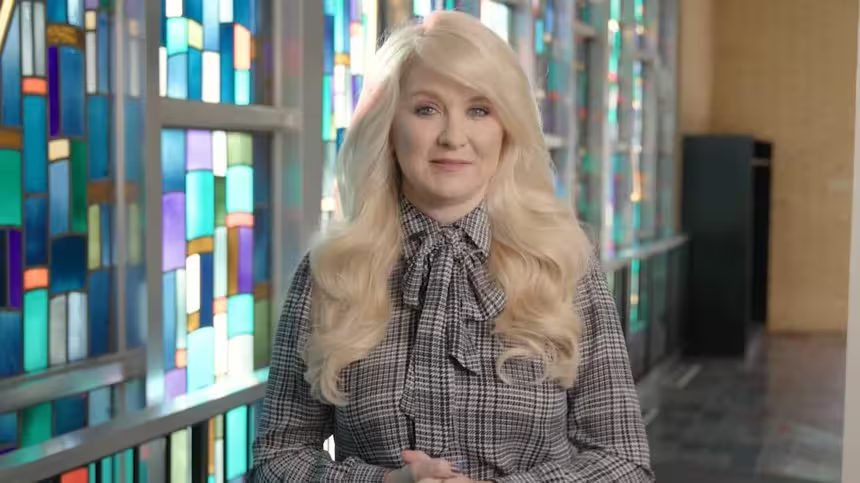
Welcome to "InFocus."
I'm Steph Whiteside.
On this episode, we feature three distinct stories of individuals whose passion led them down a path to find their roots.
We go to Jak Tichenor with our first story.
- Welcome to Julie Moses and Sandy Beattie.
First of all, it's a privilege to help share your story here.
It's quite a story at that.
Julie, I've known you and your husband since you moved to southern Illinois about a dozen years ago.
And I knew that you were adopted when you were very young, but it was only recently that I learned that you'd been reunited with your birth mother.
How did this whole thing get started?
- Well, I had done a 23andMe test and sent it off, and regularly send up updates that say, this relative is this way, this relative is yours.
And they're usually second and third, fourth, fifth removed of either side.
And I always check on 'em, though.
And one day it popped up that I was 48, this person had 48.9% of your DNA.
And this is no doubt your mother.
And it was a shock, but I also just messaged her and said, I think you're my mom, so.
- And, Sandy, what did you say back?
- I told her that, she sent me a message.
I sent her back one, and I said, if you want to know if we're mother and the daughter, here's my phone number.
You can, if you wanna call me, and, by the way, when is your birthday?
And she sent me, her birthday was June the 1st.
And I said, that's, I'm on the phone with my best friend screaming, going, like, I found her, I found her.
So, and, and she's going like, no, there are lots of babies born in Houston in 1967.
And so, she called me on the Saturday, and I talked to her for about five minutes.
And I asked her if she knew where she was adopted from.
And when she told me, I asked her, and I told her, I said, you don't have to look anymore.
You're mine.
- Oh, that was kind of a leap of faith, though, Julie, going out there, because a lot of adoptive children, their parents don't always want to know them.
- Well, that's why I messaged her first.
I think that's one of the things that 23andMe has on there is you're able to message somebody without having to give too much information such as phone numbers and, of course, emails.
It comes through the service first, so.
- What was your motivation to try to find your mom?
- Well, my motivation initially was just to find out some information about me, especially as I get older, anything that might be genetically in there.
And I thought there might be, perhaps, a chance that, if she was living, that she would show up on the test, as well, so.
- And, Sandy, Julie, in her notes, said that you said to her, well, I've been looking for you for the last 25 years or so.
- I actually never, I mean, I wanted to find her, but I, it was one of those things that all I ever wanted was for her to have a good family.
But if, you know, my mom and them were gone, and it would've been, it was God's will, that's all.
- And you had gone on to, after a very rough childhood and a very rough start in life, you kinda recast yourself in many ways, working with people over the years.
You became a deacon in the Episcopal Church.
And, I'm curious, how did your faith life help you to make this reconciliation all come come about?
- Well, if you are a true believer, the Lord has a plan for everything.
And I mean, who would've said that I would've had a foreign exchange student that would've started all this, and then, becoming a deacon.
I belong to the man upstairs now.
And I, if it was His will, it just, I don't know, it just all fall into place for some reason.
It's hard to explain that part of it.
- And now, you have a son and you have two, as you said, foreign exchange daughters.
Is that right?
- Yes.
- And so all of this comes back down on Julie, like, okay, I found my mother, I've got a brother.
I've got other people who want to be close to me.
There are cousins, all of this.
That must have been just a huge thing to get your head around.
- It was.
And Darrell and I talked a lot about it, about how I went from having just me and my adopted, my brother that I grew up with as an adopted brother, to having this entire family of people that are sending me Facebook messages, friend messages.
They, it was a little overwhelming, uncertain for a little while, unsure what it was really gonna entail, but exciting, as well, because I had a family again.
- I want to ask you about something that I just found here.
- Tara brought it.
- Tell me about that.
- So, for my birthday, my mom brought me several nice little presents, and then this one where, and I knew that she would look at, she had never forgotten.
I think was probably a proof that she had never forgotten.
So, back when babies were born then, they didn't put a little plastic band on it.
They put a bead, little beads.
So, as soon as I opened, she had told me she had kept this.
But as soon as I opened the little dish, little jewelry dish, I cried 'cause I knew what she had had.
- So proud.
- You know, not every family's the same, and some birth parents don't always want to be reunited with their children.
What advice would you give to people who find themselves in in a similar situation, both of you?
- Well, I think they should try because it may, there may have been a reason.
There's always a reason that somebody is giving a child up for adoption.
They're giving it to somebody that they hope will care for that child.
And I know there are some cases where families are not wanting to do so.
It may have been something that was really hidden from the rest of the family, but it's worth trying, because it's good to know.
- Sandy?
- Where you came from.
- I think people should just go through it with an open heart.
I never, you know, like I said, to begin with, I was just hoping and praying that she had found a good family, which she did, which gave her a good heart.
But if you don't pursue it, you know, you never know what you're gonna be missing out on.
I have a grandson.
He's the only grandson I have.
The rest are all girls, but I have a daughter again.
I've always had her, but you know, she wasn't with me.
It's just, you just need to have a little faith and just try, and just be patient with each other and listen.
- Julie Moses, Sandy Beattie, thank you so much for sharing this incredible story.
We appreciate it.
- Thank you so much.
Thank you.
- Thanks.
- Families come in all shapes and sizes, and adopted families are no different.
Sometimes, it's simple.
Sometimes, it's complicated, and sometimes, all one needs to find is a connection or a sense of where they belong.
Jennifer Fuller spoke with Dusty Rhodes about her journey to find her birth family and what that connectivity meant for her.
- People, in fact, people, a lot of people think adoptees should be just grateful.
Just be grateful.
And I am, but I'm also a very persistent advocate for open adoption because there's a better way to do adoption than the way that I was adopted.
- [Jennifer] Dusty Rhodes knows about digging for answers.
The former journalist has made a career of searching for answers to her questions.
She grew up knowing she was adopted and knowing she wanted to know more.
- Felt like I wanted to find my birth family when it was possible.
So, when I was in college, I had a birthday coming up, and my boyfriend at the time decided to give me, as a present, that he would take me to San Antonio where I was born and start the process.
And despite all of my big talk about how much I wanted to do that, when I got there, I couldn't get out of the car.
It was terrifying, but I did.
Filled out some forms, underwent a mandatory hour of counseling.
And they then sent me some non-identifying information, which felt like a feast.
It just, having not known anything forever, even though it was non-identifying, it was still so much more than I'd ever known.
- [Jennifer] Dusty found she looked like her birth mother, a connection she'd never had with someone before, but she knew there was more.
The counselor at the home she was adopted from encouraged her to write a letter to her birth family in case they reached out.
- And since I worked for The Dallas Morning News, I had an 800 number, and I included that, and the next thing I know, I get a call from my birth mom.
And unlike most of these stories, we didn't meet for three years.
I mean, she just put it off and put it off.
And I finally was about to take a job in Anchorage, Alaska, and she finally agreed to meet me at a motel on the edge of town.
It was, it felt like a drug deal.
- [Jennifer] She found the process painful, even demoralizing, but Dusty says those feelings changed as she met more of her birth family, including a half sister on her father's side.
- We kinda look alike, her voice, she sounds like my sister.
She sent me a gift recently, and it was some jewelry.
And, but the part that I liked was just the tag.
It just said sis.
And, I don't know, I just feel very, I feel very connected to her, and that's really what I was looking for was just someone to feel a family connection to.
I always sort of felt like I hatched in a swamp.
Like I was a salamander that, like, the mom, you know, like the eggs are deposited and then they're fertilized.
And then they just, like, hatch and you just grow up.
And, because, it wasn't like I felt like I grew up in a bad place.
I just didn't feel like, I didn't feel very connected to my adoptive family.
But then, when I met my birth mother, I didn't feel very connected to her.
And so, my sister, Monica, I feel very connected to.
- [Jennifer] For Dusty, connection is everything and something she says others take for granted.
So, she works hard to forge connections for her own children.
She has two boys, one adopted, one homemade, as she calls it.
She remembers helping each of them with family tree projects in school.
- And my homemade son, I helped him make his family tree.
And I included my birth family to the best of my knowledge and his adoptive family.
So, it was a very complex tree.
And then for my adopted son, since we have a very open adoption, I included his birth family and a little bit of his adoptive family.
And I just kind of, I wanted the teacher to get the message that, be careful what you ask for.
- [Jennifer] In her research, Dusty found lots of connections she never knew she had, a lineage to Daniel Boone, for example, and, after feeling drawn to civil rights causes, and as a reporter writing on racial issues, she found another connection.
- So, both of my paternal grandparents were mixed, but they were both very light skinned.
In census records, they're both referred to as Negro.
And my birth father is referred to as Negro, and very Black man.
And they had seven sons, and my grandfather was the oldest, and he was very light skinned, and then they got darker as they went.
So, and I've got a picture of that family.
And you can pick him out because he's the lightest skinned person besides his mother.
One day, we picked up Milo from some afterschool event and we were giving a ride to a couple of his friends, who were both girls, and Evan was in the car.
And Evan was just doing the social mosquito thing with those two girls.
And after they, after we dropped them off, I asked Milo.
I said, did you warn these girls that you had an older brother who's Black?
- And he's like, Mom, nobody even notices that.
It's, like, he kind of shamed me for even thinking it was a thing.
And from then on, I never brought it up again.
Like, bad for me to even care.
Like, to his generation, it's not even worth mentioning, whatever, you know.
- Tom Harness of Carterville received a gift for Christmas from his daughter that changed his life and opened a door to a family he never knew about.
Tom and his half sister, Erin, share their story.
- I have not actually heard from her perspective how, on her end, how it transpired.
So, the question was, Erin, like, how did you find out and how was that process and what were you thinking?
And how was this, like, how was the whole thing on your end of, like, finding that out?
- Well, I had been on Ancestry for about a year or so, just doing my own family tree, and Tom's picture popped up as, like, a first cousin, actually.
And so, I started to research, like, what side of the family he was on.
So, I started to see if he matched up either with my mother's relatives, if I had, you know, or on my father's side.
And then it was very clear that he was from my father's side.
And so, then I started to think back, and I'm like, hmm.
I remembered that as a young girl, just stories from relatives, talking about my father having a a secret son.
And I was trying to connect the dots.
I said, well, maybe this is him.
And I'm like, okay, science does not lie, and - - [Tom] No, it does not.
- I was like, okay, this, he's my half brother.
And I was excited about it.
And he looks like my, he looks like our father.
He looks like our father.
I mean, there's just, there's just no doubt about it.
- So, on my end, it was, you know, my daughter Mia got me AncestryDNA for Christmas, and I had done that, and there was such a backlog, it was taking a while to come back.
Hard to explain when you get the AncestryDNA.
Like, it lets you know where your heritage comes from, like, what part of the world you're from.
But there was people popping up, and I didn't know them.
And there were some African American people.
And then, you popped up on mine.
And I was like, what is this?
And I didn't see, my last name is Harness.
And I didn't see any Harnesses when I went through.
So, I was completely like, what's going on.
But I did see people from my birth mom's side of the family.
And so, it was, it's weird when you're in that moment, 'cause I feel I'm fairly smart and intelligent, but my brain cells dropped, because I was in denial about what was going on.
This was a shock for me.
And I guess the first one is, how would you identify our family on your end?
Like, how would they be ethnicity wise?
Because we had that conversation.
And, but, so people understand.
Where would that side where our father comes from, what would you classify that as?
- Yeah, well, we're Black, as you can see.
Now, the interesting thing is, and this is very important.
This is what I wanted to tell Tom, because I'm sure, culturally, Tom grew up white, you know, most likely, you know, with white parents, and you know, physically looks very white.
- Yes, I do.
- So that, I'm sure that that just like you said, you know, it might have been a little bit of a shock to see that he had these African American relatives, and like, that's why I told Tom, it's very important for him to know that we have physicians in our family that go back six generations and educators, heads of colleges, principals of high schools, presidents of colleges, and so forth.
And I think that's where we get our energy from.
- I, it's like a perseverance gene or something that we have, because, I mean, entrepreneurs and, they had businesses and pharmacists.
These are, like, when you go back that far, in my mind, I'm like that's not the picture that was painted for me growing up in schools when African Americans were in the south.
It was more oppression.
And not saying that there wasn't.
I didn't even know the possibilities that were going on until you told me about our family and what they were doing and overcoming it.
- Okay, I'm a grown woman.
I'm doing research.
Yes, I forgive you for having an affair and having this son, but I embraced him, and it's like, okay, we're doing research.
It's like, this is the truth.
Everybody has, you know, things that come, bones that come out of the closet and things.
And so, I'm looking at it as an education and saying, okay, this is who I am.
The, you know, this is my ancestry.
This is what my father did.
And he was gone, and now I have a half brother, a white brother.
I wanna meet him.
And it was time for him to meet his dad, because he looked very much like him.
And actually, I wanted to see my dad's reaction.
- I will never forget this.
We're sitting in the car, and I am nervous, and I'm pretty sure Erin knows how nervous I am.
And I said, so what do we, you know, what do we do?
Like, how does this work?
And I love it because she is, again, definitely my sister.
She looks at me and she goes, we're gonna go in there, tell him that you're his son, and we're gonna have a conversation.
And it was like, just a matter of fact.
- I'm not embarrassed about it.
I wasn't then, and that's why I said, no, we're gonna go in there and he's gonna see, and I wanna see his reaction of him looking at his son and looking just like him.
- Yeah, if you know that you have a son out there and you've never met, and if you have, you know, your, towards the end, you know, of your life, I think we have that natural to fix things or to make things right.
And I think walking in there and him being able to see me and have a conversation, as much as I would, will say that I was there for me, I really, after I left and had time to reflect, I think it was a God moment where I was supposed to be there for him.
- Tom's visit, it just was kind of a stamp at, towards the end of his life saying, you know, look, you've done well, my faithful servant, you know, just something of that nature.
So, I agree.
I think it was a God moment.
- I hope that people understand that AncestryDNA is not a novelty kind of thing.
It's, it is a responsibility.
You know, it might not change your life, but you might change someone else's life by the connection that you have.
And I am also very grateful that you reached out and, you know, our sisters and that side of the family has been so open and wanting to connect.
- Thank you for watching this month's "InFocus."
We hope you've been encouraged to do some digging and find your own roots.
When you find those answers, you not only learn about yourself, you grow in understanding, and it's our hope that you pass those lessons on to future generations.
For more information, visit wsiu.org.
And for all of us at "InFocus," I'm Steph Whiteside.
Have a good night.
(funky electronic music) (soulful music) - [Emily] What was it like for you to come here to the US?
- [Maria] I didn't know besides good morning and what's your name when I came here.
And when you were baby, I used to read to you the Dr. Seuss books, like "One Fish, Two Fish, Red Fish, Blue Fish."
And that's how I learn English, reading to you.
- [Emily] You know, I never really put in much thought that you were an immigrant.
I just thought that, you know, you're my mom.
And I never thought that you would have to leave.
I was at school when my phone buzzed, and I just saw the notification that TPS was going to terminate.
And I remember, I started crying.
- [Maria] When you called me, I tried to calm me down.
I am like, okay, this is happening.
This is really happening.
So, I put myself together because I knew that I have to be strong for you.
And I didn't promise something that I cannot keep.
So, I didn't promise you that everything will be okay, but I promise I'm going to make sure that you are okay.
- [Emily] What are you most afraid of?
- [Maria] I terrified of missing you growing up.
It's terrifying.
I think that I'm more afraid of that than to go back to my country.
- [Emily] Yeah.
I'm scared that I'm gonna have to do everything by myself.
- [Maria] You're not going to be alone.
I promise to you that, and I'm very hard to get rid of.
So, I'm going to be on the phone all the time.
- [Emily] What are your hopes for the future?
- [Maria] That I'm going to die of an old age and be the pain on your neck all the time, and make sure that you find strength, even in a bad moment.
(jazzy music)

- News and Public Affairs

Top journalists deliver compelling original analysis of the hour's headlines.

- News and Public Affairs

FRONTLINE is investigative journalism that questions, explains and changes our world.












Support for PBS provided by:
InFocus is a local public television program presented by WSIU