
InFocus 208 – RIAS Student Exchange Program
4/6/2022 | 26m 46sVideo has Closed Captions
Fred Martino, Ph.D. speaks with guests from the RIAS Berlin Student Exchange Program
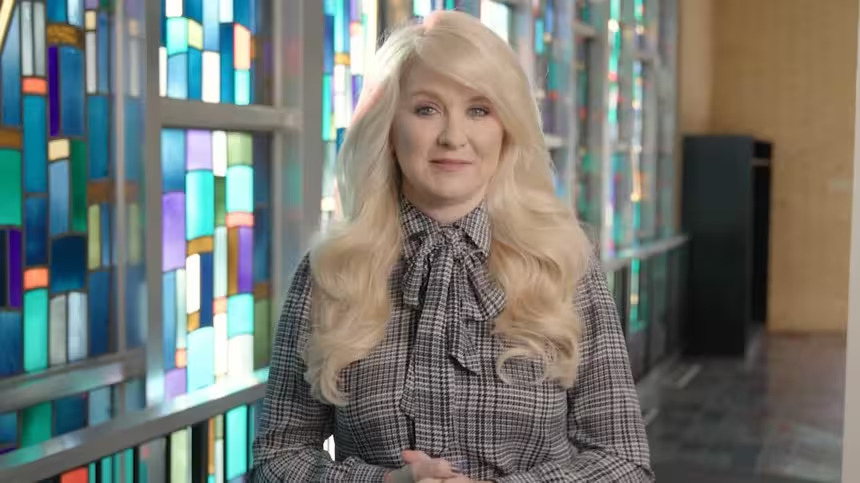
Host Fred Martino, Ph.D. speaks with guests from the RIAS (Radio in the American Sector) Berlin Commission Journalist program. Started in 1994, RIAS has recently expanded to include a student exchange program. Joining Fred in the discussion are student exchange fellows: Leonie von Randow, Tom Wagner, and Simon Lanzerath.
Problems playing video? | Closed Captioning Feedback
Problems playing video? | Closed Captioning Feedback
InFocus is a local public television program presented by WSIU
Support provided by:

InFocus 208 – RIAS Student Exchange Program
4/6/2022 | 26m 46sVideo has Closed Captions
Host Fred Martino, Ph.D. speaks with guests from the RIAS (Radio in the American Sector) Berlin Commission Journalist program. Started in 1994, RIAS has recently expanded to include a student exchange program. Joining Fred in the discussion are student exchange fellows: Leonie von Randow, Tom Wagner, and Simon Lanzerath.
Problems playing video? | Closed Captioning Feedback
How to Watch InFocus
InFocus is available to stream on pbs.org and the free PBS App, available on iPhone, Apple TV, Android TV, Android smartphones, Amazon Fire TV, Amazon Fire Tablet, Roku, Samsung Smart TV, and Vizio.
InFocus
Join our award-winning team of reporters as we explore the major issues effecting the region and beyond, and meet the people and organizations hoping to make an impact. The series is produced in partnership with Julie Staley of the Staley Family Foundation and sponsored locally.Providing Support for PBS.org
Learn Moreabout PBS online sponsorship(upbeat music) - Thanks for joining us on this special edition of InFocus, I'm Fred Martino.
The RIAS Berlin Commission Journalist Program is an incredible initiative that recently expanded to include a student exchange as well.
About 2000 American and German journalists have been part of the exchange since it started in 1994.
It preserves the spirit of the legendary Cold War era, radio and TV station RIAS, Radio In American Sector.
The fellows from the United States and Germany have been building bridges of understanding through the RIAS Berlin Commission Alumni Network ever since.
Through the RIAS program, I traveled to Germany almost 20 years ago, and since then I have been honored to welcome many German journalists during their visits to the United States.
WSIU and Southern Illinois University Carbondale are also pleased to welcome my guest today from Germany, Simon Lanzerath, Leonie Von Randow, and Tom Wagner.
Thank you all for being with us today.
- Thank you very much.
- Thank you for having us.
- You know, I wanna start with something that I realize is really a general question, but it's one that interests me and is important to me, 'cause I hope we'll be welcoming guests from Germany every year here.
Leonie, I wanna start with you, tell me about your decision to apply for this program and what have been the highlights for you so far in the US?
- Well, first of all, I think what was really interesting for me was that I've been to the US many times, been to the us many times, So I've been to the East Coast a couple of times, I have family living in Washington, DC, so I knew that quite, and I'd been to Florida once, but never to any of the states really that you call flyover states states or the Midwest.
So I was really interested in learning a bit more about the people here and how it's different from the rest of the country that I knew.
And just also getting to look into journalism, how that's done here, how American journalists work, all of that, so, yeah, and the highlights we spent a week in New York, the past week, so we went to different places there.
We went to Bloomberg, we went to, or we talked to people from Fox News even, what else?
- [Tom] NBC.
- NBC, many different broadcasters.
And I think, yeah, that really was a highlight just being able to talk to people we knew from television, we spoke to Michael Cohen, so Donald Trump's former lawyer that was shocking in some ways, but always very interesting and insightful in other ways.
- The programs are always so diverse here and in Germany, and that's one of the things that I appreciate so much about it, and then I tried to working with the journalism department, make this one diverse.
And certainly Tom, as Leonie said, it couldn't be more diverse in terms of locations.
- Yes.
- For you because you were in the biggest metropolis of New York City, millions, and millions of people.
- [Tom] Yes.
- And then you are coming to the Midwest in a small town and this is really an interesting experience.
So tell me, in terms of your thoughts about that, the highlights for you and then why you applied for this?
- Yeah, definitely the highlight for me in the first week beside meeting Michael Cohen, who was a lot, (all laughing) to say the least.
But beside that, I think my highlight was visiting the Bassenian church, Baptist church in Harlem.
Something I've never experienced.
I never experienced anything like that, and I have been to churches in Germany, but that was a totally different experience and to see like this community, yeah, with all their struggle and all the, everything that comes up there that was really in a way life changing because I understood the power of religion, something I never experienced like that in Germany or anywhere else.
And now coming here is completely different again.
And it's also highlight because this is a place, nothing against this place, but somewhere I probably wouldn't have gone and wouldn't have come to if not for this program.
- [Fred] Yeah.
- And why I applied is, I mean, I think in a contrary to Leonie, I've never been to the US, and I applied because it is a easy or good way to come to the US because I was always interested in this country and yeah, it was a good way to see more of an insight because we get to talk to a lot of people.
We met a lot of people in New York, which is easy because people are very friendly and talkative here.
But yeah, that was, my reason was to come here and to experience the US maybe from an inside perspective, going to different places, I'm meeting a lot of people.
- Yeah, and it is, it's wonderful.
I mean, that's what, at the end, that's what it's all about is getting the exchange and a chance to meet people.
Like Tom, Simon this is your first time.
- Yes.
- In the United States, right?
- Yes.
- Unlike many people watching this program in the United States where the international news is not often the focus in Germany and many other countries in Europe, the United States is in the news a lot, so there is a lot of interest in the US.
And I know just from the short time we've spent together, you have great interest in the US, you have a lot of curiosity.
I imagine that was part of why you applied for the program.
Tell me about that, and tell me about the highlights for you.
What stood out to you?
- Yeah, first I will start why I applied.
In school, my favorite subject was history, and so the Germans have some similar history with the Americans, especially in times of a Cold War and after this World War II.
And yeah, I said US was like a saving brother or protection brother for us during this time, especially, yeah, because of threats out of the east, from Russia and the Soviet Union.
And so, yeah, I think also the US has an important role why Germany got this democratic republic, what it is today.
And therefore I was always very interested in the United States and in politics, but I've never been to the US, so now I took my chance to go to the US and to get some insights.
- And getting insights and meeting people I know has been a highlight for you.
- [Simon] Yeah.
- Anything else that stood out to you in particular?
I mean, Tom mentioned a church in particular and the people he met there, but... - Yeah, meeting very different kind of people was a highlight for me.
So, meeting, as Tom said, Michael Cohen, the follower of Donald Trump.
But on the other hand, also we founders of Black Lives Matter, so getting... - The diversity.
- Yeah, the diversity of the US, and also speaking with people on the street, and yeah.
- Those impromptu meetings are really important, aren't they?
- [Simon] Yeah.
- I wanna ask you Simon, and you revealed something just in our last meeting.
I mean, every time we meet there's something new I learn that all three of you study different things, not journalism or radio TV, but different subjects, but you decided to pursue journalism as a career, and that was important.
Why was that the choice and why was that important?
- Yeah, I started studying business administration after I finished school because I wanted to get some benefits out of my studies.
And as a school boy, I imagined, okay, what could be my career when I have finished my studies?
And okay, I thought yeah going into business in something like this, but yeah, in the end, during my studies, many other student wanted to go into business consultants or something like this, it's very common to get a consultant when you study business administration.
But I was always very interested into media and I recognize.. - And where is the motivation for that, why media?
- Yeah, (laughs) during my childhood, my parents would say, okay, I was, in Germany you call it the Papa mouse, so I love to talk to people.
- [Fred] Papa mouse?.
- [Leonie] Yeah.
- And... - Okay.
- [Simon] So yeah.
- Talking to people and sharing.
- Talking to people.
- Learning from people, and sharing it.
- Yeah, definitely.
And, I thought, okay, maybe that could be something for me.
And then I did an internship at my local radio station, and then I enjoyed it really much to be the informer for the people who listened to the radio.
And yeah, I recognized this is something that I can and what I want to do.
And so I try to yeah, to do everything that I can to get in this media field.
- I'm so glad to hear that.
I mean, we have internship programs here, something that I want to continue to expand, not just college internships, but I'd like to see more high school students intern as well.
I think that is just absolutely critical in getting that next generation of journalists.
Tom, you have an incredible educational background for journalism, studying history and English.
Two of the most important things in terms of, when I think about hiring a journalist, someone that has an appreciation and an understanding of history, and in our case of the United States, the English language, for sure.
Why did you choose journalism?
What was it about journalism that interested you?
- Yeah, as for Simon, I was always very interested in politics and sports, and media in general, I watched a lot of news broadcasts even when I was younger.
And then I did an internship at WATO in Berlin, where I met the organizer of this program.
And I felt maybe journalism is not what I really want to do because I didn't feel comfortable when thinking about this disasters in the world, thinking about where's the story?
What can be my story?
What can I write down?
So I started studying history and English in order to become a teacher actually, but I obviously never lost interest in politics and also in sports and... - And many journalists think of themselves as teachers, as educators.
- [Tom] Yeah, exactly.
- But just with a different audience, right?
A big audience on television, or radio or websites.
- Exactly.
- So there's that commonality isn't there?
- Yeah, exactly, that's why becoming a teacher was a good alternative for me because I thought I still can, as you say, educate people about the world, about the history, about history of America.
So I can still do the same thing in a way, but with younger people now, but yeah, in the past couple of years, some chances presented to work in the field of journalism again, and I took them and now will look where that leads to, and maybe that leads to journalism career.
and maybe that leads to maybe not.
- And maybe it leads to both.
- Yeah.
- Maybe it leads to both.
- Maybe like me, you'll do journalism and also teach.
- Yeah, I would love that.
- You never know.
Leonie, how about you, your decision on journalism and you, I should say, you work in television, in Germany regularly.
- [Leonie] I do.
- And this is a passion for you I know.
- It is, it really always has been, some of it like Tom here, I always watched news broadcasts when I was a child.
I even watched CNN a lot because I really like that for some reason my parents always had it on as well.
So, it's just always been something I've been passionate about.
I'm very interested in politics as well.
And generally I would always read a lot growing up.
My parents always had, you know, a newspaper at home and different magazines, so we are all really into news at my home or where I grew up.
Everybody's kind of a news addict and we talk a lot about politics and what's going on in the world, so, that has definitely been instilled in me by my parents, I would say.
And then I also love language and writing, so I studied French, Spanish and English, and I just loved bringing together my passion for politics, people, curiosity, and also being able to, yeah, just express myself in both German and sometimes English and yeah, just work with language and people are my two passions.
- I love that last point express yourself, because I always tell people that when I got to go to Germany, I felt this sense of comradery that was amazing.
It was electric in that, so many people that I met from all walks of life were very open about expressing themselves about opinions, about issues, and there was this freedom of expression I felt immediately.
That's true.
- It was so powerful.
- I think Germans are very direct, so sometimes people might find it strange in other countries because we are very, very direct, very honest people, I would say, and sometimes that might come across as a little bit rude or, you know.
- [Simon] Yeah.
- But really all that we really mean by it is just, I think people don't care so much about what other people think in Germany and we just say what we feel, so there is a lot of, yeah, just the (indistinct).
- And now you know some people really appreciate it.
- Yeah, it was such a surprise for us that being in New York, we talked to so many people.
- Your work is different.
- To so many people on the street who, one woman came and said, "You just spoke German here?"
Are you from Germany, right?
And we had this conversation for 20 minutes I think.
And these things do not happen in Germany, maybe in Cologne, but not everywhere.
- Yeah, very interesting.
So, you know, Tom, I know this is a tough question, but don't worry I'm gonna ask everyone this question.
- [Tom] Yeah.
- I know it's hard to pick one thing too, but from your time here, if you had to pick, like what one thing, what stands out to you most about the United States?
What's just jumps out at you.
I shared one thing that jumped out for me about Germany, that I loved.
- Yeah, I think Simon just spoke about it, how open arms people are, how friendly they are, how they approach you without hesitation and just talk to you about whatever and show real interest in what you tell them, when you just tell you a story or tell what you're going to do today.
I really like that because it's not common for Germans, and so it was, and I normally, I like that in Germany.
I like to just walk across the street without being bothered by anyone, but... - Well, when someone does ask, you're very direct, so that's the good thing, right?
- [Tom] Yes.
- Good.
- But I still love it here, how people approach me and how I changed and how I just felt more and more comfortable with that, and enjoyed speaking with random people on the street, something I would hate to do normally.
That really surprised me, that stands out maybe the most.
- How about you Simon?
- Yeah, I also was wondering how open people are and how interested they are in different cultures and also different perspective.
But I was also surprised that people also, the American culture is like, yeah, America first a little bit, but they do not know so much about German culture I think.
- [Fred] Yeah.
- Because we had this one meeting with a guy in a supermarket, we told him that we were Germans and he said, oh, okay, and he could just remember World War II and this yeah this bad times for Germany during the Nazi regime, so... - Yeah.
- Yeah, and I thought, okay, is that the only thing that people in America know about Germany are, yeah, the way also... - Highlights the importance of the international exchange.
- [Simon] Yes.
- To learn.
- [Leonie] Yes sure it does.
- To learn much more.
- Definitely.
- Yeah, Leonie, how about you?
- I would say the same things, so really just how friendly people are also how well behaved, I feel that people are very polite here, and yeah, just always say, please and thank you and look you in the eye and shake your hand and come up to you and make small talk.
I think that's something that really stood out to all of us, how well Americans know how to work the room, do small talk, speak to everybody.
That's really something that stands out to me probably the most, I would say.
And also the patriotism that people have here, that's very different from Germany as well.
Lots of people have the American flag in their front yard, nobody has that in Germany.
And it would be kind of strange to have that in Germany.
So that's something that's very different here and that I think some people from Germany are kind of envious of, I would say, because we feel like we're not entitled to be patriotic.
- Very interesting.
Well, one thing I'm sure Germans are not envious of, and I wanna know kind of your general thoughts on, how has as the US image in Germany changed since the attack on the US capital, this was such a seminal event, and so much worldwide attention and continues to this day as the investigations continues.
Tell me about the US image, how it's changed in Germany.
Your reflections on this too, your own reflections.
- Well, generally I would say that many people were very shocked about that.
I think the US always comes across as very strong, very capable of protecting self from, you know, from external threats, but also from threats that come from within.
And that has kind of crumbled during the Trump administration, I would say, that's how I see it at least.
- So just like many people said here, I never could have imagined.
- Leonie] Exactly.
This happening in the US.
- [Leonie] Exactly.
- This was the reaction in Germany.
- See, I think when we came to this country just to get into the country, you might not know this because you're Americans, but when you travel to the US, you have to do this long immigration line and show your passport and they will ask you several questions and make sure that nobody enters the country who may be a threat.
So, we just know that the US is usually very careful about all sorts of dangers and then that they just had their capital stormed, that seemed really like, I could wouldn't have dreamt that.
That was really shocking to everybody, it was all over the news in Germany.
- Since we had something comparable, I think some days after that, so that also people from the right ring tried to get into our German Bundesrat, which is our capital in Germany.
- [Fred] I've been there.
- Yeah, and just two policemen, I think, yeah.
- Defend Bundesrat.
- Could defend our capital.
Yeah, I think we are all very worried about the situation here, but also the situation in Germany, but in the end, yeah, as I already said, America brought kind of democracy to Germany, and if this democracy now gets destroyed here in America, sorry, in the US, we are very worried that this could also happen in Germany.
- Or other places.
- Yeah or other places.
We are very dependent all over the world on a strong democracy in the United States.
- Of course, of course.
- Other reflections Tom?
- Yeah, I think what also changed a little bit of what this brought to light was that I think a lot of people couldn't understand how in Germany, as well as here, couldn't understand how a guy like Donald Trump became president, because we know the US from movies, we know it from sports, we know it from entertainment.
And we know all these very seemingly progressive people, and we couldn't understand who voted for this guy.
(all laughing) And suddenly with the storm of the capital, you had not like one face, but you had like, I think one of the first times in Germany, or as far as I experienced it, you saw his crowd, you saw his people.
And I think that was really intimidating because you saw how much anger and how much problems and division of society there is.
And I think that really, this attack gave this movement face or an image, and that was really scary, I think.
- Yeah, but that people try to storm their capital, which we present their opinions where their representatives sit in was so, yeah, I cannot find any words for it because democracy might not be always the best, but I think we have no better alternative to it.
- [Leonie] Yeah.
- Yes.
- And we've gotta understand each other and that's so important to prevent this kind of thing.
You know, this is a time when some might argue that that both journalism and international relations are more important than ever before.
We have a, think about this, an attack on Ukraine, climate change, dramatic inflation, all on top of a worldwide pandemic.
All of these major stories affecting all of us across the globe.
Leonie, how do you see efforts like this exchange program being a catalyst for change and for us working together?
- I think it is a catalyst as you say for change, because as you just said, the pandemic and also the war in Ukraine just shows how important to is to face the world's biggest problems together, and climate change down the line as well.
So none of these problems could have been solved or can be solved if we don't all work together.
And I think that is something that really gave a lot of us, a really good feeling just seeing that the west really acts united now in this war in Ukraine, that that Vladimir Putin started.
And that is just one of them many crises that we have right now and that we have to fight, so I think, yeah, it can really help to bring people closer together if you have these exchanges, if you try to speak to people, get their perspective, learn from them, develop solutions together, so I feel like this is a great opportunity.
- Well, I have learned from all of you during this program, and will continue to learn together as the exchange continues.
Thank you so much for being here and for being willing to do the show too.
- Thank you so much.
- Thank you.
- For having us.
- Thanks a lot.
- We are out of time.
Thanks to my guest today from Germany, Simon Lanzerath, he has been with us today.
Also joining us, Tom Wagner and Leonie Von Randow, I knew that was going to happen.
For all of us at WSIU, and Southern Illinois University Carbondale, I'm Fred Martino, have a great week.
(upbeat music)

- News and Public Affairs

Top journalists deliver compelling original analysis of the hour's headlines.

- News and Public Affairs

FRONTLINE is investigative journalism that questions, explains and changes our world.












Support for PBS provided by:
InFocus is a local public television program presented by WSIU