
InFocus 210 - A Journey of Two Veterans
5/26/2022 | 26m 46sVideo has Closed Captions
A journey of two veterans as we prepare for Memorial Day.
On InFocus, we’ll follow the journey of two veterans as we prepare for Memorial Day. A path to reconciliation, and first-hand accounts of service.
Problems playing video? | Closed Captioning Feedback
Problems playing video? | Closed Captioning Feedback
InFocus is a local public television program presented by WSIU
Support provided by:

InFocus 210 - A Journey of Two Veterans
5/26/2022 | 26m 46sVideo has Closed Captions
On InFocus, we’ll follow the journey of two veterans as we prepare for Memorial Day. A path to reconciliation, and first-hand accounts of service.
Problems playing video? | Closed Captioning Feedback
How to Watch InFocus
InFocus is available to stream on pbs.org and the free PBS App, available on iPhone, Apple TV, Android TV, Android smartphones, Amazon Fire TV, Amazon Fire Tablet, Roku, Samsung Smart TV, and Vizio.
InFocus
Join our award-winning team of reporters as we explore the major issues effecting the region and beyond, and meet the people and organizations hoping to make an impact. The series is produced in partnership with Julie Staley of the Staley Family Foundation and sponsored locally.Providing Support for PBS.org
Learn Moreabout PBS online sponsorship(upbeat music) (camera clicking) (uptempo music) - Welcome back to another edition of "In Focus".
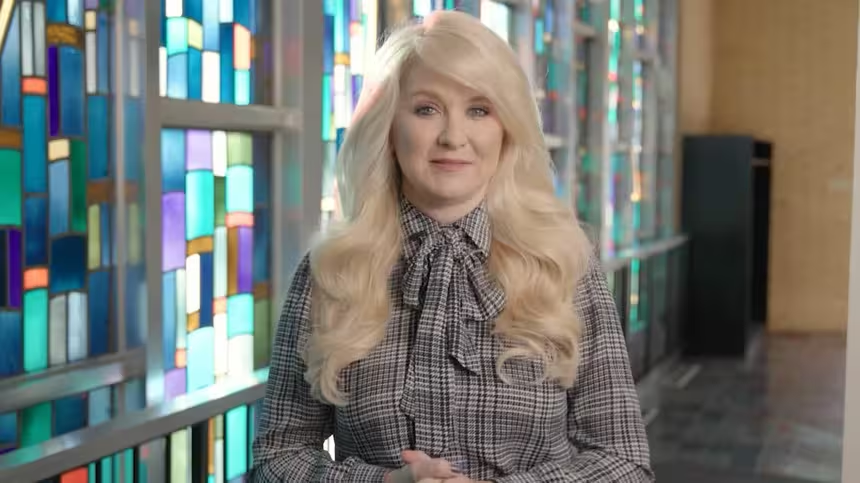
I'm Jennifer Fuller.
Memorial Day in the United States is a day to remember those who have died, particularly those who died in service to our country.
In this addition of "In Focus", we're pleased to bring you two stories of veterans recounting their journey in service.
The first story, which follows that of a World War II combat veteran, comes to us through an organization called Beyond the Call.
Here's the story of Charlie Kohler.
- Courage.
You gotta have courage every day in your life.
You just can't fall back.
You gotta keep going forward and have courage that today is gonna be better than yesterday, I'm gonna make it better.
I'm gonna take advantage of it.
Now that's the thing, people don't take advantage sometimes of what could be.
(pensive music) I was born in 1921.
I grew up in a small town right outta St. Louis called Pine Lawn, Pine Lawn, Missouri.
As soon as I could walk, my father gave me a baseball and a hand and started playing catch with me and I could hit the baseball pretty good.
Some of the scouts caught me in playing baseball for the varsity team and signed me to a contract.
When I graduated, I played for a year and the war broke out.
It was on a Sunday.
We turned the radio on and the first thing we heard was the Japanese bombed Pearl Harbor.
And we looked at each other and we said, "Where's Pearl Harbor?"
No idea where it was, but we found out pretty quick.
They started telling us all about it.
And I said, "We're gonna have to get into that thing," you know.
They would say to us "You're probably gonna have to be, you're gonna be drafted."
And I said, "Well, if I am, I'm gonna join the Marines before they draft me into the army."
There was an island called Wake Island and sure enough, the Japs wanted to get that out of the way first and they started coming in and the little group, I'd say about a thousand Marines fought these big war ships, just knocked the heck out of us, but we held 'em off for a while.
I said, "I'm gonna join the Marines.
I like the way these guys are going."
(bomb blasting) My brother, younger brother, wanted to be with me.
He was still in high school.
And I said, no.
And my father says, "Oh yeah, you could take care of each other."
(chuckling) You can't take care of each other.
You take care of yourself and the rest of the group as a group.
My father had to go down to McBride High School, sit down with the principal down there, and sign some papers to get him out of high school before he graduated.
I thought it was a bad move on my father.
We should have been separated instead of together.
You're gonna lose one, you might lose 'em both, both boys.
I thought that was a terrible move on his part.
We went through bootcamp together.
And when we graduated from bootcamp, we got spreaded out, but I stayed there because I played baseball.
Marine baseball team had to be really good 'cause we had to play against all the big leaguers that were being brought into army.
'Cause I batted against some pretty good pitchers.
The outfit broke up when the baseball season was over and we got trained to go overseas and that was it for baseball.
Didn't have any more time than do any fun things, it was all shooting.
And then I got pretty good at shooting, too.
(pensive music beginning) You know, at Camp Pendleton, before we went overseas, our company, the Regimental Weapons Company, got a very fine bottle of wine and they pledged to each other that the last two of us that are still living would get together and have a drink for the rest of you folks that didn't make it.
We went to Hawaii and that's where we got our equipment for the invasion of the other islands.
We got onboard ship there and we went off to the island that we're gonna take.
And the first islands was two islands, Roi and Namur.
And then we went to Saipan and then to Tinian and then to Iwo Jima.
We had instructions for every island we took.
We had to know where we were going, how far in we had to go, and then make a turn to clean it up all the way up to wherever the Japs were finished.
Saipan, the island was just like in a island that we just got off of, one of the Hawaiian islands.
So our group, we're going through a cane field and the Japs were all around us and they knew we were in there.
And I'll tell you what, when we had to stop and stay in that thing, that's when you heard the noise, the yelling and screaming and hollering, just trying to scare the hell out of us.
It sounded weird, I'll tell you, in middle of the night.
They always had their sake, which is some kind of a gin that the Japanese drank.
And they would all be all high and screaming and hollering, making a lot of noise and trying to scare the hell out of us.
But the problem didn't change, we still had to shoot 'em.
We made it through the night, but we didn't sleep well.
They caught us just coming out.
There was a Jap that was right in front of me when I jumped out and the first thing I did, I had on my gun and I shot him and he dropped down, fell down, and I picked up that gun and put it in the Jeep.
We were supposed to kill the Japs and that's what we did.
That's the only thing we were trained to do.
And they were trying to kill us.
(pensive music continuing) The ultimate failure of mankind is war.
The reason that we have these wars, because there's a lot of old men out there don't know what the hell they're doing and they start these wars and guess what?
(chuckling) They send us young guys to fight 'em.
(guns firing) It's killing people that don't want to be killed, don't wanna fight.
That don't seem right, does it?
But that's the way it is.
And how can we stop that?
Smarten up the old men, huh?
(pensive music) What happens is you got an island and you're laying on the island.
The Marines come out this way and these guys are all this way.
We're pushing 'em back, going this way at 'em, pushing 'em back, back, back.
They can only go so far.
All these people got back to the point where there was a great big fall off and the the water was down here and it wasn't very deep.
So there was rocks there.
There's a lot of civilians on these islands, little kids, mothers, grandparents.
They would take their little children and themselves and they'd jump off.
They jumped off 'cause they didn't want to get shot or whatever they thought we were gonna do to 'em.
People that are just civilians, don't even have a gun, little children, everybody gets involved.
And that's what the war's all about, nasty.
We got back to our camp in Maui and I'm in a tent.
We have five guys in a tent and I got out of the tent to either go to the bathroom or something.
And as I walked out the tent, I see guy coming up, like, oh Jesus Christ, that's my brother, Eddie.
I walked over to him, we came together and my God, what are you doing here?
He says, "I put in for the Fleet Marine Force.
I wanted to be with you guys that are doing all the work.
We're over here in Bermuda, just doing nothing but cutting grass for the lieutenants."
And I said, "What do they have you doing?"
He says, "I'm carrying a flame thrower."
Oh, I said, "Paul, that's what they want to give these guys coming in because that's the worst thing that could happen to a Marine."
If you want to get killed, carry a flame thrower.
They see it on your back.
They hate it, they don't want it, and that's the first thing they'll do.
You're gonna get killed with that thing.
Get a sore back, you've gotta get a sore back.
You can't carry that thing, it's too heavy.
I want you get back who to your mama and poppop.
(somber music) He didn't do it, he was too much of a man.
(recording scratching) - [Father] It's you dad, son.
Your mother and I sure enjoyed your visit.
We're sorry that it's so short.
There's one thing to remember, we'll always think of you.
- [Aunt] Well Eddie, this is Aunt Ann and I hope the next time you come to our house for dinner we'll have a lot of more sausage for you, boy.
- [Uncle] Hiya, bud.
This is your Uncle Bill, your old sidekick in noise and stuff.
I hope to God you get back here in a hurry and we'll have some more singing after this day is over.
- Between Japan and Saipan was a little island called Iwo Jima.
So we were flying our bombers over to Japan and that little island had these little bombers on it.
And they came up and intercepted our plane to Japan.
And we had to get rid of that island so that we could fly right on in and back.
'Cause if they didn't get us going in, they'd catch us coming back.
(suspenseful music) The way we do it with the guys with the guns would always go in after the infantry with the rifles, they'd go in first in a wave, like waves.
They call 'em waves.
And the first wave and the second wave, the third wave, we were in the fourth wave, I think on that.
Well that time, all those fellows are up there.
Now they know where we're coming in this way, so now they're starting to try to stop more landings.
We're shooting at them from the ships out there.
Boom, boom, boom, boom.
And the Navy worked on it from the air.
So we're going this way underneath trying to open up the area on the ground so we can get further in.
Iwo Jima is about 600 feet.
They had holes with guns all over this place.
Can you imagine what a beehive is like?
That's what it was.
It was a beehive with a lot of bees in there.
And boy, we make a move down there, they're firing at you.
I got two or three of those guys out of there.
I saw the orange.
You could see the, when they shoot and they're shooting at you, you can see the little orange.
You can see it fire.
I gotta get up there up there, I got a couple of 'em out of there with the 37, but that wasn't enough, they were all over the place.
The black sand, we were really deep into it and they saw us and they're starting to shoot at us.
And there was one good size hole that we could duck into, but they found a shell that would drop 'em in there.
Killed every one of 'em except me.
(somber music) I was kind of on the outside of the gun where these guys were on the gun.
And I was out here looking to see where we could get this gun up and out, but they hit me.
Now I'm up here and I'm bleeding like hell and I said I gotta get outta here 'cause they're gonna drop another one.
So I crawled out of the top part of that hole and onto some kind of a path.
Got down to the beach, but they hit me again.
One of the guys saw me and put a tourniquet on my leg, it was bleeding so bad.
Took his belt off.
And then he had to get the hell out of there, too, but at least he got the blood stopped.
I finally got down there and they said, "Oh Jesus."
They looked up like oh my God, you're bleeding all over the place.
I didn't worry about that.
I didn't see that.
I just wanted to get the hell out of there.
They turned the boat around and took me up through the Bayfield, which was a big-time landing ship that we got off of to begin with.
Took me up in this wire basket into the hospital.
I didn't know that Eddie was on the same ship right next to me, dying.
I didn't know that 'til I got back to Aiea Heights Naval Hospital in Hawaii.
One of the chaplains there told me that Eddie died out there.
He was with his flame thrower after some position that the Japs had when they shot him.
He was working hard to get an opening so we could get out of that one area.
And him going straight to that hole, he never quit.
He still got shot, but still didn't fall down and he burned 'em out.
Now trying to get back and getting to a hospital where he could get fixed up.
He couldn't make it.
(somber music) It was time for me to move out of the Bayfield and they got me to the top of the ship and they'd taken me to the boat that I was gonna get on.
And I looked up and I saw the American flag being raised on Suribachi.
I watched the whole thing and I couldn't believe it.
I just stood there and saw what was happening that I knew was history now.
And here I am, I'm looking at it.
I thought that we won the war.
I thought, oh, this is it, this is what we came to do.
(uptempo orchestral music) They had a burial ceremony for Eddie aboard that ship.
They had him in a metal stretcher with a big bag with a lot of metal cartridges, empty cartridges so it would sink.
And then the American flag over that.
And now they got him over the ship that they let him go.
They slides down and they play the "Taps".
He would've probably got into country music if he didn't get killed.
He could yodel and sing and he played a guitar.
(inspirational orchestral music) Every Memorial Day, I fly my brother's flag so I don't ever forget my brother, Eddie, who gave his life for all of us.
You don't carry a grudge.
You get rid of the grudge.
You have to do that.
You just gotta do it.
You didn't start the war, but you finished it and that's all you can do.
Start your life over again.
I had a hell of a time deciding what I wanted to do, whether I wanted to go sell something or try to go.
I couldn't play baseball anymore because I couldn't run.
(pensive music beginning) My father had this little printing business, he raised a family with it.
And I thought, well, maybe I could learn something from the bottom up.
So I said, "I'll give it a try."
War is the ultimate failure of mankind.
Wars started by people that don't understand what life is all about.
Life, to me, is enjoying what you have, especially the people around you and your neighbors, friends, and relatives.
Enjoy 'em all while you have the energy and ability to do so.
It so happens that I am one of the last few men that has survived this whole thing.
I consider myself as lucky.
I was lucky in being in the right place at the right time and making it through.
I'm proud of my family, my home, and giving them a good life.
Two cars in the garage.
They always had a little bit of money, nothing big or anything, but I'm proud the way my life and what I did with it.
Took advantage of it.
And life is all about living.
(laughing) (pensive music) - Cheers, Charlie!
- Cheers from your friend, Alex, and looking forward to speaking to you more.
- Cheers, Charlie.
This one's for you.
Take care and God bless.
- Here's to the 23rd Regimental Weapons Company.
- Cheers.
- Cheers.
- It's an honor to know you, we love you.
Thank you so much and cheers.
- Cheers.
- Cheers from Denton, Texas.
- Cheers to Charlie.
- Cheers to Charlie.
- Thank you so much for all that you do and for your courage and for being willing to share your stories with us.
We love you and cheers to you, Charlie.
(yodeling music) - And again, special thanks to Beyond the Call for that story.
Our next piece comes to us via producer, Mark St. George.
You may remember his documentary, "A Bad Deal" from a few years ago here on WSIU.
In producing "A Bad Deal", Mark was introduced to another veteran with another story to tell.
Here's a sneak peek at "Shrapnel Down".
- [Bill] My name is Bill Rector.
I was born in 1930 and I am a farmer from Denver, Iowa.
Growing up in the Depression, I've seen some hard times.
They were cold nights.
My grandfather and father were both farmers, so I followed in their footsteps.
My grandfather served in World War I.
My dad was in World War II and I followed them again.
My name is Bill Rector and I was a gunner's mate on the USS Los Angeles during the Korean War.
The footage you are about to see is my own.
It has never been shown on television, filmed on my eight millimeter or camera during the war.
This is my story.
- You can catch "Shrapnel Down" right here on WSIU.
Check your local listings or go to WSIU.org for more information.
Thanks for joining us for this edition of "In Focus".
For all of the WSIU team here, I'm Jennifer Fuller.
We'll see you next time.
(uptempo music) (upbeat music) (camera clicks)

- News and Public Affairs

Top journalists deliver compelling original analysis of the hour's headlines.

- News and Public Affairs

FRONTLINE is investigative journalism that questions, explains and changes our world.












Support for PBS provided by:
InFocus is a local public television program presented by WSIU