
InFocus 301 - Suicide Prevention
9/13/2022 | 26m 46sVideo has Closed Captions
Rollout of the new 988 Crisis and Suicide Lifeline.
The National Crisis and Suicide Lifeline, 988, launched in July of 2022. In this episode of InFocus, we take a closer look at how the rollout is changing the way people think about mental illness, crisis, and suicide. From support groups to advocacy organizations, clinical experts, family, and friends, we explore how everyone plays a role in our collective well-being.
Problems playing video? | Closed Captioning Feedback
Problems playing video? | Closed Captioning Feedback
InFocus is a local public television program presented by WSIU
Support provided by:

InFocus 301 - Suicide Prevention
9/13/2022 | 26m 46sVideo has Closed Captions
The National Crisis and Suicide Lifeline, 988, launched in July of 2022. In this episode of InFocus, we take a closer look at how the rollout is changing the way people think about mental illness, crisis, and suicide. From support groups to advocacy organizations, clinical experts, family, and friends, we explore how everyone plays a role in our collective well-being.
Problems playing video? | Closed Captioning Feedback
How to Watch InFocus
InFocus is available to stream on pbs.org and the free PBS App, available on iPhone, Apple TV, Android TV, Android smartphones, Amazon Fire TV, Amazon Fire Tablet, Roku, Samsung Smart TV, and Vizio.
InFocus
Join our award-winning team of reporters as we explore the major issues effecting the region and beyond, and meet the people and organizations hoping to make an impact. The series is produced in partnership with Julie Staley of the Staley Family Foundation and sponsored locally.Providing Support for PBS.org
Learn Moreabout PBS online sponsorship(rolling bouncy music) (upbeat music) - Welcome to this special edition of "In Focus."
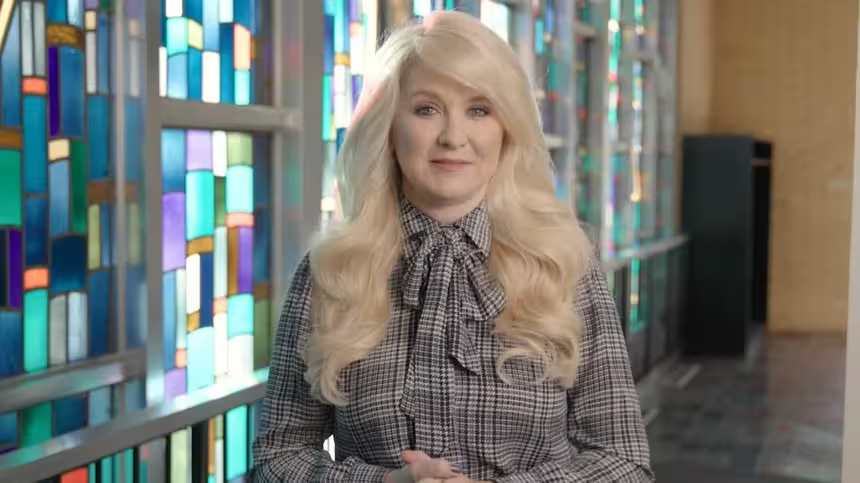
I'm Jennifer Fuller.
We're taking a closer look this episode at how services are changing when it comes to mental health and in more specific areas, suicide prevention.
Our first guest on this episode of "In Focus" is Andy Wade, the Executive Director of NAMI, Illinois.
Andy, thanks for joining us.
- Thanks for having me.
- NAMI is the National Alliance for Mental Illness.
It's a nationwide organization, and you're the head of the Illinois chapter.
Can you tell us a little bit about the organization and how you are seeing things change with the rollout of the 988 Helpline?
- Okay well, NAMI the National Alliance on Mental Illness is the nation's largest grassroots network of people working for and on behalf of individuals and families who are directly affected by mental health concerns.
I like to say it as we're the public in the public conversation about mental health.
So our programs are not clinical programs.
We're not psychologists.
We're people who have lived through similar experiences in our own lives and who have gone through training, and to deliver evidence-based support programs and be the friendly helping hand that people need in times of duress.
Just in terms of what's changed, obviously since the pandemic is we've seen a sharp increase in suicide rates, mood disorders, things that were already epidemic prior to the pandemic have surged, and we expect them to continue to stay high.
So this is a serious public health issue, and it's something that we're working on, and in multiple fronts.
- You mentioned it's a serious issue.
It absolutely is, and what we hear far more often than not, is that mental illness is complicated.
When you are actually able to find some help, a lot of times it takes a little while for, if there's medication involved for that to take effect or to find the right kind of counseling.
or help that you need.
How difficult is that when you have someone in crisis to get the help that they need, and make sure that it's the effective form of help?
- Well, if you're in crisis, one of the good news things is that we now have the 988, three-digit extension, which is a direct line to what used to be called the National Suicide Prevention Helpline.
So there is a fairly direct path to speaking with someone when you're in a moment of crisis who understands the situation, and can help connect you to resources.
That's very much a work in progress.
So it is also important to connect to people closer to home.
One of the challenges that Illinois faces, and really the whole nation faces is that the mental health workforce has been overstretched for many years.
There was a report that came out in 2019, that basically declared the Illinois mental health workforce in a state of crisis.
And that was before the pandemic, that work began in 2017.
So we have a need to fill every position.
You'll have counties, especially in rural areas that don't even have access to a child psychiatrist.
So in many ways, your family doctor is often the resource that people start to.
That's why NAMI exists though.
NAMI is an organization of people who have experienced mental health concerns of a large variety.
And our programs, while they're not clinical therapy, can help people understand how to navigate the system.
And also just have someone who's been there, who knows the drill, who has some training just to use as a support system.
So there are resources there, but the entire mental health community in Illinois has been working on expanding.
So this is actually a wonderful time to go into that, if you're interested in it as a profession, because there are plenty of unfilled jobs.
- You mentioned the fact that these are people who have experienced a need for mental health, or maybe have navigated the system already.
How important is it to have that almost someone who can take someone by the hand, and guide them through to get the help that they need?
- Well, it's critical to have someone that you can relate to.
I mean, any therapist will tell you that making progress in therapy is really about trust and connection.
I do wanna clarify though, that NAMI programs are really, this is not what you go to if you are feeling suicidal.
NAMI programs are things that are ongoing, but if you are feeling that you're in a state of crisis, if there's imminent danger, you wanna call 9 1 1.
If you're feeling like you're in crisis and need support, I would start with the 988 crisis intervention line and get some resources specifically focused on keeping you safe.
But as you get through that crisis, and people do, people get better.
I mean, that's one thing to really keep in mind when you're struggling, is that people get better.
We've all been there.
Once you're through the crisis, organizations like NAMI can be a big help, because it is helpful to have someone who can walk through the same, who knows the experience.
But I just wanna be clear that if you're in a crisis situation, you really do need to focus on professional help.
- Absolutely, when people take a closer look at the COVID-19 pandemic and the effects that it had on healthcare across the board, a lot of times they point to Telehealth, and the ways that it helped out people who needed to talk to a doctor about any number of things.
And one of those areas was in mental health.
Do you think that the expansion of Telehealth is helping people get the services that they need?
- We think it's a positive development.
And the fact that the state of Illinois has made, what was originally an emergency extension of coverage to confirm that Telehealth was part of it.
The fact that they've made that permanent, is an important step forward.
This is especially important in rural areas because the distance to travel, to find resources, or to get professional therapy can be prohibitive.
So Telehealth can be really effective.
I talked to my therapist on Telehealth for over a year, and frankly, we found some advantages to it.
What some people will tell you is they actually feel a little bit more willing to open up from the safety of behind their computer screen.
So there's pros and cons to everything.
I think with Telehealth, we wanna be careful to not make it a cure-all for everything.
There are some situations where sitting down with a therapist, or getting real world tests has to happen in person, but Telehealth can certainly be a part of the solution.
And we're glad to see that it's growing and we expect to see it continue to grow.
- For generations, we've heard about the stigma when it comes to people seeking mental healthcare, seeking that help when they're feeling like, well, they need a little bit of help.
Have you seen that that stigma is changing, or lessening in any way over the last several years?
- It's changing, I haven't seen data about lessening, but in a lot of ways, the pandemic was a game changer.
I know I started this role right at the beginning of the pandemic and was really grateful to have the opportunity to be in a service role.
What we saw is that people who three years ago, never would've dreamed of talking about emotional duress, or much less coming out and asking for help, are suddenly very willing to talk about it.
And that's a very positive thing.
There is still stigma.
and it is the biggest impediment to getting care.
And so it can be lonely to be in a state of emotional duress.
You're not alone, but getting past the stigma is probably step number one in getting help for most people.
- How do we get past that stigma?
And how important is it to talk about mental health as a part of overall health?
- Well, mental health is overall health.
I mean, your doctor will not make the distinction between the flu and a cold, and a mental health condition.
I mean, they're all part of the same system.
So mental health is part of who we are.
We're with it every day.
There's nobody that doesn't have mental health.
Hopefully we don't always have mental health concerns.
And having a mental health concern doesn't necessarily mean that you're mentally ill.
I mean, in mental health, one of the things that we look at, is the problem sustaining, not, am I feeling sad or down?
Have I been feeling sad or down constantly, or continuously for over two weeks, and it's interfering with my life?
That becomes a bigger issue, but we all have mental health and we all have ups and downs.
And that's okay, that's kind of who we are.
But when something's interfering with your life, it's important to get help.
You wouldn't neglect a stomach ache that lasted for two weeks.
Why would we neglect something that's going on inside our minds and our hearts?
- What about talking about this?
Particularly with young people, what should parents and friends be talking about with them when it comes to mental health, and what are some things that they should be watching for or listening for to make sure they get the help when they need it?
- Well, I would say number one is just to have an open line of communication, and to be listening and observing closely.
Sometimes what people will say isn't necessarily, I'm feeling suicidal.
It might be a statement like something that's giving things away.
Saying I won't be around next year.
There's lots of different cues.
And frankly, everybody's going to express in a little different ways.
So for family members, it's really listening and observing and keeping lines of communication open, and not judging.
Being judged and feeling that we're other, or different or broken, most likely, if people are struggling, they already feel that way.
And trying to talk someone out of their feelings, isn't really as constructive as just listening empathetically, and keeping an eye out for the signs, and encouraging people to get help.
Or if you're a parent, taking steps on your child's behalf, which is part of our job as parents.
Just like we send our kids to the doctor when they have the flu, we need to be willing to take those steps when there's a mental health concern.
- Certainly a lot of those services, and questions and answers are available through NAMI Illinois.
On your website, getting in touch with people in the organization.
What's the best way for people to do that?
- I actually would encourage people to call our helpline.
NAMI Illinois is in the process of opting into our national system.
So you can also contact us through email at NAMI, @NAMIIllinois.org.
And what we will do is generally connect you to our local affiliate, if we have one in your area.
If not, we will be responding, and trying to connect you with the best resources we can.
We're in the process of improving our own systems.
988 has been a challenge for all of us.
And this is something where we're trying to up our game as well.
- Andy Wade is the Executive Director of NAMI Illinois, and you can find more information at their website and through the information in this program.
Andy, thanks so much for your time.
- Well, thanks for having me.
- We continue our conversation on this episode of "In Focus" taking a closer look at the new 988 suicide helpline, and that discussion moves to Side Effects Public Media.
and the reporting that they've done on that.
Christine Herman is the Managing Editor of Side Effects Public Media, which is a regional public media collaborative that explores health issues across the Midwest.
Christine, thanks for joining us.
- Thanks so much, Jen.
It's good to be here.
- Your organization has done quite a bit of reporting on the launch of the 988 helpline, which officially launched over the summer in July of 2022.
But this is not a new helpline.
The suicide prevention helpline has been available for people for a long time now.
How in your reporting have you found that that launch is going?
- Yeah Jen, what we did was just kind of in the months leading up to the national rollout of 988, we have a regional team spread across Midwest, including your reporter at WSIU, based in Illinois.
And we just started checking in with different states to see how preparations were going.
So it was a couple years ago that Congress decided to dedicate funding to make additional funding available to states, to prepare for the rollout of 988.
And much of the funding was dedicated to hiring additional staff to work at the existing call centers that already provide crisis counselors around the clock, 24, 7 through the National Suicide Prevention Lifeline.
So we had reporters in Iowa, Illinois, Kentucky, kind of looking at how preparations were going.
And it was a lot of scrambling to hire because the expectation was that there would be a big spike in calls, right when 988 rolled out on July 16th.
That data at the national level has not been released in detail, but there's been some reporting.
And then also I've checked in with a source in Illinois who runs one of the 988 centers here.
And indeed they did see a spike in the week after the rollout.
And thanks to a lot of the extra hiring and preparations that were done, they said they were prepared to respond to that influx of calls.
- One of the last things people wanna hear when you've got a helpline like this, is that calls are going unanswered, or people are not getting the help that they need.
But that's also an issue when you launch something on a national level.
There will be glitches and there will be hiccups.
So what have you seen, or what have you been able to report on since that time, as far as how things rolled out specifically here in Illinois?
- Yeah, so earlier this year in the first three months, the national data that was aggregated by the nonprofit Vibrant, which oversees 988 nationwide, found that Illinois was actually ranked last in terms of in-state answer rate.
That means of the roughly 20,000 calls that came in in those first three months of this year, only about one in five were answered by crisis counselors in the state.
So calls that are not answered in state, they route the states so that they can connect you ideally to people that are closest to you, who might be most familiar with the resources in your area.
It doesn't mean all those calls were unanswered.
They bounced to other areas.
It bounced to neighboring states, or to the National Call Center that serves as a backup.
And about one in four of those calls ended up going unanswered, perhaps as a result of being put on hold.
There's obvious concerns about being put on hold when you're calling a crisis line.
So the state has not responded to my request for additional information about more recent answer rates in the state.
But I did speak with Diana Knabe, and she is the President of Memorial Behavioral Health, based in Springfield.
They run one of the 988 call centers in Illinois.
And she said that by July, they had done statewide, in many of the call centers, a lot of hiring, and were able to get that answer rate closer to 80%.
Even with the increase in call volume that they saw in July, and also spilling in to August.
So that's a really good piece of news that there was certainly concern leading up to the rollout, will Illinois be ready?
But thanks to the hiring and the influx of federal funding, it seems like the state is in a good position for the call answering piece.
I think it's important to point out that in addition to someone who can answer the calls, we kind of think of it in three buckets.
A place to call, someone to respond, if a in-person response is needed.
And then also a place to go for follow up.
And when we think about 988, a lot of the focus is maybe on who's gonna answer the calls, but I think it's also important to think about, and lots of the call centers across the state are working on a number of these buckets that the resources need to also be there, so that when someone needs a response, there's someone who can show up.
And then also for long-term care to hopefully avoid a cycle or repeating the cycle of just one crisis after another.
Getting plugged into care, or long-term treatment or support groups, those types of things is also really important as we have this conversation about 988 and being able to support people who are experiencing mental health challenges.
- Certainly, I wanted to back up just a little bit.
You mentioned that you talked with Diana Knabe, who is a part of Memorial Behavioral Health, which operates the 988 Call Center, there in Central Illinois.
And she had this to say about how things have gone since that rollout in July.
- In July, I think thanks to especially PATH, Inc, which is in Bloomington-Normal, which is answering a lot of the calls in Southern Illinois, as well as being back up for a number of other call centers.
And so it actually went up to an 81% answer rate statewide and PATH actually had over a 90% answer rate in July.
- So it sounds like things are continuing to grow when this gets started.
But as you mentioned, how important is it that those calls not only get answered, but they're connecting people to the services that they need?
- Yeah, it's really important, Jen.
And so that's why there is really emphasis or focus on all three elements of what's called the mental health continuum of care.
So Diana Knabe actually there in Springfield, they have a mobile crisis response team that is available to report in person, to show up at your house.
They wear plain clothes.
They show up in unmarked vehicles.
It's an alternative to 911, and police officers showing up.
Police officers will show up if you call 911, and you're in a crisis and you need help.
But we can think about all the reasons why, we hear tragic stories about how that can go wrong when police officers who are not trained mental health professionals, are called in to handle mental health crisis calls.
So Diana there at Memorial Behavioral Health, they're working closely with the Springfield Police Department to better coordinate.
When a call comes into 911, that might be better handled by them.
They have a way of communicating with each other about that, to either hand off that call, or perhaps co-respond.
And Diana was really clear that actually the vast majority of people who call, they're able to get the help they need on the phone.
And it's only really 1% of calls or so, she was saying that need an in person response.
And whenever possible, they're sending, they're dispatching their mobile crisis team in person.
And they also have a virtual option where they can come in via video to talk with people, and help with their situation.
The other thing they do to address that third bucket, which is really the follow up, she was saying, they ask permission from the caller, would you like you know, can we follow up with you in a day or in the coming days?
And so then they'll have one of their peer recovery coaches or their mental health crisis counselors do a follow up call and check in on people, and also be a connector to resources in the community.
Whether it's specific to mental health or substance abuse, or other needs that they might have.
So there in the Springfield area and all the surrounding counties, they have these services available.
But Diana did say, that not all parts of the state have all three aspects of this continuum of care in place.
And so there's still a lot of work to do in many parts of the state, especially in places with fewer resources, maybe more rural areas that there just aren't as many resources available for mental health.
And so there's been a lot of momentum and focus on building up this continuum of care with the launch of 988 happening this summer.
And I think a lot of mental health advocates, and people who work on the front lines, just wanna make sure we see that momentum and that progress continue into the future.
And that's gonna require additional funding, 'cause a lot of the federal funding I mentioned, it's time limited.
And so states may have to step up, and kick in additional funds going forward to keep a lot of this growth sustained into the future.
- Certainly one of the things that you mentioned was similar to this stigma about talking about mental illness, talking about the need for help, people being able to reach out.
And there was that hesitation.
We've seen stories, as you mentioned about people being hesitant to call and get help when they're in crisis, because they're afraid of law enforcement getting involved.
Maybe they're just afraid of the police actually showing up.
Maybe they have a history with law enforcement that leads them to think that it would be a negative outcome.
This is what Diana Knabe had to say about the work that they're doing to kind of change how that works.
- Nationally, that was a big concern that people were afraid that by calling 988, it would automatically send out law enforcement.
And certainly here in our area, that's not the case.
We're working very, very closely with law enforcement.
Law enforcement's calling our mobile crisis response line, especially if they're getting a call from 911, and they believe it's a mental health issue.
They'll call our folks on mobile crisis response, and we'll either respond with them virtually, and help them to assess the situation, make the determination as to whether we'll go out on site.
Or maybe they just, based on what they've told us, we're like, yeah we're gonna be out there.
Lots of times, they'll wait for our teams to get out there.
And so that's a really good partnership, really in kind of our greater area with a lot of our local law enforcement.
- So lots of information there, but I wanted to spend the last minute or so talking about the importance that people are seeing in making sure that you're having the conversation.
How important is it to lessen that stigma, make sure people know that they can and should make the call when necessary?
- Yeah, that's really important, Jen.
These are trained mental health crisis counselors that are available 24 7 through calling 988.
Now easy to remember number.
There's also a text feature.
You can text the word HOME to 741741.
And sometimes just having a trained professional who can help you talk through what you're going through, the vast majority of time, that's what people report when they call.
Their needs are met through even just a simple conversation.
You can also call to get resources or information on how to support a loved one, or a friend, or family member who's dealing with a mental illness.
So I think the takeaway is the number is there, the resources are there, and hopefully going into the future, there'll just be continued focus on building up a continuum of care for mental health, so that when people call there's a place.
There's someone they can speak with.
There's a place where they can go, if they need help for continuing support in their life.
- Sure, Christine Herman is the Managing Editor for Side Effects Public Media.
Christine, thanks for joining us.
- Thank you, Jen.
- And thank you for joining us on this special edition of "In Focus."
I'm Jennifer Fuller.
(upbeat music)

- News and Public Affairs

Top journalists deliver compelling original analysis of the hour's headlines.

- News and Public Affairs

FRONTLINE is investigative journalism that questions, explains and changes our world.












Support for PBS provided by:
InFocus is a local public television program presented by WSIU