
InFocus 302 - The Middle Radio Program
9/15/2022 | 27mVideo has Closed Captions
Our guest: The host of a new public radio program, “The Middle,” Jeremy Hobson.
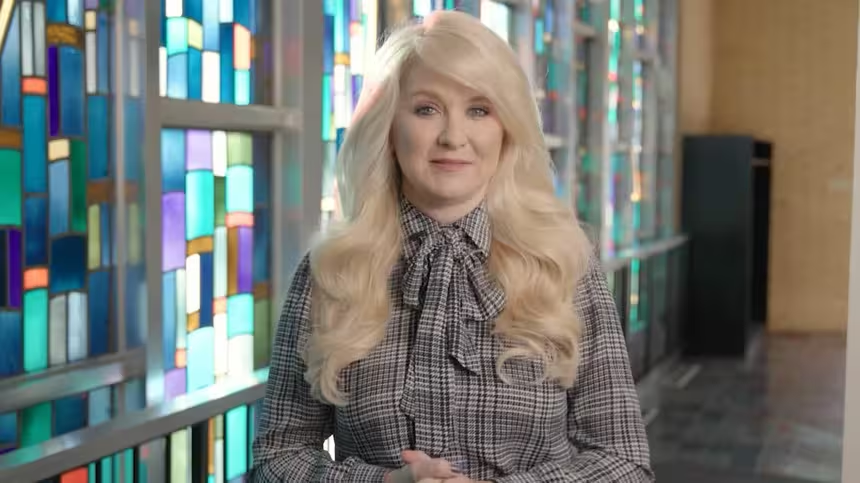
A new radio call-in program will launch October 19 on Public Radio stations across the country. WSIU’s Jennifer Fuller talks with the host of “The Middle,” Jeremy Hobson. Hobson is a past host of NPR’s Here and Now, as well as Marketplace.
Problems playing video? | Closed Captioning Feedback
Problems playing video? | Closed Captioning Feedback
InFocus is a local public television program presented by WSIU
Support provided by:

InFocus 302 - The Middle Radio Program
9/15/2022 | 27mVideo has Closed Captions
A new radio call-in program will launch October 19 on Public Radio stations across the country. WSIU’s Jennifer Fuller talks with the host of “The Middle,” Jeremy Hobson. Hobson is a past host of NPR’s Here and Now, as well as Marketplace.
Problems playing video? | Closed Captioning Feedback
How to Watch InFocus
InFocus is available to stream on pbs.org and the free PBS App, available on iPhone, Apple TV, Android TV, Android smartphones, Amazon Fire TV, Amazon Fire Tablet, Roku, Samsung Smart TV, and Vizio.
InFocus
Join our award-winning team of reporters as we explore the major issues effecting the region and beyond, and meet the people and organizations hoping to make an impact. The series is produced in partnership with Julie Staley of the Staley Family Foundation and sponsored locally.Providing Support for PBS.org
Learn Moreabout PBS online sponsorship(gentle upbeat music) (gentle upbeat music) - Welcome to a special edition of "In Focus."
I'm Jennifer Fuller.
Tonight we're talking about a new program on public radio, specifically WSIU Public Radio and stations across the country.
This new program is called "The Middle" and it'll be hosted by Jeremy Hobson.
You may be familiar with Jeremy who is a past host of "Here & Now" on public radio, as well as "Marketplace."
Jeremy, thanks for joining us.
- Jennifer, it's great to be with you.
- The program begins October 19th leading into the midterm elections, and it's called "The Middle."
Can you tell us a little bit about the inspiration for the show?
- Yeah.
So I think the media, which I've been a part of for the last 22 years, and maybe even longer if you go back to my days hosting "Treehouse Radio" in Champaign-Urbana when I was nine years old, but let's just say 22 years for the moment, is very coastally focused.
All of the main media hubs in this country are in New York, in Washington, some in Los Angeles, maybe San Francisco, maybe Boston.
I spent seven and a half years hosting "Here & Now" from Boston, but there's so much of this country that is ignored mostly by the media.
And it's a really important part of this country.
It's the part of this country that you live in, it's the part of this country that I grew up in, and it's the part of this country where a lot of earth-shattering events happen that really change our politics.
And the idea of this show is to put those people, the people in the middle, first in a nightly discussion, or in this case, a weekly discussion of some of the big issues of the day and make sure that the people in the middle are the people who we're hearing from first.
- To be clear, you're not talking about a rural versus urban conversation.
You have cities like Chicago, Houston, St. Louis, Indianapolis, others that are quite large.
So you're really looking at issues that are affecting kind of that interior part of the country?
- Absolutely.
As we've been talking to NPR stations around the country about this show, yes, I am so excited that we have the entire state of North Dakota, South Dakota, Nebraska, Wyoming, Iowa, Minnesota, airing the show.
I'm also glad that we have Chicago, Kansas City, St. Louis, Dallas, Houston, Phoenix, Denver, big cities in the middle of the country.
I think that all of those places are places that don't have an adequate voice in our media right now.
And so it's not just about rural voters or rural people or people in suburbs or people in cities.
It's all of that.
But just saying, let's start with the middle, let's start with the middle out and really have that conversation that focuses on people in the middle.
- There are a lot of people, experts on down to those who say this is flyover country that say that the fact that those issues and those people were somewhat ignored, gave rise to the Tea Party movement, perhaps even that this is what put Donald Trump into the White House.
There were a lot of people that were surprised, but I think people in the middle of the country said, "No.
This is stuff we've been hearing about "for a long time."
Is that kind of what you're getting to as well?
- Yeah.
And I think first of all, let me say, I don't use the term flyover country because for those of us (laughs) who are ever there, it's not flyover country.
When I was a kid, we drove to visit my aunt and uncle out in Philadelphia.
We didn't even fly there.
We drove there from Central Illinois.
So let me start there, but look, you bring up Donald Trump and the Tea Party.
The other thing I think is the abortion vote in Kansas this year was probably the most impactful single event of this entire midterm election cycle.
It changed the politics for everybody from coast to coast.
That happened in Kansas.
Why was the media, why was the country so surprised by that?
Because nobody ever listens to anybody in Kansas or talks to them in the mainstream media.
And so they're like, "Wait a minute, what?
How could that happen?
"That's a red state.
"How could they possibly have done this?"
Well, if you actually look at Kansas, and we did "Here & Now" from Kansas City and Laurens several years ago, they've got a Democratic female governor in Kansas because the former governor, Sam Brownback, caused such a mess with tax cuts that the Republican legislature had to raise taxes over his veto.
And so there's a lot of history in Kansas, and Kansas, if you go way back in the day, this is the place where Bob Dole came from who would've been considered today, certainly a moderate Republican.
There are a lot of voices I think that are not heard and not understood by the media in the middle of the country and that's what we wanna focus on.
- What are some of the other issues?
People put a lot of emphasis on, as you've mentioned, the votes that are coming out regarding abortion rights across the country.
What are some of the other big issues that you think may be ignored or downplayed on those coastal stations?
- Look, I think the impact of inflation is something that is not totally understood by, especially wealthy people in the coastal cities, how much that affects somebody who might drive an hour and half every single day for their work, to take their kids to school, or whatever they have to do, or for their business, or how much it's gonna cost them extra to fill up the truck that they need for their business to take them from one place to another.
I definitely want to get into economic issues and inflation.
In fact, we found as we were sort of looking into various topics that Tampa, Florida, which is gonna air "The Middle," has the highest rate or had the highest rate of inflation in the entire country, largely driven by the cost of housing.
So that's something I wanna get into.
Climate change is another thing I definitely think we should talk about, but also I think we want to zoom out a little and instead of focusing on a single issue, maybe ask a question like, what's an area where you disagree with the party that you affiliate with?
Because I think a lot of people in the middle of the country don't feel that, and frankly, people on the coast as well, don't feel that they fit 100% into either the Democratic Party or the Republican Party or whatever party they're a part of.
They might say, "I agree with them on these things, "but I don't know why they don't talk more about this."
So I wanna hear from people about what are the things that the parties are missing in this country that would appeal to them?
- Let's get a little bit into the weeds on kind of how the show's going to work.
It'll air on public radio stations across the country, as you've mentioned, but how can you get more people involved in this conversation that you're hoping to elevate?
- Yeah.
So it's gonna air on public radio stations across the country.
I'm gonna do each of the shows from a different station in between the coasts, and all the shows by the way, will run through WILL in my hometown in Champaign-Urbana to get up to the satellite.
That's one of the things you have to do in order to have a live radio calling show, but we're in conversation with Twitter about maybe we do simulcast on Twitter Spaces to bring in some non-public radio listeners into the conversation.
We're gonna try to do as much engagement over the next month and a half as possible to try to just get this word out so that we can really have a very wide ranging conversation with a wide swath of people from this country.
That being said, this is going to already be the most widely distributed national talk show, live talk show on public radio since the end of "Talk of the Nation" in 2013, which is nine years ago.
So this is already gonna have just a huge number of people all across the country, listening and contributing at the same time.
- And we should let people know too, that it's already available to follow and engage with online.
You can go and find "The Middle" on Twitter.
You can find "The Middle" on Facebook and you can find Jeremy Hobson as well.
And Jeremy, when we talk about some of the political issues that you're going to be getting into, you mentioned that people feel they don't really fit in either of the two major political parties with polarization the way that it is, you have these conversations that appear to be more argumentative than perhaps coalition building.
How do you hope to get over that hurdle?
- So I'm glad you brought up polarization because I think politicians at this point actually have an incentive to make us more polarized, to push us into our corners.
And the media should not have that incentive to make us more polarized.
There is no reason that we shouldn't have media in this country that is trusted on all sides of the political spectrum.
That's what I want this to do, is to be a place, and I've always done that.
I've always hoped that our show is listened to and respected and believed and trusted by people on the right and the left.
And I think over the course of my career in public radio, I have gone to so many events with donors, with listeners where I hear from, you know, I'll hear from people who are really progressive liberals and I will also hear from Conservative Republicans who say, "I love listening to your show "because I know that you're really "trying to be as objective as possible."
That's what I want this program to be.
And I think when we build that trust across the political spectrum, people know that the people behind the microphone or behind the camera are really trying to hear from different points of view to bring you the truth.
I think that that goes a long way in dealing with the polarization that we're seeing right now.
- Not to put you too much on the spot, but there's a lot of criticism of the media right now in terms of bias or agendas or things like that.
Do you think that criticism is legitimate?
- That the media are too biased or that the media are not biased?
That the media are too biased, one way or the other?
- Sure.
Mm-hmm.
Mm-hmm.
- Yeah.
I think that there is legitimacy to that.
I think that, you know, look, this has been a very difficult time to be a journalist.
Let me put that out there.
The most difficult time of my entire career has been in the last several years.
It's hard to, you know, there's a lot of misinformation out there.
There are a lot of people that are trying to push false things.
And it's hard to know what's true, what's not true.
How seriously to take something, how not seriously to take something.
But I think at the end of the day, journalists have a responsibility to hear from different points of view and to not say my way of thinking is the only way and so therefore that's the only point of view that I'm going to bring.
There are people that do that.
If you want to go listen to opinion or you want to go listen to Conservative talk radio or watch certain shows on television, you can get the opinion that you want, but I actually get the sense from talking to people about this show that most people really do want to hear things, even if they disagree with those things.
They want to hear the news, they wanna know what's going on and have a better understanding of the world that we live in.
- Your focus right now is on the midterm elections, these shows, three of them before the midterm and one after.
What are you you hoping for beyond that?
Is there a plan for "The Middle" going forward?
- Yeah.
So "The Middle" will, I keep saying might, but I should just start saying will, because it will become a weekly show next year in 2023.
What we're trying to do right now is build the coalition of stations that are interested in this and show that this show is really gonna be something that public radio stations in particular need to be part of their day if they've got, you know, I went and did a calculation.
0% of the hosts of national public radio shows right now from Sunday to Monday or well from Monday to Sunday, so the entire week, 0% of the hosts are anywhere, but the coast in the national news shows.
Only 28% of the hosts are from anywhere, but the coasts.
So what we're trying to do right now is build the coalition of people that say, we've gotta have this on our air, find the funding, which we're currently trying to get right now to make sure that this becomes a long term program that is successful for many years.
And then we'll sort of move into phase two after these specials are done, which will be launching sometime, I'm hoping in the first quarter of 2023, a weekly program.
- You've talked a little bit about your background as a Midwesterner.
You grew up here in Illinois, in Central Illinois in the Champaign-Urbana area.
Did you find a lot of people not really understanding your background or was there a big culture shock when you yourself moved out to the East Coast for your work?
- Hmm.
That's a good question.
I think what people don't understand about living in the Midwest in particular is that we don't spend all day every day thinking about politics.
We get through our lives.
We make our decisions based on what makes sense in our lives.
Look, I grew up with two immigrant parents who were classical pianists, all classical pianist.
They didn't really talk to me about politics ever when I was a kid and yet I became a huge news junkie at a very young age and a political junkie.
They cared about the world and they instilled in me the idea that I should pay attention to what's going on, not just in the United States, but around the world, but it was never political.
And I think that they were trying to basically, I was one of seven children, they were trying to feed all the kids and make sure that the kids got to school in time and all that.
And I think a lot of people in the middle of the country, and that's one thing I think people in the coast don't understand is that, we're not waking up and watching "Morning Joe" and then get in our daily podcast and then get in the subway to go to work.
And then the first thing we wanna do at the end of the day is turn on the TV and watch more political news.
That's just not the way that life works in the middle of the country, but in some coastal cities, it is the way that life works.
- I wonder when we talk about, going back to some of the criticism of the media, particularly the larger media networks, what are they missing about how to cover the Midwest?
Is it just a context issue or do they really not understand the issues that are going on in the middle of the country?
- I think that it's an issue of all of the big media companies have stayed in the coastal areas of this country.
And so these are the lives that they live and they pop in for the Iowa caucuses every four years.
And they'll fly in when there's a huge flood in the Mississippi River or something like that, but there aren't enough people that are out there doing national news programs.
Now, that being said, I think one of the exciting things about this show is that the people that call in are gonna be the drivers of this program.
And so I have however many people, hundreds of thousands, millions of people that will be listening to this show that will be part of this show, that will actually help drive the show in a really authentic way.
Not let's pre-screen everybody and we'll only call back the people that we like.
A lot of the public radio talk shows now that's what they do.
You'll leave a message, they decide who they want, then they call you back.
In this case what we're gonna do is actually take live calls, which I think is gonna be interesting and great.
- Certainly a level of risk there, but are you surprised at all, because of course, you'll do some preparation for the show.
You'll think about the topics, the issues that you want to address from episode to episode, but have you been surprised at all about any of the reaction or is there something that you weren't expecting as you went down this road?
- You know, one thing that I've heard.
And I was talking to the program director of a major station on the East Coast of the United States to try to get them to take the middle as well, because right now we're gonna be on in Los Angeles, San Francisco, Miami, Baltimore, like a lot of big cities on the coast, San Diego.
One of these people said to me, "Well, why do our listeners care about the middle?"
And I said, "Well, they probably should, "because they're making a lot of your decisions for you."
When I said to you a minute ago, that we've got North Dakota, South Dakota, and Nebraska, and you sort of rolled your eyes like, "Okay, great.
Good for you."
Those states all have two senators just like New York state.
They're making a lot of choices for you, for your listeners.
And so you probably should have them on your air for at least a few minutes a week, because you might wanna hear what they have to say.
- You mentioned Senator Bob Dole several minutes ago, coming from Kansas.
Here in Illinois, we have us Senator Dick Durbin, a ranking member of the Democratic Caucus in the US Senate.
Do you think voices like theirs are overlooked somewhat because of where they're from?
- Well, look, I think Dick Durbin is a very high ranking, high ranking Senator.
I think he's gonna be the number two on the Democratic side in the Senate.
So I don't think his voice is overlooked.
I think though, if you look at the last several presidential elections, going all the way back, really to 2000 in George W. Bush and Al Gore, the races really get decided by a handful of states in the middle of the country, even though most media don't pay that much attention to those states the rest of the time, at the end of the day if you win Wisconsin, Michigan, Iowa states like that, you're gonna be the president of the United States.
So I think the voices from the middle aren't getting enough attention.
There are certainly people like Dick Durbin that have a big, big platform, and have for a long time.
I remember Dick Durbin was running for Senate when I was in high school.
So (laughs) he's been around for a while.
And I guess it takes that long to work your way up in the Senate.
But yeah, I just think that there needs to be more focus than there is currently.
- As we've said, "The Middle" premieres October 19th on public radio stations including WSIU across the country.
What are some of the things that you covered earlier in your career, Jeremy, that are informing the way that you tell stories today?
Things that perhaps you learned along the way, whether it's in Illinois at WILL or perhaps early on when you moved east?
- You know, I have learned so many different things along the way.
I will say that, I started out in radio when I was nine, hosting this show called "Treehouse Radio."
And learned, you know, I already loved the media.
I got obsessed with an oldie station in Champaign-Urbana as a six and seven year old and would call in in the middle of the night and win pizzas.
(laughs) I had to hang up the phone before they delivered it, 'cause my parents would be angry at me if I had a pizza delivered to the house at that time.
I would call into Elvis request nights.
So I loved the media.
I felt like I had a friend on the other end of the dial, but what I learned when I started doing radio documentaries, when I was 11, 12 years old in Champaign-Urbana, through a project through my high school, was that this media that I loved so much could be used for really good purposes to inform people, to educate them, to enlighten them.
And once I moved down that path and started getting into public radio and what public radio could do, I learned a lot of lessons over the years.
I'm thinking of one piece of tape that I still, we call it a piece of tape.
We don't really use tape as you know anymore, but in those days we did.
A piece of tape that I think is the best piece of tape I've ever gotten.
I was doing these projects in Cape Cod.
I was working with this radio producer there when I was 18 years old.
And we would go around and we could interview people about anything that we wanted.
And we would produce these little one minute long vignettes called Sonic IDs that would air at the top of the hour, all day long on the station.
And instead of the announcer saying, "This is 90.1 WCAI Woods Hole," we would have the person that we'd interview at the end whenever they they'd tell us about doing the laundry or how they like to go clamming, they would say, "I'm, Marjorie Smith.
"And this is WCAI 90.1, whatever."
So I was interviewing this guy who was sitting on a park bench next to a congregational church in West Tisbury, Massachusetts.
And I said, "So like, what do you do?"
And he said, "Well, I'm retired.
"I used to be the keeper of the clock at the church."
And I said, "Oh, that's great.
It's almost two o'clock.
"Should we go up there "and I can get a little sound of the bell going off."
And he goes, "Oh, sure."
She takes me up to the top of the church, this incredible sound of the bell going off and all the machinery working and he starts to get a little emotional.
And he says to me, 'I think my ultimate reason for retiring is that "I don't really care what time it is."
And I was like, "Oh my God, "this is the best piece of tape I've ever gotten."
And it still is, I think.
(both laughing) - Those personal stories are so critical, particularly in public radio as you know.
I've spent a lot of time there as well.
Are you hoping that "The Middle" changes the game when it comes to how those stories are told and the people that they're coming from?
- I'm hoping that "The Middle" convinces public radio that it needs to broaden its reach and it needs to broaden where it gets its stories from, who it talks to.
One rule that we're gonna have on this show is that we're not gonna have guests that are on the coasts.
So I'm not gonna have a New York Times reporter and a Washington Post reporter as my guests on the show.
We're gonna go after people that are in the middle of the country to bring different perspectives forward.
So yeah, I hope that this, I think it already is having an impact.
I was just at a conference with all the public radio stations in the last couple weeks and people are talking about this because it's different.
Also, it's not being distributed by any of the major distributors.
This is not an NPR show, it's not an American Public Media show.
We're distributing it ourselves with the help of WILL thankfully, 'cause you need that to get it up to the satellite, and they've been super helpful otherwise, but I think it's gonna change, I think it's gonna make public radio realize that it's gotta get outside of its bubble, which it has been in too much recently, I think.
- People criticize the media.
One of the things that they're saying too, is that social media has allowed people to kind of stay within their own affinity groups or their own thought processes.
Will "The Middle" help kind of break down those barriers, do you think?
And do you see some of the same criticisms on social media?
- Look, I don't think that this is gonna solve all the world's problems, (laughs) unfortunately, but I do think that...
I've been really excited to hear from people who say, "You know, I'm sick of turning on TV "and only hearing from people that I agree with "or just looking at social media "of people that I agree with.
"I actually wanna hear what people think "across this country about things."
And so, yeah, I hope so.
I hope that to some degree it shows people that, "Hey, you know what?
We're all Americans, "let's have a conversation with each other.
"Why do we have to say I can't talk to you "because you believe this "and you can't talk to me because I believe this.
"Why don't we just restart the conversation?"
- The show, as we've said, premiers on October 19th.
Do you have kind of a trajectory of the issues that you wanna talk about first and what you wanna do leading into the week before the election?
- You know, we're figuring out the topics and the guests of the shows right now.
Yeah.
I do wanna leave some of it for a bit later because you never know what's gonna be in the ether that week.
That being said, one thing that I really would like to do just to start us off is to ask people, what is the most important issue to you heading into this election?
And just hear what people have to say about that.
Because I think when people, when we can in an unfiltered way, ask listeners that question, we're gonna hear some surprising things.
- Have you been surprised by any of those suggestions so far, not to kind of tip things off and let people know what it'll be, but?
- Any of the suggestions of the topics that we're going to cover?
- Sure.
Yeah.
- Oh, no.
I mean, I don't know about surprise.
Well, I will say actually, one thing that has come up a number of times is water.
And I think whether you are in the Midwest where there have been these terrible floods or whether you are in the west where they're thinking about water restrictions in California and Arizona, I think water, it could be a topic that we get into because it is so important.
And we, as a country, some places have too much water and some places have too little water, but we're all part of the United States.
Maybe we should figure out a way to get the water from the places where they have too much to the places where they have too little, 'cause we're all part of one country.
- Jeremy Hobson is the show host and creator of "The Middle," premiering on public radio stations across the country, October 19th.
Jeremy, thanks so much for your time.
- My pleasure.
Thank you so much for having me.
- And thank you for joining us on this special edition of "In Focus."
I'm Jennifer Fuller.
We'll see you next time.
(gentle upbeat music)

- News and Public Affairs

Top journalists deliver compelling original analysis of the hour's headlines.

- News and Public Affairs

FRONTLINE is investigative journalism that questions, explains and changes our world.












Support for PBS provided by:
InFocus is a local public television program presented by WSIU