
InFocus 303 - Jackson, MS Mayor Chokwe Antar Lumumba
9/22/2022 | 27mVideo has Closed Captions
Jackson, MS Mayor Chokwe Antar Lumumba
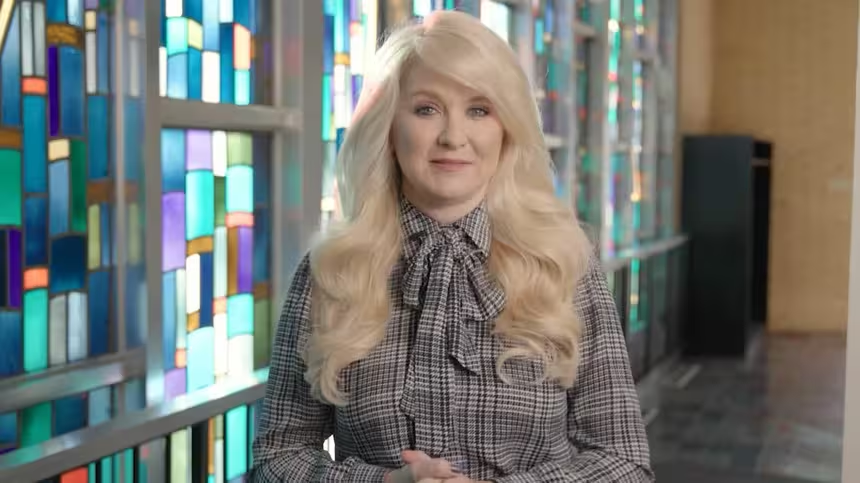
Jackson, Mississippi has been thrust in the spotlight with its water crisis and the US Supreme Court’s Dobbs decision – which began in Jackson. WSIU’s Jennifer Fuller talks with Mayor Chokwe Antar Lumumba about those issues, and his goals and plans for the city, in this special edition of InFocus.
Problems playing video? | Closed Captioning Feedback
Problems playing video? | Closed Captioning Feedback
InFocus is a local public television program presented by WSIU
Support provided by:

InFocus 303 - Jackson, MS Mayor Chokwe Antar Lumumba
9/22/2022 | 27mVideo has Closed Captions
Jackson, Mississippi has been thrust in the spotlight with its water crisis and the US Supreme Court’s Dobbs decision – which began in Jackson. WSIU’s Jennifer Fuller talks with Mayor Chokwe Antar Lumumba about those issues, and his goals and plans for the city, in this special edition of InFocus.
Problems playing video? | Closed Captioning Feedback
How to Watch InFocus
InFocus is available to stream on pbs.org and the free PBS App, available on iPhone, Apple TV, Android TV, Android smartphones, Amazon Fire TV, Amazon Fire Tablet, Roku, Samsung Smart TV, and Vizio.
InFocus
Join our award-winning team of reporters as we explore the major issues effecting the region and beyond, and meet the people and organizations hoping to make an impact. The series is produced in partnership with Julie Staley of the Staley Family Foundation and sponsored locally.Providing Support for PBS.org
Learn Moreabout PBS online sponsorship(soft music) (upbeat music) - Welcome to a special edition of InFocus.
I'm Jennifer Fuller.
Our guest is a guest of the SIU Honors Program.
The Glassman lecturer is the mayor of Jackson, Mississippi, Mayor Chokwe Antar Lumumba.
Mayor, thanks for coming in.
- Thank you for having me, happy to be here.
- People may be familiar with your community.
It's been thrust into the spotlight quite a bit over the last year or so.
Can you tell us a little bit about how things are going?
Let's get up to date, for example, on the water crisis that you had.
- Well, thank you for asking.
First and foremost, I want to express immense gratitude for the love and support that has poured in from all over the country.
Fortunately, we have good news to report, water pressure has been restored to all of our residents and the boil water notice has been lifted.
For us, while that is good news in the interim, we wanna make certain that we see the significant capital improvements that need to take place so that we have greater reliability, sustainability, and equity within our water system.
- For people who are unfamiliar, there was a flood.
It inundated your water and sewer system and left the city without potable water for quite some time.
People couldn't take showers and baths, let alone drink or use the water for cooking.
This is not an unusual situation for a lot of communities and cities in that the infrastructure is aging, and this is a problem.
We saw it in Flint, Michigan.
We're seeing it in communities all over the country.
What plans are you putting in place to update that infrastructure and make sure that problems like this don't happen in the future?
- Well, there's great insecurity, water insecurity, not only in Jackson, but we believe we are the tip of the iceberg, both Jackson and Flint, and that is due to a multitude of reasons.
So most recently, it was the flood, two Februarys ago, it was a winter storm that debilitated our water system.
And so it really expresses the fragility in our system.
And so this is why we need to see to a great investment in our infrastructure.
We're taking advantage of our federal funds, taking an opportunity to see what loans we can take out on our own, but we wanna make certain that affordability is front and center in every plan that we make.
We don't wanna move people from one state of misery to the next.
Fortunately, we have good relationships in Washington, talking with the administrator of the EPA, as well as both the president and the vice president.
The problem is making sure that we get funds from the federal intent into our hands.
Sometimes that is a political challenge that makes it difficult for the type of system and the type of reliability we want to see in our infrastructure.
- This fits into one of the things that you were invited to come to SIU and talk about.
And that's something that you call a dignity economy, as you try to rebuild some of the areas in the community that have really been hit hard by economic pressures and other issues, how is this helping people kind of pull themselves out of such a difficult situation?
- Well, I think you're absolutely correct, that this circumstance is a prime example of what I wanna talk about and the great transformation or shift that I think we have to make in electoral politics.
Often, the metrics that we guide success or determine success and failure as a nation are things like GDP or stock market.
And I believe that it should be less about that and more about sustainable development goals.
What is the reliability or the resiliency of our infrastructure?
What is our residents' access to fresh fruits and vegetables, the quality of our education, and how does the economic development serve our residents?
And I think that those are the true metrics that really determine the quality of life that people have.
And I think that that is the shift that we have to make make towards so that we have something that is more dignified for our residents.
When residents don't have water, when they have to make decisions, when they're gonna pick up their children, when they'll leave work, if their children are out of school, whether or not their jobs are flexible or amenable to that, those are cycles of humiliation that people are suffering from time and time again.
And we have to be able to end those cycles and present something that represents the inherent dignity in every person.
- Too often, we see in communities where things get bad, there's economic depression, there are issues in the education system, there are issues in infrastructure.
People's choice is to pick up and go somewhere else.
And that leaves people who are underserved or underrepresented in an even more difficult situation.
How are you hoping to attract people to Jackson and how are you hoping to keep them there because the economy dives and rises so often?
- Well, instead of pushing people away, we wanna lift people up, right?
That is our aim and our focus, and present something that is more than just a model of how Jackson overcomes its challenges, but how we change the world from where we stand, how do we present a model that can be reflected across the nation, that demonstrates what beauty comes out of an investment in people, an investment in community.
And so that's what we're looking to do, and we're being unapologetic about that aim and aggressive towards it.
- One of the ways that I'm sure you do that is to get young people involved.
And I know the education system in Jackson had some challenges and continues to work on some of those challenges as well.
What are some of those challenges specifically, and how are you working through those as a city and then closer in as a school system?
- Well, one of the first things I had to contend with early on in my first term less than a month was the potential state takeover.
And we were able to ward off that state takeover, in fact, make an agreement with the governor, a governor who, our ideology, our political ideology is not most often in line, but what we were able to focus on were our common ends and objectives and demonstrate what I call operational unity, being able to focus on those common ends and objectives.
And so we were able to build a united front, not only looking at the city and the state, we brought the Kellogg Foundation in, and we created an alliance with the community.
We had town hall meetings.
We knocked on 60,000 doors in the City of Jackson to get a survey of where we found ourselves and where the goals and aspirations of our parents and our students would have us to be.
And so we've been building around that.
Now, we like the rest of the nation, have suffered some unique challenges in a pandemic that took children out of the institutions in which they thrive.
And so we're in recovery just as the nation is in that regard.
However, we are building a model which is more reflective of community aspirations.
- When you look at this through a lens of diversity, equity and inclusion, what are the challenges that you continue to face there?
In a larger community, you've got the haves and the have-nots, how do you raise everyone up but maintain that equity and inclusion as well as the diversity?
- Well, our goal is to have excellence for all.
We have a school district which encompasses both the highest performing schools in the entire state and some of the lowest performing schools in the state.
And so you have equity questions from school to school, and even you have those that whose parents are the staunch advocates for their children that have those teachers that are the most engaged with them versus those students whose parents may not be able to afford the time to make that effort.
And so we have to build a district which is inclusive of everyone, that has those goals and find out where those gaps lie.
And so that's more than just a district effort, that's a city effort.
How do we begin to make our city into a classroom?
How do we begin to expose young people to opportunities that they would not otherwise have?
I tell people that it wasn't a distant idea for me to become a lawyer because I lived in the house with my hero and he happened to be a lawyer.
And so we have to begin to introduce these opportunities and these concepts to young people as soon as possible.
It's one of the reasons why I love, for instance, my mayor's youth council.
It's not just about getting those that are achieving at the highest level of scholastic achievement, it's about those young people who never envision themselves sitting in a room with the mayor, talking about the politics of the city.
Also looking at collective genius, understanding that young people have something to offer in terms of how we re-envision our world, how we re-envision the success and failure of our city and how do we incorporate their experiences into that thought process.
- Too often, people forget this young people's collective intelligence and what they can bring to the table.
I know I work with students in my job and I'm always amazed at the perspective that they bring to things.
What are you learning from the young people in Jackson that surprises you, that makes you think, wow, maybe we could do this?
- Well, I wouldn't just limit it to the young people in Jackson, but they certainly are part and parcel of what I'm learning, is that we have a generation which doesn't only want to go along for the ride, they want the keys to the car.
They want some opportunity to guide where we're going.
When we looked at the demonstrations that took place around the nation after the assassination of George Floyd, we saw young people rising up and expressing their voice and demanding a shift from where we are to where we must be.
We saw young people, high school student and college students that were leading those demonstrations.
And so I think it's important that we concretize those ideas and bring it from its mystical place to something tangible, and not only build on what they're learning and what they're trying to present, but lessons of the past.
I do consider myself a student of history and it is because of that history, it gives me a framework of where we must go.
And so building on both kind of that new, developing knowledge and what we've learned over the years.
- One of the issues that many mid to larger size communities have a problem with is crime.
What is your city doing to combat crime rates?
And what are you seeing as the challenges in kind of changing that culture?
- Yeah, so it goes back to the notion that I spoke to earlier, sometimes as mayor, your choice is the choice between a bad decision and a worse decision.
So in the midst of the pandemic, we took young people out of the institutions in which they thrive.
And I think not coincidentally, what we saw was the sharpest rise in crime amongst our youngest demographic.
And so how do we reengage?
How do we make certain that we feel the gaps that they experience?
And so one of the things that we are creating is an Office of Violence Prevention and Trauma Recovery.
Sometimes you not only need to spend as much time following who was murdered, but you need to follow the families of the victims to make certain that there isn't retaliation, to make certain that you're wrapping your arms around them.
So our Office of Violence Prevention and Trauma Recovery is looking at violence interrupters, looking at credible messengers, people who have unfortunately experienced some of the worst side of our criminal justice system, to be those voices for young people to share about those experiences.
We're also looking to bring on, understanding that you can't just out police crime.
I'm not saying that I don't believe in police, we believe we need a well funded force, right?
But at the same time, understanding that police are not the psychologists that young people need.
They don't deal with the mental health issues that young people, that many people, that all people deal with.
And so for every officer we bring on, we wanna bring on a social worker to help in the city, understanding that our demographic of young people are some of the most at risk.
Instead of just engaging in a curfew, we're looking to have curfew centers.
Centers that don't just arrest young people and put 'em in jail often when their action is not yet criminal, right?
But misguided, why don't we interrupt that cycle and understand what trauma they're dealing with and try to make whole communities?
- We've talked a lot about the challenges facing your community, but there are a lot of bright spots as well.
What are some of the successes that you like to highlight when helping other communities try and make some of these changes?
- Well, Jackson has been a very, very resilient community.
One of the things that we've been able to do as we're talking about that infrastructure, our administration has been able to pave more miles of road in two years than the previous 10 years combined, right?
And that was part and parcel of our resident's willingness to participate in shared sacrifice.
Under my father's administration, the residents voted 90% in order to tax themselves in order to change them, we were able to make a significant change in our credit rating initially, in spite of the many challenges.
And in addition to that, we've been able to see economic development take hold in our capital city, areas of our city that have been vacant for decades, generations.
As a little boy, I remember Capitol Street, which is in the heart of downtown, becoming a ghost town of sorts.
And so we're starting to see that regenerate.
We also are creating a sense of place that the nation is taking hold of with one of our institutional assets in Jackson State University.
Everybody's becoming familiar with Deion Sanders and so we're seeing people pour in from all over the country to support not only what they're doing at Jackson State, but to support the economy of our city.
And so there's a lot to be proud of.
Our most precious resource is our residents.
And so there's a warmth in hospitality that exists in Jackson that I believe is one of a kind.
- One of the ways that you help build that dignity economy, and you touched on this a little bit, is the work that you've done within education.
Now, you mentioned higher education.
There are a lot of ways that people can get to that sustainable future, whether it's higher education, trade schools, those sorts of things, how are you working with young people to help them understand that the future can remain where they are rather than outside the community or even outside the state?
- Well, we're really just speaking to the diversity of needs we have as a community.
If you understand that, then you understand not only the need for the formal education of institutions like SIU, right?
But also the education that takes place in other areas of the workforce that all contribute to the whole.
For instance, one thing that we learn in the midst of our crisis with our water treatment facility is the need for professionals that are water technicians, class A water technicians.
And so the opportunities are abundant, but even beyond that, how do we re-envision economic development that creates opportunities?
For instance, what we're looking at is cooperative enterprise, taking away from the brilliance of people like Fannie Lou Hamer, a Mississippi native, the idea of how poor people bring their resources together in order to sustain life and protect each other is not an original idea.
And so how do we build on that?
So we're looking at cooperative enterprise, being a city that not only is able to fill the gaps of what we need, more grocery stores, movie theaters, all the things that we need, but also how in the objective of doing so, do we create a mission statement where those entities part and parcel, their development is serving the communities in which they exist in.
- I hear from young people from time to time who hear about ideas like this, and they have similar ideas on ways that they wanna help their own community, even their neighborhood on smaller scales but they feel like they're not big enough or they don't have the capability.
But you talk about making that change from where you stand.
What would you say to some of those young people?
- Well, first and foremost, I would give them my story.
And that is that I never intended to be in politics.
Now, I was raised in a family of organizers.
And so serving community has always been a part of my upbringing.
However, what I would share with them is, there are issues right where they exist right now.
And so what you do is start on those issues that you see in front of you, it may be an issue that you see in your school, and as opportunities present themselves, broaden your horizon, spread your wings towards those opportunities.
They're typically things that you don't have to look for, they're right in front of you.
And so that is how you become an organizer.
That is how you affect change, is starting with some of the smaller things.
Scripture tells us that if we're faithful over the little things, that He will make us ruler over much.
And so if you're faithful over those little things, then those opportunities will present themselves and you'll be ready for 'em.
- I know a lot of places operate with an each one teach one kind of philosophy.
What about that mentoring and that, if you've been through this experience, helping someone behind you, do you encourage that as well?
- Without question.
One of my favorite quotes is one that my father gave me as a young boy, as I finally started to turn my grades around, he told me that our talents are not ours alone, they are the fruit of our labor as a people, belonging to us as a people and they must be used accordingly.
And I just find that as a poetic way of saying that all of the gifts and abilities that you acquire, are acquiring or have acquired, were not due to your own brilliance or genius or capacity, it was because someone sacrificed in some regard in order to make that path for you.
And that being the case, that means that you now have the responsibility to do the same for more young people or more people coming up.
- I wanna talk a little bit more about your initiatives within the city.
And we talked about the sustainability of a people or the sustainability of a culture, but you also have a green picture for Jackson in terms of renewable energy and sustainable manufacturing, things like that.
How challenging is it to kind of bring that change to the community and how's it going?
- Well, it's extremely challenging because it's breaking old habits and basically, bringing into the forefront the fact that this isn't some distant concept.
We're talking about our infrastructure, that is due to the extreme changes we have in our climate.
We have colder winters, hotter summers, and more annual precipitation, and all of that takes a toll on our infrastructure.
And so that is why we have to have a goal of being carbon neutral, such as we have.
That is why we have a goal of looking at heat island effect in our city, understanding that the communities that we typically see the most disparate impact of heat island effect are the same communities that we see the highest crime, are the same communities that have the most inequitable challenges with infrastructure.
And so time and time again, we continue to see these cycles of humiliation, as I said earlier.
And so we have to be able to not only address that immediate challenge, but be able to look at the bigger picture as to why these challenges keep surfacing and what some of those threats are, and environmental justice is one of the significant threats that are posed against communities.
- One of the other things that thrust your community into the news over the last year or so has been the US Supreme Court decision, Dobbs versus Jackson Women's Health, which is not a government agency but it was located within your community.
And it's changed the trajectory of healthcare for millions of people across the country.
How are you working in terms of healthcare to provide services needed for everyone in your community and help them get what they need if it's not available?
- Yeah, because it is litigation that we're still looking at in different ways, there's some things I can't go to, but what I will say is this, is that our city's position is that we believe that a man can't tell a woman what she can or cannot do with her body.
This has been a challenge that we've seen in our city for many years, our police department even having to step in at the very clinic that is at the heart of this litigation, protecting women's rights.
And so, we need to make certain that we ensure human rights for human beings in every regard.
And we think that the most compassionate thing that you can do is show love for people, and harassing them, restricting the decisions that they make with their body, I don't believe is a reflection of that.
Instead of trying to force our beliefs on people or someone's beliefs on people, we need to make certain that we understand where they sit.
The last time I checked, our Lord and Savior gives us the ability of free will, right?
And so it is not incumbent upon us to impose our beliefs on anyone.
- That's certainly something that is going to continue.
You've made a lot of stops and a lot of public appearances.
I'm sure that you get from those visits as much as you give.
As you're visiting Carbondale, are there things that you're hoping to pick up and things that you're hoping to kind of drop off?
- I am most interested in the conversation with the students, the engagement back and forth.
Invariably, I'm hit with a question that I've never heard before or a position that is enlightening to me.
So I don't look at myself as coming to just impose my knowledge or share what I know on anyone.
I'm looking forward to the dialogue.
I believe it's our collective genius that improves us each and every day.
And so I'm certain that I'm gonna find that here at Carbondale, it is my first time here, beautiful campus from what I've seen.
I came in and it was a little dark but I look forward to seeing the campus and experiencing the students.
- A lot of times this will tie people together in ways that they didn't understand before.
People are often surprised to learn that Southern Illinois is considered a part of the Delta because of some of its economic issues.
So are there a lot of things that you see in similarity to Jackson and parts of Southern Illinois and Carbondale?
- Well, first and foremost, the relationship between Mississippi and Illinois is undeniable.
In Mississippi and Jackson, we often joke that we call Illinois just Southern, I mean, Northern Mississippi.
And the great migration of people led them from Mississippi straight up 55 and found themselves here.
And so there's an unmistakable historical connection, and that being the case, I think we will always be linked.
Haven't had the opportunity to really experience Carbondale as much as I would like to, so I can't speak with great specificity over that relationship but I look forward to learning more and I don't want this to be my last visit.
- As we kind of get to the end of our conversation here, I wonder if you have some specific goals that you're hoping to work on in Jackson over the next couple of years that people should be on the lookout for.
- Well, first and foremost, my goal is always to leave it in better hands than I received it and to make certain that we build on that dignity economy, more than just it being a nice catch phrase.
What we wanna see as an economy which serves our residents.
I share with people that Jackson isn't a city that has a problem producing wealth, is a city that has a problem maintaining wealth.
And far too often, we see that in communities that resemble Jackson across the nation.
And so how do we begin to democratize power so that it really matters very little who the mayor is, who our leadership is?
How do we establish control and power within the community, so that the community itself begins to develop its own agenda for success and make certain that whomever is in leadership submits to that?
- Are there challenges that you see on a regional or a national level that you hope to overcome starting in Jackson?
- Well, I think that Jackson, whether we're talking about the Dobbs decision, whether we're talking about infrastructure, I think Jackson is a place that you can see a reflection of the challenges that exist across the nation in many regards.
And so that idea of changing the world from where we stand is one where we believe that we can begin to establish a new model.
A new model for what whole communities, how do we create a society beyond contradiction that supports and loves everyone?
What you ultimately find when you're trying to make these big changes is that people are not actually afraid of change, they're afraid of loss.
And so how do we reframe the message about our shared and collective gain?
- Mayor Chokwe Antar Lumumba of Jackson, Mississippi, thank you so much for your time.
- Thank you for having me.
- You've been watching a special edition of InFocus on WSIU.
You can find all of our videos by going to our YouTube channel, WSIU-TV, and find us online at wsiu.org.
I'm Jennifer Fuller, we'll catch you next time on Infocus.
(upbeat music)

- News and Public Affairs

Top journalists deliver compelling original analysis of the hour's headlines.

- News and Public Affairs

FRONTLINE is investigative journalism that questions, explains and changes our world.












Support for PBS provided by:
InFocus is a local public television program presented by WSIU