
InFocus - Glenn Poshard
2/12/2024 | 28m 42sVideo has Closed Captions
InFocus - Glenn Poshard
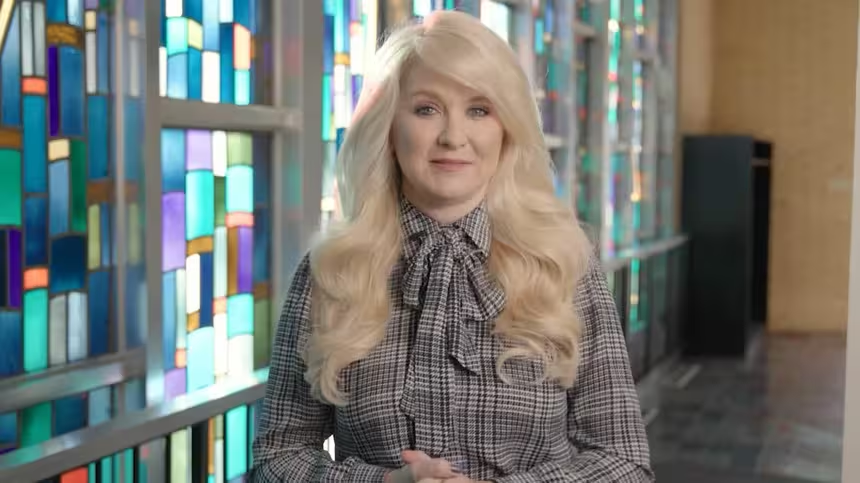
Former educator, State Senator, Congressman, and SIU President Glenn Poshard discusses his new biography, “Son of Southern Illinois” with Jak Tichenor. The new book traces Poshard’s path from childhood poverty to elected office, leadership in higher education, and ongoing work with the Poshard Foundation for Abused Children.
Problems playing video? | Closed Captioning Feedback
Problems playing video? | Closed Captioning Feedback
InFocus is a local public television program presented by WSIU
Support provided by:

InFocus - Glenn Poshard
2/12/2024 | 28m 42sVideo has Closed Captions
Former educator, State Senator, Congressman, and SIU President Glenn Poshard discusses his new biography, “Son of Southern Illinois” with Jak Tichenor. The new book traces Poshard’s path from childhood poverty to elected office, leadership in higher education, and ongoing work with the Poshard Foundation for Abused Children.
Problems playing video? | Closed Captioning Feedback
How to Watch InFocus
InFocus is available to stream on pbs.org and the free PBS App, available on iPhone, Apple TV, Android TV, Android smartphones, Amazon Fire TV, Amazon Fire Tablet, Roku, Samsung Smart TV, and Vizio.
InFocus
Join our award-winning team of reporters as we explore the major issues effecting the region and beyond, and meet the people and organizations hoping to make an impact. The series is produced in partnership with Julie Staley of the Staley Family Foundation and sponsored locally.Providing Support for PBS.org
Learn Moreabout PBS online sponsorship(gentle music) (lens clicking) (slide swooshing) (upbeat music) - We're talking with Glenn Poshard at his farm near Tunnel Hill about the new book about his life, "Son of Southern Illinois," published by the SIU Press.
It's written in collaboration with veteran newspaper reporter and editor Carl Walworth.
Glenn, thank you for taking the time out and talking with us.
- Jack, thanks for having me.
I really appreciate the time.
- Tell me about your early life.
You're one of five kids raised near a little place called Harolds Prairie in the hill country of White County.
Your folks were poor.
They only went through third grade in school, is that right?
- That's right, both of 'em third grade.
- What kind of values did they pass along to you and your siblings in those days?
- Well, we were out in the hill country there and so we all knew each other.
It was all family and close friends and hill country neighborhood and I think, if I had to look at the values, I'd say from my mother, faith.
We always kidded that we were the most churched kids in White County.
(laughing) We were in church on Wednesday night, Saturday night, Sunday and Sunday night, but my mother had a deep faith and I think she wanted us to have that.
From my dad and my mom both, just hard work 'cause, boy, that was a hard place to be.
They only had a very small little farm and neighbors and friends shared everything to get by, but very poor.
And I think hard work.
We all had a, mom and dad made sure that we all were responsible for something in our home and for us kids, it was maybe household chores and milking the cows or feeding the hogs or whatever, but also studying, making sure we make good grades.
That was as much our responsibility as it was for dad to go to work, try to earn what he could, or for mom to raise the family, and I think we knew what contribution to the family meant growing up that way and we all accepted it and got along pretty good.
- One of the things I learned in the book that I didn't know about, and I've known you for a long time, was that you started writing poetry at an early age.
- Yeah, I did.
My mother loved poetry.
She read it all the time.
She wrote her own poetry and she insisted that we read it and memorize it and my sister Jolene and I shared it all the time with each other.
- You mentioned Jolene, and one of the things that comes through in the book is her tragic loss at a very early age, along with some of your friends, and that figured prominently in part of the book where you talked about how that came back to haunt you.
You dealt with that head on.
Why tell it now?
- Well, Jack, I guess because, you know, Jolene was killed in an automobile accident with four of my best friends.
That was real tragic for me because she and I were the only ones at home still together, best friends.
But I think I say in the book that poor farmers and poor farmers' kids don't seek out psychological help.
You just don't do that.
You don't even talk about it.
So when they were killed, my mom and dad, because we grew up in a very strict church, religious background where there were no drinking, no alcohol of any kind, there were beer cans scattered around the accident scene and it caused my mom and dad to feel like they were failures in the eyes of the church, in the eyes of the community, and their marriage began to really suffer badly and I was home alone and watched that happen.
That affected me deeply.
And then my first cousin that grew up a half mile down the road that I'd spent my entire upbringing with hunting and fishing and so on, he was the first young man from White County to be killed in Vietnam.
And those things together, I had just suppressed.
I never let my emotions come up at all and later in my life, after I had been in the army and seen the devastation in Korea of children and so on, I just kind of fell apart one time and I had to go seek mental health.
I actually had a breakdown and had to have electroshock therapy, which I'd never, you know, ever considered I'd have to have in my life and it really devastated me, but I feel like now I worried about that my whole career when I went into government.
You remember Thomas Eagleton and the things that went through there?
I had that in the back of my mind.
It was a real fear that that would be exposed, but I thought at some point in my life, I've gotta share this so that people understand that you can get through these things.
I worked very hard in the State Senate and Congress both, trying to put more funds into rural healthcare, particularly mental healthcare, and so I just felt like, well, if I'm gonna write a biography about my life, or help write it, this is something I can't ignore and so I talk about it.
- You described a higher education as the meal ticket to the middle class.
- No doubt.
I mean, you know, I'd come from small, closed community and I went to SIU and it was like the whole world opened up to me because, you know, what you learn is that to be a citizen in a democracy, you know, one of these days you're gonna live next door to somebody that's got a different cultural belief or religious belief or ethnicity or race.
You gotta learn to get along.
You gotta learn to understand folks and the college experience is where you get that.
If you don't get that, then you can fall prey to a lot of misinformation and so on.
But I thought what it gave me in the way of understanding other people, accepting other people for who they are, there's no value you can attach to that.
- You were appointed to fill out the unexpired term of the late Gene Johns from Marion.
What was your legislative agenda in Springfield?
The Democrats were in the majority in the Senate at that time, if I remember right.
- They were, they were in the majority by a slim margin, 31 to 28 when I went to the State Senate.
I think I held some basic principles that I believed in as a Democrat and that's what I wanted to bring to Springfield.
First of all, I believe in balancing the budget.
I don't believe we oughta borrow and spend a lot of things that we're using now.
If we're using it now, pay for it now, even if it means raising a tax or something to do it, but don't leave the debt hanging on the backs of our kids and grandkids, so I wanted to bring a more conservative financial approach to it.
By the same token, I sponsored all of the community college appropriation bills.
Higher education was important to me.
The community colleges were still being developed around the state and they came to me and so that was an important thing for me.
I sponsored a bill called Rural Revival, Jack, and that was the biggest agriculture bill that went through while my tenure was going on in the Illinois State Senate because I knew we had to bring connectivity to rural Illinois because our infrastructure in the way of the internet and so on was non-existent so I wanted to help out there.
I knew we needed more infrastructure, roads, bridges.
Transportation issues are big in agricultural areas.
I also wanted to do more to protect the most vulnerable because I grew up in an area that has, you know, highest rates of unemployment in the state, more poor folks and so on.
I wanted to protect them and so I worked on issues like that all the time in the Senate.
- A little bit later, of course, an opportunity opened up when the legendary Congressman Ken Gray decided to retire the so-called Prince of Pork.
- Yes.
- Billions of dollars in spending in infrastructure.
Tell me about that first campaign with a man who later became a good friend of yours, Pat Kelly, the Republican candidate.
- Well, you know, I look back on that campaign, Jack, with the greatest pleasure.
Pat Kelly, of all the people that I ran against in my career, Pat Kelly was the most intelligent, he was the most skilled debater.
He had a passion for his work.
He was a law professor at SIU.
And we had debates, Jack, in college gymnasiums throughout the district, packed houses.
Pat held to the traditional Republican conservative values, but he was a moderate, he wasn't way out on the edge, and I was more of a traditional Democrat, and we just had great debates on the issues.
The SIU students got fully involved in the campaigns.
I would be up answering a question on the stage and look up in the back and they'd be 100 SIU students back there tearing up my signs.
(laughing) And then the kids who were favoring me would do the same thing to Pat.
I mean, it was a campaign.
We had forums and debates all over Southern Illinois.
I loved that.
And I just thought, my gosh, what a wonderful Congressperson Pat Kelly would've been.
- A terrific guy.
- His is.
- In all respects.
- He's just a great guy.
- Your legislative agenda on Capitol Hill mirrored a lot of what you were doing in the state capital, education, healthcare, infrastructure, all of those figured prominently.
How did you expand that portfolio in the federal scene?
- Well, in education, the Federal Government has a lesser role to play, but it has a big role to play in things like Title IX, special education, vocational education, particularly, federal work study programs and those kinds of things so I focused on that when I served in the education committee and that meant bringing more things, keeping those programs going.
Infrastructure, I served on the transportation committee, and fortunately for me, every five years we renewed that transportation and infrastructure bill and I always put as many projects for Southern Illinois in there as I could.
I worked really hard on the Olmsted Locks and Dams.
That was a big deal for us.
It's created hundreds and hundreds of jobs over the year, good paying union jobs.
That was part of the infrastructure that I worked on.
Healthcare, I co-chaired the Rural Healthcare Caucus in Congress.
We had big issues in keeping OB-GYN people in the rural areas, tried to make room for that.
We had big issues and rural transportation networks for medical care.
We had hospitals that were closing because they had such a high percentage of folks who couldn't pay and didn't have insurance and they would've to write that off, so I established what's called a critical care access hospitals where poor hospitals in the inner city and in rural areas get a higher reimbursement for poor people than they would otherwise and that keeps them going.
So, you know, there were a lot of things that I worked on very hard in education and infrastructure, those areas.
- One of the biggest issues that you covered had to deal with was the Clean Air Act of 1990 and I remember covering that story in detail.
It was an uphill fight.
- It was an unbelievable fight.
I had sponsored legislation on clean coal technology research, which greatly benefited SIU, has one of the foremost research labs in the country.
But, you know, Jack, acid rain had become a catchphrase for this whole thing and the claim was that high sulfur coal was destroying the forest in Canada, and Michigan and places like that, and I'm sure it was having some effect, but it wasn't just from coal, it was also from oil and those kinds of interests, but I had made the case, I debated this several times that this is a national problem.
It's not just a problem for Southern Illinois and Western Kentucky and parts of Virginia or West Virginia that have high sulfur coal.
It's a national problem that needs national support.
I made the case that Hoover Dam had been built by federal money.
It produces cheap electricity out West.
TVA had been built for the Southeastern states of the United States.
It produces cheap electricity for those areas.
So the whole nation oughta contribute to helping us find a way to clean up the sulfur in the coal so that we could continue our economy, it's been based on coal.
Didn't work.
There was nothing we could do.
Senator Simon, Senator Dixon, they were all on my side or I was on their side, we fought this, but coal was just a dirty word, particularly among the urban legislators and we couldn't overcome it and it literally broke my heart because I had to go to those mines.
I wasn't going to run away from it.
And I went to those mines, to every one of 'em, and I stood in the wash houses, and when those guys would come off ship, and I would explain the whole situation, but I never had anything hurt me so badly in public service as that Clean Air Act and I understood, as we often do, the need for the whole country.
We've gotta address this and President Bush was very honest about it.
He considered that his greatest accomplishment, the Clean Air Act.
I understood that, but for my area, it was devastating, and I think continues to be.
- After 10 years in Congress, 1998 comes along and you make the decision to jump into a four-way primary for the Democratic nomination for Governor of Illinois.
What would a Poshard administration have attacked as priorities had you been elected?
What were the things you wanted to do as governor?
It's an entirely different situation than Capitol Hill.
- Yeah, for sure.
It is different in a way, but what I wanted to do was find a way, and thankfully we've made progress now 25 years later, but I wanted to find a way to equalize educational opportunities for children.
It didn't make any sense to me that kids in suburban Chicago were having thousands of dollars spent on their education and kids down here in this end of the state, half of that or less, so I wanted to equalize those opportunities.
That was big on my agenda.
The connectivity thing was big also because I saw the infrastructure being built for the internet and so on, being an economic development tool that downstate needed.
Protecting the vulnerable people was in my mind as governor.
We'd had so many problems with DCFS.
Jack, every year it was another crisis with DCFS.
I don't know how many directors we had gone through back then.
We're still do doing it now, but that was part and parcel to my heart, and I wanted to get that situation solved.
I wanted it to particularly affect poor families, you know, poor children and so on, that we could get them a normalized kind life.
So those things were big, but always at the back of your mind, when you follow somebody like Kenny Gray or Paul Simon, it's job creation, so I knew we needed sewer systems, water systems, those kinds of things.
Every governor has to emphasize infrastructure.
Those were the kinds of things that I wanted to dwell on.
- One of the things that I've heard you talk about is the morning after the electoral loss.
You and Jo sat down together, your wife, you sat down and started talking about, "Well, what's next?"
- Right.
- You know?
- We did.
- And some of the things that come together in this, I'm talking about the Poshard Foundation for abused children.
Your experiences in Korea with the orphanage there and the poor children there, and what you saw campaigning from the State Senate to Congress and governor, how did that shape what you decided to do with this effort?
- When we got up that morning, we discussed that and we said, "This is something I still think we have the reach to get done, so let's form this foundation and let's help these abused, neglected, and abandoned children."
And that's what we've done.
We've built shelters.
We try to educate the public to the needs of these children.
We try to help the kids gain a normal life.
In our foundation, a social service worker can call us and verify the need of that child.
Within 10 minutes, we can have our board on the phone, approve that expenditure and get a check on the way to that social service agency to pay for that need.
We don't take any federal money, no state money.
It's all local money that donors give us and so on and that Jo and I contribute to.
We've done this for 25 years now and it really fills in the need, but Jack, one of the most important things that we do is help the children afford the activities, summer camps, we take 'em to ball games, things like this.
These kids would never get that opportunity otherwise and so we kind of focus on what does it take to normalize this child's life?
- You came back to your alma mater, Southern Illinois University Carbondale.
You came back as Vice Chancellor.
You came back as Chairman of the Board of Trustees, and later SIU System President over the Carbondale campus, Edwardsville and the School of Medicine.
Talk about the challenges that confronted you when you took office as SIU President.
- Well, the biggest challenge that confronted me was when I took that job, there were two state representatives from Metro East, both of whom had bills to separate the campuses and start two separate boards for each campus.
I had to get that settled so I went to talk to them and thankfully they had been colleagues of mine and so that was very important, I think, to keep the system together.
That was the first thing that challenged me.
The second thing was that we needed a plan to, we had this tremendous opportunity with a medical school, with a dental school, with a pharmacy school and so on, to become a leading downstate organization in providing medical care for all of downstate, basically.
We built on that.
I worked with Kevin Dorsey.
The medical school went from one block to two blocks in Springfield, as you well know.
We put in new labs at our dental school.
We upgraded the pharmacy school.
Our nursing training program at Edwardsville took on national status.
So that was important to me because the medical care that our medical school provides, our dental school and so on, it's unbelievable to the people of this end of the state.
That was important as a system president.
It was important for me, Jack, to develop a stronger relationship with the community colleges.
We put SIU offices on each community college campus and began to recruit those kids toward SIU.
That was important for us to get done.
So I think in those kinds of ways, we strengthened the system and I strove very hard to keep the costs down, not because of Chancellor Wendler, no criticism, but we raised the tuition pretty high when he was chancellor here because it had been so low in previous years, but I wanted to keep a cap on that and make us the lowest tuition university in the state for PhD research granted universities and Edwardsville the lowest for the master's degree institutions.
- And it was kind of a perfect storm of things.
If you look at the enrollment challenges that many colleges, many universities faced at that time, there weren't as many 18-year-olds going into the college market.
Tuition and fees had been raised at Illinois universities over the years because the state investment in higher education had fallen off over the decades, and community colleges were also growing their portfolio.
- That's right.
- A lot of those certificate and associate degree programs went to the community colleges after the Edgar administration.
- That's right, that's exactly right.
- So how did you deal with that?
- Well, Jack, here's the thing.
SIU Carbondale faces this storm, as you call it, in a way that no other university in the state has to because we're surrounded with three states, Missouri, Kentucky, and Indiana, each of which have institutions of higher learning right on our border, University of Southern Indiana, Murray State and SEMO, and they use the entire Southern Illinois region to recruit heavily our kids, and especially our best kids.
No other university in the state is surrounded by three other states that are actively recruiting in their areas so that makes it very difficult for us to keep our enrollment up.
We have to work twice as hard, but we have to do that.
We opened up enrollment with low tuition to people in neighboring states and then we extended it to the whole country at one point in time.
That was important for us to be able to recruit from these surrounding states.
These states didn't cut back on higher education like Illinois did, so we had to fight that fiscal battle.
I had to go directly to agencies, not through the legislative process, even though we did that, but, Jack, I knew those agency directors.
I would go to the Transportation Secretary and say, "What do you got down in my region that my university can help you with?"
Go to all the agencies and we would, you know, I would bring millions of dollars back that wouldn't have been coming otherwise so we offset some of the financial issues with that.
But there were many things that we worked on.
We strengthened collaboration between Edwardsville and Carbondale, because it doesn't make any sense with two schools in the same system, both teaching the same subject area in two different places, if we can use connectivity, you know, the technology to bring that together, and so, you know, you have to be as creative as you can.
The other thing is, we had to balance the budget and that meant we had to cut some things back and when you get into faculty travel and things like that, you run into a lot of criticism and pushback, but we had to do some things that we had to do.
And yeah, I thought we did a good job of keeping our enrollment up as best we could, because other universities in the state were losing greater percentages of students than we were losing.
And even though it appeared to some board members, who were very critical about our loss of enrollment, they didn't look at the other universities and say, "Yeah, but you know, on balance, we're doing better than they are."
But you just do the best you can with these things.
When I left, our finances were as good as any place in the state.
We'd had national studies showing that we were financially stable and our enrollment had begun to grow back a little bit.
It wasn't falling anymore.
The year that I left, we actually had a little uptick, so I was proud of some of those things.
- Glenn Poshard, thank you so much.
- Thank you, Jack, for having me, I appreciate it.
- [Jack] The book is "Son of Southern Illinois," published by the SIU Press.
(upbeat music)

- News and Public Affairs

Top journalists deliver compelling original analysis of the hour's headlines.

- News and Public Affairs

FRONTLINE is investigative journalism that questions, explains and changes our world.












Support for PBS provided by:
InFocus is a local public television program presented by WSIU