
InFocus - Pride Month 2024
6/28/2024 | 26mVideo has Closed Captions
InFocus - Pride Month 2024
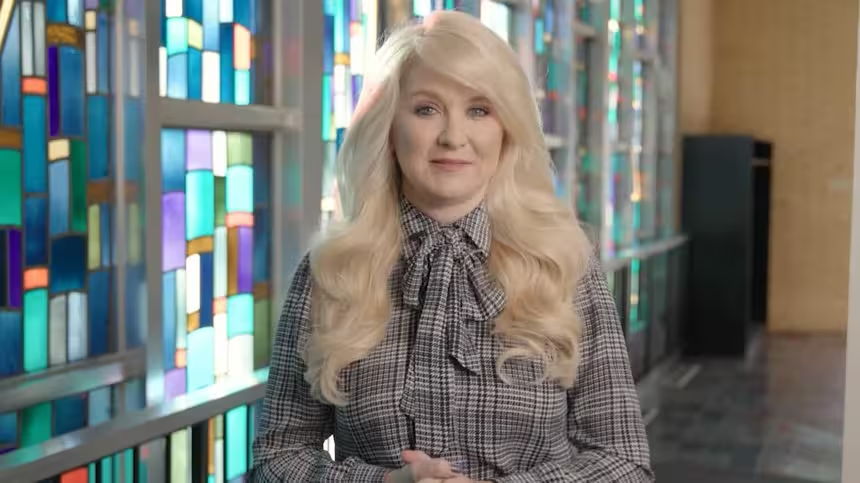
Ethan Neir brings us a story that highlights how pride month is being celebrated in Southern Illinois. Ethan also sits down and talks with Clare Killman, the first transperson elected to a city council position in the state of Illinois.
Problems playing video? | Closed Captioning Feedback
Problems playing video? | Closed Captioning Feedback
InFocus is a local public television program presented by WSIU
Support provided by:

InFocus - Pride Month 2024
6/28/2024 | 26mVideo has Closed Captions
Ethan Neir brings us a story that highlights how pride month is being celebrated in Southern Illinois. Ethan also sits down and talks with Clare Killman, the first transperson elected to a city council position in the state of Illinois.
Problems playing video? | Closed Captioning Feedback
How to Watch InFocus
InFocus is available to stream on pbs.org and the free PBS App, available on iPhone, Apple TV, Android TV, Android smartphones, Amazon Fire TV, Amazon Fire Tablet, Roku, Samsung Smart TV, and Vizio.
InFocus
Join our award-winning team of reporters as we explore the major issues effecting the region and beyond, and meet the people and organizations hoping to make an impact. The series is produced in partnership with Julie Staley of the Staley Family Foundation and sponsored locally.Providing Support for PBS.org
Learn Moreabout PBS online sponsorship(upbeat music) (upbeat music continues) - [Narrator] As the summer stretches on, we reach an important month for part of the Carbondale Community.
Pride Month.
It's a tradition that has existed in the United States since 1970.
And while the history of Pride is one built on a conflict for rights, the modern day pride is much more of a celebration of what it means to be a queer person and queer culture.
But what does Pride Month mean for the Carbondale community?
- Just getting to be yourself.
You know, this is a place where everyone can come and just do, like, just be happy.
And that's all that matters, you know, just being happy and living your life and enjoying it.
- Pride means people respect inclusiveness, dignity, and equality for sure.
- It just means acceptance.
It means not being afraid of being who you are.
It's just acceptance, love, and a good time.
- [Narrator] But pride isn't just a parade once a year, it's a constant struggle for rights and equity.
We had the chance to sit down with Juniper Oxford, the program coordinator for the LGBTQ Resource Center on SAU's campus to talk about how the campus is helping its students.
- The LGBTQ Resource Center is a place for, well, I always say the resource part of the title is in bold 'cause what we do is we connect the students and our staff and faculty to resources that are kind of, you know, disparate and across the campus and also in town as well so... - [Narrator] And centers like the LGBTQ Resource Center serve an important role in helping a large group of students.
- If you look at any of our, you know, surveys that we've had on campus, I'm thinking in particular our campus climate survey.
We're seeing very large parts of our student population who are LGBTQIA+, I think it's something like a fourth.
- [Narrator] Juniper also made it clear how important it is to bring equity to areas like Southern Illinois.
- You know, a lot has changed nationally over the last two years.
I was very interested in seeing how, you know, I could bring more inclusion back to this area and work with all of those different wonderful organizations that have cropped up right here in Carbondale.
- [Narrator] But the resource center isn't just there for the students.
They also aid in the training of teachers and other staff.
- We do a two hour training.
Once you receive that, you get a placard that hangs on your door indicating that your office has been properly trained and is a safe space for LGBTQI+ students.
- [Narrator] Like how the training operates all year round.
So does recognition for different members of the LGBTQ community with the most recognized being Pride Month in the month of June.
- The month is, it's very, very important to our community.
And I would say, you know, of course we have all these days where it's lesbian visibility day and trans day visibility, but it certainly is the month out of the year in which our community is most visible.
You see that in stores, you see that in commercials.
You see that in, you know, a lot of corporations and companies, you know, courting that sort of support and I should say less cynically showing their support for the community as well.
And so I think Pride month is a tremendous, tremendous time.
And the excitement in the air whenever you see the communities and organizations coming together to create some really, really beautiful programs and events.
I'm teaming with excitement just thinking about it.
- [Narrator] Pride is a continual struggle for rights as studies from the Illinois Criminal Justice Information Authority show that people were 25% more likely to experience any crime than their straight counterparts.
With more than 90% of those crimes being violent ones.
And with the national culture surrounding pride shifting, now more than ever, pride events are vital.
- [All] We're here, we're here get used to it.
We're here, we're here get used to it.
We're here, we're here get used to it.
We're here.
(upbeat music) (upbeat music continues) (upbeat music continues) - Thank you for tuning into InFocus, I'm your host Ethan Neir.
The month of June means that it is Pride Month in Carbondale.
And today we have the pleasure of sitting down with Clare Kilman.
Now Clare is the first transgender person to be elected to a city council position in the state of Illinois.
Clare, thank you so much for taking the time to sit down with me today.
- Thank you for having me.
- Now, Clare, obviously a historic election for you and for the entire LGBT community.
What was that experience like for you?
- Quite overwhelming, unexpected upon my election.
I didn't know that I was the first trans person ever elected to a city council in the state of Illinois.
So it came as quite the surprise.
But, I'm happy to pave that way.
- Awesome.
And obviously coming out as trans and figuring out one's identity can be incredibly difficult.
What was that journey of self-discovery like for you?
- Carbondale was a unique and incredibly important part of that for me.
It gave me the space to self integrate and self-actualize and really incubate my sense of being, and I'm still in a process of becoming myself.
And so Carbondale's been a very safe space for me to be able to do that.
Although, I will say I've always had a strong sense of self and a deep sort of understanding.
There's been a deeper reflective sense of knowing myself.
- Yeah, obviously, you know, Carbondale acting is kind of a democratic hub for the rest of Southern Illinois, obviously I'm sure it was a much safer environment versus other places in the area that you could have been.
- Certainly.
- Yeah.
And now being such a public queer figure can come with a lot of harassment, I'm sure.
Have you faced any since being appointed to the city council?
- Some.
So I'll say much more positive encounter, much more shows of overwhelming love and support for my community and people who follow what I do.
I am very blessed to have a lot of wind in my sails despite whatever else is percolating out there that isn't particularly pleased with my holding an elected position.
Week two, after getting elected, I received my first strange email where someone was referring to me as a branch on the tree of life that necessarily must be brewed quite strange.
- Interesting.
And it never really subsided though after the coincidence of Trans Day of Visibility and Easter this year.
- [Ethan] Oh.
- There was a resurgence through no fault of my own or any other individuals, just that they coincided made trans people, particularly public facing ones more of a target.
- I saw many a joke on Twitter and other social medias about it being two different kinds of egg day that day.
Now, in addition to being a councilwoman, you have worked on different political campaigns.
So what initially got you into politics?
- I think I've always been a person who felt a deep sense of political responsibility.
That there are no apolitical choices even the lack of choice is in and of itself something that carries political consequence.
And so I grew up in a very political household, one where philanthropic endeavor and giving back and humanitarianism as a set of values was highly prized.
And so it was deeply ingrained that service above myself and adopting a cheerful heart of service was a modus operandi that I was set on the path toward.
And coming to Carbondale, it's very open space for experimentation with a variety of political philosophies and activations.
And so I got very active in grassroots organizing here before becoming tangentially affiliated with progressive schools of thought here.
And eventually that led me to running mainstream political campaigns.
I think by the time I was 24, I was on the executive committee to a US congressional campaign for Illinois's 12th District.
- Wow, I mean, that's very impressive in a very short amount of time.
Now, has being a minority, you know, not only being transgender but also being a woman made your work in politics more difficult.
- No, no, not even one iota.
- [Ethan] Really?
- There's not been a roadblock I couldn't overcome by my own merit and the help of others.
I think oftentimes there's the idea that because I'm in a minority, that I am less powerful or more of a victim.
But I think that that reconstitutes a sort of narrative and framework that isn't helpful.
And one I certainly don't see played out within the course of my own life.
I've been empowered to make all sorts of choices for myself with a whole range of agency.
And I've never felt that the way that I show up in the world has inhibited my progress or success in any way.
- Awesome.
You touched on this a little bit, but in your time in Carbondale now as a student and now as a council member, has the perceptions and feelings about LGBTQ peoples changed?
- In Carbondale or more broadly?
- I would say in Carbondale, but also I know that there has been a lot of change in feeling very recently nationally, so we can touch on both of them.
- Sure from a national perspective, I wrote about this in a textbook with a couple of professors from San Jose State and the way in which we receive and intuit new information specifically through media and journalism, but more broadly as sort of a sociological stimulus.
There's a sense of novelty associated with things that are new.
And then once those become adopted into the mainstream through various pushes around people who occupy those sort of fringe and more marginal spaces, you have a subsequent dialectical reaction to it.
And so the pendulum is always in swing.
And right now we're experiencing these very reactive elements within American politics that are causing a sort of political balkanization here.
Where we are now as LGBTQ individuals forced to assume that borders that had long since been taken for granted as open are now defacto closed inside of the United States.
And for the first time in a 100, 200 give or take years, we're seeing mass exchange of bodies along state lines around people's basic human rights and their own bodily autonomy.
It's very disconcerting on my end.
So things certainly have changed in the sense that all of the pernicious, tumultuous, turbulent energy has now been brought more to conscious awareness in the surface, at least as the national politic is concerned, Carbondale remains unchanged.
And if anything has deepened, entrenched, and broadened its scope of values around being progressive, being open to people from all walks of life and maintaining a sense of safety and dignity for people in the LGBTQ community specifically becoming a beacon more so than it was when I first came here.
And it certainly was that by really rising to the occasion and meeting the needs of people regionally who are seeking a better life for themselves.
- Yeah, I mean we've heard many a story about different crew people having to, you know, uproot their lives, leave their homes because of the new legislation that's been passed in southern states.
And as more and more of those anti anti-LGBTQ laws get passed inside states, it seems to, as you kind of put it, be as hard as ever to simply exist as a queer person in public spaces.
So how do we make sure that people of all walks of life are feeling safe in our community.
- Invite them here from other places.
And, this transcends anyone specific identity, but I've always had the idea, and this is a lot of what my own political philosophy filters through as I craft it, someone who's involved in our local government is that I would love Carbondale to be the sort of place where anyone can come to, regardless of their circumstance, regardless of what they have or have to offer, and they can see a future worth living for themselves here.
And building Carbondale up in such a way that people can come here with maybe simply what they can carry, maybe what they can fit into their vehicle as the world grows more dangerous along a number of axes, that's the way forward that we can make ourselves craft ourselves into a space where anyone can feel loved, welcomed and accepted here.
- Setting up Carbondale is sort of this light on the hill for the rest of the Southern Illinois and other southern regions.
- Culturally speaking for sure.
- And now in addition to being a councilwoman, you also do some work for some nonprofits, including the golden rainbows of Illinois South.
So what is your role like there?
- I'm the secretary of our board on Golden Rainbows and I enjoy the work that we do.
We provide community connection and oftentimes services to aging members of the LGBTQ community.
And what better way to bring my own origin story here full circle than to give back elders that have shepherded me through so many important periods of my life here.
- Acting as sort of a example setter for other young people that are in the area and sort of lending that assistance that you got is amazing.
And now as you have broken the glass ceiling so to speak, what advice would you give to other members of the LGBTQ community that would like to follow in your footsteps?
- Hmm.
If I can do it, certainly anyone can.
There's nothing particularly special about me, aside from the fact that the only thing that qualifies me to govern is the will of my people.
And so it has nothing to do with me being transgender.
It has nothing to do with me being a woman and everything to do with my ability to inspire the confidence of my public.
And so that is a process many years in the making.
If you are intent on running for office, my advice would be to go about deeply setting down roots, showing your community a lot of love, opening yourself up to their ideas and their creative energy.
That this is the way that we are able to create positive feedback loops in a community that ultimately put you in a position to be qualified to run for office at the behest of a community.
- So very much ingraining yourself in a community to become a a part of it in a way.
So, you're just like any other member of the community at that point.
And we've sort of touched on this already, but how vital is pride in more southern and rural areas like the areas surrounding Southern Illinois?
- So often there's an adage in our community that pride started as a riot and that is routinely refrained over and over again throughout pride, celebrations, pride in its modern iteration is usually not such a thing, at least as it's conceived of in the United States and in safer states at that.
And so it is a celebration often to my mind, it should be geared toward newly minted or, you know, younger adults, that these are the individuals for whom pride is most valuable as they are seeking and accepting community.
And that it can be a deeply affirming experience to know that you're not wrong.
I think there's this misconception, particularly within right wing schools of thought that the sort of pride that is being displayed is a sort of biblical one where it go with before the fall and that we are in some way saying that are better than others.
When I think when you're faced with people who are telling you that what you're doing is bad criminal and offense to God, abominable, that all pride ostensibly is for the purposes of this discussion.
And is a practice of communal behavior, that it's simply saying, I'm not wrong.
That what I am is not incorrect, that I exist and that it is okay for me to exist.
- Now you were speaking sort of there to the misconception that can be held by right-wing communities and what pride means.
How do we sort of reach out to bridge that gap of understanding between right-wing communities like that?
- I can speak to my own ideas personally.
- [Ethan] Sure.
- I'm a rural American.
I grew up in one of the most conservative portions of a neighboring state of being Missouri.
And I come from a long political tradition of having a healthy and deep mistrust of federal and state governments.
And I hold those portions of my own political ideals near.
And so I think that there's always more in common than the macro level big picture partisan game wants us to think that there is, we are always much more aligned around shared systems of values because we all value very similar things.
When it gets right down to one-on-one interpersonal communication, we all want to have dignified employment, to put a roof over our heads and to take care of our children.
Basically those are the building blocks of any community and any way of life.
And so we all want to the best of our ability to secure those for ourselves and our neighbors.
And so if there's something I think that like we all share, it's that there are means developing a language devoid of political dog whistles is an important component of this.
But being able to translate those sorts of concepts into something that everyone can hear.
- Yeah, I mean frankly it seems, it's like it's getting harder and harder to even hold a conversation without the dog mode of politics constantly popping up.
So you're saying to sort of look past the party divisiveness that has been ingrained in the country, find what brings us together more so and work on growing that is what can bring us together and break apart those walls.
- The only solution oriented approach.
- Yeah.
- And now as we are doing the Pride Month, what has Pride Month and other pride month initiatives meant to you personally?
- For me, it's a very busy time of year.
I'm often tasked with speaking a number of times at events and appearing.
And that is helpful I think, to my community.
And I'm able to display on the one hand how Carbondale specifically is safeguarding their sense of dignity, safety, and their ability to be themselves.
And so it can be a form of catharsis for me where things are coming full circle.
At this point, I'm quite exhausted and ready for the festivities to be over.
- Yeah.
- However, it's been quite a joyous Pride Month.
- No, yeah.
I mean personally I've seen you at the parade that took place on the 15th.
Unfortunately I didn't have the chance to see you speak 'cause I got a heat stroke and had to leave a little bit early.
Yeah.
But, I know you spoke at the event the previous week before that, so I can imagine every year that Pride month is just constantly a very, very busy event for you.
- Yes.
Learning to set clear boundaries and take time for myself not needing to linger around longer than I'm needed is very helpful.
- Now, we were talking a little bit about this before the set of the show, but the sort of undue burden that could be put on individuals like yourself.
Obviously you are a very public figure, so do you feel that at times minorities such as yourself are called on too much to speak and called to do too much?
- Yes.
I don't think I have trans issues or LGBTQIA queer issues figured out any more than anyone else.
I'm simply one person with a multiplicity of ideas and who am I to speak for or on behalf of my entire community?
Who am I to be the standard bearer for the sum total of trans opinion on a subject?
And oftentimes there's a tendency to defer to minority opinion as if it is all encompassing.
That to defer to someone who is more oppressed means that you'll get better, more accurate information about the means and mechanisms behind an underlying that oppressed state.
It robs me of meritoriously to see me as such on the one hand, but two, it produces nothing inherently of value.
I think there are many other reasons why I could and should be and am invited to speak, you know, my transness being certainly a component of that during this month.
But that oftentimes the media will latch onto me as a trans person, as a member of the LGBTQ community.
And it has an idea that is very reductive idea that I am going to be able to answer their questions better than anyone else.
And that is not necessarily the case.
- And you touched on it a little bit there, but the idea that, you know, calling on you because of your transness is reductive.
And is that something that media outlets need to kind of reevaluate when they are getting to people to speak on issues like this?
- Yes, I would say so.
It happens quite frequently and has happened since I was elected, before I was elected even.
And it takes away from my other accomplishments, the many other things that I am good at and bring to the table.
And also people rarely ask if that's something that I feel comfortable talking about.
- Yeah.
- It's never something that I seem to have any direct agency or control over, and that can be very frustrating for me.
- Is it almost that your experiences are assumed almost to be information for others, whether or not you are willing to give them up or not?
- Right, up for public consumption, which is part and parcel of being a public figure and putting myself into a public life.
However, you know, facets of my character must remain mine and mine alone.
- Yeah.
And as you just said there, you know, being a public figure allows almost, how would you put it?
The assumption that your personal life, everything about you is just up for open debate and discussion when you are a person just like anyone else allowed to your own private life, aside from the the glaring eyes of the public, so to speak.
- [Clare] Quite.
- Right?
Well, Clare, thank you so much.
My guest today has been Clare Kilman, the first transgender city council member in the state of Illinois.
Clare, thank you so much for your insightful answers.
I really do appreciate your time here today.
- Thank you for having me again.
- And for everyone here at WSIU, I'm Ethan Neir.
Thank you so much and goodnight.
(upbeat music) (upbeat music continues) (upbeat music continues) (upbeat music continues)

- News and Public Affairs

Top journalists deliver compelling original analysis of the hour's headlines.

- News and Public Affairs

FRONTLINE is investigative journalism that questions, explains and changes our world.












Support for PBS provided by:
InFocus is a local public television program presented by WSIU