
InFocus - Small Business Development Center at SIU
2/15/2024 | 26m 46sVideo has Closed Captions
InFocus - Small Business Development Center at SIU
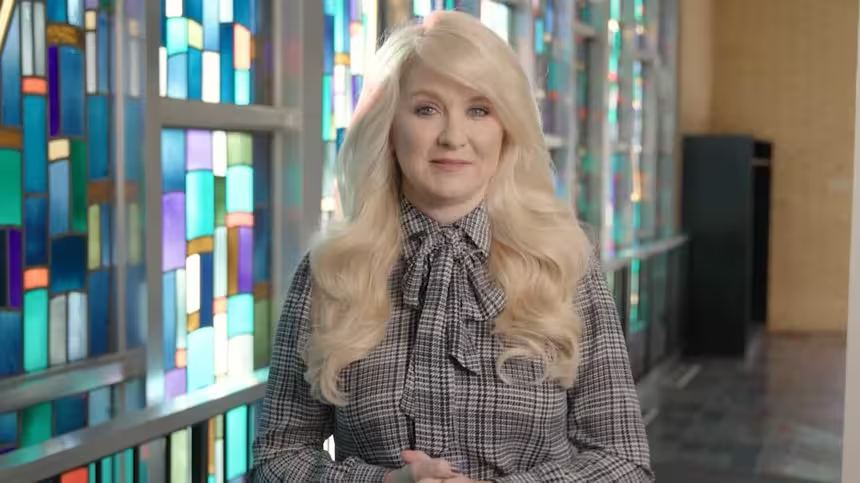
Learn more about the services available to help those interested in starting or expanding a business. Fred Martino talks with Melissa Ray Roach, Director of the Small Business Development Center at Southern Illinois University Carbondale. There are SBDC locations throughout Illinois and the nation, offering free services.
Problems playing video? | Closed Captioning Feedback
Problems playing video? | Closed Captioning Feedback
InFocus is a local public television program presented by WSIU
Support provided by:

InFocus - Small Business Development Center at SIU
2/15/2024 | 26m 46sVideo has Closed Captions
Learn more about the services available to help those interested in starting or expanding a business. Fred Martino talks with Melissa Ray Roach, Director of the Small Business Development Center at Southern Illinois University Carbondale. There are SBDC locations throughout Illinois and the nation, offering free services.
Problems playing video? | Closed Captioning Feedback
How to Watch InFocus
InFocus is available to stream on pbs.org and the free PBS App, available on iPhone, Apple TV, Android TV, Android smartphones, Amazon Fire TV, Amazon Fire Tablet, Roku, Samsung Smart TV, and Vizio.
InFocus
Join our award-winning team of reporters as we explore the major issues effecting the region and beyond, and meet the people and organizations hoping to make an impact. The series is produced in partnership with Julie Staley of the Staley Family Foundation and sponsored locally.Providing Support for PBS.org
Learn Moreabout PBS online sponsorship(melodious music) (upbeat music) - I'm Fred Martino.
InFocus this week, small business in Illinois.
It's a big issue and there's help to create or expand a small business.
We'll have more on that in a moment.
But first, some stats that highlight how important this is to economic development.
Take a look at the numbers.
Small businesses employ nearly 62 million Americans.
That's almost half of private sector employees.
How about job creation?
From 1995 to 2021, small businesses created 17.3 million net new jobs.
That's nearly 63% of net jobs created since 1995.
Finally, small businesses pay almost 40% of the private sector payroll.
So how do you start a small business?
Or expand?
There's help available.
Small business development centers do the job across the country, and there are many in Illinois, including one at Southern Illinois University Carbondale.
Today, I am very pleased to welcome Melissa Ray Roach.
She is the Director of the SBDC at the University.
Melissa, thank you so much for being with us today.
- Thank you so much for having me, Fred.
- Good to have you here.
I was amazed when I found those statistics from the U.S. Small Business Administration.
I knew small businesses were incredibly prevalent and important in our economy, but I had forgotten just how prevalent they were.
How important.
I wanna start with the basics of what you do at the Small Business Development Center in Carbondale, at the university, and your mission.
- Sure, Fred.
So the mission is one simple sentence that comes from us from the State of Illinois, and it's professional guidance for business growth.
That's one sentence that turns into a much larger picture, but we help businesses start, grow, and succeed through one-on-one advising that's confidential and no charge, and also workshops and education.
- And I'm very fortunate 'cause I've been to one of your workshops to see the work that goes into it.
It's incredibly impressive, the kind of training that is provided.
And I just got a taste of it, you know?
I mean, if you're starting a business or expanding a business, you get so much more.
Tell me about some of the key services that you offer to help support small businesses.
- And we really meet every entrepreneur in small business where they are.
So it starts with what they need.
It's general business advice, financial projection assistance.
If they're needing to go to a bank and apply for a loan, we help them develop business plans.
We also help with research, marketing, and just finding out really what it is that they need.
We help them look for pain points that they may be experiencing over and over and over.
Is there a system that you could implement that could help that pain point go away and ultimately make you more profitable?
- I was so fortunate because of our partnership together, that I've already done, on another program at this very place we're sitting right now, an interview with one of your clients, one of the gentlemen who benefited from your services.
A lot of people will be surprised to find out that in general, these services are free, right?
- Yep, our services are no cost.
So our funding comes from the Small Business Administration as well as the Illinois DCEO and SIU.
So no cost services.
That's part of our mission.
- Yeah, so very important for people to know because that is of course, one of the barriers if you're thinking about starting a small business or even expanding.
If you were to hire someone to try to help you do a business plan or some other research that you needed, that could get very expensive.
What would you say are the most important questions to ask yourself if you're thinking about starting a small business?
- I would start with why you want to do it.
You know, I think that's very important because a lot of people have great ideas, but it goes beyond just the idea.
So if it's, "I just don't wanna work for someone else anymore," and it's just that, or, "I wanna have an easier life," it's not always easier, right?
So understanding your why, and then how much time can you commit to this?
Because maybe it's not a full-time position, maybe this is a side hustle that you wanna do, which can also be incremental revenue for you and your family.
So we have a lot of businesses that do this on the side.
It's not a full-time thing.
So what's the amount of time and why do you wanna do it?
Those are two great questions to start with.
- Looking at the why.
One, it reminds me of one of the things that I always tell students, 'cause I also advise students and I teach occasionally, particularly students who want to get into this field, into broadcasting.
I always tell them, you know, this is not something...
If you wanna get into this, if you wanna get into broadcasting, it's not something that you like, this better be something that you love.
Because there are weekends, there are nights, there are a lot of moves sometimes involved.
I mean, I've moved all over the country in my career.
And I think the same might apply with starting a business, right?
That if you don't love it, it's probably not something that you want to think about.
- Yes, it can be very time-consuming, depending on what you're doing.
And if you love it, that it makes it seem a lot less like work, right?
Because ultimately, even if you don't have a boss or someone you report to, you do, you have your customers, you have the bank, you have stakeholders, various stakeholders that you report to.
So those are great questions to definitely start with.
- Yeah, I often hear and see advice from professionals.
I'm so glad that you already mentioned, starting a business, that it may not be your sole source of income.
It may be a, you could use the term, I think, side hustle.
It may be a part-time job.
It may be a supplement.
And I've seen advice that says that's a good way to start, and sometimes those do develop into a full-time job, but you have to start somewhere.
- Correct.
And if you do financial projections that show what is the market?
At what point could I maybe ease into this full-time?
It makes it much more likely that you're going to succeed if you know what the market is and what the potential is rather than just jumping off the cliff.
- This gets to kind of one of the other questions that I wondered about when I knew that you would be joining us on this show.
Tell us how the SBDC tailors its services based on the needs of the client.
- Sure, so we cover a six county area.
So not only do we meet people where they are geographically, we go out into the community and meet them there to find out what they need.
Every business owner is different, so we really find out where they are, get to know them, see what their needs are, and the services are customized for each one.
There are some similarities in what we do offer, but one person may learn differently than another.
So making sure that we are giving information in a way that they're going to be able to receive it, and then also going at their pace.
And a lot of times, people just need an accountability partner and helping them stay on track, but just making sure that we fully understand what the client needs and then helping them by giving them those resources.
- I mentioned to you that I've already had on a different show, one of your clients who started a business, and what a great interview that was because he had so much enthusiasm, he was so excited, and he couldn't say enough about the help that he got from the SBDC, that he wouldn't have been able to do this without that help.
I know this is a hard question, but share with me some stories that come to mind of small businesses that have benefited from your services.
Some examples.
- Sure.
Our services are confidential, but we do have clients that sign releases so we're able to talk about specifics, and you can see testimonials on our website that has more specifics.
But some of my favorite moments are when you see the light bulb go off, and they get it, you know, and you can take a product where you were losing money before, and you understand now, something as simple as, I need to charge for the container it goes in, and the straw, and all of the additional items to now make something more profitable.
And then to see that in action, and then they come back and they're so excited to show that sales have gone up.
It's really just rewarding to see that.
Or clients that have been with the SBDC for years, and you can see the trajectory, they'll talk about that.
"When I started here, I didn't have a business plan.
Now not only do I have a business plan, I have an operating business and we're growing.
Now we need to hire more people."
So it's a journey, and every client has the opportunity to stay with us for as long as they'd like, for the lifetime of their business.
There's no limit to the amount of hours that you're going to get with us, or it's just a business plan and then you're done.
- So, I mean, as we're doing this, this conversation in 2024, you've been with the SBDC at SIU for about a year.
In that time, is there any particular client that has allowed you to use their name or a description of their business that just comes to mind?
I mean, when you think about the success stories, somebody in particular, or some type of business in particular.
- Yeah, there's 17th Street Barbecue.
And we helped them when they were expanding with their business plan.
And Amy Mills, the owner of that is on our advisory board and is still in contact with us.
- And was that the expansion that went from having a restaurant to then having the bottling of the barbecue sauce, and the marketing of it online, and selling it and...?
- Correct.
And then clients that are small businesses like The JAY Effect with Yemisi Anderson, she's also one of our part-time advisors, but is also an SBDC client.
And watching her sales double this past year, and the excitement that she sees.
So small scale to large scale operations, and the success, and the excitement, and passion that these entrepreneurs have, it's so rewarding to be a part of their journey.
- I can't imagine how exciting it must be because, I mean, I chose a career in broadcasting as opposed to starting my own business.
But when I think about one of the most amazing experiences I had growing up in my K-12 education, I always remember junior achievement, and we had to start a business, and I remember organizing that and doing that, creating a product, selling the product.
It is an incredible feeling of achievement.
And to be able to give people the tools to do that, foster that learning and then see an exact business actually created or expand as a result, has to be incredibly rewarding.
We all know that a big part of this involves marketing and promoting a small business.
Tell me about how you help in that regard.
- Sure, so we have multiple advisors and one of our advisors has over 20 years of marketing experience.
And so it really depends on the individual, like I said.
- [Frank] And the business.
- And the business, and where they are and what they need.
So from basics of how do I create an event on Facebook?
Or how do I get my business to show up on Google?
To more advanced clients who need a marketing plan, and they've got sales that are coming in.
But what are you measuring?
What's working?
How much are you spending on marketing?
How much should you be spending based upon your industry?
And so helping put together marketing plans, and looking at analytics, and really understanding what's working, as well as market research to help with that marketing plan.
But marketing's huge, you know, sales are directly related to marketing, so the better your marketing is, the better your top numbers are gonna be.
- Most people watching this show will think in terms of marketing, will think immediately about advertising.
But one of the things that's exploded in recent years that I think is so important and so valuable and you see it so much more often now, is that businesses will do surveys.
I mean, I answer a lot of these when I get emails, particularly for businesses where I will patronize the business regularly, because I want them to improve, I want them to know, here's what you're doing right, here's what you're not maybe doing so well.
And I'm wondering, are more people asking you for help with something that has always been important, which is customer service, with the so-called soft skills of making sure that employees understand that you want every customer to feel valued?
- Yes.
Customer service is huge.
Hospitality, right?
How do people feel when they leave your business?
Not every client asks about it, but it is something that we do focus on with some of our clients.
And we also are working on some educational opportunities around that as well, especially when you look at the opportunities for tourism and the revenue that that brings into our region here in Southern Illinois.
So those things go hand-in-hand.
The best marketing is word-of-mouth and what people are saying about you after an experience with your business.
So it's a major, major part of just the plan, for sure.
- I think about that a lot because when I think about the businesses that I regularly visit, in addition to the fact that I use their product or their service, I think about how they make me feel.
And when the customer service is good, you feel good.
You feel good about helping that business.
- Right.
Absolutely.
So the great thing about our center is all of our advisors have either owned businesses, they currently do, and have different expertise, and customer services is one of the things that I've been involved in my entire career, so that's one of the things that I like to focus on with clients.
And those touch points from the first time that they come into your business till the minute that they leave.
And then how are you staying in touch with them, right?
So these are the kind of conversations that we have with the clients who are ready for that.
- And it really matters.
Well, the business environment is always changing.
Tell us how the SBDC stays updated on how things are changing, the current challenges and trends.
- Sure, so all of our advisors are certified through the State of Illinois.
And then we have 40 hours of professional development every single year.
And then we also do weekly center-to-center calls.
So we have good connection within the center to stay up to date on what is the center up north doing that's different from what we're doing.
So we have the ability to attend workshops for somebody who might have expertise in international trade or grant writing, those types of things.
So we have a tight network throughout the whole state, and then we also have monthly connection calls, and then conferences that we attend.
So there's a lot of educational opportunities out there for us.
- I know that you're also very in touch, because you are working with other organizations and local communities.
Tell me about that.
- That's a huge part of our success and getting the word out.
So economic development groups, municipalities, chambers of commerce, banks, accountants, insurance agents, attorneys, all of those people are wanting the region to be successful, they want businesses to be successful.
So that ecosystem is huge and it's something that we're constantly developing.
The great thing about our center at SIU, the center's been there since 1985, so it has a very strong foundation, and that ecosystem, it's there.
We get support all the time.
You never make a phone call and say, "No, I'm not interested in helping small businesses grow."
That just doesn't happen.
- Yeah.
Yeah.
It seems like technology is more and more important.
What role does it play in your efforts to support small businesses?
- Technology's huge, especially since COVID, it really just amplified everything.
So for us, technology is in our database and systems, how do we become more efficient?
And that's the way that small businesses use it as well.
Everything is online or digital, and so helping businesses stay up-to-date with that kind of thing.
And then also, we offer the ability to be via Zoom, which so many people are doing now and utilizing, especially, like I said, since COVID.
And then making sure that our clients know how to utilize those platforms.
Even when you look at accounting platforms, it's technology.
- Yeah.
Technology helps us do our job better.
It also is critical to that marketing piece that we just talked about.
You know, my last position, I was so grateful and fortunate that I helped reinvent a local media organization.
And as part of that, a big part of that, when I first arrived, was the digital transformation.
We talk about the website is the front door to the organization, also the front door to the business, right?
- Right.
And I remember in the nineties, I started my career in television advertising.
It was, is a website really gonna be needed?
You know?
And that's just so funny.
Absolutely it's needed.
- Yeah, that's how people find you and find out about what you do.
We're hearing a lot about AI, artificial intelligence.
I had a chance, and I was so glad I did, to see a presentation at your SBDC about AI.
Give us an idea of how important this is becoming.
I mean, we have no idea in the future, but even right now, how important this is becoming.
- It's so important, it's one of the hottest topics out there, and we're just scratching the surface.
I think it's similar to what I just said with is a website going to be important, right?
It's that kind of turning point.
- It is.
- And it's not just about the language generators like Chat GPT or Google Bard, but starting there as a small business is a great way to kind of dip your toe in the water, and we can help with starting to wrap your mind around how to utilize those tools to become more efficient.
Just the basics.
But artificial intelligence is huge, and like you said, we don't know, we can't even imagine what that's going to be in the future, but we don't want people to be left behind.
So starting where you are.
- Part of why I was so excited that you were coming today and that we have a partnership and hopefully we'll do more and more programs about creating and expanding businesses, talking with your folks and talking with business owners or entrepreneurs, is this is a topic where, as you say, we've only just begun.
And I just saw a story on television about how it's already so advanced, AI, that they have a variety of companies around the country using a platform where there are AI-created voices answering phone calls, and they actually say, "Mmm," and "Ah."
I mean, it sounds just like a person.
These are not ones that sound like computers.
They sound like people.
And it actually gives more capacity to the business because that automated phone answerer can take care of a lot of the calls that are routine.
Like, somebody needs to have their password reset or they need this or that, it's very straightforward.
And then if they do need to get to a real person, it can quickly transfer them to the right real person.
So that's just one example that businesses, I'm sure more businesses will be using.
- Exactly.
And you can make it be any voice that you'd like it to be.
Even your own voice, right?
So those kind of things.
It's about efficiency and making things faster.
The more efficient you are, the more profitable you are, right?
If you do it well.
- If someone is watching this right now, they are interested in maybe starting a business or expanding their business, how did they access the resources that you offer?
- The website for our center is sbdc.siu.edu, or you can also call, which is 618-536-2424.
But if you're not in our coverage area, if you just Google SBDC, there's over 1,000 centers in the nation.
So SBDCs are everywhere.
- Yeah, and I think before we sat down today, I Googled SBDC at SIU and it was like one of the top results.
So it was easy to find the website, lots of information.
And as I said, I mean, I cannot say enough about the services that you offer.
I spent the better part of a day, and AI was just one of the topics that I saw at that day-long seminar.
There were all sorts of experts talking about many different topics that are important.
So I assume that's also, if you go to the website, you can see when is the next kind of in-person seminar and how to sign up.
- That's correct, that you can go to the website, you can sign up in the middle of the night for our no-cost services and see our workshops.
You can sign up to attend workshops 24/7.
We also have online workshops that are available all the time on starting your business in Illinois.
- So self-directed things that you can do on your own time too.
- [Melissa] That's correct.
- That is amazing.
Well, best of luck to you as you continue to help folks with this topic.
It is so important.
And I appreciate so much that you were able to join us today.
- I appreciate so much you asking us to come over and look forward to a continued relationship, and appreciate everything that you do.
So thank you.
- Thank you very much, Melissa.
My guest was Melissa Ray Roach, Director of the Small Business Development Center at Southern Illinois University Carbondale.
Thank you for being here for all of us at WSIU.
I'm Fred Martino.
Have a great week.
(upbeat music) (upbeat music continues) (upbeat music continues) (upbeat music continues) (upbeat music continues)

- News and Public Affairs

Top journalists deliver compelling original analysis of the hour's headlines.

- News and Public Affairs

FRONTLINE is investigative journalism that questions, explains and changes our world.












Support for PBS provided by:
InFocus is a local public television program presented by WSIU