
InFocus - The Idea of Democracy
9/15/2024 | 26m 24sVideo has Closed Captions
InFocus - The Idea of Democracy
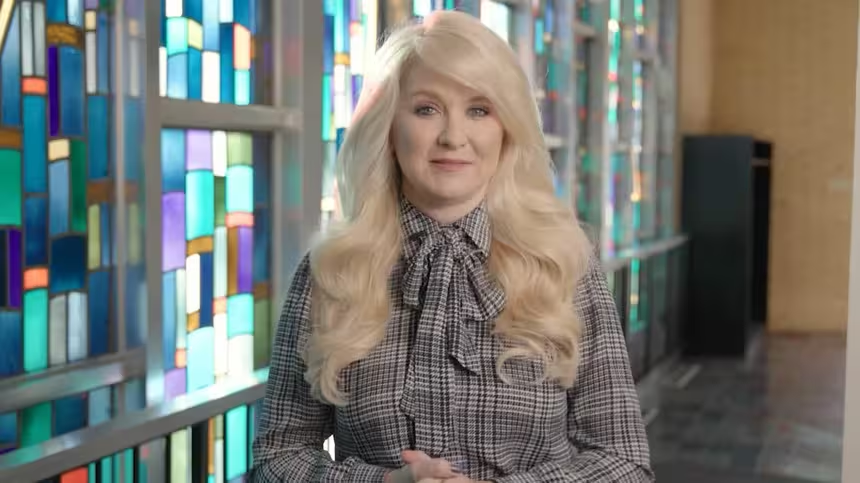
Fred Martino talks with Carolyn Deane of Artspace 304 and Kay Rippelmeyer from the Jackson County Historical Society.
Problems playing video? | Closed Captioning Feedback
Problems playing video? | Closed Captioning Feedback
InFocus is a local public television program presented by WSIU
Support provided by:

InFocus - The Idea of Democracy
9/15/2024 | 26m 24sVideo has Closed Captions
Fred Martino talks with Carolyn Deane of Artspace 304 and Kay Rippelmeyer from the Jackson County Historical Society.
Problems playing video? | Closed Captioning Feedback
How to Watch InFocus
InFocus is available to stream on pbs.org and the free PBS App, available on iPhone, Apple TV, Android TV, Android smartphones, Amazon Fire TV, Amazon Fire Tablet, Roku, Samsung Smart TV, and Vizio.
InFocus
Join our award-winning team of reporters as we explore the major issues effecting the region and beyond, and meet the people and organizations hoping to make an impact. The series is produced in partnership with Julie Staley of the Staley Family Foundation and sponsored locally.Providing Support for PBS.org
Learn Moreabout PBS online sponsorship(gentle music) (upbeat music) - Thanks for joining us.
I'm Fred Martino.
In focus today, the idea of democracy.
During this historic election, we are going to learn more about the history of democracy, and we'll preview a free event.
Artspace 304 is hosting a discussion on Sunday, September 22nd at 2:00 PM at the Murphysboro Event Center, "The Idea of Democracy in Southern Illinois, from 1700 to the Present" features 10 of our region's most distinguished historians.
They will share the important and very relevant history about how the idea of democracy evolved through our region, from the 1700s until today.
The event is free, but requires online registration.
You can find the link at artspace304.org.
I'm very pleased to welcome from Artspace 304, Carolyn Deane, and a speaker at the event, Kay Rippelmeyer, she is from the Jackson County Historical Society.
Thank you both for being with us today.
- Thanks for having us.
- It is so good to have you here.
This is a really interesting event, an important idea to talk about, the idea of democracy.
Carolyn, to start off with, tell me how this idea came about during this very historic election season.
- It grew organically.
Illinois Humanities asked Artspace 304, about a year ago, to pull together a group of people who work in the humanities, who are involved in the humanities, from Union and Jackson counties.
Their interest is in supporting rural economies, rural humanities, rural arts, with the idea of strengthening and enriching the lives of people within rural Illinois.
And they've been wonderful as a supporter.
So, what we did was we convened a group which included historians, videographers, librarians, poets, artists.
We also got people from social service organizations who represented different, sometimes marginalized communities.
We tried as much as we could to get a wide range of people, and were successful and started monthly conversations.
And because we were somewhat spread out, we also, we started on Zoom, and we just talked about what was of interest to us, starting initially thinking there wasn't that much that brought us together, but let's see.
And what we discovered was we had a ton of projects and events that we were all interested in, and we shared them across the different groups.
And gradually, as we came to know one another, Illinois Humanities said, "Take this one step further and start looking for a project that you would do together that would bring all of your disciplines together."
Great idea.
But what we ended up finding was that we kept coming back to this concept of democracy.
It's so prevalent over the last year in everybody's mind, both personally and also organizationally.
But how do you take something like democracy without turning it partisan?
So, what we did was we stripped it back and came up with two questions.
Who belongs, and who decides who belongs?
So those two questions started to really be meaningful to us, and we realized that that was something we could build a program around.
Democracy was still part of it, but by putting that focus on the concept of who belongs and who decides who belongs, like, what is the power structure, basically, we found that we were able to make sense out of it.
And I will give all credit to Kay.
This is her brainchild.
We had a lot of different ideas, many of which were simpler and would've been easier to pull off, but this was the one that captured everybody's imagination.
And honestly, also, kudos to Illinois Humanities, because even though this was much bigger than any of us thought we would move forward with, they stepped up to the plate and said, "Well, we wanna support that.
That's important.
That could really be meaningful."
And it's taking these ideas and these important things and saying, moving them out to a community in a meaningful way, that will hopefully stimulate great discussions and thoughtful reflections.
So, that's how it all got started, and culminating in about a week from now.
- Yeah, yeah, we're taping this a little over a week early, but I'm glad you said that, because we wanna encourage people that if they want to participate, you have to register, it's free, but you have to register, so you wanna register right after you watch this show.
- As soon as possible.
- Because about half the registrations have been taken up.
You have 200 people, up to 200 people that you can register.
That's exciting to me.
- We're excited.
- To hear that there's already a great response to this even before this show.
So, it's fabulous.
- it's capturing people's imaginations, yes.
- It is, and it's important.
Kay, as a member of the Jackson County Historical Society, someone who appreciates history, the importance of understanding history, tell me your thoughts first on the historic nature of this election.
- Well, I volunteered with the Historical Society in the '80s, and then I began doctorate work in history and philosophy, American culture.
So, it's a topic I'm very interested in.
And this election, it's so important because, honestly, we have nearly half the country that's scorning the idea of democracy.
And it's because they don't understand that it's an idea and it's actually an experiment, and it may not work.
It's often referred to by historians as an experiment.
You know, look, taking a long view, you live a long time, several generations, and you think, well, this is the way it's always going to be.
I mean, I think of that we're gonna discuss the French culture that came for three or four generations to this area, and they thought it was just gonna last like this, and pretty fast, the English came and took over.
So, the idea of democracy has got to be in the front of people's minds.
They have to understand that this is just one way people govern themselves.
And there have been threats to it.
There were huge threats in the '30s and '40s.
- And there are threats now.
- You bet.
- Lots of threats.
So this is so relevant, and I am so glad that you framed it in this way.
I've heard historians in other interviews framing it this way in many, many conversations, saying that we can't take democracy for granted.
We do, but we cannot.
So, is this kind of connected, Kay, to my next question, how you think the understanding of other periods in our history will help people understand the importance of democracy, the fragile nature of it, and the need for civic engagement, not just voting, but all civic engagement.
- Well, if you study history, which is what we're gonna get a load of in this symposium, what history allows you to do is compassionately imagine.
You put yourself, when you study history, you can't help it, you put yourself in the place of people who lived at other times under other circumstances.
So, we're going to be understanding what being a slave here in Southern Illinois was like, what being a slave catcher was about, what being a Kaskaskian Indian, hunted down, so that there were none left by 1840.
One historian said, "People here thought of it as if they were squirrel hunting."
So, we're going to try to put people's minds in each of these other spirits that have lived here.
And I like so much that it's just Jackson and Union County.
I taught writing for a long time.
And the rule is always be specific, be specific.
The more specificity you can get, the more imaginative you can be then.
And so we're just talking about Jackson and Union County and what happened here.
And Southern Illinois is so great.
All of United States history can be reflected in what happened in just these two counties.
- Yeah.
- And so that's what we're gonna do.
- That is so exciting.
- From 1700 on.
- And Carolyn, Artspace 304, where you work, is involved in so many different types of programs.
Many of your programs, though, have this commonality of sparking discussion and dialogue, sometimes during the event like this, sometimes after and before, and hopefully all three, right?
So, that's really at the very heart of this event.
Folks are gonna learn from Kay and other historians, but then they'll also talk with each other and hopefully be more civically engaged.
Give us a sense, and I know this is a big question, but why this is so important for our region, and really, for the entire country.
- Well, one of the things that...
I loved your concept of compassionate imagination.
I think the arts and humanities really provide us with an opportunity to find that common spark that goes beyond just an idea.
You're sitting there watching, as you mentioned, we have many different programs, watching a children's theater program, listening to music with other people.
And there's something that moves you.
Not just your ideas, but also your heart and your spirit.
And in that moment, you turn to your neighbor, and boom, there's your common humanity.
Somebody you've never met before.
That's one of the things that becomes possible when you have creative people who are sharing a perspective that's different from yours, but that the way in which they share it, it opens you up.
That's what we expect to happen in this series of talks.
These folks, these historians know their world so much that they will paint pictures of the world in ways that we couldn't ever possibly imagine, make it real for us.
And what that allows us to do then is to get beyond our own narrow perspective, where we are encouraged over and over and over again in this current day, to find out how that makes us different, and, you know, other, and that I am this and you are that.
And what this does is it opens us up and we start to understand, instead of the other, we start to understand this person or this group from their perspective, from the context of their lives, their worldview, their everything.
That's such a different thing.
Instead of this, we end up entering in, and there's a flow between us that allows us to hold onto some bigger images that might include, you know, our common good, might include helping each other, might include the concept of community.
And that kind of transformation, I think, is very possible with this.
And yes, it's just happening in little bits and bites, but we're making space for there to be some exchange, an extra half hour or so, for people to get to know who's there, you know, talk about what they learned.
It's very exciting.
Those sorts of things are great.
And our hope is that people will go forth and share their experience.
That is our hope.
- And the event is 2:00 to 5:00 PM on the 22nd of September.
Three hours.
But we're gonna get a little taste of the history during this conversation, because Kay has volunteered to do that for us.
So, two of the four eras that are gonna be covered at the event are the end of the Civil War and the lead up to World War II.
So let's start with the Civil War and how democracy evolved during that time in this region.
- Well, that era that's being covered is from...
It covers the Civil War and goes up to 1940.
The Civil War tore Southern Illinois apart.
Just tore it apart.
And we have two speakers coming who are fascinating.
One is Aaron Lisec, he's at Special Collections, and he's delved deep into the Civil War letters.
And he and I talk often about this.
What we've found in our research is that there were many people in Southern Illinois who did not wanna be in any way helping emancipation.
But letter after letter, and veterans' accounts later speak to how fighting that war, going to the south, seeing slavery, seeing the slaves getting away, coming to Carroll, to the refugee camp, changed them completely.
The title that he chose for his program is "Teach Them to Hate Slavery".
It was a quote from some of the letters.
So, that's just wonderful and interesting to be brought out.
The other speaker is Darrell Dexter, who's famous.
He's a school teacher.
He wrote a book called "Bondage in Egypt" about the whole history of slavery, from the French colonial time up to 1910.
Then he picked up and wrote another book about the Klan.
He'll be speaking about that in the last session.
So, he's got the most detailed data from records kept in courthouses about how much slavery was happening here before the Civil War, and then some after, you know, they tried to, even though it became illegal.
So, you'll learn a lot about slavery.
- Very interesting.
Now, let us move up to more recent times, but still a very long time ago, the lead up to World War II, and why that turning point was important in this discussion.
- Well, democracy was really suffering.
There were grave threats to it.
You know, Rachel Maddow is doing a program called "Ultra" on MSNBC, and she's got a podcast, and I didn't know about this, how rabid the fascist movement in this country was.
And it's very similar to what's going on.
The congressmen were in on it, connected to Hitler.
So, things were at a really threatening point in the '30s, and the economic situation was terrible.
World War II got people involved, and it was like forced democracy on 'em, and it was like, enough of that, because they went to war to fight for democracy, to help Europe, and it changed everything.
And then FDR's economic policy, he had a New Deal.
- Yeah.
- He wanted to put people to work.
- Yeah.
- He wanted people to understand that you can be part of this, this process, again.
- I'm so glad that we got to talk about this today, Kay, because as I was thinking about doing this show, I didn't know that you would frame the answer in that way, but I have been asked many, many times why I am wearing a Ukraine pin.
And I have never worn- - Thank you for doing it.
- A pin like that on television in over 30 years.
But I've been wearing it since Ukraine was attacked because I never imagined, ever imagined, in my entire life, that that would be the subject of any controversy, defending an ally, defending democracy, defending an ally who was attacked.
I never thought that would be a controversy.
- No, thought it was over.
- I never thought anything like January 6th would happen.
I remember covering it in my last position and thinking I was living through history that I never thought would happen in my lifetime.
I knew that it happened, things like that happened in the past, but I did not think such a thing would happen.
Carolyn, give me a sense, when you thought about this event and learning about this history, but also knowing that we're living through history, what that brought out in your thoughts about this event and what it could mean.
- That's a great question.
It takes it back and forth between the personal and the universal, which is such an important opportunity with this event.
Because on a very personal level, I hope people get inspired by history to learn, find that they love it, that there's something that is compelling about knowing where they live and the history that they are part of, either consciously or unconsciously.
I also think that it's really important for people to have an opportunity to understand that democracy is not set it and leave it.
It's fluid, it's vulnerable.
And if they are going to belong and be part of this, that there is a responsibility to own it and be a steward of it.
And also to acknowledge that there are people for whom democracy hasn't worked the way we've been practicing it here, and that there is a legacy where there were people who were excluded, and still people are feeling excluded.
How do we who, not only do we belong, but if we want to decide who belongs, how do we make sure that everyone feels they belong?
- Yeah.
And events like this are so powerful in doing that.
I was at a Carbondale event also receiving some sponsorship from the state earlier this year, and it was a presentation where you learned the history of Brown versus the Board of Education.
But then at your table afterwards, you sat down and learned the experiences of those around you, and reflected on the issues and how they are alive today, how they affect all of us and our communities and our country.
Kay, you know, as we said earlier, you are involved deeply in this, not only in your work with the Jackson County Historical Society, but what you've done in terms of your educational work over your life.
In addition to events like this, 'cause not everyone has a chance to go to an event like this, for a variety of reasons, how else do you think as a society we can have opportunities for people to better appreciate the importance of history?
- Well, I'm a big advocate and fan of place-based education, and I had learned a quote one time, you know, that big history is made up of local histories.
The Jackson County Historical Society is a perfect example.
There, out of many historical societies, you get an idea of the regional history.
Out of the regional history, then a national history could be written.
But the facts, the specifics, the people who felt different edicts that came down from the Supreme Court, you know, you can capture at the local level, reading local newspapers.
And it's a lot more fun, it's exciting, you know, not just to hear about what generals did on a war battlefield, but to get a soldier's view of what that felt like, who wrote home.
It's just, you know, brings it all alive, and it touches you.
- Yeah.
That's such a great point, that when we do something, it really helps with learning so much.
I agree with you on that.
And what we all want anyone to do watching this program, whether they go to the event or not, of course, is to vote.
This is essential for our system of government.
And, you know, there was a lot of celebration after the 2020 election because voter participation did increase, but still, even with the progress in 2020, only about two thirds of the voting eligible population turned out for the 2020 presidential election.
Only about two thirds.
So one third, one in three, did not participate.
A good way, in our last two minutes or so here, Carolyn, to say, how, you know, can events like this, the other things that we've talked about today, and even programs like this, encourage people to say, "Well, I haven't done it.
I can do it."
In Illinois, you can even do it on election day.
- That's true.
- If you forgot to register, we got same day registration.
- Yeah.
A lot of the barriers have been broken down.
The barriers are now within us if we're not voting.
And I believe that events like this provide a sense of community.
Just by being there, you are part of, you are claiming your part as one of the people who's interested in your region.
You're claiming your part that you belong.
I think social movements, we forget sometimes, social movements start with individuals who say, "This isn't right."
So, huge movements that bring about permanent and hopefully lasting change for the good start with individuals saying, "This matters to me."
And again, we come back to who belongs and who decides who belongs.
Stake your claim.
Vote.
You know, it's great and important to also take those steps of standing up for what you believe in, for showing up when somebody is in need, for having that compassion and kindness that is the smoothing essence of our society.
But we are a democracy, and voting matters.
- It matters.
- It matters, yeah.
- Carolyn, Kay, what an honor.
Thank you so much, both of you, for this event, and for talking with us today.
- Thank you so much.
On behalf of both Artspace 304 and also Illinois Humanities, we're delighted and honored to be a part of this.
Thank you.
- Thank you.
My guests, Carolyn Deane of Artspace 304, Kay Rippelmeyer of the Jackson County Historical Society.
Once again, here's the event information, "The Idea of Democracy in Southern Illinois, from 1700 to the Present", features 10 of our region's most distinguished historians, taking place Sunday, September 22nd, at 2:00 PM at the Murphysboro Events Center.
Registration required at artspace304.org.
For everyone at WSIU, I'm Fred Martino.
Thanks for being with us.
Have a great week.
(upbeat music) (upbeat music continues) (gentle music)

- News and Public Affairs

Top journalists deliver compelling original analysis of the hour's headlines.

- News and Public Affairs

FRONTLINE is investigative journalism that questions, explains and changes our world.












Support for PBS provided by:
InFocus is a local public television program presented by WSIU