Washington Grown
Inland Northwest Flavors
Season 13 Episode 1313 | 26m 46sVideo has Closed Captions
Northeast Washington and Spokane, where small farms and strong communities keep local ag thriving.
The team visits Northeast Washington and Spokane, where small farms and strong communities keep local agriculture thriving. At Casa Cano Farm, creativity and care bring fresh produce to the Inland Northwest, while the Ferry Conservation District connects people to the land through hands-on outdoor programs. We savor local flavors at Wild Sage Bistro and Madfire Kitchen & Catering.
Problems playing video? | Closed Captioning Feedback
Problems playing video? | Closed Captioning Feedback
Washington Grown is a local public television program presented by KSPS PBS
Washington Grown
Inland Northwest Flavors
Season 13 Episode 1313 | 26m 46sVideo has Closed Captions
The team visits Northeast Washington and Spokane, where small farms and strong communities keep local agriculture thriving. At Casa Cano Farm, creativity and care bring fresh produce to the Inland Northwest, while the Ferry Conservation District connects people to the land through hands-on outdoor programs. We savor local flavors at Wild Sage Bistro and Madfire Kitchen & Catering.
Problems playing video? | Closed Captioning Feedback
Where to Watch Washington Grown
Washington Grown is available to stream on pbs.org and the PBS app.
Providing Support for PBS.org
Learn Moreabout PBS online sponsorship- "Washington Grown" is made possible by funding from the Washington State Department of Agriculture and the USDA Specialty Crop Block Grant program, and by the Potato Farmers of Washington.
Learn why Washington is home to the world's most productive potato fields and farmers by visiting potatoes.com.
- Hi everyone, I'm Kristi Gorenson, and welcome to "Washington Grown."
For generations, people have relied on small farms to feed their communities.
And here in Washington, we have many of these small family operations that are putting in the work to bring food to your table.
Val's visiting CasaCano Farms.
- Oh yeah, this is great.
- Then Tomás is learning about a conservation district that's helping its local community.
- We do a lot of stuff with kids.
It's really important for them to get out here, learn about where food and livestock, everything kind of comes from.
- And I'm making a special dish from veggies right from the farm with the chef from Wild Sage in Spokane.
Gonna eat the rainbow today.
- We are going for the rainbow.
- That's what parents tell their kids, right?
Eat the rainbow.
- It's not candy.
- All this and more today on "Washington Grown."
[cheerful upbeat music] Cooking with Kristi.
Sweet Pete!
- Jiminy gee willickers.
- Watch my bangs.
Go big or go home.
- Ah, right in my eye.
You made me a believer.
[both laughing] Oh, I am making a mess.
- Oh, Val, I love you.
- Heaven on a plate.
That's yummy.
- We're gonna get a to-go cup for these?
- Yeah.
- You keep talking, I'll keep eating.
[bright music] - Right in the heart of downtown Spokane, there's a small brick building with quite the reputation with a bright and beautiful interior and plates that are just as eye catching, Wild Sage certainly is a treat.
- We've lived all over the country, and this is one of the best.
- It's a good balance of fine dining and casual with freshly sourced local ingredients.
- I try to create a platform where people can have memories to remember.
They might not know exactly what they ate, they might not know exactly who waited on them, but they know that they had a good time.
- Garth Hicks is the managing partner for Wild Sage.
They describe themselves as farm-to-table, which might explain the change of scenery today.
We are not at the restaurant, as you can see.
So tell me where we're at.
[laughs] - Right now we're just outside Spokane at CasaCano Farms, who's one of our main purveyors of vegetables that we've had a partnership with for a dozen years now.
They've been a really big part of our success.
Why do it at the restaurant if we can do it at the farm?
You know, it's- - I love that.
- It's kind of a cool spot.
- Why not?
- It's fresh.
It's locally sourced.
- The food is fantastic.
Service is great.
- It is fine dining, but still very relaxed.
It doesn't get better than that.
- From the farm, we get everything from tomatoes to greens to micro greens, to really fun plating stuff like, so like watermelon radishes.
And they'll just always come in like, "Hey, isn't this cool?"
And like we geek out with them, you know, it's like, "Yeah, that is really cool.
What are we gonna do with it?"
- Don't go anywhere because later in the show, executive chef Elijah and I are going to make a special dish made with vegetables harvested right from the farm.
And then the nasturtium leaves, like on the outside.
- Oh, I probably do here.
- Okay.
[indistinct].
- I know.
[laughs] [Kristi laughing] [cheerful upbeat music] - Today I am in Valley Ford and I'm visiting CasaCano Farms.
Here, owners, Jorge Cano and Madyson Versteeg, grow a wide variety of crops and livestock on only a few acres of land.
- So we grow everything from like lettuce mix, tomatoes, kale.
We raise pork and then we raise grass-fed and finished beef as well.
So a big diversity.
That's been something we've done from the beginning.
And so we are able to feed like our garden scraps to our animals.
And then we're also able to compost manure.
- It makes sense because we are first generation farmers, so we didn't have any land or resources coming into this.
We have total control over what we're doing.
And we're direct marketing and retailing everything.
So I just feel insulated, I guess, from the like commodity pricing and bigger global issues.
- Madyson and Jorge explained that they accomplished all of this while only using hand tools, a choice they made early on after a lesson learned while still in college.
- We were able to start a farm as interns.
And the first year I rototilled everything with a big tractor and then that year flooded.
It was a hundred-year flood.
The top soil completely washed away right to where we tilled.
So from that moment on, both of us knew that we did not wanna be tilling, the disruption to the soil and then the chance for erosion and loss was just, is too much.
- The CSA program and relationships with restaurants in Spokane and even local school districts brings food from CasaCano Farms to be enjoyed by many in the area.
They have even built a farm store on their property that helps them to share their food and food produced by other small farms.
- We've added more products, so we've been working with more local farms.
So it started just with working with like our friends' farms and filling in where we didn't have something.
And then we've also expanded into like some organic grocery.
- We'll see a new product and try it and see if it sells and if other people like it.
It's been nice to fill the shelves in there, especially we're open year round and there's less produce here in the winter, so having more of that pantry staples has been helpful.
- Oh yeah, this is great.
Oh, it's so lovely.
What are you guys most proud about in the store?
- Just the space in general.
For the first six years of our business, this was like junk and storage.
[chuckles] So now we're be able to be open a lot more, leave stuff in the coolers.
It's just made everything really good.
And I think it helps showcase what we do and what other farms do here.
- This has been really great.
And I really wanna thank you.
- Yeah, thank you.
- And I think I'm gonna grab a cart and pick up a few things myself.
[laughs] - Republic can be found in the northeast corner of the state where there's a small but mighty team of people working to better the environment and the community at the same time.
That team is none other than the Ferry County Conservation District.
- The history of a conservation district goes back to the Dust Bowl.
- Dave Hendrick manages the Ferry Conservation District.
And it was obvious when I first met him that he and his team have so much passion for this work.
So I was excited to ask so much more.
What does a conservation district do?
- We have very few limits as far as what we can do, but generally, we work a lot with agricultural producers.
We work a lot with education and the schools, outreach and that sort of thing.
- In this area, agriculture typically means one thing, cattle.
- We're unique in the State of Washington in that we only have one agricultural commodity and that's livestock.
That's mostly due to our growing season, which is very short.
And as you can tell by the mountains around here, there is very little flat ground to farm.
And so all the farm ground grows forage for cattle to eat in the wintertime.
- One of the things the Conservation District does in this area is to help forage growers rejuvenate their soils naturally.
Because being this far north makes it very difficult to bring in other products.
- We're a long ways away from any supplier that supplies commercial fertilizer.
And so coming up with new techniques to enhance your soil, rebuild the chemistry naturally is very important.
- But that's not all they do.
- We do a lot of stuff with kids.
So they come out here and they do field trips.
- McKinsey works for the Ferry Conservation District as the outreach resource technician.
Although with their current team being as small as it is, everyone pitches in to help wherever and whenever they can.
- Republic is very resource-stricken and definitely high on the poverty line.
So I think it's really important for them to get out here, learn about where food and livestock, everything kind of comes from, and really getting the sense of why these things are so important, and how they could probably help themselves in the future.
- This is an opportunity to bring kids out here.
They can understand, you know, things about soil health.
We've done soil testing.
They get to, you know, get their hands dirty and do things like that.
That was the impetus for starting this out here.
- What does it feel like for you when you see those kids show up who maybe haven't experienced some of this stuff before?
- Oh, I love it.
Hearing them go, "Oh my goodness.
Whoa."
You know, I mean all the hoop and holler all that is, it just kind of makes all worthwhile.
- I love to hear your passion for working with the kids.
It's contagious and it's great.
So keep it up.
- Thank you.
[laughs] - Awesome.
[cheerful upbeat music] - What's the difference between hardneck garlic and softneck garlic?
We'll have the answer for you after the break.
- Coming up, I'm making a farm-to-table dish with the chef from Wild Sage in Spokane.
And then the nasturtium leaves like on the outside.
- Oh, I probably do.
- Okay, [indistinct].
- You know.
[laughs] - And Tomás is learning about the history of Northeast Washington.
- We can't talk history and relevance and importance without mentioning the Indigenous peoples that have been here.
So there is a lot of that history to be seen here.
[cheerful upbeat music] - The difference between hardneck garlic and softneck garlic is that hardneck garlic has a hard central stock and it produces garlic scapes, which you can eat.
They're delicious.
Softneck garlic has a soft central stock and they store longer.
- We're back at Wild Sage bistro in Spokane.
The motto here is not to overthink things, just make some great food using local ingredients.
- The food is the star.
I just try to set the table for the star and get outta the way.
- Garth Hicks is the managing partner for Wild Sage.
He and his team work closely with local farms like CasaCano, making sure every ingredient is perfect for their plates.
- We're lucky to be in the bounty of the Inland Northwest where we live.
The Palouse south of us has the best wheat in the world.
There's Yakima over here with cherries.
There's Chelan with apples over here.
We're pretty much, we're pretty much set and we buy as much as we can of those things.
- I always wanted to be a chef.
- Really?
- I started really young.
- Elijah Krum is the executive chef at Wild Sage.
Today, we're at CasaCano Farms where he's handpicking ingredients for us to make a special dish.
- They definitely spoil us, yeah.
Right, here is the freshly harvested watermelon radish.
- Oh my gosh.
That's like the biggest radish I've ever seen.
- I know.
They're perfect peak season right now.
So we're definitely going to take a couple of these and make something cool with it.
- What are we gonna make with these?
- We're gonna make a vegetable carpaccio.
- And all the vegetables are from here.
- Exactly.
So it's in season and it's, you know, as fresh as farm-to-table you can get.
- Yeah.
- Classic carpaccio is technically a thinly sliced beef tenderloin.
So we're gonna do a play off that.
We're gonna do something more farm-to-table-esque.
- Awesome.
So watermelon radishes.
Why are they called that?
Because of that?
- Yeah.
[laughs] - 'Cause of the beautiful color inside.
- The beautiful color inside.
And you can try it if you want.
- It tastes like summer.
- Yep, it's fresh.
[chuckles] Fresh from the the garden.
- Yep.
Woo.
That's got a kick- - You get a little kick to it.
[laughs] - Mm-hm.
We finish up by thinly slicing carrots, zucchini and turnips.
Then season them with some champagne vinaigrette.
Gonna eat the rainbow today.
- The rainbow.
- We are going for the rainbow.
- That's what parents till their kids, right?
Eat the rainbow.
- It's not candy.
- [laughs] Yeah, exactly.
- We're just gonna go and take our thinly sliced vegetables and layer it around.
It's like painting, [laughing] if you will.
And the plate is our frame.
- Hopefully you don't mind, my fingers are all over the- - Oh, it's fine.
We're the farm, so.
- We're at the farm.
No, I don't like.
[both laughing] I think that looks pretty good.
- It's coming together.
- We had some micro greens in the center, then add some dots of Crème fraîche and smoked tomato sauce.
This seems like a glorious summer dish with like a chilled rosé or a white wine or something like that.
- Or a spritz.
- Or spritz.
Yes.
Perfect.
- We have our sauce work.
We have our marinated vegetables.
And now we're gonna finish with a little bit of the- - Fun stuff.
- Yeah, fun stuff.
Let's go with the crunch element.
Produce some toasted pine nuts first.
This is the Pecorino cheese.
- Okay.
- And then now we get to do the fun part.
- Is this where the tweezers come out?
- Yeah, well.
- [laughs] We're on the farm.
- We're on the farm.
We're on the farm.
We don't need tweezers.
- And then the nasturtium leaves like on the outside.
- Oh, I probably do.
- Okay, [indistinct].
- You know, [laughs].
I was like, it just seems right.
I don't know.
I follow my gut.
- I love it.
- All we need is a little bit of good olive oil to finish it off with.
- There we go.
- Voila.
- Where's our spritz?
- Right.
[Kristi laughing] [bright music] - So just dig in wherever.
- Yeah.
Honestly.
- Right?
- Very fresh farm-to-table flavor.
- It is.
It's so fresh.
Has a little bit of richness to it.
I mean, it's easy to to chew because they're thin.
You know, you don't wanna be like struggling with your food.
It feels like summer.
That is delicious.
Thank you so much - Of course.
- For sharing this.
- Painting with summer.
- It was really fun.
It was painting with summer.
For more recipes adapted for the home chef, visit us at wagrown.com.
[cheerful upbeat music] - Well, ladies and gentlemen, this summer is coming to a close.
The temperatures are dropping.
We're here in mid-October and as you can see, the tamaracks behind us are changing to yellow.
- Yeah.
- And that means our camping season's over.
- Sad.
- It is sad.
We had a lot of great times.
We had a lot of good food.
What were some of the highlights for you?
- I think I really enjoyed going to the ice caves and trying to navigate and not like fall.
It was really cold though.
And I think it was really cool to see all of like the ice.
- But it was also great being able to get out there and go to the beach.
- Yeah, the beach is fun.
I liked how we brought our dog Rusty, and seeing him experience the ocean and the water and the people there.
I think that was really funny.
Another thing that I really enjoyed was going on that hike at Cape Flattery with Maureen.
I liked how like the trails, it wasn't like just a trail, there was like bridges and like little walkways and stairs.
And I thought that was different and cool.
- Cape Flattery was awesome.
The forest area was beautiful there.
You know, overall just getting out a chance to go out into the mountains, getting a chance to spend time with you, was incredible.
You know, these are memories that we will always have and we will always treasure, and it's been great.
And I can't wait to see where we go next summer.
- Me too.
- [laughs] It was good.
We will see you guys next year.
- Coming up, Tomás is cooking up something delicious at Madfire Kitchen and Catering in Spokane.
- Mm.
- See I love it when we just get mm, 'cause that's all you need.
I don't even need to ask her any questions.
[cheerful upbeat music] Nestled in the northeast corner of Washington State, thousands of miles of forest blanket the landscape.
But underneath that canopy, there's a storied history and robust communities who adore this corner of the state.
It seems like this is kind of a quieter corner of Washington.
Is that safe to say?
- Yeah, in the three counties up here, this whole region, we can say there's 11 people per square mile.
- Okay.
Wow.
Shelly Stevens is the regional marketer for the Tri-County Economic Development District.
And if you love the outdoors that this is the perfect place for you.
- If you like outdoor recreation, we have millions of acres of public lands up here.
Come in the winter and ski, snowshoe.
It's hunting season right now.
We have more wild turkeys in Northeast Washington than rest than the rest of the state combined.
- [laughs] And most of 'em are in my yard.
- Yeah.
[both laughing] - Kettle Falls is rich with history.
Lake Roosevelt was created by the Grand Coulee Dam, and now the history of fur trapping, missionary work and thousands of years of indigenous history are just below the surface.
What's the significance of this mission house?
- Well, this was at the time kind of the hub for the settlers and the fur trappers.
We can't talk history and relevance and importance without mentioning the indigenous peoples that have been here for, you know, time immemorial.
So there is a lot of that history to be seen here.
- So what are we looking at here?
- This is called the Sharpening Stone.
Before Lake Roosevelt was formed by the construction of Grand Coulee Dam and this was just the Columbia, the Kettle Falls were right over here.
And it was a gathering spot for Indigenous tribes to fish for salmon with their spears.
And the Sharpening Stone is where they would sharpen their spear points.
And you can see the grooves- - And you can see the grooves that are all here in the front of this.
- Yeah.
- Look at this.
- It's just something to think, you know, thousands of years, how many thousands of spear points were sharpened on this?
- Gosh, and it just wasn't that long ago.
There used to be a fort right down here.
- Yeah.
Can you believe it?
Right down in that valley before it was flooded, that is where Fort Colvile once stood.
Every year in the spring, they draw the water level of Lake Roosevelt down very low.
And depending on the year and how far they draw it down, sometimes you can actually see outlines of agriculture zones in different areas.
- Wow.
- There's a lot under that water out there.
- Just right there.
- Yeah.
- This is an old mission.
- This is it.
This is St.
Paul's mission.
Or I should say it's a restored version of the original mission.
- Okay.
- This was of course missionaries who built this and to engage with the locals.
And it's just stood in this same place for hundreds of years in one form or another.
You see how wide the floorboards are and, you know, that's old growth.
- This is definitely one of those situations where you say, if these walls could talk.
- Yeah, really.
Yeah, it's remarkable.
- There is so much history, beauty and open space to see in Kettle Falls and the surrounding area.
So if you get the chance, take a trip and see it for yourself.
Who knows what adventures await?
Now you may think food court is a word of an era long gone, but that couldn't be further from the truth.
You see, like its predecessors, Twin Pines, The Galleria, Star Court, Spokane Valley Mall has plenty of incredible places to eat to fill your belly while you're shopping.
Now, today I'm gonna check out Madfire Kitchen and Catering that is ran by a guy right here from Spokane Valley.
Let's go check it out.
Owner Will Standage isn't playing around with his food.
From sandwiches to rice bowls and even crispy fries, every item on his menu is meticulously crafted and locally sourced.
How does using Washington ingredients help you as a chef?
- Oh, it helps tremendously.
We're getting local arugula.
We make our red onion marmalade, we make that with Walla Walla sweet onions.
And then all of our fries are also Washington potatoes.
It means a lot with how much access we have in Washington.
- I'm looking at my clock here.
It's about lunchtime.
- Oh, yeah.
- I think we need to go check out this pastrami sandwich.
- Yes, we do.
Yep.
Yes, we do.
- All right, so here we are.
We're gonna make this famous pastrami sandwich.
What makes it so good?
- I would have to say it's our marmalade.
We cook down about seven and a half pounds of red onions and Walla Walla sweets with a whole bottle of wine and a little hint of Chipotle peppers in there.
Some sugar.
- All right, there's a good pop of flavor happening.
- Yeah.
Yeah.
- This is not your typical fast food little meal.
- No, we hear that a lot.
We hear, you know, "We don't expect this of mall food."
And, you know, my big thing that I tell people is I'm not mall food.
I just- - Working in a mall.
- Get in where you fit in, right?
Get in where you can get in.
Right?
- Right.
That is beautiful.
Oh, look at that juice coming outta the pastrami.
- Ready for this?
- Here we go.
- All right.
- That jam that you put on.
- Mm.
- Mm, that sweetness balances out that tartness of the mustard and the arugula.
I mean, that's a good balanced sandwich.
I can taste- - It's quite popular.
- Oh, oh, I know why.
I only imagine what everybody else is gonna think about this sandwich but this is on point.
All right, time to see what others have to say about this bad boy.
- Mm.
[chuckles] - See I love it when we just get mm, 'cause that's all you need.
I don't even need to ask her any questions.
- I do like that.
[Tomás laughing] - Oh, this is heaven.
- That's good.
I like that.
- The fresh cut of meat, the dressing or whatever's on it.
The greens and the ciabatta bread.
- The seasoning is like really good.
- Sold.
Check.
Over.
- Mm-hm.
I'll buy it.
[Tomás laughing] [gentle music] - For many of us Washington agriculture means apples, potatoes, wine, grapes and cherries.
But in the northeast corner, from Spokane to Lincoln to Ferry counties, agriculture took on a distinct character, shaped by climate, railroads, the rise of dryland farming and a deep dependence on both grain and livestock.
Here's how farming grew in the Inland Northwest.
Long before settlers arrived, the lands that would become Spokane, Lincoln and Ferry Counties were home to native peoples who knew the landscape intimately.
In the Spokane River Valley and the great inland plains, Indigenous communities hunted and gathered what the land provided.
By the late 1800s, railroads pushing west opened access to these remote plains.
Lines like the Northern Pacific and the Central Washington Railway brought settlers, supplies and the promise of farmland, helping towns grow and connect with markets near and far.
- It was an interesting mix of serendipity and sometimes hard times at home, sometimes persecution overseas.
A group of people from all sorts of background came here.
It's easy to think that these towns and villages are homogenous.
Actually, the roots are anything but that.
Onecho just down the road here is Swiss Mennonite community.
Dusty is a Black Sea German community.
Ritzville and Uniontown and Colton are Russian-German.
Oakesdale is an Irish community in background.
Chinese had a strong presence here.
And even some rough and ornery Scotsmen settled here.
- In the dry rolling lands of the Big Bend and Palouse, wheat quickly became king.
The soil and climate in eastern parts of Lincoln County proved ideal for dryland wheat farming.
And by the early 20th century, the region was producing huge quantities of grain.
- Grain was sacked at first, and it was sacked for a long, long time.
Part of it was the challenge of harvesting on 30 and 40 degree slopes, making movement of that grain in a bulk truck or wagon difficult.
And there were interesting characters and stories about sewing with needle and thread all those sacks and the process that went on.
One fellow recalling that he was just 16 years old, and in his first half day, he and a companion carried bags, over 20 tons of bags, that they had stitched together from the sack pile off to a wagon.
- Along with grain came livestock.
In the early years, cattle ranching helped pioneer settlements in the region.
Sheep also played a role in the region's ranching landscape.
- Sheep were well suited to this land because they could be moved with the effort of a herder and a couple of dogs from place to place to place.
And especially as farming started to become more and more of a presence here, you could move sheep pretty handily to unclaimed land.
Whereas herding cattle was a different proposition entirely.
- Nearby in Spokane County, agriculture wasn't limited to fields.
Spokane became a major market and processing hub for agricultural products.
Farmers brought grain, livestock and produce to the city to be milled, packed and shipped throughout the nation.
In more rugged parts of the northeast, like Ferry County, farming was never as extensive as it was in the Big Bend.
Timber and mining dominated early economic life with agriculture present in smaller ranches and homesteads.
[gentle music] Today the legacy of Northeastern Washington farming endures, wheat still defines many landscapes, ranches and pastures stretch across hills and valleys.
And while Spokane is a bustling urban center, it remains tied to the rural places that have fed, clothed and fueled this region for generations.
- Farm-to-table food comes from so many different places, but every bit of it comes from a hardworking person who cares about their craft.
So next time you see a Washington farmer, tell them thank you for everything they do.
That'll do it for this episode of "Washington Grown."
We'll see you next time.
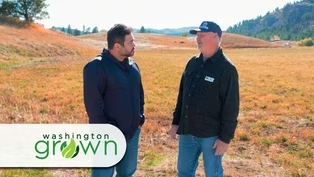
Inland Northwest Flavors | Preview
Video has Closed Captions
Preview: S13 Ep1313 | 30s | Northeast Washington and Spokane, where small farms and strong communities keep local ag thriving. (30s)
Providing Support for PBS.org
Learn Moreabout PBS online sponsorship
- Food
Christopher Kimball’s Milk Street Television
Transform home cooking with the editors of Christopher Kimball’s Milk Street Magazine.

 New Episode

Support for PBS provided by:
Washington Grown is a local public television program presented by KSPS PBS