
Inside Kentucky Politics (2/23/24)
Clip: Season 2 Episode 191 | 7m 31sVideo has Closed Captions
Inside Kentucky Politics with Stephanie Bell and Jason Rainey.
Inside Kentucky Politics with Stephanie Bell and Jason Rainey.
Problems playing video? | Closed Captioning Feedback
Problems playing video? | Closed Captioning Feedback
Kentucky Edition is a local public television program presented by KET
Inside Kentucky Politics (2/23/24)
Clip: Season 2 Episode 191 | 7m 31sVideo has Closed Captions
Inside Kentucky Politics with Stephanie Bell and Jason Rainey.
Problems playing video? | Closed Captioning Feedback
How to Watch Kentucky Edition
Kentucky Edition is available to stream on pbs.org and the free PBS App, available on iPhone, Apple TV, Android TV, Android smartphones, Amazon Fire TV, Amazon Fire Tablet, Roku, Samsung Smart TV, and Vizio.
Providing Support for PBS.org
Learn Moreabout PBS online sponsorshipTime now for end of week review of some major political happenings, particularly what's happening at the state capitol in Frankfort during this legislative session.
We've got a dynamic duo where that's today we've got Jason Rainey, who's back again with us with the Mount Sterling, Montgomery County Industrial Authority.
He's the executive director and UK adjunct professor at the Gatton College of Business.
And we also have for the first time with us Stephanie Bell, vice president of governance affairs for Windstream, and also has a connection with KCTCS.
Yes, as chair as chair.
So we've all talked maybe a little bit about some higher ed stuff.
Thank you, guys.
Yeah, they're having us again.
Absolutely.
A busy week, busier week, Frankfurt week, where a lot of child centered legislation passed, or two major bills, I should say.
The child labor law bill is picking up momentum.
And then, of course, we have Senator Danny Carroll's bill that's trying to rescue the child care industry, the adult, you know, early education, daycare industry.
Talk to us a little bit, Jason, about these bills and how they're moving.
Yeah, it's interesting to think about and look at what the floor debate was about, the allowing students to work more, work more while they're while they're in school.
Right.
And give them more time out and.
Right.
I don't I don't think the solution to our workforce participation and more people in the workforce necessarily is just allowing them to work later at night.
Right.
That's a bigger conversation.
But the bill dealing with the child care communities being designated as child care friendly, I think that's a very interesting thing that the legislature is leaning into and in a good opportunity for the state.
Right.
That that would be housed at the cabinet for economic development.
And, you know, we just hope that they give them the staff to administer more programs that are right.
The Cabinet is doing a lot of stuff with a lean team right now and if you noticed, there were a lot of school groups there at the Capitol this week like they were.
Yeah.
So just coincidentally, I thought it was very interesting that those two subjects were, you know, really hot on debate.
And if and if those groups are actually paying attention to that debate.
Right.
And going back to the debate about the child labor laws, we heard a lot of commentary, particularly from Democrats who are they were against it, but there were some Republicans who voted against it.
I think that vote was like 60 to 30 something.
Right.
So it wasn't a party line vote.
But we heard how this could affect possibly school funding.
If kids are working late, they can't get to school.
They you seek funding based per pupil funding is based on average daily attendance, which has been a conversation and maybe it's average membership as opposed to daily attendance.
But all of these things, I mean, it's all complicated and it's all connected.
Stephanie Yeah, So anything else on that?
I think it's very interesting.
You know, the, you know, it'd be interesting to see is their best practices around designated community designations around, you know, childcare friendly communities, right?
We think about what like what keeps our workforce participation low, right?
We're the eighth lowest ranked state and workforce participation with you know, right at I think it's 57% plus or minus.
You know, how do we how do we increase that?
And that's a ranking that's going to help the whole state, right?
Yeah.
Well, in in the corporate world, when you have a snow day, you can see the productivity go down just because of childcare issues.
You know, people scrambling to to take care of those, you know, childcare needs so well.
One of the points that Senate President Robert Stivers has made several times in this studio is that it's a conversation about daycare, which I think Senator Carroll tried to reframe that.
But Stivers makes a good point about how, well, what about weekends and after 6:00 and 7:00, Right.
I mean, a lot of parents don't work the traditional 9 to 5.
Most people don't work traditional 9 to 5.
So rethinking about that delivery model is pretty important.
And we'll see how much this House bill, the Senate bill two or three does on that front.
Yeah, well, and when I talk to manufacturers out in our community in Mount Sterling, you hear you hear that that how do we solve for childcare?
Yeah.
And how does that relate to the working hours?
You know, how do we how do we deal with that?
And that's something you hear across the state.
It's a I believe, a Kentucky Chamber initiative on their legislative plate this year, too.
And a big plug is we're going to talk about this for an hour.
Monday night, Kentucky Chamber will be represented by Kate Shanks, and Senator Carroll will be on.
And Bridget Blom with the Prichard Committee and other stakeholders making conversation.
I do want to talk a little bit about some higher ed issues because we're having some conversations about comprehensive universities getting into the research mode and offering doctoral programs, possibly even a four year publicly funded institution, and Eastern Kentucky Hazard Community and Technical College could be Hazard University.
What do you think about that, Miss Board Chair?
Well, you know, I mean, there is a whole it's been demonstrated there is a hole, an education hold there in eastern Kentucky that needs to be filled.
Whether, you know, it comes with that proposal, I don't know.
But there is there is something that we need to do for those for that area and that region of the state.
Right.
And it's been talked about for a while.
And I think they're just proposing a study for the CPE.
There was already one resolution to do some study.
And now this is specifically about, you know, this particular issue was, you know, years ago they had proposed to a university in Somerset.
So, you know, that area of the world, that's not a new issue for them.
So, you know, I think it needs some more study.
Yeah.
What do you think about you hearing.
Well, from the business community, I think the the thing that's very interesting is when we've created performance based funding for the universities, it's created more consternation and competition amongst not only regional comprehensives but across the board.
Right.
Yeah.
And so, I mean, how do we get those folks to continue to lean in to working with one another?
And, you know, it seems like there's a point of pride with with every university in their strategic plan.
And, you know, you've seen a lot of good collaboration between University of Kentucky, University of Louisville on a metals initiative and where they've partnered with the federal government on a grant to further that.
How does that lead to innovative manufacturing solutions?
Right.
Yeah.
And you look at I think Senator Stivers is the example of you've got the aviation program at Eastern Kentucky University, which is top notch, and then you've got the aerospace program at Morehead, which is top notch.
I mean, is there some collaboration that could happen there?
So it makes sense to look at some of those things?
Yes, it does.
The Senate bill one, right?
That's right, Senate Bill one, Bill one.
And what that's going to mean for the universities and almost forced collaboration and.
Right.
Yeah.
You know, Dr. Thompson do such a great job of Council on Postsecondary education.
And, you know, I think it's good to have it where they're really the implementation arm of this.
You know, once it gets once it all gets approved, there is a bill that has been filed, though, to do away with the CPE.
It hasn't really gotten any discussion yet, I should say, but it's out there.
Yeah, well, I think what Dr. Quarrels coming on, I think that I think there's a lot of room for KCTCS in the universities to work together to solve these educational needs that Kentuckians have.
And, you know, their KCTCS is going to be doing they've done their own study.
They may be you know, they they've got some offices that may be consolidated.
They may be doing some things like that.
So I think it's it is time to look at how they can work together to solve this.
We're glad to have you back, Stephanie, to talk about broadband because we're out of time.
Yes, but we'll have to do that.
Okay.
Very soon.
Thank you all for being here and have a great weekend.
Rest up.
Thank you.

Around the Commonwealth (2/23/24)
Video has Closed Captions
Clip: S2 Ep191 | 3m 6s | Hit the road and enjoy some music, some theater, and some nature. (3m 6s)

Video has Closed Captions
Clip: S2 Ep191 | 1m 50s | A group of Kentucky Colonels are calling on the governor to decriminalize cannabis. (1m 50s)
Video has Closed Captions
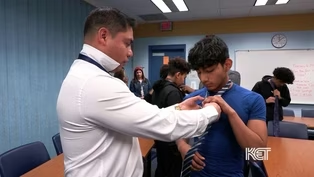
Clip: S2 Ep191 | 2m 58s | How a mentoring program, Guys with Ties, is helping prepare students for their future. (2m 58s)
Video has Closed Captions
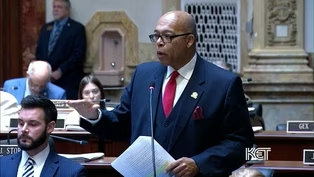
Clip: S2 Ep191 | 2m 52s | A new bill could help school districts struggling to hire student resource officers. (2m 52s)
Video has Closed Captions
Clip: S2 Ep191 | 1m 27s | Bills involving shoplifting, cosmetology, and artificial intelligence pass Senate. (1m 27s)
Providing Support for PBS.org
Learn Moreabout PBS online sponsorship
- News and Public Affairs

Top journalists deliver compelling original analysis of the hour's headlines.

- News and Public Affairs

FRONTLINE is investigative journalism that questions, explains and changes our world.












Support for PBS provided by:
Kentucky Edition is a local public television program presented by KET