
Inside Kentucky Politics
Clip: Season 5 Episode 68 | 7m 22sVideo has Closed Captions
Inside Kentucky Politics with D. Stephen Voss.
Our Emily Prince sits down with University of Kentucky political science professor D. Stephen Voss to talk about a new national poll and what it's saying about the outlook for the midterm election, why we are seeing fewer candidates debating each other, and Governor Andy Beshear's book tour and his possible presidental run.
Problems playing video? | Closed Captioning Feedback
Problems playing video? | Closed Captioning Feedback
Kentucky Edition is a local public television program presented by KET
Inside Kentucky Politics
Clip: Season 5 Episode 68 | 7m 22sVideo has Closed Captions
Our Emily Prince sits down with University of Kentucky political science professor D. Stephen Voss to talk about a new national poll and what it's saying about the outlook for the midterm election, why we are seeing fewer candidates debating each other, and Governor Andy Beshear's book tour and his possible presidental run.
Problems playing video? | Closed Captioning Feedback
Where to Watch Kentucky Edition
Kentucky Edition is available to stream on pbs.org and the PBS app.
Providing Support for PBS.org
Learn Moreabout PBS online sponsorshipWe have made it to Friday, so that means it's time to go inside Kentucky politics.
I'm Emily Prince, and I'm joined by Doctor Stephen Voss, political science professor at the University of Kentucky.
Thank you for making the trip over here to our studio.
Thanks for having me here.
Yeah, we're glad to.
So we're going to jump into the midterm elections first.
I want to kind of give the peg that Emerson College put out a poll just last week talking about a national kind of look at how things are going.
And their poll, they said that nationally, again, congressional Democrats are expected to have about an 11 point advantage.
So let's take this national poll and bring it down and translate it to Kentucky.
How does it translate and what are we seeing?
You know, when we look at polls.
How do we know which ones we can trust?
So that's what's called the generic ballot poll.
People aren't being asked.
So you voting for this person or that person?
They're asked going into the congressional elections.
Would you rather vote for a Democrat or a Republican?
So with that poll is giving you is the overall national mood.
Now, some of those voters who said they wanted to vote for a Democrat may not even have a Democrat on the ballot.
Right.
And same thing with the Republicans.
So you have to take the generic ballot with a grain of salt.
It's it's going to be smooth out over the whole country.
It's not specific, say, to the second district of Kentucky.
Right.
On the other hand, that generic ballot is a pretty good predictor of how congressional elections go later on.
All the signs right now, although it could change, are that the Republicans could be headed to a bloodbath.
Now, having said that, the electorate isn't as responsive as it used to be.
More and more congressional districts are lopsided, very Democratic or very Republican.
Fewer ones are competitive.
We're unlikely to see the sorts of huge swings in which party controls the House of Representatives the way we used to.
Okay.
Now, something else that came out of that I thought was pretty interesting is that they asked voters to rank issues as far as how impactful they would be to their vote.
There were several things that were listed, but some of the top concerns the war in Iraq, jobs, tariffs, gas prices, even immigration.
Those are just a few of the top ones.
So again, to take us from a national scale to back down to Kentucky.
Do you feel that those issues carry the same weight for Kentuckians?
But along with that, for people who are on the ballot in Kentucky, are we hearing them talk about these types of issues?
So the main thing that determines people's vote is their party.
Most people are Democrats, whether they admit it or not, or Republicans whether they admit it or not.
And they vote that way in most elections.
But when you talk about the people who move, the economy is almost always the main thing that drives them.
And this is why Donald Trump should be worried and why the Republicans should be worried, because, as that poll told you, everybody is focused on the economy and they're unhappy.
They're unhappy about gas prices.
They're unhappy about prices in the grocery.
Even, you know, they were on war could actually be economic because some people people have a sense that that war is partly why gas prices are up.
You know, I'm going to throw maybe a curveball.
But when we think about people who are on the ballot, we think about, you know, in the U.S.
Senate race, Charles Booker and Andy Bar, we've heard some folks say, well, maybe it actually benefits Andy Bar to not give as much of an opinion about some of these issues, because he does seem to be far further ahead in the polls.
Do we feel like that the candidates are actually talking about the issues, or is it being more party based?
The more a campaign seems lopsided, the more it seems as though one candidate is is almost a sure victor, the less they're going to engage in the issues.
Engaging in the issues just means they risk saying something that goes viral that people don't like it.
Really, a candidate who feels comfortably ahead tends to focus on upbeat messages, broad based messages, and they don't get down into the weeds.
That kind of brings me to my next point that I wanted to ask you your opinion, and from a political science perspective about debates.
So we know that again, in the U.S.
Senate race, there is one debate expected where we will see Charles Booker and Andy Bar at the podium together in the sixth district race with Ralph Alvarado.
There is nothing confirmed.
What?
We will see them at the same time.
So there does seem to be less of an appetite, especially this, you know, this time around with the midterms to see people actually debate one another.
Talk about why is that so?
For a long time, it was hard to get the front runner to debate because, you know, as I said before, that just represents a risk.
They could say something that could hurt their lead by appearing on the same stage in the same conditions as the person that they're on track to trounce.
It sort of raises that person up, gives them credibility.
It's a little less it would have been in the past, a little less common to see a case like the Alvarado race struggle to get debates, because that is race that we don't have a lot of information about as far as we know, could be quite close.
But there's a second reason candidates don't want to debate that might apply here, which is very few of the people who are going to sit around and watch a candidate debate are politically unaware of people trying to decide how to vote.
The vast bulk of that audience are people who are dyed in the wool.
It's like a sporting event.
They're either wearing the red jersey or the blue jersey.
They're not.
There's not really a lot of votes up for grabs with the direct audience of a debate.
Of course, we like to see from our perspective, right?
We like to see people come in to bay because we want to put the information out there to the voters.
But yes.
We find it interesting because that's what we do.
That's our industry.
Yeah.
And also, you know, people who are more politically active tend to think voters process things the way they do, weighing the issues, weighing the most.
Voters are trying to find shortcuts to get that homework done as fast as they can, so they can go do things they enjoy more.
Fair points.
Fair points.
Okay, I want to switch topics real quick to one more thing.
Governor Andy Beshear, he's in the midst of a national book tour.
He's promoting his book.
Go and Do likewise.
I wanted to ask you your opinion about something he said specifically when he was in Bowling Green.
He's told the story many times, but he told about how after he won reelection for governor, he looked at his wife and said, will never have to do another campaign, run for another election again.
And he looked at the crowd in Bowling Green and said, now, I'm not so sure if that's true.
So he kind of keeps teasing what might be next for him, based on what we've seen in past circumstances.
When do you think we might see an actual confirmation of is he running for president?
Yes or no?
And to be sure, is doing all the things one does to run for president, including releasing a book, Outlying Your Vision, the National Travel with a bit of international travel.
Everything Andy Beshear is doing sets up a presidential run.
But, you know, people test the waters and they're there's a decent number of politicians who do the things Bashir has done, and they end up not running.
They end up not pulling the trigger if they feel like they're not going to get traction.
So, you know, I don't know when or if Governor Beshear will ever fully launch a presidential campaign, but he sure gearing up for one.
Drop in the bread crumbs.
Right.
Bringing us along a little bit.
Pretty big chunks of bread.
Absolutely.
So, doctor, boss, thank you so much for coming to break all this down for us.
And I'm sure many more things will happen before we get to Election Day.
But thank you for stopping in.
Here today.
See you again.
Thank you.
Thank you.
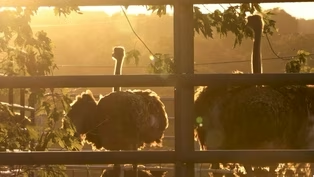
Danville Ostrich Farm Offering Options for Alpha-Gal Patients
Video has Closed Captions
Clip: S5 Ep68 | 5m 16s | Kentucky ostrich farm giving Alpha-gal patients a red meat alternative. (5m 16s)
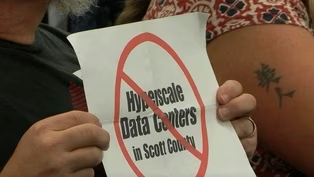
Kentuckians Voice Data Center Concerns in Frankfort
Video has Closed Captions
Clip: S5 Ep68 | 4m 20s | Residents bring data center concerns to lawmakers in Frankfort. (4m 20s)
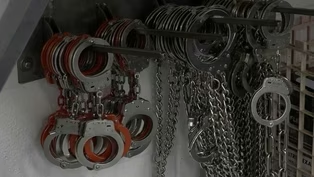
Kentucky Leaders Continue Push to Reform Jail Funding
Video has Closed Captions
Clip: S5 Ep68 | 2m 47s | Rising inmate costs renew effort to overhaul how Kentucky jails are funded. (2m 47s)
Providing Support for PBS.org
Learn Moreabout PBS online sponsorship New Episode
- News and Public Affairs

Top journalists deliver compelling original analysis of the hour's headlines.

- News and Public Affairs

FRONTLINE is investigative journalism that questions, explains and changes our world.
 New Episode
 New Episode
 New Episode
 New Episode
 New Episode
 New Episode
 New Episode
 New Episode
 New Episode
Support for PBS provided by:
Kentucky Edition is a local public television program presented by KET