
Inside Kentucky Politics
Clip: Season 4 Episode 367 | 10m 15sVideo has Closed Captions
Insight into Kentucky politics with Trey Grayson and Bob Babbage.
Bob Babbage and Trey Grayson discuss financial reporting, polling and ad messaging in the U.S. Senate race with Renee Shaw.
Problems playing video? | Closed Captioning Feedback
Problems playing video? | Closed Captioning Feedback
Kentucky Edition is a local public television program presented by KET
Inside Kentucky Politics
Clip: Season 4 Episode 367 | 10m 15sVideo has Closed Captions
Bob Babbage and Trey Grayson discuss financial reporting, polling and ad messaging in the U.S. Senate race with Renee Shaw.
Problems playing video? | Closed Captioning Feedback
How to Watch Kentucky Edition
Kentucky Edition is available to stream on pbs.org and the free PBS App, available on iPhone, Apple TV, Android TV, Android smartphones, Amazon Fire TV, Amazon Fire Tablet, Roku, Samsung Smart TV, LG TV, and Vizio.
Providing Support for PBS.org
Learn Moreabout PBS online sponsorshipRene Shaw here with you.
And we're going to go inside Kentucky Politics with our two faves.
We've got Trey Grayson and Bob Babich who are with us.
We are counting down until the primary election, May 19th.
And we'll also talk a little bit about the Kentucky General Assembly that just wound up this week.
But let's start with the U.S.
Senate.
Trey, I'll go with you first.
We got some big financial numbers that came out April 15th for the this quarter's financial reporting.
What did we learn?
So on the Republican side, kind of a continuation of the last couple of reports, Andy Barr continues to to pace, outpaces other two primary opponents, the two main primary opponents and the money raised by individuals.
Daniel Cameron continues to struggle.
But to Cameron's credit, he hasn't spent a lot, so he's got some cash on hand at the end.
Maurice's number was really low, but we all know he can sort of write a check.
And then the other wild card, of course, is how much of the third party groups, independent groups that are able to be out there.
And so I guess on the one hand, I think it's on to reinforce what we all think is going to be, you know, Barr is going to have a lot of money to get his message out, which has been the case kind of throughout the race.
But I'll be interested to see if Cameron has got enough money and maybe a little bit of outside money to remind Republican voters, hey, remember me?
You liked me.
You nominated me a couple times.
And put some stuff on the air.
And that personality gets to come through.
My dislike polls.
Dollars don't vote.
So does this have any direct reflection on someone's electability by where they stand financially?
It always does.
But when we get to the end, they're going to have a terrific rush of cash onto the scene, especially with the congressional race.
Mexico.
Ryan is going to spend a fortune in the Cincinnati and Northern Kentucky markets every way they can.
Social media, traditional media, every way.
And the Senate money will come rushing in.
That's going to be a lot of millions of dollars, in a hurry.
We're a month away from the primary, roughly a day away from Trey Grayson's birthday.
I might have to go to the.
Early birthday to Mr.
Grayson.
Absolutely.
It'll be quite, quite the show.
Literally and figuratively.
Yeah.
So how do you size up where things are now?
The latest polling shows that he is pulling ahead.
Do you believe that?
I think that's a general sense, but it's close.
There's a lot of undecideds.
And again, that's why I mentioned this.
Does Cameron have enough money to to get him to get himself back on the air and say, you know, here's just remind voters who voted for him quite a bit.
And, the bar continues to kind of double down.
I will say the one thing that the money shows, and I think the polling shows, is that I think they Morris has struggled to get the kind of traction that he needs to.
You know, if you look, if you look at the polling, you look at the dollars raised and and you know, he's been on the air a lot.
And I thought, well, we've talked about this, had some pretty effective messaging.
But he's struggled to bust out of third place.
He's kind of a distant third place.
That's not a place where you want to be.
Still at this.
Point.
And at this point.
No.
That's right.
Well, I remember at a recent Lexington forum, Bob, that I believe you did found that group many, many years ago.
Yes, yes.
And one of the questions that came from a very astute Kentucky voter was, when are we going to go from scare to care in terms of what we're seeing and advertisements and etc., and the messaging, when does that happen or does that happen in this particular election cycle?
In the US Senate race, where.
You almost always want to wrap up with a positive?
That's probably a 40 year old adage, maybe longer, but we may not see that Morrisey still has to push to get up.
Cameron's gotten knocked down a little bit because of the, the negative gearing he the association with the ACLU on a case, which is not really a fair accusation, but it still sounds bad.
And the bar has moved up into the mid to, 20s.
Nobody's of the winner yet, but as that moves around, a lot of those messages will turn out to be negative.
They've been unbelievably negative in some rotations lately.
It's been more as 4 or 5 ads and a half an hour more set following a war, said, yeah.
Are we going to get an April or May surprise?
Like we get an October surprise?
I hope not, I hope not, but let me go back to your question about, I mean, I think one of the challenges is campaigns generally do what has worked in the last campaign.
And so for campaign after campaign, after campaign going negative works.
We've we've seen this in November where both parties seem to especially right now, you know, the, the national level, the parties to find themselves is I'm not them.
And in a primary, the reality is on issues that these three have very little disagreement.
And so what you want to do is you try to find the thing the, the potential weak points.
So the, this independent group thinks that Cameron's maybe weak on crime.
And we've seen in the fourth district race and also a little bit in the Senate races you know tie stuff.
And Barr's got a voting record for being in Congress.
And so they actually Afghanistan refugee issue, which was ironically a Republican attack on Biden, is now being turned against Barr.
But but if you step back like they all three generally agree on issues.
And so you find these small things and try to leverage them.
But it's, you know, to that question that we're going to be on, what was that scare.
Husker.
A lot of scare.
And less care.
Yeah, but Bob's right at the end.
Usually you do see some some coming back to care.
Also in shock beef, Cameron stayed more the care because given again his strengths, his past electoral success, that's probably the message.
He probably doesn't need to go against Barr, against Morris, so much as reminding voters why they supported him in the past.
And he could say, look a bit different.
I haven't heaped on all this negative as the other two have been positive.
That's how you know me.
That's why you voted for me before.
Well, over half of the primary voters who are Republicans have voted for Cameron some time for attorney general or governor.
Either of those two shots, he may close with that.
And that might work.
Still, about the care part.
You know, years ago you were building a resume.
Anything you could put in and document that I helped here, I helped there was budget chair of my church board or anything.
You added.
We don't do that so much anymore.
It's almost like I may not be great, but they're horrible.
That's the contrast we're always seeing and seeking.
If you're a political campaign and it doesn't educate the voter very much, it doesn't respect the voter very much.
It certainly doesn't encourage the turnout.
The and I would love to see.
Right, right.
And we still think that turn around.
It's going to hover around.
I don't know, 30 something.
30 something.
For something or it's never I can't imagine it's been any different than the past couple of, you know, federal midterms that have said, I mean, just at some level, you just look at the turnout like it just is what it is.
And there's obviously big variations across the state.
Where I live in Northern Kentucky will be under 20.
The other thing I will say about primary turnout that's tricky is because of the fact that if you're an independent or other, you may not have to vote no, you may not have anything to vote on.
And so you can't turnout.
That's right.
So right now 10%, 10.
To 11%.
Or others.
So right off the bat, the best case scenario, if everybody voted, we'd be like at 90% in most places because you don't have nonpartisan primaries, except there's probably a few judicial races, maybe some city primaries.
And then, you know, and in some counties they don't have primaries.
You know, it's one party rule, right?
The other party doesn't have much of a primary.
So that's one thing that skews primary turnout a little bit.
But, yeah, it won't be great.
It'll be a which I hate saying that, but that's just the reality.
It also is, if you get out, vote it will matter.
Yes.
That's right, you'll have it.
Your vote will be worth more in this primary than it was last November of 2024.
Yeah.
Okay.
30s, give me one big success from Kentucky General Assembly session 2026.
Bob.
Start with three.
Start as a able bodied minded politician does defer is right.
What was the biggest success?
Other than the budget?
Oh, other than the budget, I'm going to say House Bill two, which was the Medicaid reform bill, that the state had to do something to implement Medicaid, after the H.R.
one.
And I really appreciated how legislators listened to folks about how to do that in a way that protects patients, but also protects the taxpayers.
Also surfaced, you know, here's some more reports.
When you use more transparency as opposed to diving in and doing a whole bunch of new reform.
So HB two, if it works, should help us to learn more of the next couple of years.
So when we go to the budget in two more years, we'll have a better sense of what things can cost and what what policy changes we need.
And that's a policy success.
Right.
And there were some a lot of negotiation on those co-pays that were really rankled some where they're really nominal.
Yeah.
Well they ended up started.
Yeah.
Yeah yeah.
Always higher education is a big factor.
The emotional presentation for Kentucky State University and redesigning it as a polytechnic university, is was quite a hearing and quite a success for Kentucky.
Say Kentucky State deserves that kind of push and investment and a bright future.
Additionally aviation airports had some major support CVG Covington or Cincinnati, Northern Kentucky, also Lexington got a big dose.
Oddly, the same aviation museum of Kentucky, all of these investments are paying off aviation.
Avionics is bigger than bourbon.
And, let's say, bourbon.
It's the biggest other signature industry.
So, in, in common parlance, we talk about the others because they have the panache.
But aviation is kind of the end.
Yeah.
There was and there was a last minute credit that's passed for sustainable aviation fuel, alternative aviation fuel.
Which the carriers need.
And it was a coalition of the business community, aviation industry and farmers.
Yeah.
So we came together and and one of the cleanup bills passed in the last day, there's a tax credit as well as a, a fuel tax credit.
So the hope is to start a new industry where we can grow it, make it, and use it all in Kentucky.
Yeah.
Yeah, like you said.
I mean, that's not one of the sexy and glossy, kind of items, but it makes an enormous impact.
And, it's going to keep growing for Kentucky.
We've got a terrific advantage in aviation right now, and we can seize on that.
And the legislature certainly did that.
That's a winner.
Yeah.
Okay.
Good.
Do.
We'll talk, said the loser.
Talk later, Thank you guys.
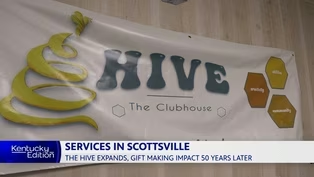
More Resources for Special Needs Adults in Southern Kentucky
Video has Closed Captions
Clip: S4 Ep367 | 4m 31s | How an Allen County's family's gift continue to give back decades later. (4m 31s)
Providing Support for PBS.org
Learn Moreabout PBS online sponsorship
- News and Public Affairs

Top journalists deliver compelling original analysis of the hour's headlines.

- News and Public Affairs

FRONTLINE is investigative journalism that questions, explains and changes our world.












Support for PBS provided by:
Kentucky Edition is a local public television program presented by KET