
Inside Kentucky Politics
Clip: Season 4 Episode 327 | 8m 35sVideo has Closed Captions
Renee Shaw discusses local political headlines with Bob Babbage and Trey Grayson.
Former secretaries of state Bob Babbage and Trey Grayson discuss the Kentucky Supreme Court ruling on charter schools, state budget draft and where both parties are finding common ground, a sweeping elections measure that has passed the House, new ads in the U.S. Senate race, and Governor Andy Beshear's new book.
Problems playing video? | Closed Captioning Feedback
Problems playing video? | Closed Captioning Feedback
Kentucky Edition is a local public television program presented by KET
Inside Kentucky Politics
Clip: Season 4 Episode 327 | 8m 35sVideo has Closed Captions
Former secretaries of state Bob Babbage and Trey Grayson discuss the Kentucky Supreme Court ruling on charter schools, state budget draft and where both parties are finding common ground, a sweeping elections measure that has passed the House, new ads in the U.S. Senate race, and Governor Andy Beshear's new book.
Problems playing video? | Closed Captioning Feedback
How to Watch Kentucky Edition
Kentucky Edition is available to stream on pbs.org and the free PBS App, available on iPhone, Apple TV, Android TV, Android smartphones, Amazon Fire TV, Amazon Fire Tablet, Roku, Samsung Smart TV, and Vizio.
Providing Support for PBS.org
Learn Moreabout PBS online sponsorshipTime now to go inside Kentucky politics with our two faves, Bob Babbitt and Trey Grayson, to get caught up on the week's news.
And we got a lot of news to get into in about eight minutes.
So let's let's hit the pedal here Kentucky Supreme Court.
Let's start there first.
On Thursday, they said a measure that was passed in 2022 that would made public dollars go for nonpublic education.
They said that's unconstitutional because it violates this kind of common schools concept.
Tell us about that.
Well, a legislator has passed a charter school law, which we were one of the last states in the country to pass one.
Charter schools allow entities, usually public schools, but sometimes other entities, to charter, educate kids and usually have a little bit less oversight reviews.
But you have to report back your results.
Supreme court said that is outside.
That is not a public school, even though most other state supreme courts have ruled otherwise.
And so they struck it down, and it was a unanimous decision, which was kind of striking.
Did you find that surprising, that it was unanimous?
Yeah.
I mean, I thought they probably would strike it down.
The trial judge struck it down on this court seems inclined to very narrowly interpret or maybe, I guess, broadly interpret that part of the Constitution, again, different than other states.
To me, what's going to be interesting about this is the reaction to the of the legislators, to the court.
I don't know that we'll see much this session, but in the future, this might mean Partizan elections redrawing districts.
There's a lot of frustration among legislators with the Supreme Court for striking down legislation that's been passed.
Yeah.
And what do you think about this, Bob?
And is that really solve the whole.
Are we done with this issue or could there be other creative ways to get at?
You would think so.
Were they, at least for this period of time, we put it to the voters.
So we've been to the court, unanimous decision.
When you read the words common schools, and figure that out, it's not a shocker.
But there are people angry about it, and they may react to it and change the system to try to get a better outcome.
And we know that in Congress, you have the you know, the beautiful bill makes the provisions for scholarship tax credits or school vouchers or.
So a couple years ago, this court struck down a scholarship tax credit program in Kentucky under a similar when I say court, the Kentucky's record for similar reasons.
House Bill one, which was filed this week, is an attempt to opt in under the H.R.
one one big beautiful bill provision, which creates a federal tax credit.
But the states have to opt in.
It'll probably set up a court fight as well.
Maybe not in the Kentucky courts, but in the federal courts, because it says the secretary of state can make the decision.
Would it be cool to get real power for it again?
Yeah.
So it gives the Secretary of State the power to opt in, because I think there's some concern, rightly, that Governor Beshear, who's running for president, would not opt in.
And so this gives the power to the secretary of state.
And my guess is that'll create some litigation there as well.
Yeah, it's day 31, the day that we tape this program and we have not seen the House Bill 500 get a floor vote to even get discussion beyond the budget review subcommittees and some testimony.
Right.
But there seems to be a lot of conversation about the proposed cap on health insurance, right.
Which could could result in premiums spiking 78% or a reduction in benefits.
Is that the crux of why this bill is hung up right now?
What's going on?
So I think I think that's the a big part.
That was a good story.
I think the Herald-Leader wrote about this, the challenges that the state health care plan as a whole, the costs are going through the roof.
And so just like employers are trying to figure out how much do we pay and how much do we ask our employees to pay?
Same thing with state government.
And this initial draft of HB 500 has drawn the ire of state employees, retirees and, unusually, the personnel cabinet secretary wrote a letter.
Not that the administration weighing in, but that the cabinet secretary of a cabinet usually doesn't get involved in those kinds of things.
Wrote in.
My guess is they'll have to fix that to get the bill advanced, because there's a number of Republicans that right now say, I'm voting no, on HB 500.
Now we know it's going to be amended, right?
But they're going to say this is.
The first draft.
And Jason Petrie, who chaired said that.
Right?
Yeah.
But I think they're going to have to fix this sooner than they maybe would have thought, as opposed to trying to fix something, say, at the conference committee version.
Right.
What do you think?
Senate members say their mailboxes are full, hundreds even breaking a thousand up to 2000 emails a day from employees who are writing over and over again saying, this is wrong.
THP probably five, six years ago, actually produced a surplus.
It was a mess for the employer.
Health insurance plan, right?
Yeah.
Here we are with that not working now.
And it's not working for anybody.
Not just public employees, but everybody's rates are going up, it seems, everywhere every year.
But definitely a point of contention.
Right.
And it could lead to quite a bit of attrition in the state workforce if this were to go as is.
Yeah.
If you don't I mean, at the end of the day, whether you get a salary, you have salary and then you have things that cost money that come out of your salary and you pay for a share of your health care.
So if your share of your payment goes way up, it's like getting a pay cut, right?
Right.
So, another measure that got some attention this week.
House Bill 534 kind of sweeping elections measure.
The Kentucky County Clerks Association testified against this bill.
And this deals with all kinds of things.
Yeah, it's, there's some campaign finance stuff in there.
There's some things related to judicial, but the the part that got the headlines today and were the part where the clerks weighed in.
There are a couple of ways this bill and actually leans into some of the things we're seeing in other states.
So nationally, some of the stories in election administration involve the citizenship issue and how to ensure Kentucky citizens are not allowed to vote.
They're not allowed to register to vote.
How do we make sure that those lists are accurate and the people aren't doing that?
And so this bill proposes to ask the state board to, match data with the federal what's called the save service, which is not a database, but it's a collection of interactions that individuals have had with the federal government where the citizenship status is revealed.
So there were some questions, technical questions about how that might work.
Should it, should it work?
The second one was there's an emergency clause.
Bill goes into effect, let's say April 15th.
And the 19th.
Yeah, I mean, we're here, we're in the studio and, you know, four weeks later talking about elections, but people are already voting via absentee, right.
There's also some questions about some language that would, phase out some of our current voting systems and how well that grandfather clause works.
And then the last one, and this is where the clerks were most concerned, was an idea of allowing ballot images to be made public out of transparency.
Transparency is normally a good value.
But in elections, particularly in Kentucky, we have some concerns that if ballots became public, vote buyers could take advantage of that or you could figure out how somebody voted.
We've seen in other states that some of these images been able to do that.
So balancing transparency to increase trust with elections but making them more vulnerable.
The bill sponsors expressed concern.
Expressed willingness to address these issues.
And so we'll see how this plays out.
It cleared committee, but there's going to be some work before it goes to the floor, let alone to the.
Two former secretaries of state sitting here.
Bob Babich, what do you think about this bill?
Is it a good idea and is it even needed?
Well, there's a lot there.
And this process, it will probably be, changed a bit, but one provision is a judicial candidate running instead of saying I'm a conservative can say I'm a Republican.
We really don't permit candidates to identify their political party.
Although most of us can find that out or most of us are aware of their party.
So when you get a unanimous decision by the state Supreme Court, I think it confirms that they're doing their job and doing it effectively.
But, that's an interesting turn and an interesting discussion and something that has that kind of sizzle, takes over for some of the more academic questions in the bill.
Yeah.
Final point, 30s Andy Beshear book, go and do likewise how We Heal a Broken country.
Lots of media blitzkrieg this week.
Been on CNN just yesterday with Pamela Brown.
He's actually running for president, although he's not saying he's.
Been running for president.
Presidential candidates write books.
Nobody reads the books.
But you write the book, you get the title.
He's got a good title.
He'll talk about the book.
People really don't read these books, but it's what you do when you run for president, which is what our governor is doing.
You know, the, the, the disease of division in our country is so great that to put a book together on how to change that will have some audience.
It will be reviewed, it will be noted, some pieces pulled out and used or used, not so fairly, but the book only underscores that.
In fact, he is a candidate 100%.
Yeah.
We we saw it coming.
Right.
Yes we did.
Well thank you all for always seeing all the things coming.
Appreciate it.
Have a good weekend.
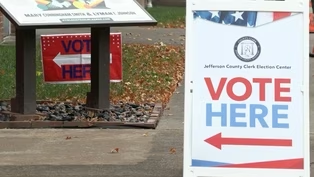
Bill Looks to Restrict Identification Used to Vote
Video has Closed Captions
Clip: S4 Ep327 | 3m 8s | Lawmakers debate bill that further restricts what forms of ID can be used to vote. (3m 8s)
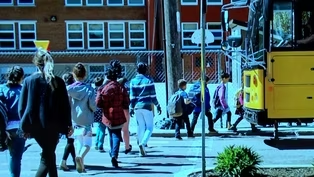
Bill Would End Juvenile Court Intervention Program
Video has Closed Captions
Clip: S4 Ep327 | 1m 33s | Lawmaker says program to reduce juvenile court involvement is not working. (1m 33s)
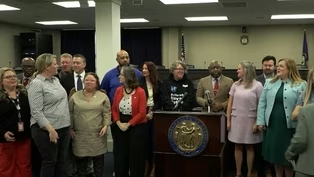
House Democrats Unveil Amendments to Republican Budget Plan
Video has Closed Captions
Clip: S4 Ep327 | 3m 41s | House Democrats deliver their budget proposals in response to Republican budget plan. (3m 41s)
Providing Support for PBS.org
Learn Moreabout PBS online sponsorship
- News and Public Affairs

Top journalists deliver compelling original analysis of the hour's headlines.

- News and Public Affairs

FRONTLINE is investigative journalism that questions, explains and changes our world.












Support for PBS provided by:
Kentucky Edition is a local public television program presented by KET