
Inspired to Succeed
Season 2 Episode 207 | 26m 48sVideo has Closed Captions
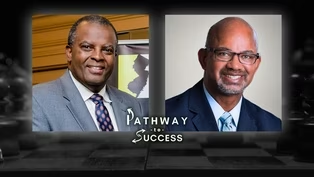
Michael Sutton talks about his successful business, Infrastructure Engineering Inc.
John E. Harmon, Sr., Founder, Pres. & CEO of the African American Chamber of Commerce speaks with Michael Sutton about his successfull business, Infrastructure Engineering Inc., and about how he was inspired at an early age to become a Engineeer. Produced by the AACCNJ, Pathway to Success highlights the African American business community.
Problems playing video? | Closed Captioning Feedback
Problems playing video? | Closed Captioning Feedback
Pathway to Success is a local public television program presented by NJ PBS
Inspired to Succeed
Season 2 Episode 207 | 26m 48sVideo has Closed Captions
John E. Harmon, Sr., Founder, Pres. & CEO of the African American Chamber of Commerce speaks with Michael Sutton about his successfull business, Infrastructure Engineering Inc., and about how he was inspired at an early age to become a Engineeer. Produced by the AACCNJ, Pathway to Success highlights the African American business community.
Problems playing video? | Closed Captioning Feedback
How to Watch Pathway to Success
Pathway to Success is available to stream on pbs.org and the free PBS App, available on iPhone, Apple TV, Android TV, Android smartphones, Amazon Fire TV, Amazon Fire Tablet, Roku, Samsung Smart TV, and Vizio.
Providing Support for PBS.org
Learn Moreabout PBS online sponsorship- Support for this program was provided by Horizon BlueCross BlueShield of New Jersey... PSE&G, proud sponsors of "Pathway to Success"... JCP&L, and the African American Chamber of Commerce of New Jersey: "Working together to build a stronger community for all."
Investors Bank, "Banking in your best interest."
Berkeley College: "Education drives opportunity.
Be inspired."
NJM Insurance Group.
Wardrobe provided by Vandiver.
[bright jazz music] ♪ ♪ - Hello, and welcome to "Pathway to Success."
I'm John Harmon, founder, president, and CEO of the African American Chamber of Commerce of New Jersey.
So delighted to have you tune in today.
We have another special guest, Mr. Michael Sutton.
He is the CEO, president.
He's the guy that makes it happen for Infrastructure Engineering.
Welcome to "Pathway to Success," Mr. Sutton.
- Thank you.
- So my first question, I just want to really get our audience to know who you are and what you represent.
Talk about the firm.
- Infrastructure Engineering, we are a professional consulting engineering firm that does primarily civil and structural engineering.
We do a lot of roadways and streets.
We do a lot of bridges.
- But we're going to start with some very basic questions in terms of, where are you from?
Talk a little bit about your upbringing.
Where were you educated?
And then slowly talk about your career leading up to the establishment of Infrastructure Engineering.
- Okay.
First, I'm really happy to be here today with my good friend John Harmon.
I was born in a public housing development on the South side of Chicago, you know, when moms used to have babies at home.
I was not born in a hospital.
I was born in a public housing apartment.
Living in public housing, you know, has its challenges.
My dad died when I was three years old, and basically we became very poor.
We went on welfare, and, you know, what can I remember about being on welfare?
You get a check once a month and you're hoping that, you know, food and everything lasts till the end of the month.
And I don't have no shame in my game, right?
I'm not ashamed of where I come from, who my parents are, any of that.
And so if there's anyone out there listening, you know, especially young people that, you know, are struggling with their thoughts about where they come from, and how they grew up, who their parents are... you know, you can transcend all of that.
My mom had nine kids-- five boys and four girls.
And my younger brother died when he was about two months old.
And, you know, that was very hard on the family.
I loved school when I was growing up.
I did not want to miss a day of school, even since the--kindergarten.
Right?
And because all the action was in school.
There was absolutely nothing to do at home.
So even when I got sick, my mom would say to me, "Michael, you're sick.
You need to stay at home.
You don't need to go to school."
And so but I'd say, "Mom, I want to go to school."
So the humble beginnings also started, you know, there was a few days where we didn't have anything to eat.
You know?
There was a few Christmases where we didn't get anything for Christmas.
Right?
And so I remember those things, and as the business grew and all that type of stuff, now I sponsor Christmas programs for children.
I sponsor food pantries at schools, where children are known not to have food and all that type of stuff.
So we do all those things.
- What school did you go to?
You had--appear that you embraced education early on.
So you went on to college.
Where did you go, and why engineering?
- When I was in the third grade, two Black architects came to my school.
And I'm sitting in my class.
I'm looking at them.
They were dressed in suits.
They brought some contract documents, some plans.
They brought a model.
That day... - Mm-hmm.
- I decided I wanted to be an architect.
I'm a spiritual person.
I would say I'm not a much religious person.
But I got to give God the glory on providence has played a big part in my life, that hand that works behind in this, you know, behind the scenes that is making things happen in your life.
And I have to contribute a lot of my success to that hand working behind the scenes.
I had to do my part.
Right?
I had to do my part.
And so that day, I decided I wanted to be an architect.
So what happened was, I was a smart kid.
I told you I love school.
Right?
I loved learning.
I was even competitive, you know?
We had SRA, reading program to compete.
I went to Lindblom Technical High School, which was about two hours from my home.
You had to take a test to get in there.
It was one of those selective schools.
I told my mom I didn't want to go, because it was too far from the house.
But my mom said, "You're going."
And you don't argue with mom, right?
So I went to Lindblom Technical High School.
And my major in high school was architectural drafting and design.
I had a daughter when I was in high school.
But eventually, I did okay in high school.
I got a scholarship to Northwestern University and Everson.
And they did not have an architectural department.
But I wanted to go to that school, so I said, "What's the closest thing that you guys have to architecture?"
They said, "Civil engineering."
I said, "Sign me up."
So that's where I went to school at.
I struggled at Northwestern.
It was very, very difficult.
I graduated barely.
You needed a 2.0 to graduate.
I had a 2.01.
So I graduated from Northwestern.
I found a job after I graduated, and I was off and running as a civil engineer.
- So you barely made it across the finish line.
But nonetheless, you had the will, the desire to be successful.
And I believe that is what has led you to where you are today.
What year did you establish Infrastructure Engineering?
- I started Infrastructure Engineering in 1997.
Now before, you know, that venture, I started other businesses also that failed.
And I have to say, you learn a lot from failure.
And you also learn a lot from success.
I was an Amway salesman.
[stammering] I was a car salesman before I went into business.
I wanted to sell skills.
And I started an engineering firm called Michael Sutton and Associates that flopped.
I did a business plan with Michael Sutton and Associates.
And what did my business plan tell me?
My business plan told me, "You need to go back to work for somebody, "because you're not ready to go into business yet.
You don't have the money," and all that type of stuff.
So I went back to work and, again, providence.
I talk about providence.
I went to work for this firm called UBM.
And they had a subsidiary called UBM Engineering, in which they asked me to run and manage.
Right?
And UBM was basically a construction management company.
And they hired a consultant that says, "Why don't you focus on construction management and get rid of this engineering part of your business?"
And they asked me did I want to buy it.
Well, I said "Yes.
I want to buy it."
During that time, I sold my house for-- and I made over $100,000 in profit in selling my house.
I took that $100,000 and I bought UBM Engineering.
And I can tell you that was the most money that my wife and I ever had.
And matter of fact, when I took the money to put it in business, she started crying, because she didn't know if we were going to make it.
And a year later, I renamed the business, Infrastructure Engineering Inc. And I was thinking about, you know, what should I name it?
And at that time, infrastructure, the word was not as popular as it is right now.
If you want to go into business, one of the best ways to do it is buy an existing business.
And so I was off and running-- we started off-- you say, "What did I buy?"
I basically bought backlog, because I only had two employees, myself and a Cat operator.
My first office was in a rundown building.
Didn't have any air conditioning.
We rose the windows up in the summertime.
My first computer network, I hired a guy.
It didn't work, so I had to hire somebody else that's with me now, that made it work.
He's been my IT guy for the last 23 years out of 24.
His name is Inas Marungwe.
And so we were off and running.
And let me tell you, you know, being in business is not for the faint of heart.
Right?
It's a struggle.
I worked seven days a week for five years.
Seven days a week for five years, I worked.
And in the fifth year, it was on a Friday.
I felt sick.
I was just...
I was just exhausted.
I felt sick and I prayed to God.
I said, "Let me just get home."
So I made it home, and I went upstairs to bed.
I didn't wake up until Monday.
I didn't know-- I knew that I was not sick.
I was just exhausted.
- So you had a little Rip Van Winkle experience.
- Yes.
- But there's a number of things you said there that I want to go back to.
Do you ever reflect back on that third grade experience?
Since you've referenced it today, how significant was that in who you have become today?
- If it would have been a couple of white guys that came, I may not have gotten that impression that I got as a third grader.
But growing up in my neighborhood in public housing, I rarely saw black men in suits and stuff.
I don't know if they know that they touched somebody that day that became a professional in the AEC industry-- Architectural Engineering and Construction industry.
So I go out today to do the same thing, because I don't know what kid out there, male or female, that I can spark some interest, that I can inspire to be whatever they want to be.
I love being a civil engineer.
I do.
I enjoy the work.
Even my first job, I was sitting there.
I'd pinch myself.
I said, "You know what?"
I wouldn't tell anybody that-- I'd say, "They don't even have to pay me to do this."
I loved it that much, right?
One of the things that influenced me a lot, I used to read Black Enterprise from cover to cover.
So I kind of knew that if I really wanted to make some money, I needed to go into business.
- So on that note, we're going to take our first break here on "Pathway to Success."
We'll be back in a moment.
- We encourage you to visit our website at www.aaccnj.com.
Or call us at 609-571-1620.
We are your strategic partners for success!
- Welcome back to "Pathway to Success."
You know, we're having a great discussion as we listen to Mr. Sutton and his story.
But we need for our viewers to hear from you a few large projects that you have done successfully.
- We work on some wonderful projects.
Let's begin with Chicago, where--it's called the "Chicago Menu Program."
And in Chicago, there's 50 aldermen.
And each of them get $2 million to do improvements in their wards.
That adds up to $100 million worth of improvements that come through this program.
And so we do the programming, the planning, the design, the construction, all that.
And it's a multi-year contract.
Our fees are in the millions of dollars, you know?
So that provides stability to the firm, right?
That gives me the ability to go out and use those profits not to buy me a Cadillac, not to buy me a BMW.
I reinvest the money in the business to grow the business.
It means investing in your people, that they become better at what they're doing, and providing them the tools and things which they need to have to do a great job.
- So give us another project.
- We were retained by the city of Chicago as the prime consultant to lead the effort for the redesign of all the roadway around the Obama Presidential Center.
The construction cost of the project is over $100 million for the roadway improvements.
That's an exciting project.
And what makes that project exciting?
Fast track.
We had to do phase one, the planning, and phase two, the design, all at the same time.
It was fast track.
And so-- - They never make it easy on a brother.
- Oh, man.
But I can tell you, we love it.
They love it, you know, the challenge.
We're working on some big tollway projects, you know?
One that we have right now is about $50 million.
We're the prime on it.
We've been working for the tollway for years.
And there was a time when the tollway didn't have any women, Blacks, or minorities working for them.
I remember that.
And so our Indianapolis office been working on all types of trails, all types of parks, and all types of street projects, water projects.
In Peoria, we did the restoration of the MacArthur Street Bridge, which is a historical bridge.
And we had to maintain the historical character of it as we rebuilt it.
In New York, we're working on suspension bridges in New York.
I can only say that I'm having a lot of fun.
I feel really blessed.
And again, I kind of give my team-- I wake up every morning thanking God for the people that work at Infrastructure Engineering.
We got some really wonderful people.
My direct reports, my operating guy, Kashif Khan, he's from Pakistan.
He grew up in New York.
He's an American citizen.
My daughter that I had when I was 16 years old in high school, she went on and got her accounting degree.
She's my CFO.
And she handles all the money for the firm, the banking relationships, all that.
My other person is Clarice.
She's African American.
She's my Chief Marketing Officer.
My HR Director is Stephanie Coleman.
Now Stephanie--all these people are brilliant.
Stephanie has a degree from Tennessee State, a master's in labor relations, and also a lawyer.
My IT guy, Inas Marungwe from Zimbabwe, a U.S. Citizen, I mentioned to you when I first went into business my IT network did not work.
I had to get somebody in there to get it to work.
Inas got in there and made it work.
And so all my direct reports are minorities.
- You exemplify within the construct of your organization that diversity is the differentiator from a value proposition.
Just how does it make you feel to have assembled such a body of talented individuals who knock the cover off the ball every day?
- I feel great, John.
You know, again, the team is magnificent.
And the diversity, again... there's some intentionality about it, you know.
But we're really looking for the best people, right?
And in our community, we have some of the best people.
I'm very proud of the diverse team that we have, because they are sharp, they are brilliant, and they get the job done.
- I mean, your story is just a phenomenal story.
2020 was a very tumultuous time.
The COVID-19 pandemic... we witnessed the murder of George Floyd.
And so that had some implications on the economy.
How has it affected your business?
- It created a lot of uncertainty, a lot of anxiety.
And it impacted us.
When COVID hit, we started a task force internally, all the key folks.
We got together and we said, "Okay.
Remote work is a reality."
It was accelerated.
Were considering remote work.
I was not a big proponent of remote work.
And so we were sandbagging, right?
And--but once COVID hit, you know, remote work became the reality.
One of our best years was 2020, you know, in service, in profitability.
We grew probably 10 percent in 2020.
But in January and February, we didn't know that.
We didn't know what was going to happen.
You know, we didn't know what clients were going to shut down.
We did have clients that shut down projects, and for a month or two.
And then they came back and said, "Okay, let's start on the project again."
We didn't know if we were going to have to lay off people.
We didn't know what was going to go on when COVID hit.
- So it appears that notwithstanding the tumult, you came out of 2020 in pretty good shape.
- We came out in pretty good shape.
- My final question of the day is the African American Chamber of Commerce of New Jersey and your thoughts about your relationship with our organization.
I'd like to, you know, hear that.
- John's the man.
John's the man.
I always tell people about John, right?
I say--I even tell my people, I say, "When you call John up, we better be ready to go.
"Because John, once you engage John, "you got to be ready to go.
"You can't be half step in.
"You can't be scratching your head, "and all that type of stuff.
You got to be ready to go.
"What is it that John is going to get you?
"He's not going to guarantee you "a contract for your support.
"You know, don't come here "thinking that you're going to give $100 "and you're guaranteed a contract.
"No, that's not the way it works.
"What you get from supporting the Chamber, "the Chamber will provide you access.
"It will be an advocate and it will do its best "to ensure that the procurement process is fair.
"That is what the Chamber will do for you.
And that is what John and his team does for infrastructure."
- Thank you so much, Michael Sutton, here on the "Pathway to Success."
And thank you for tuning in.
[bright jazz music] ♪ ♪ Today's message is about striking the right balance.
And I'm going to start by contrasting our former president with our current president, and ultimately what's in it for Black people?
President Trump, his focus appeared to be on business and appointing judges.
He checked a box in both of those areas.
President Biden, on the other hand, appears to be more comprehensive, focusing on family, individuals, and at the margins.
But also, he has a lot of emphasis on unions and what they represent from his perspective to America.
And what I heard recently, it sounds like he's trying to-- attempting to unionize more of America.
And I don't want to put words in his mouth, and don't leave it to me to translate what I think he said.
But I know what I want to say as it relates to Black people.
Here in New Jersey, 93 percent of Black businesses are sole proprietorships.
From a public contracting perspective, we receive 1 percent of public contracts.
So where is the balance?
What's in the formula for us?
And this is what we're pushing day in and day out.
You just heard my conversation with Mike Sutton.
I think he and his organization represents the value proposition that Black businesses bring to the marketplace.
And all we're asking is for a level playing field to compete.
We want to be a part of the economy, in the equitable way.
So when I hear terms like unions, we have nothing against the trades.
They perform a very good role in the economy.
But the lack of inclusion is the problem.
We're paying taxes just like everyone else is paying taxes.
And we want a degree of reciprocity.
So that's what, when I say "balance," that's what I mean, a balanced approach.
We're saying, "If the agenda is in the middle, "Black people have a better chance of being able to participate," where we're setting policies, particularly from a public sector perspective.
We don't just want to have the mosaic where you're checking the box off for these different groups.
We want to have impact.
And we're willing to do our part and holding our people accountable, as well.
And in closing, the African American Chamber of Commerce of New Jersey is your partner for success.
Thank you for tuning in today on your "Pathway to Success."
I'm John Harmon.
Thank you so much.
[bright jazz music] ♪ ♪ - Support for this program was provided by Horizon BlueCross BlueShield of New Jersey, PSE&G, JCP&L, Investors Bank, Berkeley College, NJM Insurance Group, Vandiver.
Video has Closed Captions
Preview: S2 Ep207 | 32s | Michael Sutton talks about his successful business, Infrastructure Engineering Inc. (32s)
Providing Support for PBS.org
Learn Moreabout PBS online sponsorship
- News and Public Affairs

Top journalists deliver compelling original analysis of the hour's headlines.

- News and Public Affairs

FRONTLINE is investigative journalism that questions, explains and changes our world.












Support for PBS provided by:
Pathway to Success is a local public television program presented by NJ PBS