
Instagrammable Spots
Season 19 Episode 5 | 26m 46sVideo has Closed Captions
NC Weekend visits Instagrammable places around the state and visits a selfie museum.
North Carolina Weekend visits Instagrammable places around the state and visits a selfie museum.
Problems playing video? | Closed Captioning Feedback
Problems playing video? | Closed Captioning Feedback
North Carolina Weekend is a local public television program presented by PBS NC
Instagrammable Spots
Season 19 Episode 5 | 26m 46sVideo has Closed Captions
North Carolina Weekend visits Instagrammable places around the state and visits a selfie museum.
Problems playing video? | Closed Captioning Feedback
How to Watch North Carolina Weekend
North Carolina Weekend is available to stream on pbs.org and the free PBS App, available on iPhone, Apple TV, Android TV, Android smartphones, Amazon Fire TV, Amazon Fire Tablet, Roku, Samsung Smart TV, and Vizio.
Providing Support for PBS.org
Learn Moreabout PBS online sponsorship- [Deborah] Next, on North Carolina Weekend, join us from the Selfie Symposium in Durham, as we highlight Instagrammable spots around our state.
We'll take you to the Chinese Lantern Festival, visit Camp North End, and tour Durham through postcards, coming up next.
- [Female Speaker] Funding for North Carolina Weekend is provided in part by Visit NC, dedicated to highlighting our state's natural scenic beauty, unique history, and diverse cultural attractions.
From the Blue Ridge and the Great Smoky Mountains, across the Piedmont to 300 miles of barrier island beaches, you're invited to experience all the adventure and charm our state has to offer.
[upbeat folk music playing] ♪ - Hi, everyone.
Welcome to North Carolina Weekend.
I'm Deborah Holt-Noel, and this week we are highlighting Instagrammable spots.
Did you know that North Carolina Weekend has more than 50,000 followers on Instagram?
We live in such a beautiful state with so many picturesque landscapes, cityscapes and iconic landmarks.
Today, I'm at the Selfie Symposium in Durham, an interactive space with more than 13 fun and creative backgrounds to strike your pose.
Whether you come by yourself or with friends, you are guaranteed lots of LOL moments and some pretty awesome photos.
We'll check out more of this space later.
Right now, I'm actually standing against the backdrop that was created by a local artist named Candy Carver.
We're gonna tour more of this space throughout the show, but first, let's head to the mountains where there are breathtaking backdrops around every corner on the Appalachian mural trail.
[calm folk music playing] - Well, we knew that we needed a mural trail here in this area.
There's just so many artists to showcase and so much work to showcase.
And, I'm not a logistics person, but I love art, obviously.
And I love painting.
And my husband is a logistics person.
He is an engineer, and a web designer.
So he just put his hat to this and worked out the whole system.
You could go directly to the murals, open up your smartphone, and read about the mural, and read about the artist that created it.
[upbeat folk music playing] Right now, mural trail is really promoting postage staff murals.
These are small murals, usually like seven feet by four feet.
And they tell a little story, but there's a lot more detail in them.
You can get up close and see all the colors and the strokes and everything, like the mural here at Pack's Tavern in Pack square in Asheville, that's three postage stamp murals put together, but each panel tells a different story of a shindig on the green.
Bascom Lamar Lunsford, of course, is the key figure there, who originated a lot of the mountain music traditions here in Asheville.
And of course the final panel is the one where the visitor, the visitor is so important to the shindig.
And in fact, I've painted my husband and I into it.
We're sitting there watching the shindig.
[speaker chuckling] [upbeat music playing] This is the triangle park mural in downtown Asheville, and it tells the stories and the history of African-Americans of Asheville.
This is one of the sayings, "Streets are homelands, and pockets are deeper 'cause nobody thirsts when you're each other's keepers."
West Jefferson is a good example of a mural town.
It was just a plain Jane in the beginning.
And once those murals started going up, the town started cleaning itself up.
They started putting flower beds out on the streets and it's just turned into a magnificent little town, and in a small community.
So murals can really uplift the spirit of a community.
A very traditional mural is the fresco, and it is just quite a process to create.
And Ben Long, here in this area, has created quite a few frescoes along the way, and we have some of those on the mural trail.
Those are a must-see.
- Move away from her mouth to the little, a little bit that way.
Yeah, there we go.
One, two, three.
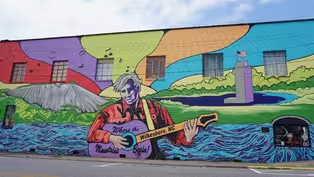
- Oh, the most popular one is pretty obvious.
It's Dolly Parton.
- I'm Terra Marshall and I own Beauty Parade in west Asheville, North Carolina.
Dolly Parton is a Smoky Mountain girl, and so I wanted to pay homage to her.
I would say on average, there's at least five people a day.
Weekends, it could be 10 to 20 and even I'll see shots where people have driven by, and you can tell that it's from the street and they just want to snap a shot, you know, so it's pretty fascinating.
- What I really love about murals is they're for the public and they're inclusive.
They include everybody, not just a select few.
[country music playing] - [Deborah] To find out more about the Appalachian mural trail and to download their app, go to muraltrail.com.
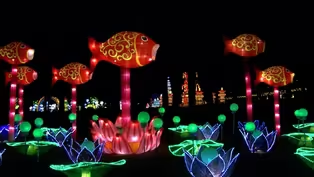
- Probably one of the most stunning visual events in our state, happens every winter in Cary, and it's highly popular on Instagram.
Back with all new displays this year is the Chinese Lantern Festival.
Let's join Derek Long.
[Asian-inspired music playing] - When we were approached for the possibility of hosting a Chinese lantern festival, it seemed a perfect way to accent the holiday season in a little bit of a different way.
- So China's Lantern Festival originated from Zigong in Sichuan province in China.
Sichuan province is the province that's right next to Tibet, and it's also where the panda from, and then the festival has, you know, several thousands years history already, and then usually it takes place during the Chinese new year, is when people celebrate and then people, you know, they will go to see the lantern festival, you know, with families and friends, and it's a really great gathering.
- And so as you wander through the park, you experience different ways of looking at all kinds of things, from the mythical dragon here on Symphony Lake to the beautiful Lotus blossoms - [Derek Long] Assembling this dazzling display of lights was no small feat.
- All of the materials were shipped from China, but they were actually built on-site, and so what you see is the work of these phenomenal artisans who put together an incredible experience.
And to know the artistry and the care that was taken in making this happen.
- The most popular one is the dragon, is 100 meters long, which is 300 feet, right?
Yeah.
And then you can see, actually, the really beautiful reflection on Symphony Lake.
- There's also a magnificent peacock display, right as you come in the main gate.
And just coming through the outside gate is phenomenal with its great green arch covered with colorful flowers.
But then, you know, you see insects coming out of the woods and various animals in different locations and who doesn't love pandas?
And so you've got pandas frolicking around, so there's a lot of different things to see.
- [Derek Long] Under the lantern lint archway, you can grab concessions at the Crescent cafe or at food trucks on hand during the festival.
But the enchantments to be found in the symphony of lights displayed throughout the amphitheater grounds.
- We definitely hope that this festival can give visitors, you know, a sense of a feeling of the Chinese culture and what Chinese Lantern Festival means.
And then they can experience, you know, the Chinese culture, but at the same time, you know, it's also their holiday season, then.
You know, I do know that Americans have a tradition of seeing holiday lights.
So I hope that this festival can be a good combination of both, so they can experience Chinese culture.
- [Lyman Collins] Great way, I think, of melding cultures.
- [Derek Long] This is Derek Long, for North Carolina Weekend.
- The 2021 Chinese Lantern Festival will run seven weeks from November 19th, 2021, to January 9th, 2022 at the Koka Booth Ampitheatre in Cary.
For tickets and more information, go to boothampitheatre.com and search for events.
- I'm here with Faith Jones, who is a co-owner of the Selfie Symposium.
Faith, this is amazing.
How did you come up with this concept?
- Thank you.
I actually majored in photography in college, and so I've always had a love for photography, but I also love anything artistic, and fun, and I enjoy going to things like this myself, and so it just seemed like a natural fit.
- So as folks come out here, what do they experience?
What's actually here at the Selfie Symposium?
- It is a straight-up party here.
We play music.
Everyone's having a good time.
You can just relax and be yourself.
There are no stigmas only taking selfies, you know, "Why you take so many selfies?"
No, you come here to take lots of selfies.
So you can come alone, you can come with friends, you can come as a date night, and we also have a rental space, so you can actually have parties here.
- [Deborah] Tell me about some of the different backdrops that you've created.
- So some of the most popular ones are our throne room, of course, everyone wants to be a king or queen, so even the guys get excited about that one.
Then we have of course, hello sunshine, which is a fantastic, bright, positive, space.
And that's really what I was thinking about with all of the booths, is just making a positive space to come to, especially with COVID and everything that's going on, you know, you need somewhere where you can just relax and have fun.
If I hear one more time, "Why do you take so many selfies?"
Now I can say, "That's my job."
Literally, it's my business, so- - I love that.
Thank you so much for having us.
I think it's going to go take a few selfies.
- Yes, let's go have fun!
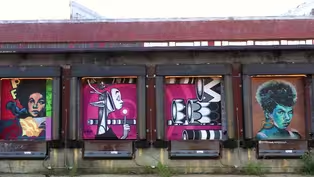
- Our next destination is actually one of the most photographed places in Charlotte.
Would you believe it's an industrial complex that's covered with murals by local and international artists.
Let's join Rebecca Ward at Camp North End.
Woo!
[upbeat mood music playing] - Just north of Uptown Charlotte is a 76-acre industrial site, a collection of doers and creators as crafts range from visual art, to food, to motorcycles, to coffee, and beyond.
So Charlotte's known for being a banking city, but Camp North End is this amazing, magical, anomaly.
It used to be a Ford factory, which was then turned into a missile plant, turned into a distribution center.
And now, today, it is an innovative space for artists and chefs and more.
So we're gonna come through, and see what all they have to offer here across, - [Deep-Voiced Male Narrator] 1.3 million square feet.
- Camp North End is like its own little city.
A breath of fresh air filled with unapologetic black art, historic relics, untouched by developers, and an inclusive collection of businesses.
Perhaps the coolest thing about this place is that the original Model T factory remains standing as-is.
- So we are currently sitting in the Ford factory at Camp North End.
This building was built in 1924 by Henry Ford, designed by a famous architect, Albert Kahn.
It's 800 feet long, 300 feet wide, 240,000 square feet.
It's basically like a block of New York City, but all in one room.
Here, in 1924, they manufactured Model T's and Model A's, about 300,000 cars in the '30s.
And when the great depression hit, of course, that affected car sales.
So they shut down the Model T production and they just kept the office in the front and the showroom.
in 1941, the US Army actually bought this building from Ford Motor Company and used it to start ramping up for World War II.
While the US Army was here, they built another million square feet of warehouses surrounding this one at the center of the site, and used it as a quartermaster depot distributing supplies to basic training camps across the Southeast.
Fast-forward to the Cold War.
They were still here building missiles.
They actually called this place CAMP, Charlotte Army Missile Plant, so that's a nod to the history right there in our name, Camp North End.
After Model T's and missiles, Rite Aid/Eckerd was here for the better part of 40 years.
And then 2016, ATCO, the company I worked for, purchased the site and set out to redevelop it.
This building is a significant piece of American history, and you know, certainly Charlotte history.
Basically for the better part of a hundred years, it's been closed off, and somewhat secret about what's going on in here, you know, with the Army.
Now we're working to give it new life and open it back up, take down the fence and transform this site, which has served as a barrier between eight neighborhoods, and reimagine it as a central gathering place.
[upbeat mood music playing] - It's a space that's poppin', okay, it's an incubator, it's a space for dreamers and doers.
It's colorful.
It's a place that you want to be.
It's inspiring to be here.
- We love, you know, anything that has to do with a place that is inviting for community, for there to be inclusion, or just, just to seeing, you know, the diversity with even the shops or the people that are here.
That's very important for us as a business, you know, we're immigrants and we enjoy, you know, spaces where you feel that there's a big sense of community.
So that's really the main reason we came here.
- It is the coolest spot in Charlotte, and we have needed something hip and something that brings young people, and old people, and people of every age, every ethnic background, every race, it is that community that I think is creating community.
- So Charlotte is definitely known for lots of shiny new construction.
Finding old buildings in Charlotte is somewhat of a rarity, and reusing them even rarer.
What we're doing here is pretty special for our city, but also unique in the context of our country.
This is one of the largest adaptive reuse projects underway in the US as we speak.
The site actually has three districts because it's so large, across 76 acres, we have defined areas, the Boiler Yard being the main one where we started, and now we've expanded to The Mount, and Keswick.
So here in the Boiler Yard is where we really started to activate Camp North End.
The Raceway building here, naturally lent itself to hosting a dozen small businesses, so we renovated this building first.
Now it has HEX coffee, art collectives like DUPP&SWAT, and Black Market, Prism Supply Company, a bunch of others, these are like the original tenants of Camp North End, who helped us get this place started, set the tone for a creative atmosphere.
They really have embraced the vision of a place where people from all across Charlotte, all different industries, can be in close proximity and form a community and collaborate.
- We are DUPP&SWAT.
- We are DUPP&SWAT.
- [Offscreen Interviewer] What is DUPP&SWAT?
- I was going to say, honey, it's a whole vibe, okay?
It's a whole vibe, like, the energy is just, it just feels good in there, you know?
- [Male Store Owner] DUPP&SWAT is an event space.
You can also see the art that lines the wall, that comes from people that are local to Charlotte.
We also have apparel from people that are local to Charlotte.
- It's just a space where we can art and create, and provide platform to others who need it, to others who deserve it, to others who need that "Yes."
- I asked DaVita if I could do an art show in her spot and her response to me, like, "Yeah, I don't care, let's go!"
Shout to our fairy godparents/neighbors/you know, brothers, in this underground art thing that we have going on.
We are like a second generation of this non-institutional, art movement.
- I see a lot of people bringing in people from outside the city, 'cause like, "Oh, I like this person."
We got 30 people right here alone that can do better than that.
- Creative spaces abound at Camp North End, where you'll also find Hygge Coworking, That's Novel Books, Good Postage, Wendy O'Connor Art & Home, and so much more.
- I think, because you get to park your car in one spot and spend a few hours outside, bouncing around to all different types of businesses, be it, art galleries, or stationery companies, or used books or food.
It just has this diverse community of businesses that make it a fun place to visit.
And it gives you a little taste of what Charlotte's all of about.
[upbeat mood music playing] - Camp North End is at 300 Camp Road in Charlotte.
To find out about all the restaurants, shops, and things to do there, go to camp.nc.
When you think about it, postcards were the first Instagram, right?
Iconic images, taken all around the world, with a personal note.
And postcards are actually a really interesting way to learn about the history and culture of a place.
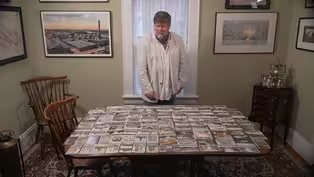
Let's meet John Schelp, a street historian who uses postcards to reveal the history and culture of Durham.
[upbeat folk music playing] A postcard journey with John Schelp through downtown Durham is a fascinating way to see history.
- A wonderful way to learn about your town's history is through postcards.
I always loved Durham history, and I started to find postcards at, you know, antique shops, and Brightleaf Square.
And then I started going to these postcard conventions at small hotels, like outside of Burlington and down the 85 Corridor.
And you know, you're lookin' through shoe boxes and you find a postcard of Durham and that's exciting, but you know, after a while that kind of gets old.
And so eBay's my friend, and I'll find myself late at night waiting for the final seconds to tick down on an auction to make sure I get a postcard for Erwin Mills, or workers in the tobacco factories, some pretty rare postcards that I've come across.
So this is just a small sample of my collection.
And whenever I start to talk about the history of Durham, I like to talk about the Ridge.
And here's a shot of downtown Durham.
And right through the middle of downtown is the Ridge.
And most of these postcards in the collection are of churches, cotton mills, tobacco factories, courthouses, banks, that are on the Ridge.
They're up in the elevated areas of Durham.
- [Deborah] But the large city of Durham started small.
It was first a traveler's rest, called Pinhook.
- So before Durham, 1830s, 1840s, was the settlement of Pinhook.
And on the other side of town was Prattsburg.
The railroad company came to Pratt and asked them if they could put a station there.
And he said, no, because it would scare the horses.
And so they went a little, another mile down the road and they asked Durham and Bartlett Durham said yes.
And so we are Durham, not Prattsburg, because of Dr. Bartlett Durham.
There were two tobacco warehouses here at the end of the war, and not much else.
The largest troops surrender right down the road.
We're four miles from Downtown Durham, and after the surrender, soldiers emptied the tobacco warehouses, went home, ordered more tobacco, and that's what started the tobacco industry in Durham.
- [Deborah] Perhaps Durham's first industrialist was Washington Duke, and John has an early postcard of his home.
- This is a beautiful postcard, it's hand painted.
We're looking at Duke Homestead.
At the end of the Civil War, Washington Duke walked back from New Bern, and started Duke and Sons Tobacco.
- [Deborah] From pipe tobacco, to snuff, to cigarettes, tobacco played a major role in Durham's growth.
- All right, we're standing at what is historically speaking, the most important intersection in Durham.
We have old bull, the oldest building in downtown, right across from the train station, the old Durham Depot, which is right across from Bartlett Durham's house, the namesake for town, which is right across from the two oldest tobacco warehouses in town.
We have a street in downtown Durham called cigarette street.
We have Fatima street, we have, you know, Chesterfield.
We have all this tobacco history, but the Dukes, for instance, wanted to diversify their investments.
They didn't want to just put all their money in tobacco.
So they started investing in water power and cotton mills.
So the Erwin cotton mills on ninth street is owned by the Duke family.
Alright, So I'm standing right here at Erwin Mills and in west Durham, 5,000 people worked here By 1905, in fact, more people were working in cotton mills in Durham than in tobacco factories.
And for many years, Durham had as many millionaires as the rest of the state combined.
- [Deborah] Another watershed event in Durham's history was when Trinity college, now Duke University, was invited to move to Durham.
- Struggling far away from the nearest telephone/telegraph line, low student enrollment, Trinity needed to move to flourish, and they chose Durham over Raleigh.
This is a postcard of Trinity College.
We're standing right here.
Just across the way Teddy Roosevelt stopped his train, said "Gentlemen, I've never heard so much noise."
It was all the bells and the whistles from the tobacco factories, the cotton mills, that were here greeting the president.
- [Deborah] Of course, all stories have their characters with conflicting paths.
Meet Julian Shakespeare Carr.
- Carr was a white supremacist and he was a member of the KKK.
In the early history of Duke University, No one was more important than Julian Shakespeare Carr.
He backed up their loans with the banks, so he kept the university afloat.
All right, we're standing in front of the estate of Julian Shakespeare Carr, he was an industrialist who was involved with tobacco and banking, the Confederate alumni, and all we have left is the parking lot.
- [Deborah] Blacks persevered in Durham, despite the obstacles erected against them.
Perhaps the most vivid Durham destination of that era is what is now called Black Wall Street.
- Mechanics and Farmers Bank, because black families couldn't get loans from white banks.
North Carolina Mutual, because black families couldn't get life insurance from white companies.
These and other companies grew to be very important.
And in fact, W. E. Du Bois and others who have come, Booker T Washington and others who have visited Durham would say in speeches after, "You haven't seen anything, until you've seen what they're doing in Durham."
- To find more of John Schelp's historic Durham postcards, find him on Instagram at @postcardsfromdurham.
Well, that is it for tonight's show.
We want to thank the folks at the Selfie Symposium for hosting us.
It really is a fun place to come and take photos and have a good time.
So, stop by when you're in Durham.
And if you've missed anything in today's show, just remember, you can always watch this again, online at pbsnc.org.
Have a great North Carolina weekend everyone.
[upbeat music playing] ♪ - [Female Speaker] Funding for North Carolina Weekend is provided in part by Visit NC, dedicated to highlighting our state's natural scenic beauty, unique history, and diverse cultural attractions.
From the Blue Ridge and the Great Smoky Mountains, across the Piedmont to 300 miles of barrier island beaches, you're invited to experience all the adventure and charm our state has to offer.
Clip: S19 Ep5 | 3m 16s | The Chinese Lantern Festival in Cary draws huge holiday crowds. (3m 16s)

Promo for Instagrammable Spots
Preview: S19 Ep5 | 22s | : NC Weekend visits Instagrammable places around the state and visits a selfie museum. (22s)

Video has Closed Captions
Clip: S19 Ep5 | 1m 38s | The Selfie Symposium in Durham is a great spot for Instagramming. (1m 38s)
Video has Closed Captions
Clip: S19 Ep5 | 5m 34s | Street historian John Schelp teaches Durham history through vintage postcards. (5m 34s)
Video has Closed Captions
Clip: S19 Ep5 | 4m 30s | The Appalachian Mural Trail offers an app to discover public murals in the mountains. (4m 30s)
Video has Closed Captions
Clip: S19 Ep5 | 7m 31s | We visit Camp North End Charlotte’s hub for creativity and innovation. (7m 31s)
Providing Support for PBS.org
Learn Moreabout PBS online sponsorship











Support for PBS provided by:
North Carolina Weekend is a local public television program presented by PBS NC