
Instruments From the Past Helping Tell Holocaust Stories
Clip: Season 4 Episode 322 | 3m 38sVideo has Closed Captions
Violins of Hope uses instruments to shares stories of World War II Jewish musicians.
Violins of Hope brings together the healing power of music, with the painful stories of World War Two. Made up of 100 instruments that were owned and played by victims of the holocaust, it is a memorial to all those who were lost, and an educational experience to help the audience learn from the past. Hear the stories behind the strings.
Problems playing video? | Closed Captioning Feedback
Problems playing video? | Closed Captioning Feedback
Kentucky Edition is a local public television program presented by KET
Instruments From the Past Helping Tell Holocaust Stories
Clip: Season 4 Episode 322 | 3m 38sVideo has Closed Captions
Violins of Hope brings together the healing power of music, with the painful stories of World War Two. Made up of 100 instruments that were owned and played by victims of the holocaust, it is a memorial to all those who were lost, and an educational experience to help the audience learn from the past. Hear the stories behind the strings.
Problems playing video? | Closed Captioning Feedback
How to Watch Kentucky Edition
Kentucky Edition is available to stream on pbs.org and the free PBS App, available on iPhone, Apple TV, Android TV, Android smartphones, Amazon Fire TV, Amazon Fire Tablet, Roku, Samsung Smart TV, and Vizio.
Providing Support for PBS.org
Learn Moreabout PBS online sponsorshipViolins of Hope brings together the healing power of music with the painful stories of World War Two, made up of 100 instruments that were owned and played by victims of the Holocaust.
It's a memorial to all those who were lost and an educational experience to help the audience learn from the past.
Here are the stories behind the strings and our arts and cultural segment we call tapestry.
We.
We never intended it to be what it is today.
So.
But, in the past few years, especially when we started doing lots of educational program and, and looking and seeing what's going on in the world today, the cultures, history, education is more important than what people think.
Usually when we learn about the Holocaust, it's about the numbers and the fights and the battles.
And how much can you grasp?
What does it mean?
50 to 70 million people dead in a matter of six years?
Probably not.
But you can relate to a story of a person that he heard his name, and he was going from point A to point B to point C with his family, or without surviving or dying.
It's something you can understand.
It can be your next door neighbor, your cousin or family from, a different place or someone from down the road.
But it brings it closer to us.
It makes it, in a way, a bit more reality than just the numbers.
I think in a way it reframes the music in a different way that maybe they haven't thought about before.
Like, music.
Maybe as a means of survival or music, as a way of maintaining one's dignity or, as a way to resist.
It's really interesting to see these, these instruments that their own unique stories about where they came from and the amount of history between each instrument, because normally what you hear from the instrument is what you think of the instrument.
But behind these instruments is an actual story, like where they came from, who was owned by them.
That doesn't really get translated among a lot of other instruments.
You don't really get to see that side of them.
It makes history come alive for them, you know, like they've, they've studied World War Two, the Holocaust, you know, in their social studies classes.
And they come to me and they play on their instruments.
But to put that together in this very real way, I think it's, very impactful and brings that history to life.
We are not going to have survivors for much longer.
Those who are still alive, most of them were kids during the war.
It's a different type of memory and, experiences.
And these instruments are telling the stories of their owners about what happened to them, what was going on in the war, different stories from different places of different people, different experiences.
And this is something that we all have to learn not to make the same mistakes again.
The violins for Hope concert, in conjunction with the University of Kentucky Symphony Orchestra, is tomorrow night at 8 p.m.
Eastern time with an educational pre-concert lecture at 630.
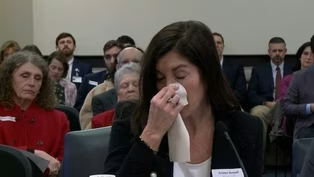
Bill Seeks to "Modernize" Mental Health Statutes
Video has Closed Captions
Clip: S4 Ep322 | 2m 25s | House Bill 485 would update state statutes on mental health. (2m 25s)
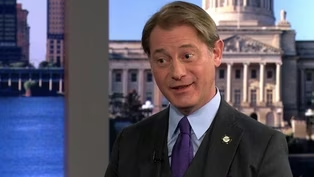
Kentucky Secretary of State Outlines His Legislative Asks
Video has Closed Captions
Clip: S4 Ep322 | 7m 39s | Secretary of State Michael Adams says he wants to see payraises for county clerks. (7m 39s)

Religious Liberty in Medicine Bill Advances in Frankfort
Video has Closed Captions
Clip: S4 Ep322 | 3m 33s | Bill allows providers to deny services based on religious beliefs. (3m 33s)
Providing Support for PBS.org
Learn Moreabout PBS online sponsorship
- News and Public Affairs

Top journalists deliver compelling original analysis of the hour's headlines.

- News and Public Affairs

FRONTLINE is investigative journalism that questions, explains and changes our world.












Support for PBS provided by:
Kentucky Edition is a local public television program presented by KET