
Integral CEO Ashok Sivanand on why he calls Detroit home
Clip: Season 8 Episode 29 | 6m 44sVideo has Closed Captions
Toronto transplant Ashok Sivanand explains why he decided to move to and live in Detroit.
Toronto transplant and Integral CEO Ashok Sivanand has chosen to call Detroit home. One Detroit contributor Zoe Clark sat down with Sivanand at the Detroit Policy Conference to talk about what drew him to work in the city and make Detroit his home. Sivanand talks with Clark about the sense of community he found in Detroit and the opportunities to grow as a member of the community.
Problems playing video? | Closed Captioning Feedback
Problems playing video? | Closed Captioning Feedback
One Detroit is a local public television program presented by Detroit PBS
Integral CEO Ashok Sivanand on why he calls Detroit home
Clip: Season 8 Episode 29 | 6m 44sVideo has Closed Captions
Toronto transplant and Integral CEO Ashok Sivanand has chosen to call Detroit home. One Detroit contributor Zoe Clark sat down with Sivanand at the Detroit Policy Conference to talk about what drew him to work in the city and make Detroit his home. Sivanand talks with Clark about the sense of community he found in Detroit and the opportunities to grow as a member of the community.
Problems playing video? | Closed Captioning Feedback
How to Watch One Detroit
One Detroit is available to stream on pbs.org and the free PBS App, available on iPhone, Apple TV, Android TV, Android smartphones, Amazon Fire TV, Amazon Fire Tablet, Roku, Samsung Smart TV, and Vizio.
Providing Support for PBS.org
Learn Moreabout PBS online sponsorship- Ashok Sivanand with Integral, welcome.
- Thank you so much for having me.
- So you took the stage and you really told this story of how you came to Detroit and then stayed in Detroit.
And I feel like it's the story that the Growing Michigan Council really wants.
So not just folks from Michigan staying in Michigan but coming to the state, experiencing it, and then not leaving, tell us your story.
- Yeah, I'll say first off, I'm really lucky that there were maybe this first wave of folks that already made downtown Detroit and the tech ecosystem here just really hospitable.
When I moved here in 2016, we hadn't gotten the press yet.
So it was a job opportunity where I was here for six months that brought me here.
And my plan based on everything I heard about Detroit was to go back and I was gonna get promoted.
And there were a lot of sort of intellectual or financial reasons that brought me here to try it out.
And when I came here, I realized that what we hear about Detroit and what I got to experience here are completely different.
- So let's start with what you heard about Detroit versus what your experience was.
- I'll put it this way.
I had already gotten to work with some folks here before I moved here.
And there would be a number of them that were very excited that I was moving from Toronto to here and they get to hang out with me more and everything.
And they would say, "Hey, if you're moving here as a single person from downtown Toronto, be careful which suburb you pick because it could be kind of boring."
And then they'd all do this thing where they say, "And of course don't live in Detroit, so live in Royal Oak."
And nothing against Royal Oak, I feel like, when I first chose to live there with my corporate housing and everything and it was exactly what I expected.
It was a downtown neighborhood in a suburb and it had all the amenities and it was cool and hip and fun sort of, but it didn't really have anything to compare to downtown Toronto where it was a super personification of all of those things.
I found myself coming downtown Detroit though, and it wasn't what people told me to do, but it was a whole different energy that I felt here.
The sense of community here was so strong.
Anytime I met someone and told them I was building a team here, there were even some folks you could argue were competitors that would say, "Hey, I love that you're doing this here.
Thanks for moving down here.
Here's the three folks you should talk talk to, and guess what, I'm gonna introduce you to all three."
Which is an unheard thing of in the bigger cities.
When you're in this sort of hand to mouth rat race, either it's because of competition or because people's calendars just really filled up.
It's hard to think outside of what you need to get done for this fiscal year or whatever and think towards community.
And so I hadn't really not experienced that very much and so it really drew on my curiosity.
And then I made a lot of friends and the more I put in, the more I got back.
And it's been really wonderful.
- So if you were trying to sort of be that cheerleader, that this Growing Michigan Council, they wanna see, right, that's what they want is someone spreading the word.
What would you tell someone about either coming to Michigan or staying in the state?
- I think if you're looking at it from a purely intellectual standpoint and you're trying to do the math or the bullet points, it's probably never gonna work out.
If you're looking at it not just from an intellectual standpoint, but also maybe an emotional and a spiritual standpoint and you're looking inward about how you want to grow, and it's not just in your career, but you wanna grow as a person and a member of the community, I think Detroit has a lot more to offer then, including the intellectual side of things.
There are global brands here.
I grew up just loving cars.
So that's another thing I'd say if you've kind of been drawn to manufacturing or the auto industry, like everyone here is a car person.
Even people who are not car people are car people anywhere else in the world.
So that was something that drew me.
And then that sense of community, figuring out, hey, what am I beyond my career?
Where can I contribute?
Where can I make a difference?
This has helped me personally with learning more about myself and what my purpose is and what kind of vision I wanna have for myself.
- I think one of the things we're talking about when we're talking about growing population or the city of Detroit itself is sort of, who is this future Detroit for?
So I think there's a lot of folks born and raised in Detroit and sort of see this what we who may not live in the city or be from the city call this sort of rejuvenation.
And they're like, that's great, and people coming here, but like who is the city for?
And I'm curious what you hear when you talk to folks who are lifelong Detroiters, if there is some tension there about like making sure the city still feels like it is a city of people who built the city rather than folks who are coming simply because there is this sort of rejuvenation or because it's cool now or something like that.
- I think there's a lot of this kind of rejuvenation, in other rooms, maybe it's called gentrification, right?
It's happening in a lot of cities.
One thing I'll say about Detroit is that there is a deep, deep history even before the auto industry and outside of the auto industry, which is what Detroit's really known for.
If you look at the art scene here, the cultural scene, the civil rights movements and how it's really changed the world.
And so for me, I never thought I could be someone who had a chance at standing on a stage and having a little ding in the universe.
And when you come to an environment like this, it feels a lot more accessible because that community really helps put you on that stage.
And I think very quickly, the folks who are gonna thrive here are the folks who wanna help build that community too.
Not just take from the community.
And I think if there are folks who really get those dopamine hits from going out and volunteering or serving and you're not sure how to do it in the big cities you live in the other cities, this is a great place to do it where there's a lot of history and we can be part of a lot of future too.
- So you came from Canada to Detroit.
You've been in Detroit for years now.
Are you gonna stay?
- I would say, I moved from Toronto, it might always be my favorite city, but Detroit is the place where I feel at home and it's hard to say where business will take us.
It's hard to say where my dreams will take me.
But I think it's gonna have a special place here always.
I've been here for almost seven years and let's put it this way, I don't know where I'm moving next.
There isn't a destination, this place is so...
The pull is so strong that it's not a place that I would wanna run away from.
It'd be only if there was something else that I felt that I wanted to run toward that I can see myself moving away from him.
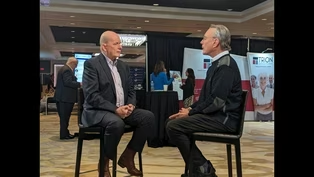
Fmr. Ambassador John Rakolta, Jr. on Michigan’s population
Video has Closed Captions
Clip: S8 Ep29 | 6m 6s | Fmr. Ambassador John Rakolta, Jr. on Michigan’s population (6m 6s)
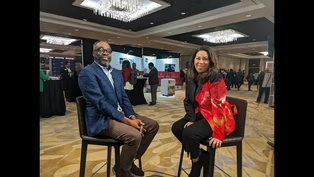
The role of Michigan’s PreK-12 system in growing population
Video has Closed Captions
Clip: S8 Ep29 | 6m 39s | The Skillman Foundation’s Angelique Power on how education can grow Michigan’s population. (6m 39s)
Providing Support for PBS.org
Learn Moreabout PBS online sponsorship
- News and Public Affairs

Top journalists deliver compelling original analysis of the hour's headlines.

- News and Public Affairs

FRONTLINE is investigative journalism that questions, explains and changes our world.












Support for PBS provided by:
One Detroit is a local public television program presented by Detroit PBS