
Intersectionality in Organ & Tissue Donation
Clip: 6/15/2024 | 13m 21sVideo has Closed Captions
Intersectionality in Organ & Tissue Donation
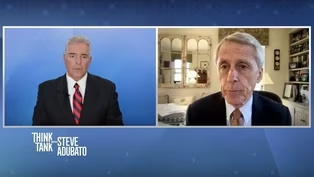
Steve Adubato sits down with Michellene Davis, Esq., President and CEO of National Medical Fellowships, to discuss diversifying organ and tissue donation and the history behind medical mistrust in the black community.
Problems playing video? | Closed Captioning Feedback
Problems playing video? | Closed Captioning Feedback
Think Tank with Steve Adubato is a local public television program presented by NJ PBS
Intersectionality in Organ & Tissue Donation
Clip: 6/15/2024 | 13m 21sVideo has Closed Captions
Steve Adubato sits down with Michellene Davis, Esq., President and CEO of National Medical Fellowships, to discuss diversifying organ and tissue donation and the history behind medical mistrust in the black community.
Problems playing video? | Closed Captioning Feedback
How to Watch Think Tank with Steve Adubato
Think Tank with Steve Adubato is available to stream on pbs.org and the free PBS App, available on iPhone, Apple TV, Android TV, Android smartphones, Amazon Fire TV, Amazon Fire Tablet, Roku, Samsung Smart TV, and Vizio.
Providing Support for PBS.org
Learn Moreabout PBS online sponsorship- We're now joined by our longtime friend, Michellene Davis, who's President and CEO of National Medical Fellowships.
And also Ms. Davis is a trustee of the Caucus Educational Corporation.
I'll get that out.
Michellene, good to see you.
- Great to see you, my friend.
- We're gonna put up the website for National Medical Fellowships, what is it and why is it so significant and related to the discussion we're about to have?
- Oh my goodness, National Medical Fellowships has been around since 1946, so for nearly 80 years it has been advancing health equity at the intersection of the health wealth gap.
We have been providing scholarships, and support, and community and service learning training to Black and Brown students who have been interested in medicine in order to ensure that we are diversifying the clinical space.
- Well said.
We're also gonna put up the website for our friends over at the New Jersey Sharing Network, the organization committed to organ and tissue donation in the state of New Jersey.
Michellene, we'll talk about a variety of health related issues, but as it relates to organ donation, there's a disproportionate, very serious problem in the African-American community.
The need is what it is, you'll describe it, and the availability of organs to those who are waiting and need them is a real problem.
Talk about it?
- Yeah.
So first of all, thank you so much for paying attention to this incredibly important topic.
You know, despite record numbers of transplants in recent years, Steve, thousands still die waiting, because there just aren't enough donated organs.
And then some don't even get a fair chance, right?
So what am I saying when I say that?
Well, you know, Black Americans are over three times more likely than our white counterparts to experience kidney failure.
But oftentimes they face delays in even being put on the transplant list, and are far less likely than their white counterparts to get an organ from a living donor as well, which as you know, is the best kind of donation, right?
The ABC news recently reported this out that over 14,000 Black kidney transplant candidates were recently moved up the waiting list.
Why?
Because race was eliminated from the candidate criteria.
Why is that important, my friend?
Well, it's important because of the fact that there was an algorithm that has been utilized, which includes a variety of things, right?
Everything from gender, weight, etcetera, age, but also the qualification of including race in that was really based on old assumptions, which were quite frankly, completely incorrect, that literally indicated that kidney function was different in African diasporan people, right?
And so eliminating that segment, they were literally able to ensure that nearly 15,000 people were ushered upwards on the wait list.
Incredibly important.
- Folks, to understand the complexity of this and how significant it is, I'm gonna go a little further into this.
The issue of donor diversity, that there's a tremendous need, Michellene, for more diversity in the donor pool.
But there's also some degree of reluctance and mistrust of the medical/healthcare system in the African-American community for a whole range of reasons.
Could you do this for us, I was going back and reading a little bit about the Tuskegee syphilis experiment back in Alabama back in the day.
That is one example of a significant reason why there's mistrust in the African-American community of the medical community, healthcare community.
The Tuskegee experiment, briefly, what is it and why does this matter so much?
- So my friend, it is only one of the many, 'cause trust me, I could give you a bunch.
So I traditionally do not refer to it as the Tuskegee experiment, I refer to it as a government experiment in Tuskegee.
And I say that because I want.
- African-American men who had syphilis in Alabama.
Please go ahead, I'm sorry.
- Yeah, absolutely.
So two things.
One, the experiment was one where they pretended to treat syphilis when actually they were just providing them placebos.
Because they wanted to see how syphilis would, literally, completely decimate the human body, and literally had individuals believing that they were receiving care just simply go through that so that they could track and monitor it, right?
So that is just one episode, Steve, to be completely candid.
But it's so important, because it's really fundamental to understand that it was a US government sanctioned experiment on individuals who literally had no ability to consent, were never informed, right?
And were literally utilized as guinea pigs involuntarily.
- All Black men.
- All Black males.
And you know, I say that in particular, because we could talk about J. Marion Sims, who, right, the "godfather of gynecological science", but really, he literally practiced it on the literal backs of African women who were enslaved in America, who received horrible experimentation and forced surgical procedures without anesthesia.
We could talk about Vertus Hardiman, which radiation treatment.
So we could go on and on.
And that, my friend, is the reason why there is so much mistrust.
Not just because these things happen, but because these things, so many of them were government sanctioned.
- So what message do you have for your brothers and sisters, your colleagues in the African-American community as it relates to the need for donor diversity?
Because the need in the African-American community is as great as it is when it comes to so many people waiting for an organ.
- Yeah, so two things.
- Even with all that mistrust legitimately in place.
- Yeah, absolutely.
So two things.
One, Steve, and you know me, we are all my brothers and sisters.
And two, it would be literally the fact that, listen, I would say to our African-American community, the truth is that all of this is true.
That literally up until the 1970s, we saw forced sterilization of indigenous women and African-American women, all government sanctioned, right?
I wanna make certain that we say that, and it's because it's important to acknowledge it.
And then to understand that this is about saving ourselves.
This is about saving one another.
This is about coming into community to understand that the need is dire, and that when we decide not to participate, not to be a part of this, then unfortunately we are exacerbating a need that we did not create, right?
But that we have the power to impact now and today.
So that is what I would say to them.
The fact that your community needs you, that we are still a family, despite whatever attempts to divide us have accomplished.
And the fact that overall, Black patients still make up 28% of the waiting list of all organs, but account for just about 16% of deceased donors, right?
So guys, we gotta do something, right?
There's a saying in the African-American community, for us, by us.
We need to do this for us, by us too.
You were the first person to introduce me to the concept of social determinants of health, okay?
Briefly, what are they and why do they still matter in 2024, now more than ever?
- Oh, my friend, you have such good questions.
The social determinants of health are literally all of those factors that impact and affect your daily existence outside of a clinical setting.
So they are literally, where you live, how you work, right?
Are you in a safe neighborhood?
Do you have access to clean, affordable, organic food, right?
So it is everything that makes up where you work, live, play, and worship.
It is literally how you exist in society.
Why are they important?
They are important, my friend, because they have a greater impact and effect on your healthcare outcomes then just the 15 minutes that you sit on your physician's table and have an examination.
Literally, the social determinants, and the only reason why I still even use that term is because anything that's been socially created can be socially deconstructed.
Traditionally, I call them the political determinants of health, because there have been.
- Political determinants of health, go ahead.
- And long before my dear friend, Daniel Dawes, wrote his book by that name, but go get it.
Rush out to go get it.
But what I will tell you is the fact that so many of these things have been literally constructed as a result of systems and laws, everything from zoning laws, right?
As in the creation of Levittown in Pennsylvania, which you can read all about in "Color of Law".
- We're talking about redlining.
- We're talking about redlining.
- where banks and/or the government engaged in the practice of making sure that only certain folks would live or could live in certain communities and other folks could and would not.
Go ahead.
- That is exactly right.
And then more, that the communities that the other folks had to live in who could not live in those areas that you're talking about, that those communities were literally built on land that was deemed inhabitable for white Americans, right?
And so as a result of that, that's why you see things like cancer clusters and higher rates of asthma in certain environments.
Why?
The environmental pollutants that were either already in the ground and/or that we're zoned to be around that particular community permitted these things to then have a horrible effect on the healthcare outcomes of those community members.
- We're talking about environmental justice here and a whole range of issues connected to it.
Please check out our website, SteveAdubato.org, come up for an interview we did with Dr. Nicky Sheats down at Kean University, we just actually taped that today, talking about environmental justice issues.
Michellene, before I let you go, lemme try this.
You and I have had countless offline conversations about a lot of things, but one of them is about race relations.
It's unfair to bring this up toward the end of the interview, but I'm gonna ask you this, as we are into 2024, important election coming up, every election is important, why, and are you, still optimistic and hopeful that we will improve upon our race relations and our ability to talk candidly, honestly, and listen to each other when it comes to race?
Loaded question, I know.
- Good question, my friend.
And my answer to you is unequivocally, unwaveringly, absolutely positively, I remain hopeful.
And I say that because I will not let this world steal my hope.
Listen, Steve, we have been taught not to speak about religion, politics, and race.
And so what we have learned as a society is how not to talk about these things in a manner with individuals who are different from us or have divergent views.
As a result, we find ourselves in a environment that is hotly tension filled right now.
However, if we begin to alter that thought, that methodology, and we begin to understand that you do not have to look like me or come from where I come from in order for me to respect you and understand that your lived experience is important too, then we can agree to disagree and still like one another.
Then we can agree that there's something to be learned from each and every individual with whom we encounter, whether we believe it or not, in our first encounter.
And so the truth of the matter is that there is always hope around how we can grow and continue to evolve together.
And I will say this, that what I am seeing right now, if we do not get it right, the young people sure are going to try.
So I remain hopeful.
- Well said.
And also check out the interview we did with Dr. Cornel West, we just taped it a couple weeks ago.
He talked about being a "prisoner of hope".
He's a prisoner of hope.
I see another prisoner of hope and I've known another prisoner of hope for a long time.
Michellene Davis is President, CEO of National Medical Fellowships.
Thank you, my friend, as always.
- Thank you.
- You got it.
I'm Steve Adubato, that's Michellene Davis.
We will see you next time.
- [Narrator] Think Tank with Steve Adubato is a production of the Caucus Educational Corporation.
Celebrating 30 years in public broadcasting.
Funding has been provided by New Jersey Sharing Network.
Johnson & Johnson.
Robert Wood Johnson Foundation.
Holy Name.
PNC Foundation.
The New Jersey Education Association.
Delta Dental of New Jersey.
The Fidelco Group.
And by The Turrell Fund, a foundation serving children.
Promotional support provided by NJ.Com.
And by ROI-NJ.
- I am alive today thanks to my kidney donor.
I am traveling and more active than ever before.
- I'm alive today thanks to my heart donor.
I'm full of energy and back singing in my church choir.
- I'm alive today thanks to my lung donor.
I'm breathing easy and I'm enjoying life’s precious moments.
- They are about 4,000 people in New Jersey waiting for a life-saving transplant.
- Donation needs diversity!
- For more information or to become an organ and tissue donor, visit NJSharingNetwork.org.
Supporting Local News in Marginalized Communities
Video has Closed Captions
Supporting Local News in Marginalized Communities (12m 46s)
Providing Support for PBS.org
Learn Moreabout PBS online sponsorship
- News and Public Affairs

Top journalists deliver compelling original analysis of the hour's headlines.

- News and Public Affairs

FRONTLINE is investigative journalism that questions, explains and changes our world.












Support for PBS provided by:
Think Tank with Steve Adubato is a local public television program presented by NJ PBS