
Invisible Embrace,' Month of Design, Ballet Folklorico
Season 6 Episode 62 | 26m 46sVideo has Closed Captions
An Is/Land performance, Detroit Month of Design and Ballet Folklorico de Detroit.
IS/LAND premieres a new performance titled “Invisible Embrace,” based on Japanese internment camp survivors’ stories. Satori Shakoor hears what's on tap for the 12th annual Detroit Month of Design festival. Plus, a local dance troupe, Ballet Folklorico de Detroit, keeps the Mexican tradition of folkloric dance alive in Southwest Detroit. And, Armando Vega’s salsa band performs.
Problems playing video? | Closed Captioning Feedback
Problems playing video? | Closed Captioning Feedback
One Detroit is a local public television program presented by Detroit PBS
Invisible Embrace,' Month of Design, Ballet Folklorico
Season 6 Episode 62 | 26m 46sVideo has Closed Captions
IS/LAND premieres a new performance titled “Invisible Embrace,” based on Japanese internment camp survivors’ stories. Satori Shakoor hears what's on tap for the 12th annual Detroit Month of Design festival. Plus, a local dance troupe, Ballet Folklorico de Detroit, keeps the Mexican tradition of folkloric dance alive in Southwest Detroit. And, Armando Vega’s salsa band performs.
Problems playing video? | Closed Captioning Feedback
How to Watch One Detroit
One Detroit is available to stream on pbs.org and the free PBS App, available on iPhone, Apple TV, Android TV, Android smartphones, Amazon Fire TV, Amazon Fire Tablet, Roku, Samsung Smart TV, and Vizio.
Providing Support for PBS.org
Learn Moreabout PBS online sponsorship- Hi, I'm Satori Shakoor, and here's what's coming up on "One Detroit Arts and Culture".
Traditional Mexican dance, a celebration of design, a performance cloaked in sound and a salsa band.
It's all this week on "One Detroit Arts and Culture".
(soft music) - [Narrator] From Delta Faucets to Behr Paint.
Masco Corporation is proud to deliver products that enhance the way consumers all over the world experience and enjoy their living spaces.
Masco, serving Michigan communities since 1929.
Support for this program is provided by, the Cynthia & Edsel Ford Fund for Journalism at Detroit Public TV, the Kresge Foundation.
- [Narrator] The DTE Foundation is a proud sponsor of Detroit Public TV.
Among the state's largest foundations committed to Michigan focused giving.
We support organizations that are doing exceptional work in our state.
Visit DTEFoundation.com to learn more.
- [Narrator] Nissan Foundation and viewers like you.
(upbeat Music) - Hi, and welcome to "One Detroit Arts and Culture".
I'm your host Satori Shakoor.
Thanks for joining me here at Marygrove Theater, where we are just finishing up the next round of Detroit Performs: Live From Marygrove, and you can see it all right here on Detroit Public Television.
Coming up on the show, Design Core Detroit dedicates a month to the art of design, a performance by AAPI artists collaborative, Is/Land, and we'll finish with a performance by Armando Vega Salsa Band.
But first, September 15th kicks off Hispanic Heritage Month.
And what better way to celebrate than to learn about traditional Mexican dance.
One Detroit contributor, Deja Moss, went to Ballet Folklorico De Detroit to learn about the volunteer run program and how it preserves Mexican culture within Metro Detroit.
- [Choreographer] Hey.
Uno.
(speaks in Spanish).
- Our mission is to emphasize or to bring to Southwest Detroit and Michigan in our community, an awareness of the Mexican folkloric culture like the Mexican dancing and its traditions.
(traditional Mexican music) - Folklorico is alive in Mexico.
It's not over here.
And so one of our missions, our students predominantly, have Mexican heritage.
They're Americans, but they have Mexican heritage.
And we wanna give them a sense of pride in their culture.
They can't experience it here.
They have to go to Mexico to experience it.
So we kinda try to bring it here, so that way they can be like, oh this is what it's like to be over there.
To be over there, and to experience all of this stuff.
So we are trying to give them like, oh, have pride.
Especially in these days and times it doesn't feel good a lot of times, in the news and everything to be Hispanic.
- If you've ever gone to a Mexican folkloric performance that you'll see the girls wear or the performers wear different costumes.
Like one time they might have a big dress on, another time a small dress on.
That's because all the states of Mexico and regions within those states all have different styles of dance.
And with those different styles sometimes there was an influence like an indigenous influence or Spanish influence.
And it's very serious keeping those traditions alive and not changed.
So, there's a whole culture behind it.
Like if you're doing this type, like right now we're learning Sinaloa.
Sinaloa Mestizo and there's different posture.
There's different ways to do the dresses.
There's different ways, the steps, everything is unique to that.
(traditional Mexican music) - The role that dance plays in Mexican culture is really free.
It's recreation, because it's fun to dance.
Everybody goes, and they love to dance.
It's educational because you're preserving the traditions and the culture.
Because they can still, like if they weren't, like making a concentrated effort to preserve it, it could change.
It could just change.
So it's educational.
And the third thing is that it's good for your health.
So anyone can join Ballet Folklorico De Detroit.
One of the first things I ask people, especially if they're not Mexican.
They're like, oh, well I'm not Mexican.
I was like, well, do you Mexican food.
And most of the time, because it's Mexican food is so good.
They say, yes, I love Mexican food.
And I'm like, but you're not Mexican.
So why do you have to be Mexican to love Mexican dance?
(traditional Mexican music) - We've been part of the Ballet Folklorico De Detroit... - For six months.
I like being a student because there's so many kids there 'cause in our other dance group that we were in there was not that much kids.
So I like being part of the group of kids that are in this group.
What most connects me to the Mexican culture is the movement, because there's like these different types of movements with putting your skirt really high or low, stuff like that.
(traditional Mexican music) - I've been a part of the dance group six years.
Before I joined the dance group I did not know much about the dances and the culture.
What inspired me to join the dance group is watching my sister dance and how she was having fun.
- I've been in the group seven years ago.
My favorite part of being part of it is getting to dance, getting to perform, and getting to know new places.
(traditional Mexican music) - So we really want the crowd to feel like if they're watching us perform Sinaloa Mestizo that they're in Sinaloa watching the performance from the people in Mexico doing the dance.
So that's what I want.
I want to transport them to Mexico and so they can experience it.
And then they'll be awe like, oh my God I just went to Mexico in these three minutes on stage.
(traditional Mexican music) When we're dancing on stage we're really trying to keep these traditions alive.
And there's people here who haven't experienced it, who even though they know Southwest Detroit has this vibrant Mexican culture, they don't know it.
So when they come in, they see us I really want to impact them.
Like, yes, Southwest Detroit there's this culture that's alive here.
And that when they come and they see us they can really feel it.
When they go to one of our shows, they feel Southwest Detroit like, oh yeah this is why Southwest they always talk about Mexico town, because it's there that we're there.
(audience applauds) - Design Core is currently holding its 12th annual Detroit Month of Design.
The event spans the city and stretches into the Metro area.
I sat down with co-executive director of Design Core Kiana Wenzell to get the scoop on the events taking place this month.
(soft music) Well hello there Kiana Wenzell.
- Hi, so nice to be here.
- So who is Design Core Detroit?
- Design Core Detroit is a nonprofit economic development organization, housed within the College for Creative Studies.
And our mission is to establish Detroit as a globally valued and recognized creative capital.
- And how did you get started 12 years ago?
- 12 years ago, Design Core was founded by the College for Creative Studies and Business Leaders for Michigan.
And in order to have Detroit be globally valued and recognized as a creative capital, we have to make sure that we're supporting our design driven businesses.
And so we do coaching for design driven businesses emerging to established.
We also have the festival as one of our strategies to telling Detroit's design story locally, nationally and globally.
And Design Core's, also the steward of Detroit's UNESCO City of Design designation.
In 2015, Detroit was designated by the United Nations Educational Scientific and Cultural Organization as the first and only city of design in the United States of America.
- What makes it the chosen city for design for this effort?
- Sure.
Detroit has the highest concentration of industrial designers nationally.
We have a high concentration of colleges and universities dedicated to teaching and training the next generation of designers.
We have a large collection of research, development institutions where you think about the GM Research Center, of 3M, Whirlpool.
We have a high concentration of museums and cultural institutions designated there and Detroit Designers, the alumni of Detroit Designers going to work either nationally or internationally around the world.
We're not just the automotive capital where you think about furniture the College for Creative Studies, or Cranbook and the Eames Chair, this iconic chair coming out of Detroit.
So the question of why is easy but the question of what's next.
- That's what I was gonna ask you.
The vision.
- And what does it mean, is a hard question.
So once we received the designation in 2015, Design Core spent over a year and a half engaging over 1000 stakeholders.
And so we said, well, what does this designation mean for us?
And we spent that one year talking to so many people doing case studies, a focus on inclusive design is what came out of that.
So how do we work more with community, business, and government and change how we design and who gets to design to have a future that's more beautiful, more sustainable and more equitable.
- And you have a whole month dedicated to design, right?
- Yes.
So Design Core, we produce the Detroit Month of Design.
Which is an annual multidisciplinary festival that occurs September 1st through the 30th.
And this year is our 12th anniversary.
- Oh, congratulations.
- Yeah, thank you.
So we're gonna have 80 events in 30 days ranging from exhibitions, installations, talks, tours and workshops.
Occurring throughout the city of Detroit.
- So what are some of the events taking place during the month of September?
- Yes, we are starting the month off with a kickoff party at Spotlight Detroit.
There is Sneaker House, also occurring, presented by Foot Locker.
Gucci Changemakers is presenting, Building a Lasting Impact at the Museum of Contemporary Arts.
We're hosting a Design Jam as well, where interdisciplinary teams get to create outdoor apparel for the limb loss community.
There is Craft in the Digital Age at the Ford House.
So for the first time ever technologically produced products next to traditionally handmade products.
There's the Black Footwear Forum.
We also have Matter Design and the Biggers, Sanford Biggers.
And then two MIT designers are doing an exhibition at Wasserman Projects.
There's the Hawkins Family Legacy.
That's near Marygrove, just honoring the Hawkins family and their apparel line that they started at home base.
There is the untold stories of black landscape architects at the University of Detroit Mercy.
Michael Ford, the hip hop architect, is hosting an exhibition at MarxModa.
So that's just a few of the events going on.
- Can you say a word about Eastern Market After Dark.
- Eastern Market After Dark this year is occurring on Thursday, September 15th, from 6:00 p.m. until 11:00 p.m. And essentially the outdoor open air market turns into a nighttime design district.
So it's amazing.
It's the largest event of the festival.
Our theme for this year is United by Design.
Focusing on connectedness and togetherness, you can go faster alone, but farther together.
And I think that Eastern Market After Dark is a real example of that.
For some of these businesses this event is their largest sales day outside of Christmas and Thanksgiving.
Savvy Chic is also hosting an event during Eastern Market After Dark.
So it's really beautiful to see all of the sheds with activity and then all of the businesses participating.
- I'm definitely gonna be there.
- [Kiana] Okay, I can't wait to see you there.
- I'm definitely gonna be there.
Take a moment to listen.
Do you hear that, there is sound in silence.
This next segment features AAPI artist collaborative, Is/Land as they present their performance piece, Invisible Embrace.
This piece shows us not only is there sound all around us.
There are stories all around us too.
We just need to take the time to listen.
Invisible Embrace is inspired by the uncovering of stories told by Japanese internment camp survivors.
We spoke to Amber Kao to tell us more.
(instrumental music) - I think art is unique in that it is an automatic platform.
Art offers that space and opportunity to bring awareness.
Is/Land is essentially a collective of Asian American artists.
There are movers, poets, digital designers, musicians.
We love to collaborate with different all facets of art and design.
The collaborators for Invisible Embrace.
We worked with, there were three dancers.
So myself and then Chih Hsien Lin and Catherine Hepler and the sound installation was by Joo Won Park and the music and set design was by Chien-An Yuan.
What kind of pushed us into this space of Invisible Embrace?
It was actually just very unexpectedly.
We came across an archive of oral life history interviews with Japanese American internment survivors.
- [Unidentified Speaker] Well, when we were very little, at age five.
- Jienan is our music director set designer and he found these oral interviews.
This did stem from, there was a lot of Asian hate crimes going on at the time.
And it just really resonated I think with him, and with myself.
Once he shared it with us, their history, their stories, how they were survivors, their trauma and just their willingness and openness to share that through their interviews.
And we were just saying, we gotta use this somehow.
So we decided to kind of use that as our focal point.
- [Unidentified Speaker] And we gathered the children.
I can't remember how many of us there were.
- Joo Won Park another one of our collaborators.
He is, I would say a sound innovator.
His theories are that, there is sound in the air, sound in the space that we cannot hear.
But it takes the correct pickups, the correct instruments to draw it out of the air.
So we wanted to incorporate that in that these stories are there.
Whether we see them or not, they're always here.
And we wanted the act of drawing them out is what we wanted to incorporate into our piece.
So there was a pickup and there are copper wires.
And so we were using these stories, these interviews and we were running them through the wires and then the pickups we would manipulate the pickups.
So if they're in a close enough distance these stories would be heard.
But if the pickup and the wire are too far away, you won't hear anything.
And I think it's reflective of how these stories are there but you have to be intentional to listen and hear and to really process all of it.
- [Unidentified Speaker] And we seemed to hit it off all right at first, so well I said, okay.
- Part of the movement that we were exploring were movements of rituals because rituals tie us back to heritage and culture.
They give us a routine, stability, and they help us process things.
So we were just thinking about our own rituals and how that ties us back to our family.
And then that brought us into memories.
You'll see a cloth, where that kind of resembles, to me anyways, how we're all kind of tied together.
It's a very long piece of cloth maybe 50 feet, I wanna say, even maybe even longer.
And it's also very heavy so that our stories are all entwined together in this cloth in some way, shape or form.
And for me, fruit is a part of my family and how my dad always prepares and cuts the fruit for us.
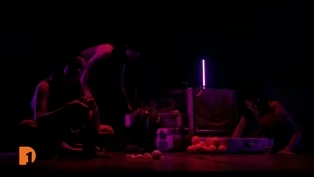
And so we were peeling oranges on stage.
And so that became a ritual and there, of course then the scent became part of the process as well as it unfolded throughout the dance piece.
We're creating a space and experience.
And so that in itself offers a platform to share.
And so that's part of what we are hoping to do is to invite people into a space where they can engage, they can reflect, and they can take away something.
I think that what we try to offer is an invitation to a dialogue, an invitation for reflection.
We really resonated with this story.
We hope you do too.
And so I think maybe if anything, that would be the takeaway is that they connected somehow and that they are engaged somehow.
And they have an experience that they'll walk away with that they'll remember or want to explore more or want to enter a dialogue into in the future with us, with other people, with themselves.
So all those things.
I think that would be our ultimate goal if we ever had one for our audience.
- You can see a performance of Invisible Embrace at the Ann Arbor Public Library in October.
For more information about all of our arts and culture stories, go to our website at onedetroitpbs.org.
Thank you for joining me and thank you to Marygrove Theater for having us.
Now get up on your feet and feel the sounds of Armando Vega Salsa Band, enjoy.
And I'll see you next Monday.
(Armando Vega Salsa Band music) (Armando Vega Salsa Band sings in Spanish) - [Narrator] From Delta Faucets to Behr Paint, Masco Corporation is proud to deliver products that enhance the way consumers all over the world experience and enjoy their living spaces.
Masco serving Michigan communities since 1929.
Support for this program is provided by, the Cynthia & Edsel Ford Fund for Journalism at Detroit Public TV, the Kresge Foundation.
- [Narrator] The DTE Foundation is a proud sponsor of Detroit Public TV.
Among the state's largest foundations, committed to Michigan focused giving.
We support organizations that are doing exceptional work in our state.
Visit DTEFoundation.com to learn more.
- [Narrator] Nissan Foundation and viewers like you.
(soft music) (piano music)
Invisible Embrace: Japanese Internment Survivors' Stories
Video has Closed Captions
Clip: S6 Ep62 | 5m 8s | Audio interviews of Japanese internment camp survivors inspired an Is/Land performance. (5m 8s)
Providing Support for PBS.org
Learn Moreabout PBS online sponsorship
- News and Public Affairs

Top journalists deliver compelling original analysis of the hour's headlines.

- News and Public Affairs

FRONTLINE is investigative journalism that questions, explains and changes our world.












Support for PBS provided by:
One Detroit is a local public television program presented by Detroit PBS