
Iran War Costing Kentucky Farmers
Clip: Season 4 Episode 353 | 3m 23sVideo has Closed Captions
Why the Iran war means higher costs and less profits for Kentucky farmers.
The war in Iran is affecting Kentucky farmers. Fertilizer and fuel costs are on the rise just in time for spring planting season. As our Laura Rogers explains, it will likely cut into profit margins.
Problems playing video? | Closed Captioning Feedback
Problems playing video? | Closed Captioning Feedback
Kentucky Edition is a local public television program presented by KET
Iran War Costing Kentucky Farmers
Clip: Season 4 Episode 353 | 3m 23sVideo has Closed Captions
The war in Iran is affecting Kentucky farmers. Fertilizer and fuel costs are on the rise just in time for spring planting season. As our Laura Rogers explains, it will likely cut into profit margins.
Problems playing video? | Closed Captioning Feedback
How to Watch Kentucky Edition
Kentucky Edition is available to stream on pbs.org and the free PBS App, available on iPhone, Apple TV, Android TV, Android smartphones, Amazon Fire TV, Amazon Fire Tablet, Roku, Samsung Smart TV, LG TV, and Vizio.
Providing Support for PBS.org
Learn Moreabout PBS online sponsorshipThe war in Iran is affecting Kentucky farmers.
Fertilizer and fuel costs are on the rise just in time for the spring planting season.
As our Laura Rogers explains, it will likely cut into profit margins.
Brad Hines farms hundreds of acres near the heart LaRue County line.
I just like being out on the farm and growing things.
We're always planting something.
That planting will cost him a lot more this spring.
A lot of talk about the grain prices, but really what tartness is, is the fertilizer prices.
That's due to the Iran war and the country's near closure of the Strait of Hormuz, and retaliation for U.S.
and Israeli bombing.
Flows out of that region.
For a key input, like fertilizer has just really dropped off.
Taylor Thompson is a commodity marketing specialist and he says farmers are feeling the squeeze from the market disruption.
It's just been really challenging.
Margins are tight and with those increasing inputs more so, the case.
Times will soon plant his 21st soybean crop.
And I don't remember it being this drastic.
It's jumped $150 a tonne here lately, and 8 or 10 years ago we could get it for $150 a time.
That multiplies quickly.
He raises 1500 acres of soybeans and 800 acres of corn, along with other crops like alfalfa, wheat, oats, and canola.
We're going to spend over $900 an acre.
We have to be real careful what ground we plant, because we have to make sure we get a good yield.
Nitrogen fertilizers are so fundamental to what we do here in the state of Kentucky and the crops that we grow.
That green color is from the nitrogen that's been applied.
Iran is a major global producer of nitrogen based fertilizers critical to grass crops and corn for.
A key fertilizer like urea.
That region plays a significant role internationally.
It also plays a big role in other energy supplies, including diesel, a necessity for farm machinery and vehicles.
A loaded truck, you know, a farm truck is is costing a dollar a mile just for the fuel.
And we were about half that last year.
Hines has to drive 100 miles one way to the Owensboro River port to pick up his fertilizer supplies.
He says he's also observed fewer companies selling the product, meaning less competition and sometimes shortages.
I actually went down one day and they were out of it and we wasted a trip.
We've added these tanks we can store a few loads, but in the future we're going to have to add more just to keep fertilizer on hand because of everything going on.
The increased prices of fertilizer and fuel could cost him an extra $100 an acre this planting season.
That's a big jump for us.
We was already, you know, kind of worried about showing a profit.
Some farmers just hoping not to be in the red.
Where's the price at now?
Where's my break even at come harvest time?
How do I balance those two?
A delicate balance of long term planning and complex decision making.
For Kentucky edition, I'm Laura Rogers.
Thank you.
Laura.
Brad Heinz says he may switch more acreage to soybeans and grow less corn, which would help save on fertilizer.
He's also reducing fertilizer rates because of the cost.

Attorney General Wants to End Hold on State Executions
Video has Closed Captions
Clip: S4 Ep353 | 3m 40s | Attorney general wants to jumpstart executions in Kentucky. (3m 40s)

Lexington Program Empowering Those Re-entering Workforce
Video has Closed Captions
Clip: S4 Ep353 | 3m 24s | Look Good, Feel Good giving job seekers resources to re-enter workforce. (3m 24s)
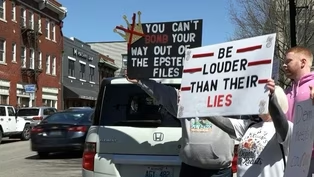
"No Kings" Rally Draws Large Crowd in Lexington
Video has Closed Captions
Clip: S4 Ep353 | 3m 44s | Organizers call Lexington's third 'No Kings' rally the largest yet. (3m 44s)
Providing Support for PBS.org
Learn Moreabout PBS online sponsorship
- News and Public Affairs

Top journalists deliver compelling original analysis of the hour's headlines.

- News and Public Affairs

Today's top journalists discuss Washington's current political events and public affairs.










 New Season
Support for PBS provided by:
Kentucky Edition is a local public television program presented by KET